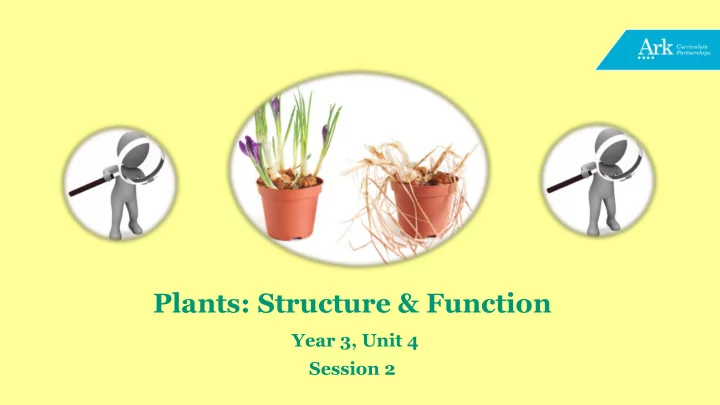
SLIDE 1 Plants: Structure & Function
Year 3, Unit 4 Session 2
SLIDE 2
Unit 4
Session 2
Do Now: Quiz 4.1
Workbooks page 9
SLIDE 3
Unit 4
Session 2
Do Now: Quiz 4.1
Workbooks page 9
SLIDE 4
What does a plant need in order to grow? Why do plants have roots? Why do plants have a stem? Why do plants have leaves? Why do some plants produce flowers? What is the life cycle of a flowering plant?
UNIT OVERVIEW 1 2 3 4 5 6
Session Number
SLIDE 5
What does a plant need in order to grow? Why do plants have roots? Why do plants have a stem? Why do plants have leaves? Why do some plants produce flowers? What is the life cycle of a flowering plant?
UNIT OVERVIEW 1 2 3 4 5 6
Session Number
SLIDE 6 Unit 4: Session 2
Why do plants have roots?
Key Knowledge:
Plants have roots for specific
reasons
Roots are integral to the survival
Roots anchor plant into the
ground
Roots absorb water and nutrients Roots can adapt to their
environment
Key Vocabulary:
Anchor Absorb Survival Adapt Environment
SLIDE 7
Thought Task
Where are the roots of these plants? What do you know about roots?
SLIDE 8
Investigating roots:
These plants have been dug out of the ground. Look at their roots.
SLIDE 9
Investigating roots:
Do you think it was easy to dig them up? Why not?
SLIDE 10
Investigating roots:
What does this tell us about roots?
SLIDE 11
Investigating roots:
If you cut the roots of a plant after digging it up they are usually wet.
SLIDE 12
Investigating roots:
Why do you think the roots are usually wet?
SLIDE 13 Investigating roots:
Workbooks page 11 Answer the questions using the sentence stems shown
Roots are difficult to dig up because ……. Roots usually feel _________, this is because …….
SLIDE 14
Investigating roots:
Why was the plant difficult to dig up? The plant was difficult to dig up because the roots were holding it tightly into the soil and also holding the soil really close to the plant. We call this anchoring the plant into the ground and it is one of the functions of the roots. Why were the roots wet when they were cut? The roots were wet when they were cut because the other function of roots is to absorb and store water from the soil.
SLIDE 15 Do you think all roots look the same?
Longer roots can absorb water from deeper underground Tuberous roots can store water for longer periods of time More fibrous roots can search for water over larger distances Roots closer to the surface can absorb surface water in addition to water underground
Why might these roots be different?
SLIDE 16 Investigating roots:
Watch the video and listen carefully to the information
SLIDE 17 Investigating roots:
Watch the video and listen carefully to the information
SLIDE 18
Investigating roots:
Read the statement and decide if it is true or false
SLIDE 19
Investigating roots:
Read the statement and decide if it is true or false
SLIDE 20
Investigating roots:
Read the statement and decide if it is true or false
SLIDE 21
Investigating roots:
Read the statement and decide if it is true or false
SLIDE 22
Investigating roots:
Read the statement and decide if it is true or false
SLIDE 23
Investigating roots:
Read the statement and decide if it is true or false
SLIDE 24
Investigating roots:
Read the statement and decide if it is true or false
SLIDE 25
Investigating roots:
Read the statement and decide if it is true or false
SLIDE 26
Investigating roots:
Read the statement and decide if it is true or false
SLIDE 27
Investigating roots:
Read the statement and decide if it is true or false
SLIDE 28
Investigating roots:
Read the statement and decide if it is true or false
SLIDE 29
Investigating roots:
Read the statement and decide if it is true or false
SLIDE 30
Investigating roots:
Read the statement and decide if it is true or false
SLIDE 31
Investigating roots:
Read the statement and decide if it is true or false
SLIDE 32
Investigating roots:
Read the statement and decide if it is true or false
SLIDE 33
Investigating roots:
Read the statement and decide if it is true or false
SLIDE 34
Investigating roots:
Read the statement and decide if it is true or false
SLIDE 35
Investigating roots:
Read the statement and decide if it is true or false
SLIDE 36
Investigating roots:
Read the statement and decide if it is true or false
SLIDE 37
Why do plants have roots? What would happen without them?
SLIDE 38 Investigating roots:
Workbooks page 11 Answer the question using the word bank to help you Word bank
water downwards nutrients grow soil 4 jobs stand up store anchor function absorb fibrous