Planning & Zoning Decisions Board Workshops Spring 2018 David - - PDF document

planning zoning decisions
SMART_READER_LITE
LIVE PREVIEW

Planning & Zoning Decisions Board Workshops Spring 2018 David - - PDF document

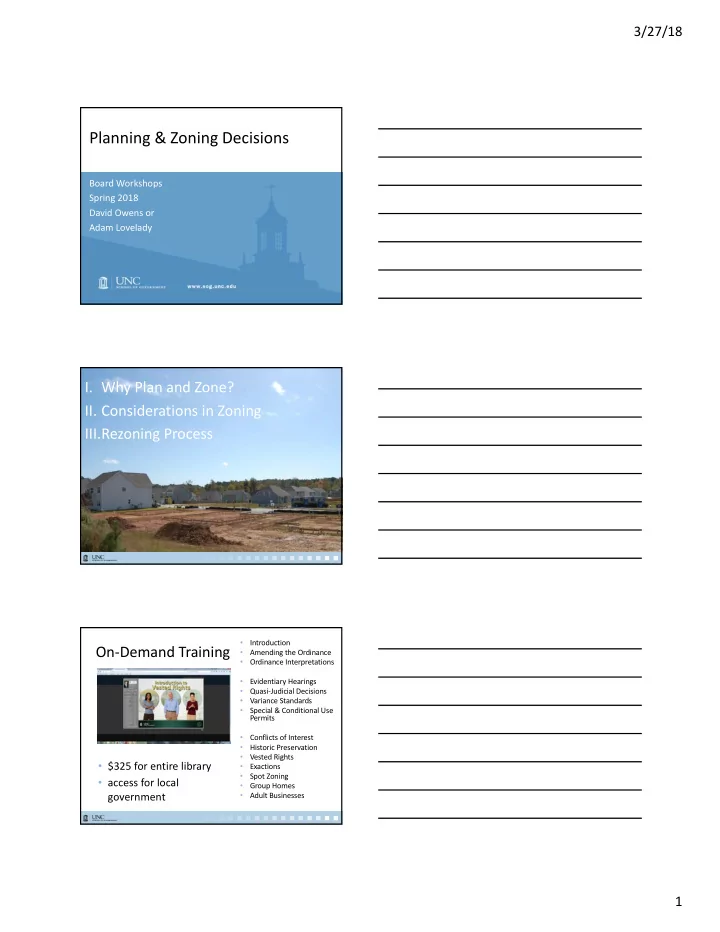
3/27/18 Planning & Zoning Decisions Board Workshops Spring 2018 David Owens or Adam Lovelady I. Why Plan and Zone? II. Considerations in Zoning III.Rezoning Process Introduction On-Demand Training Amending the Ordinance


slide-1
SLIDE 1

3/27/18 1

Planning & Zoning Decisions

Board Workshops Spring 2018 David Owens or Adam Lovelady

  • I. Why Plan and Zone?
  • II. Considerations in Zoning

III.Rezoning Process On-Demand Training

  • Introduction
  • Amending the Ordinance
  • Ordinance Interpretations
  • Evidentiary Hearings
  • Quasi-Judicial Decisions
  • Variance Standards
  • Special & Conditional Use

Permits

  • Conflicts of Interest
  • Historic Preservation
  • Vested Rights
  • Exactions
  • Spot Zoning
  • Group Homes
  • Adult Businesses
  • $325 for entire library
  • access for local

government

slide-2
SLIDE 2

3/27/18 2

Planning and Zoning Courses

– Foundations (Sept) – Zoning Practice (Oct) – Subdivision Practice (Nov) – Zoning Officer Certification (Spring)

Rezoning Z-03-18

Apartment Developers, LLC seeks to rezone from Single-family (RM-1) to Multifamily (RMF)

slide-3
SLIDE 3

3/27/18 3

  • I. Why Plan and Zone?
  • II. Considerations in Zoning

III.Rezoning Process

WHY PLAN?

REUTERS, Chris Keane wsoctv.com

Steve Early, Virginian-Pilot

slide-4
SLIDE 4

3/27/18 4

Population growth will be uneven across North Carolina

Projected population growth, 2010-2035

Data Source: NC OSBM

Public Engagement

  • Community meetings
  • Surveys
  • Appointed boards
  • Public Education
  • Design workshops/

charrettes

  • Stakeholder outreach
  • Public hearings
slide-5
SLIDE 5

3/27/18 5

Growth

Infrastructure

Economy Environment Implementing a Plan

Development Decisions Government Actions and Organization Public Infrastructure and Investment

City Manager ACM Housing & Neighborhood s Community Development Community Services ACM Planning & Development Long Range Planning Urban Design Center Development Services Inspections Development Plan Review Economic Development
slide-6
SLIDE 6

3/27/18 6

Planning Board Authority

  • Studies of areas in and around the jurisdiction
  • Determine objectives for areas
  • Develop plans to reach objectives
  • Recommend policies and ordinances to

implement

  • Advise governing board, including mandatory

comment on all zoning amendments

  • Other functions as directed by governing board

Planning Board: Optional Additional Responsibilities

  • Conditional Use (or Special Use) Permits
  • Preliminary and Final Subdivision Plats
  • Designating Redevelopment Areas
  • Board of Adjustment
  • Historic Preservation Commission

WHY ZONE?

slide-7
SLIDE 7

3/27/18 7 Considerations for Zoning

(160A-383; 153A-341)

  • Public health, safety, and general welfare
  • Encouraging the most appropriate use of land

throughout such city

  • Prevent overcrowding
  • Efficient and adequate provision of transportation,

water, sewerage, schools, parks, and other public requirements

  • Lessen congestion in the streets
  • Conserving the value of buildings
  • Character of the district and suitability for particular

uses

slide-8
SLIDE 8

3/27/18 8

Type of Decision

(Example)

Decision Maker Factors in Decision Legislative

(Rezoning) Governing Board What’s in the general public interest; Broad board discretion

Quasi-judicial

(Variance, Special Use Permit) Board of Adjustment (typically) Standards established in the ordinance requiring judgment; Evidentiary hearing

Advisory

(Planning board rec on zoning amendment) Planning Board Consistency with plans; What’s in the general public interest

Administrative

(Zoning compliance permit) Staff (typically) Objective standards in the

  • rdinance

Options for Conditions

Conventional Zone

  • General use

districts

  • No conditions on

basic rezoning

  • May include

special use permits Special Use District (Conditional Use District)

  • Combines

rezoning with special use permit

  • Complex process
  • Unnecessary now;

proposed for elimination Conditional Zoning

  • Create zoning

district with individualized standards/site plan made a part

  • f the ordinance

standards

slide-9
SLIDE 9

3/27/18 9

Conditional Zoning Limits

Only conditions needed . . .

– For ordinance/plan compliance – To address impacts reasonably expected to be generated by project

  • Mutual consent

– Conditions may be proposed by applicant or local government – But conditions must be mutually approved by the applicant and local government

  • I. Why Plan and Zone?
  • II. Considerations in Zoning

III.Rezoning Process

slide-10
SLIDE 10

3/27/18 10

Do Consider: Land use impacts

  • To the owner/developer

– Property value, free use of land, investment expectations

  • To the neighbors

– Safety, noise, odor, traffic, aesthetics, stormwater, property value, investment expectations

  • To the community

– Safety, convenience, traffic, appropriateness of use, character of community, property values, availability of housing types

  • To the local government

– Infrastructure costs (capital and maintenance), service costs, tax implications, diversity of economy, mix of housing types

Do Consider: Surrounding Context Do Consider: Applicable Plans

slide-11
SLIDE 11

3/27/18 11

Do Consider: All Permissible Uses

Do NOT Consider: Issues beyond zoning requirements

For basic zoning districts, extra conditions are unenforceable (Remember conditions may be applied through conditional zoning or special use permits)

Do NOT Consider: Identity and Ownership

slide-12
SLIDE 12

3/27/18 12 Do NOT deny based on Inclusion of Affordable Housing

  • City or county cannot deny land use permit based
  • n inclusion of affordable housing
  • Unlawful if “motivated in full, or any part at all,

by the fact that a development or proposed development contains affordable housing units for families or individuals with incomes below eighty percent (80%) of area median income”

  • Exception for consideration of avoiding high

concentrations of affordable housing Legitimate Considerations

  • Land use impacts on
  • wner, neighbors, public
  • Context and

appropriateness of uses

  • Consistency with

applicable plans

  • Staff and planning board

recommendations

(gov. board is not bound by recs)

Illegitimate Considerations

  • Issues beyond the zoning

requirements

  • Ownership status or

identity

  • Inclusion of affordable

housing (except to prevent high concentrations)

SPECIAL USES

slide-13
SLIDE 13

3/27/18 13

Family Care Homes

  • Provides room, board, and

care for up to 6 disabled persons

  • Must be allowed same as

single-family homes

  • Includes physical, emotional,

and mental disabilities (but not those dangerous to themselves or others)

  • Up to half-mile separation

allowed

  • G.S. 168-22
  • Federal protections also apply

Agricultural Uses

In counties and municipal ETJ area, exemption for bona- fide farms and agricultural, horticultural, and silvicultural activities

Cell Towers

  • Cannot totally exclude
  • Cannot regulate on health basis
  • Decisions must be in reasonable

time and in writing

  • Can impose limits on siting
  • Can impose standards: height,

fencing, co-location, stealth technology, etc.

  • Special rules for colocation,

minor additions, small cells

slide-14
SLIDE 14

3/27/18 14

Manufactured Housing

  • Cannot totally exclude

from entire jurisdiction

  • Cannot regulate value,

age

  • Can regulate location,

dimension, and appearance

Adult Businesses

  • May not totally prohibit
  • May regulate secondary

impacts

– Separation requirements – Limits on advertising, noise, operations – Licensing requirements

Regulating Signs

  • Need strong rationale

for regulation

  • May regulate size, type,

lighting, and other characteristics

  • May not regulate

content of sign (very limited exceptions)

slide-15
SLIDE 15

3/27/18 15

  • I. Why Plan and Zone?
  • II. Considerations in Zoning

III.Rezoning Process

slide-16
SLIDE 16

3/27/18 16

Application and Staff Review Planning Board Recommendation Governing Board Decision

Application

Staff Report

slide-17
SLIDE 17

3/27/18 17

Application and Staff Review Planning Board Recommendation Governing Board Decision

Planning Board Review and Comment

  • Planning board referral is mandatory for all

amendments

  • Must allow up to 30 days from referral
  • May have public notice and public hearing
  • Written comment

– Must address plan consistency – May address other matters – May be drafted in line with governing board consistency statement

Application and Staff Review Planning Board Recommendation Governing Board Decision

slide-18
SLIDE 18

3/27/18 18

Notice

Published/Newspaper Notice

– Two legal ads – first 10-25 days before hearing – Second in separate week

Additional Notice for Rezonings

– Posted notice on the site – Mailed notice to affected parties and abutting landowners (newspaper alt. available) – Actual notice for third-party rezoning

Conducting the Hearing

  • Reasonable rules acceptable

– Time limits on speakers – Sign up sheets – Overall time limits

  • Maintain fundamental fairness
  • Due process limits for quasi-judicial do not

apply

  • May continue to a subsequent meeting

Legitimate Considerations

  • Land use impacts on
  • wner, neighbors, public
  • Context and

appropriateness of uses

  • Consistency with

applicable plans

  • Staff and planning board

recommendations

(gov. board is not bound by recs)

Illegitimate Considerations

  • Issues beyond the zoning

requirements

  • Ownership status or

identity

  • Inclusion of affordable

housing (except to prevent high concentrations)

slide-19
SLIDE 19

3/27/18 19 Governing Board Statement

(153A-341; 160A-383)

  • Must adopt a statement about the consistency

between the amendment and the comp plan

  • Prior to adopting or rejecting any zoning

amendment

  • May not require any additional application for

plan amendment

  • Three options for the statement (next page)

Options for Consistency Statement

  • 1. Approving the amendment and describing its consistency

with the comp plan

  • 2. Rejecting the amendment and describing its inconsistency

with the comp plan

  • 3. Approving the amendment and the following

– Comp plan is deemed amended – Explanation of changed circumstances warranting amendment

  • All statements must also state why the action is reasonable

and in the public interest

Conflicts of Interest

Member may not participate if they have a . . . “Direct, substantial, and readily-identifiable financial interest” in the outcome of the zoning decision

slide-20
SLIDE 20

3/27/18 20

Questions

Adam Lovelady adamlovelady@sog.unc.edu 919-962-6712 David Owens

  • wens@sog.unc.edu

919-966-4208 Coates’ Canons Local Government Blog http://canons.sog.unc.edu/