Planning Development Vision OJS Committee Recommendations - - PowerPoint PPT Presentation

planning development
SMART_READER_LITE
LIVE PREVIEW

Planning Development Vision OJS Committee Recommendations - - PowerPoint PPT Presentation

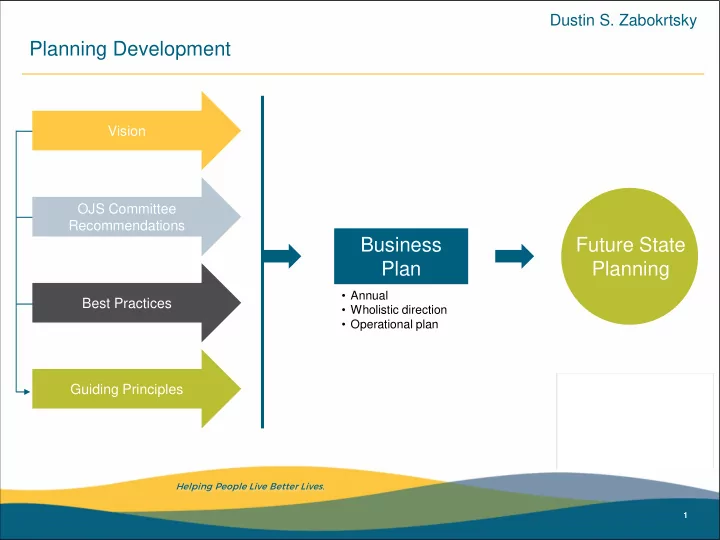
Dustin S. Zabokrtsky Planning Development Vision OJS Committee Recommendations Business Future State Plan Planning Annual Best Practices Wholistic direction Operational plan Guiding Principles Helping People Live Better


slide-1
SLIDE 1

Helping People Live Better Lives.

1

Planning Development

Dustin S. Zabokrtsky

Business Plan

Vision OJS Committee Recommendations Best Practices Guiding Principles

Future State Planning

  • Annual
  • Wholistic direction
  • Operational plan
slide-2
SLIDE 2

Helping People Live Better Lives.

2

Phased Planning – NE Youth Care System

Business Plan

  • Visioning &

planning sessions

  • Research
  • Programming
  • Assessment of

models

Consulting Assessment

  • Systems
  • Processes
  • Organization

structure

  • Programming
  • Staffing

Collaboration Meetings

  • Communication
  • Collaboration
  • pportunities
  • Crossover
  • Prevention, Diversion,

probation & re-entry programming

Stakeholder Discussion

  • Care Continuum

gaps

  • Collaboration and

partnering

  • System stakeholder

engagement

  • Care continuum &

coordination strategies

  • Facility strategies

Future State Planning

Inputs to Future State Planning

  • 2013 OJS Report

recommendations

  • Principles & goals
  • Establishing YRTC

system

  • Consultant

recommendations

  • Collaboration goals

& strategies

  • Feedback &

input for future state

slide-3
SLIDE 3

Helping People Live Better Lives.

3

Continuum of Care for Nebraska’s Children

Trauma Focused Treatment Juvenile Probation & Child Welfare Diversion Prevention Life Skills & Community re-entry

  • Community

resources

  • Family First
  • CFS
  • Public & Behavioral

Health

  • Juvenile Courts
  • Community

resources

  • Juvenile Probation
  • Community

resources

  • YRTC System
  • Juvenile Probation
  • Community

resources

  • YRTC Family

Navigator

  • Juvenile Probation
  • Community

resources

slide-4
SLIDE 4

Helping People Live Better Lives.

4

Business Plan Goals

Dustin S. Zabokrtsky

“The YRTC business plan is designed to address immediate concerns with facilities, structural security and staffing, while developing population specific programming. It is a launching point for us to conduct long-term strategic planning with goals of developing a system of care along the continuum.” CEO Dannette R. Smith

  • Develop a system that will provide appropriate level of care and security for youth as

they progress in their treatment.

  • Implement targeted interventions to high-acuity, at-risk youth separate from the core

group that is positively responding to programming.

  • Develop population specific programming (gender, acuity, culture, linguistics and

race) and programming based on a youth’s progress and needs for transitioning back to the community.

Business Goals

slide-5
SLIDE 5

Helping People Live Better Lives.

5

Guiding Principles

  • Engaging key system stakeholders in planning and collaboration – DHHS, DAS, Probation, the

juvenile courts, advocacy organizations and the Legislature

  • Strength-based programming that promotes adolescent brain development and positive human

development – skills building, mental health, healing and personal growth, empowerment, problem solving and emotional intelligence

  • Adoption of small-group care model core elements – cohort consistency, relationships, homelike living

spaces, self-care and shared responsibilities of shared spaces

  • Appropriate aftercare and re-entry are essential to case planning and successful transitioning back to

the community

  • Academic achievement and engagement are critical elements for case planning and successful re-entry

– core curriculum, life skills, emotional intelligence and career skills

  • Engaging families as partners early and throughout the continuum of care
  • Promotion of psychological and physical safety for residents and staff with integration into daily

activities

  • Designing facilities that promote treatment and development vs. juvenile detention
  • Data is continuously collected, analyzed and reported to drive decision making, guide case planning,

quality improvement and success with activities and programming

Dustin S. Zabokrtsky

slide-6
SLIDE 6

Helping People Live Better Lives.

6

YRTC System Campus/Facility Development Updates

Mark LaBouchardiere

  • Education modular
  • Vocational training
  • Teacher recruitment
  • Student Council
  • Citizen Advisory Board
  • Policy review & updates
  • Camera upgrades
  • HVAC repair
  • Security fence
  • Aesthetic Enhancements

Kearney Campus

  • New facility administrator
  • Staff training – behavioral

tech & trauma model

  • Teachers in place – distance

education capabilities in development

  • Tenant improvements
  • Policy development
  • New and enhanced

programming & staffing

Lincoln Program

  • New facility administrator
  • Staff training
  • Youth counselor
  • LaFlesche construction

completed

  • Decorations & furniture -

home feeling environment

  • Teachers in place – distance

education capabilities in development

  • Hospital contracted services
  • Community engagement –

Community Advisor Board & Community Liaison

  • City of Geneva
  • MLTC staff in place

Geneva Campus

slide-7
SLIDE 7

Helping People Live Better Lives.

7

Clinical Programming – Kearney Campus

  • Dr. Janine Fromm

Tamara Gavin

  • Single point of entry to YRTC system
  • Enhanced evaluation process with full intake assessment, medical evaluation, and psychiatric

evaluation/treatment (if indicated)

  • School, individual therapy, family therapy, group therapy, recreational therapy
  • Phase Model – behavioral positive reinforcement
  • Aggression Replacement Therapy, Moral Reconation Therapy, SUD treatment (ACRA)
  • Psychiatric treatment via Boys Town telemedicine
  • Most youth will stay at the Kearney campus and successfully complete their treatment program.

However, youth who exhibit chronic high risk behaviors, or are not responding to the Kearney program despite multiple changes to the youth’s treatment program, will be considered for transfer to the Lincoln facility as outlined in admission criteria.

slide-8
SLIDE 8

Helping People Live Better Lives.

8

Clinical Programming – Lincoln Program

  • Dr. Janine Fromm

Tamara Gavin

  • Short term, behavioral stabilization unit utilizing intensive and highly structured programming for high-

acuity and at-risk juveniles.

  • Evidence based, trauma informed treatment through Trauma Affect Regulation: Guide for Education

and Therapy (TARGET) model.

  • Higher staff to youth ratio, more intensive interventions and programming
  • Completion of an intensive behavioral assessment to help identify individual treatment needs
  • Intensive behavioral modification with positive reinforcements, utilizing tenants of Applied Behavioral

Analysis

  • Programming development, fidelity monitoring and program evaluation done in consultation with

Nebraska Treatment experts including University of Nebraska, Lincoln, Public Policy Center, University

  • f Nebraska Medical Center Monroe Meyer Institute, OMNI Inventive Care and Boys Town
  • Continuity of treatment with Boys Town Child/Adolescent Psychiatrists via Telemedicine. Additional
  • versight/collaboration/consultation with onsite Child/Adolescent Psychiatrist.
  • Continue individual, family, group and recreational therapy
  • Continue full education program, MRT, ACRA
  • Return to Kearney campus once behaviors have improved and stabilized and team believes youth

can now be successful in completing the treatment program.

slide-9
SLIDE 9

Helping People Live Better Lives.

9

Clinical Programming – Geneva Campus

  • Dr. Janine Fromm

Tamara Gavin

  • Girls who have been successful at the Kearney campus program, or those girls who will be turning 19

and need additional life skills and supports to successfully reintegrate into the community or independent living.

  • Home-like atmosphere with daily independent living skills training
  • Up to 60 days of reintegration programing including up to 90 days of post-discharge support through

family navigation follow up after discharge – Family Navigator function.

  • Increase in community/family engagement, identification of supports, warm hand offs to community

providers

  • Increase community based activities: work release, school, banking, recreational, religious,

extracurricular, restorative justice etc.

  • Multiple graduated furloughs home or to community
slide-10
SLIDE 10

Helping People Live Better Lives.

10

Clinical Programming – Future Development

  • Dr. Janine Fromm

Tamara Gavin

  • Establish enhanced screening and assessment tools (including educational assessments) when youth

first encountering YRTC and when moving between facilities.

  • Evaluation of phased programming model and implementation of evidenced based care models
  • Quality standardization of clinical programming across YRTC System and DHHS behavioral care

settings – dedicated leadership resource to oversee all programming fidelity

  • Work with system partners to define the population intended to be served at YRTC and to identify
  • utcomes expected of commitment in order to inform programmatic changes needed.
slide-11
SLIDE 11

Helping People Live Better Lives.

11

Education Updates

  • Developed schedule for female youth to catch-up on hours
  • Establishing YRTC school system
  • Goal to improve educational outcomes and career readiness for the students
  • Consistency of curricula across the system – value for students credits
  • Accreditation with Nebraska Department of Education
  • Distance education capabilities
  • Teacher training
  • Recruiting a superintendent
  • Governing board

Dustin S. Zabokrtsky

slide-12
SLIDE 12

Helping People Live Better Lives.

12

Opportunities (Solutions)

Guided Group Discussion Planning Committee

Opportunities

Best Practices - Facilities Programming Best Practices - Community Care Settings Prevention Care Collaboration across system Close gaps in the continuum

  • f care
slide-13
SLIDE 13

Helping People Live Better Lives.

13

Visioning

  • Children have hope and sense of the future – they have identified and are living the best version of

themselves.

  • Children have a voice and choice in plans for their future as well as services and resources to help

them be successful.

  • Children view their experience at the YRTC as a “watershed moment” in their lives – something having a

profound and positive impact on who they are as a person.

  • The focus of treatment is on the whole family and is rooted in compassion and well-being.
  • Children are connected to family, mentors and other caring adults for support and guidance.
  • Children experience increased resiliency and skills.
  • Children successfully transition from the YRTC with a focus on tailored services and treatment

timelines based on the need for opportunities to experience the “real world” before transitioning back to the community, and expectations that are age and developmentally appropriate.

CEO Dannette R. Smith

slide-14
SLIDE 14

Helping People Live Better Lives.

14

Nebraska Children’s Commission, Juvenile Services Committee – 2013 OJS Recommendations

  • Creates an intensive, highly structured treatment facility in an urban

area with programming designed specifically for high-risk juvenile law violators (Level 5). Consider renovating an existing structure to expedite the creation of this facility. (See pages 18-23)

  • Transfers Level 5 identified youth from the YRTCs into their own

treatment environment in the newly created facility. (See pages 18- 23)

  • Requires the YRTCs to provide evidence based, trauma informed

treatment for behavioral health disorders, mental health disorders, and substance use disorders to include appropriate medication assisted

  • treatment. (See pages 18-23)
  • Continues any additional YRTC renovations to create an enhanced

therapeutic environment for the remaining youth. (See pages 18-23)

  • Requires development of regionally based treatment facilities

including the feasibility of transitionally redesigning the existing YRTC facilities, and other state run juvenile treatment facilities, into this regionally based framework. (See pages 18-23)

Dustin S. Zabokrtsky “The Juvenile Services (OJS) Committee is recommending that the juvenile justice system be transformed to a community- based system of care.”

December 2013 OJS Report

slide-15
SLIDE 15

Helping People Live Better Lives.

15

YRTC System – Population Specific Care and Programming

Dustin S. Zabokrtsky