SLIDE 1 07/04/2014 1
UK Clinical Psychology: the promised land and the pitfalls
Dr Miles Thompson Maynooth, 7th April 2014 miles@mvdct.co.uk feel free to e-mail with any questions
Plan
The Promised Land: An overview of UK Clinical Psychology (CP) today How to get
The Pitfalls: The Future Research tensions IAPT
Background
Clinical psychologist (assistant psych: 2001 started training: 2002 fully qualified: 2005) Senior lecturer at Canterbury Christ Church University (since 2012)
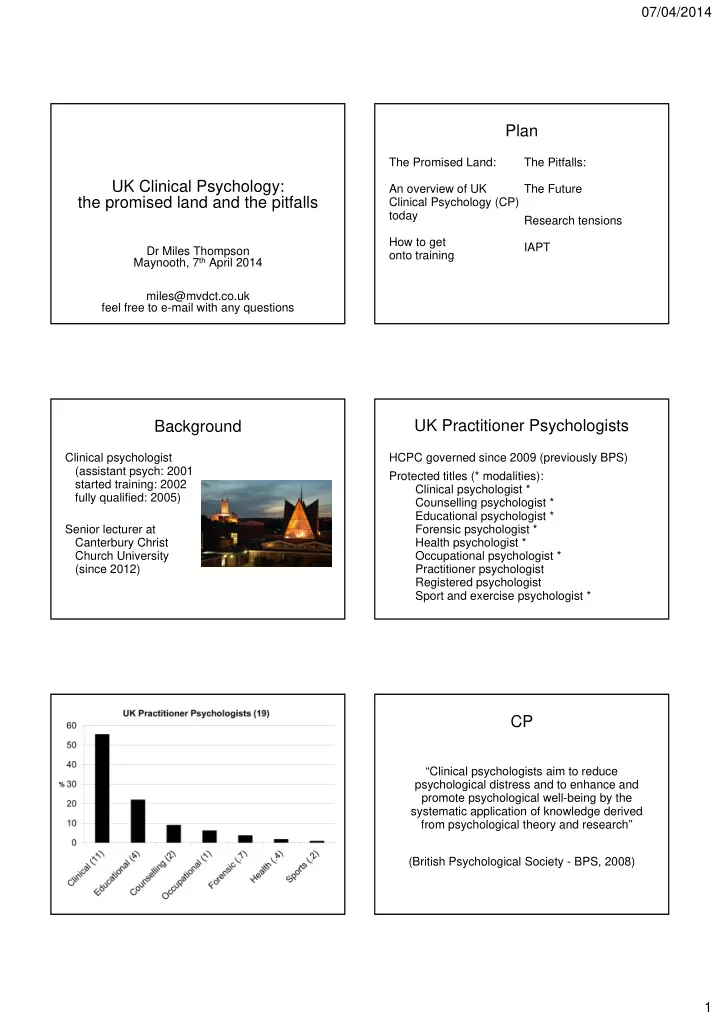
UK Practitioner Psychologists
HCPC governed since 2009 (previously BPS) Protected titles (* modalities): Clinical psychologist * Counselling psychologist * Educational psychologist * Forensic psychologist * Health psychologist * Occupational psychologist * Practitioner psychologist Registered psychologist Sport and exercise psychologist *
CP
“Clinical psychologists aim to reduce psychological distress and to enhance and promote psychological well-being by the systematic application of knowledge derived from psychological theory and research” (British Psychological Society - BPS, 2008)
SLIDE 2
07/04/2014 2
Faculties with the DCP
Addictions Children, Young People and their Families Clinical Health Psychology Eating Disorders Forensic Holistic Intellectual Disabilities Oncology and Palliative Care Perinatal Psychology Psychosis & Complex Mental Health Older People Sexual Health and HIV
Faculties with the DCP
CYPF Paediatric, Looked after children, learning disabilities, Forensic CHP Cardiac, Diabetes, Obesity, Pain, Renal, Respitatory PCMH Rehabilitation & Recovery, Family Interventions, CMHT, Social Inclusion, Assertive Outreach, Early Intervention, Acute and Crisis Network How to get onto training
How to get onto training
2:1 or 1st class Psychology degree Graduate Basis for Chartership (BPS GBC) & Relevant experience Clinical: assistant psychologist, health worker. Academic: Masters, PhD & 3 year Professional Doctorate in Clinical Psychology (DClinPsy) on one of 30 courses Note two bottle necks
How to get onto training
Clearing House for Postgraduate Courses in Clinical Psychology http://www.leeds.ac.uk/chpccp/ Success rate: 2013=16%, 2012=15% 3,725 applicants for 594 places 1 in 6.27 applicants got a place on a course Do not be put off
SLIDE 3 07/04/2014 3
How to get onto training
Potential pitfalls: Thinking academic qualifications hold the key Having clinical experience in only one job / area Poor performance in the reflective interview Poor writing skills on your personal statement Secret weapon: Time
Plan
The Promised Land: An overview of UK Clinical Psychology (CP) today How to get
The Pitfalls: The Future Research tensions IAPT
The Future
What does the future hold for CP? Government policy demands that the NHS:
- shows value for money
- reduces costs
- more competition for clients
- CPs dealing with more complex problems
- lower wages for longer
- less automatic career progression
- quicker / cheaper routes to qualification
(Wright, 2010)
CP
“Clinical psychologists aim to reduce psychological distress and to enhance and promote psychological well-being by the systematic application of knowledge derived from psychological theory and research” (British Psychological Society - BPS, 2008)
CP
"Psychotherapy is an unidentified technique applied to unspecified problems with unpredictable outcomes for which long and rigorous training is required” (Raimy, 1950, p.93)
SLIDE 4 07/04/2014 4
Research tensions
Development of clinical psychology USA: Boulder, 1949: Scientist-practitioner model Train as scientist 1st, then practitioner (PhD) USA: Vail, Colorado 1973: Creation of Psy. D. More practice, less science UK: claims to be scientist-practitioners
Research tensions
Research activity in US clinical psychology US research: Levy (1962) Checked all US clinical psychologists who qualified in 1953-1954 against publications in Psychological Abstracts from 1948-1960 N=781, publications=2,922 M=3.7, Md=1.6 29% 0 pubs, 19% only 1 pub 10% of subjects accounted for 45% of pubs
Research tensions
Research activity in UK clinical psychology "Modal number of publications zero" Trainees: only one out of four trainees publish their thesis (Cooper & Turpin, 2007) The people training the trainees: modal number of publications zero, median=3 (Newnam & McKenzie, 2011)
Research tensions
Process (not just outcome)
- Not just does it work, but how does it work?
- How does the theory say it should work?
- What evidence is there that it works this way?
- Is there any evidence that this isn’t the case?
“whatever may be the basis of change with CT, changes in cognitions, as originally proposed, are not necessary conditions for therapeutic change” Kazdin*, 2009 p.420. (*APA President 2008)
IAPT
Improving access to psychological therapies The basic idea: increase psychology provision First suggested in 2005 by Layard: “There are now more mentally ill people drawing incapacity benefits than there are unemployed people on Jobseeker’s Allowance” Mental Health: Britain’s Biggest Social Problem (http://www.iapt.nhs.uk/)
IAPT
Provide a choice of evidence-based therapy Within waiting time targets With rapid referral to consultant-led specialist services if first line treatment fails Improve self-help facilities Facilitate a rapid return to work And reduce stigma in society
SLIDE 5 07/04/2014 5
IAPT
Low intensity: mild to moderate
- Assess. Provide guided self help – e.g. books
Psychological Wellbeing Practitioners (PWPs) One-year training Accredited through the BABCP/ BPS No psych or degree background needed High intensity: moderate to severe HITs: clinical psychologists, CBT therapists, counsellors, nurses, occupational therapists…
IAPT
2006 / 2007: Launch
- pilot sites in Doncaster and Newham
- only anxiety and depression, only adults
2011: nationwide
- children and young adults
- long term physical conditions
- medically unexplained symptoms
- severe mental illness
2012 – IAPT workforce approx. 5,800
IAPT – is it working?
Time-series analysis of antidepressant prescribing rates of all 151 PCTs in England from 2008-11 (Sreeharan et al. 2013) General pattern: Prescribing rates increased by 10% during the study (ratio = 1.10, 95% CI = 1.09 to 1.10) IAPT PCTs: IAPT v no IAPT. No significant effect (ratio = 0.99, 95% CI = 0.99 to 1.00)
Plan
The Promised Land: An overview of UK Clinical Psychology (CP) today How to get
The Pitfalls: The Future Research tensions IAPT