This webinar is NOT designed to go through your individual results, - - PowerPoint PPT Presentation

this webinar is not designed to go
SMART_READER_LITE
LIVE PREVIEW

This webinar is NOT designed to go through your individual results, - - PowerPoint PPT Presentation

Tutoring Matters Webinar Series We hope that colleagues were able to access the link and complete the online Resilience + questionnaire. This webinar is NOT designed to go through your individual results, but to introduce MTQ48 to those who are


slide-1
SLIDE 1

Tutoring Matters Webinar Series

Tutoring Matters Webinar Series

Tutoring Matters is sponsored by

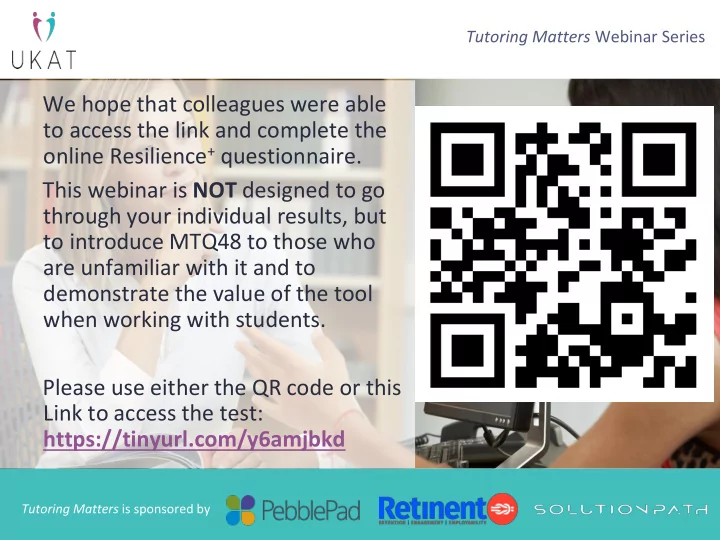
We hope that colleagues were able to access the link and complete the

  • nline Resilience+ questionnaire.

This webinar is NOT designed to go through your individual results, but to introduce MTQ48 to those who are unfamiliar with it and to demonstrate the value of the tool when working with students. Please use either the QR code or this Link to access the test: https://tinyurl.com/y6amjbkd

slide-2
SLIDE 2

Tutoring Matters Webinar Series

Tutoring Matters Webinar Series

Tutoring Matters is sponsored by

Building student resilience in a complex environment Hugh Mannerings Associate Director, Retinent

slide-3
SLIDE 3

Tutoring Matters Webinar Series

Webinar Presenters

Andrew Pye Host Hugh Mannerings

slide-4
SLIDE 4

Tutoring Matters Webinar Series

slide-5
SLIDE 5

Tutoring Matters Webinar Series

slide-6
SLIDE 6

Tutoring Matters Webinar Series

A brief introduction to Retinent Ltd

  • What is Retinent Ltd?
  • Who are Retinent Ltd?
  • What does Retinent offer?
  • Why are we interested in this area?
slide-7
SLIDE 7

Tutoring Matters Webinar Series

1

Origins and foundations of the study of resilience

2

Retinent Ltd – Resilience+ (MTQ48)

3

The Reports

slide-8
SLIDE 8

Tutoring Matters Webinar Series

Evolution of the construct of resilience

Source: Tusaie & Dyer(2004)

slide-9
SLIDE 9

Tutoring Matters Webinar Series

Origins of resilience

  • Resilience theory has its roots in the study of

adversity and an interest in how adverse life experiences impact harmfully on people.

  • Early researchers include Garmezy (1971), Rutter

and Madge (1976) and Antonovsky (1979)

  • More recently Masten (2011) and Van Breda

(2017)

  • Differences in definitions – the tension between

resilience as process and as outcome.

slide-10
SLIDE 10

Tutoring Matters Webinar Series

Researcher definitions theory Rutter (2006) An interactive concept that is concerned with the combination of serious risk experiences Brief exposure to risks can act as ‘steeling events’ Garmezy (1991) Resilience is not impervious to stress. It is designed to reflect the capacity for recovery Focus on development Focus on positive Werner (1982) Capacity to cope effectively with the internal stresses of their vulnerabilities and external stresses Identified factors that affected resilient at individual, family and community level Luthar (2000) A dynamic process encompassing positive adaptation within the context

  • f significant adversity.

Resilience is multidimensional Masten (2014) Children who have good outcomes in spite of serious threats to adaptation

  • f development

Factors exist at child, family and community level Ungar (2004) Outcome of negotiations between individuals and their environments 7 tensions of resilience

slide-11
SLIDE 11

Tutoring Matters Webinar Series

Source: Van Breda (2018)

slide-12
SLIDE 12

Tutoring Matters Webinar Series

Redefining resilience (Van Breda 2018)

  • Proposes to incorporate all three components and focus on the

mediating process. Van Breda proposes

‘The multilevel processes that systems engage in to obtain better- than-expected outcomes in the face or wake of adversity’

  • Multilevel means that the resilience processes occur across

multiple domains or levels of the social ecology or person-in- environment, rather than only in the individual.

slide-13
SLIDE 13

Tutoring Matters Webinar Series

Language/terminology/acronyms/tools

  • Grit (Duckworth)
  • Hardiness (Kobasa)
  • Self confidence
  • Self efficacy (Bandura)
  • Mental toughness
  • Commitment
  • Strength
  • Mindset (Dweck)

(growth/fixed)

  • EQ
  • NLP
  • CBT
  • Coaching
  • Counselling
  • Mindfulness
  • MBTI
  • Resilience+

(MTQ48)

slide-14
SLIDE 14

Tutoring Matters Webinar Series

What we must understand about resilience

  • Resilience is not static i.e. it’s not fixed, it can

change

  • It is concerned with how we react to pressure,

stress and challenge and as such how we adapt to any given situation (coping strategies).

slide-15
SLIDE 15

Tutoring Matters Webinar Series

Applications

  • Elite sport
  • Business, recruitment, staff, leadership and

team development, wellbeing

  • Education (all age groups)
  • US Army (large study to help combat PTSD)
slide-16
SLIDE 16

Tutoring Matters Webinar Series

Some questions

  • How important is developing resilience

among students?

  • How do you do it?
  • How do you measure it?
  • Why are we concerned about resilience?
  • What are the consequences?
  • What tools are there?
slide-17
SLIDE 17

Tutoring Matters Webinar Series

slide-18
SLIDE 18

Tutoring Matters Webinar Series

Understanding resilience

  • Resilience is the degree to which individuals

bounce back from adversity and stress and is generally seen as an asset that benefits the individual as well as the place they study and/or work.

‘RESILIENCE is often defined, in broad terms, as the ability to recover – to bounce back – from misfortune and to adjust easily to change.’

McIntosh and Shaw (Unite Students, May 2017:4)

slide-19
SLIDE 19

Tutoring Matters Webinar Series

Why is resilience needed?

  • We all need some degree of resilience in any

environment we encounter. Stressors such as deadlines, volume of work, or organizational change all trigger coping mechanisms of some kind.

  • How does this apply to your student populations:
  • Transition into HE
  • First few weeks of HE
  • Assessment (submission & feedback)
  • The hidden curriculum
  • Social interactions
  • Cooking, washing, time management, sleep hygiene,

financial management. (see Making It at Uni)

slide-20
SLIDE 20

Tutoring Matters Webinar Series

Positive case for resilience (according to McIntosh and Shaw)

  • Student mental Health & Wellbeing
  • Resilience is tangible
  • Life Satisfaction
  • Resilience can be developed
  • Greater Understanding is required
  • Cultural Exclusion
  • Peer support
slide-21
SLIDE 21

Tutoring Matters Webinar Series

Recommendations…

  • 1. A clear definition of resilience
  • 2. Implement practical steps
  • a. Embedding resilience into programmes.
  • b. National toolkit for resilience (see AMOSSHE).
  • c. Connect with secondary schools and primary schools to

develop resilience earlier.

  • d. Consider all touch points.
slide-22
SLIDE 22

Tutoring Matters Webinar Series

Understanding resilience in the context of student life

  • Making friends
  • Fitting in (belonging)
  • Looking after self
  • Eating, £, managing time
  • 1st assessment
  • 1st grade
  • Assessment feedback
  • Feeling homesick
  • Specific learning needs
  • Student profile (gender, age etc)
  • 1st generation into HE
  • Hidden curriculum
  • General physical health
  • General wellbeing
slide-23
SLIDE 23

Tutoring Matters Webinar Series

2

How does Resilience+ (MTQ48) work?

slide-24
SLIDE 24

Tutoring Matters Webinar Series

Case Study #1 Project – Culture Change

  • What is it?
  • Small HE provider, looking to innovate, meet

government metrics and introduce whole scale change

  • What happened?
  • Staff development, new values, invest in

infrastructure (Resilience+)

  • Outputs
  • Realignment of staffing and roles, improvement

in systems, policies, procedures, institutional focus on retention, assessment/feedback, employability and personal tutoring (using Resilience+).

  • Non-continuation rate

12.8%

  • Benchmark

10.1%

Student population Under 21 69% Mature 31% White 94% BME 4% Other 2% Male 40% Female 60% Disability 19% Entry High 8% medium 25% Low 37% Non-tarriff 30%

slide-25
SLIDE 25

Tutoring Matters Webinar Series

Case Study #2 Project – Student Retention

  • What is it?
  • School of Health & Wellbeing had an attrition

rate of 50%, withdrawal patterns varied across the year, patterns of disengagement

  • Solution Approach
  • Use Resilience+ with the programme to better

understand student needs

  • Outputs
  • Improved student retention, reduction in

early withdrawal, improved student satisfaction and engagement

Student population Under 21 59% Mature 31% White 78% BME 18% Other 7% Male 42% Female 58% Disability 11% Entry High 10% medium 25% Low 21% Non-tarriff 44%

slide-26
SLIDE 26

Tutoring Matters Webinar Series

How does Resilience+ work?

  • Takes between 5-8 minutes to complete the online

questionnaire

  • Reports are generated upon completion
  • Individual receives their own ‘development report’
  • Tutors receive the ‘development report’ and a ‘coaching

report’ so they can begin working with the student

  • Group report is sent to the University to show whole

cohort data.

  • Distance travelled reports are generated later in the

academic year after the student has undertaken the test for a 2nd time.

slide-27
SLIDE 27

Tutoring Matters Webinar Series

What is Mental Toughness / Resilience+?

“The quality which determines … how people deal with challenge, stressors and pressure .... irrespective of prevailing circumstances”

Studies have shown the measure to be robust and repeatable – it is not subject to day-to-day fluctuations. It will however respond to major life events. It is measured by a 48-question questionnaire and gives an individual’s perception of their own performance and behaviour. The concept is related to some others such as ‘resilience’, ‘grit’, ‘mindset’ and others. It differs in being a broader measure than these.

slide-28
SLIDE 28

Tutoring Matters Webinar Series

Defining Mental Toughness / resilience

  • Mental toughness is a personality trait, which determines,

in large part, how individuals deal with stressors, pressure and challenge… irrespective of the prevailing situation

  • Plasticity and resilience: personality is not fixed but

capable of change. This is a good thing 👎

  • Individual resilience/mental toughness largely determines

how individuals perform when exposed to stress, pressure and challenge. Other factors and context also impact.

slide-29
SLIDE 29

Tutoring Matters Webinar Series

Why use Resilience+ (MTQ48)?

It has a robust academic base There is an extensive literature demonstrating

  • Validity
  • Replicability
  • Genetic + Environment determination
  • Impacts of resilience in many situations

And very importantly:

  • Plasticity – it has been repeatedly demonstrated that

resilience scores can be significantly uplifted by support (such as coaching, self-reflection, group work etc)

  • Resilience can be enhanced
slide-30
SLIDE 30

Tutoring Matters Webinar Series

Resilience scores are directly related to:

Performance

explains up to 25% of the variation in individual performance

Behaviour

more engaged, more positive, more “can do”

Wellbeing

more contentment, better stress management, less bullying

Aspirations

more ambitious, prepared to manage more risk

Drop-out

more likely to stay on course

Employability

more likely to get a job and get the job they want

slide-31
SLIDE 31

Tutoring Matters Webinar Series

slide-32
SLIDE 32

Tutoring Matters Webinar Series

The components of Resilience+ ‘4 C’s’

Challenge Control

Emotions Life

Commitment Confidence

Ability Interpersonal

slide-33
SLIDE 33

Tutoring Matters Webinar Series

Challenge the extent to which people see challenges, variety, problems and changes as

  • pportunities or threats.

Control how people are able to control their life and emotions Commitment identifies the extent to which someone commits to delivering what has been promised Confidence identifies confidence in ability and interpersonal confidence

slide-34
SLIDE 34

Tutoring Matters Webinar Series

MTQ 48 Outcome

Each student receives (1) a score card, which outlines their strengths and sensitivities across the “Four Cs” (2) a detailed report which gives further insights and suggestions for areas of development. Individual outcomes can be compared to the well-described

  • verall population distribution.

68% of respondents achieve a medium overall score in the range 4-7

slide-35
SLIDE 35

Tutoring Matters Webinar Series

slide-36
SLIDE 36

Tutoring Matters Webinar Series

Resilience Enhancement (coping strategies)

There are a number of intervention types, each of which can be focussed towards a particular area in the Four Cs spectrum. These can be delivered as one-to-one sessions, in group work or self-directed with web supported materials.

These all help to develop the capability to deal with stress, pressure and challenge.

slide-37
SLIDE 37

Tutoring Matters Webinar Series

3

The Reports

slide-38
SLIDE 38

Tutoring Matters Webinar Series

Current studies have revealed significant relationships between mental toughness and education, including attendance, attainment, behaviour and peer relationships

Mindset and attitude impact on performance, wellbeing and behaviour and are relevant wherever these are important … everywhere! In a higher education setting this impacts on:

  • Performance – explaining up to

25% of the variation in performance in individuals.

  • Wellbeing – more contented.
  • Positive Behaviour – more engaged.
  • Openness to Learning – More

aspirational.

  • Transition

Source: St Clair-Thompson, H., Bugler, M., Robinson, J., Clough, P. J., McGeown, S., & Perry, J. L. (2015).
slide-39
SLIDE 39

Tutoring Matters Webinar Series

The Development Report

  • Control
  • Emotional Control
  • Life Control
  • Commitment
  • Challenge
  • Confidence
  • Own abilities
  • interpersonal

Overall MTQ48 Score with overview statement relating to that specific individual

slide-40
SLIDE 40

Tutoring Matters Webinar Series

Coaching Report

  • Similar layout
  • Brief description and then

some coaching suggestions

Assessor Report

  • Brief description and then

some suggested questions

  • In the HE/FE context we

advise using the questions to:

  • Get a deeper understanding of

the student

  • as ‘openers’ to discussing what

action the student should be considering

slide-41
SLIDE 41

Tutoring Matters Webinar Series

MTQ48 - Data Grid _ Training Only

First name Last name Email Age Gender Date Total Mental Toughness Control Emotional Control Life Control Commitment Challenge Confidence Confidence in Abilities Interpersonal Confidence

David 18 M 2 2 4 1 4 1 3 3 4 Anthony 19 M 2 2 4 2 2 2 2 2 4 Billy 18 M 2 4 6 2 3 2 2 1 4 Jonathan 18 M 3 2 3 3 4 5 4 3 4 Yolanda 18 F 3 3 3 3 4 2 3 2 5 William 18 M 3 3 4 2 4 3 2 3 2 Ebony 18 F 3 3 4 3 2 2 5 4 7 Rebecca 18 F 3 4 4 3 2 3 3 3 3 Lewis 18 M 3 4 4 3 3 3 3 3 4 Rebecca 18 F 3 4 4 4 2 3 3 3 3 Daniel 18 M 3 5 5 4 4 3 3 3 2 Joseph 18 M 3 5 7 4 5 2 2 3 1 Nathaniel 21 M 4 3 2 4 5 4 4 3 4 Michaela 18 F 4 3 4 3 4 2 5 3 7 Natasha 18 F 4 4 4 3 5 4 4 4 4 moynul 19 M 4 4 4 3 5 5 4 5 3 Michaela 18 F 4 4 4 4 4 3 5 3 7 Eleanor 19 F 4 4 4 4 5 4 3 3 3 James 18 M 4 4 5 3 2 4 5 4 6 daniel 18 M 4 4 6 3 4 2 4 5 3 Josh 19 M 4 4 6 3 4 3 4 3 5 Phill 20 M 4 5 8 3 2 2 5 4 7 Scott 18 M 4 6 7 4 4 3 4 4 4 Ben 18 M 4 6 7 4 2 1 5 5 4 harvey 19 M 5 4 3 4 4 5 5 4 7 Joshua 18 M 5 5 6 4 5 5 5 5 4 Mohammed 19 M 5 5 6 4 4 4 5 6 3 Shaun 20 M 5 5 6 4 6 3 6 7 4 Rebecca 21 F 5 5 7 4 5 5 5 4 6 Shamme 19 F 5 6 6 5 6 2 4 5 2 Andrew 19 M 5 6 6 5 4 3 5 6 4 Jack 19 M 5 6 6 5 4 4 6 7 4

REVIEWING THE RESULTS THE GROUP REPORT

  • Break down of the scores for

all participants

  • Group into overall MT scores
  • 1-3 (Mentally sensitive)
  • 4- 7 (Medium)
  • 8-10 (Mentally tough)
  • Additionally highlight scores
  • f ‘interest’ – see

James/Phil/Ben re commitment

  • Most at risk of
  • not staying,
  • not succeeding,
  • Poorer performance

and

  • being less happy at

University/College

slide-42
SLIDE 42

Tutoring Matters Webinar Series

Building resilience in the curriculum/programme

  • Learn your student names, the origins of belonging
  • Support the building of networks
  • Design low risk assessment early in the academic journey
  • Feedback on assessment, (see references)
  • Open up the hidden curriculum
  • Create opportunities for social interaction within the course such as:
  • Local trips, regional trips, lunch as a tutor group.
  • Create safe spaces for group discussions on university issues
slide-43
SLIDE 43

Tutoring Matters Webinar Series

Cont…

  • Be upfront about how the university/course helps support

wellbeing

  • Use the framework of Resilience+ (MTQ48) as a way to

support conversations around:

  • Control (emotional/life)
  • Commitment
  • Confidence (ability/interpersonal)
  • Challenge
  • Use group/cohort data from the tool to map against other

data points (learning anlaytics) and other student profile

  • data. What patterns emerge?
slide-44
SLIDE 44

Tutoring Matters Webinar Series

What are your pieces of the a student success jigsaw?

What areas of activity would you include in your jigsaw?

What values would you build your model of success around? What or who is central the success of your model?

slide-45
SLIDE 45

Tutoring Matters Webinar Series

slide-46
SLIDE 46

Tutoring Matters Webinar Series

Contacts Hugh@retinent.org Geoff@Retinent.org

slide-47
SLIDE 47

Tutoring Matters Webinar Series

References/Sources

  • Van Breda, A (2018) A critical review of resilience theory and its relevance for social work,

Maatskaplike Werk Vol54 No1; Issue 1, http://socialwork.journals.ac.za/pub

  • Wilson, S. Rickard, C and Tamkin, P (2014) Understanding Resilience, IES perspectives on HR

2014, Institute for Employment Studies.

  • Tuasie, K. (2004) Resilience: a historical review of the construct, ResearchGate,

www.researchgate.net/publication/8883380

  • Shean M, (2015) Current theories relating to resilience and young people: a literature review,

Victorian Health Promotion Foundation, Melbourne, VicHealth.

  • MacIntosh, E and Shaw, J (2017) Student Resilience, Exploring the positive case for resilience,

Unite Students.

  • David Carless & David Boud (2018): The development of student feedback literacy: enabling

uptake of feedback, Assessment & Evaluation in Higher Education,

  • Winstone, N. & E Medland from Surrey Uni. https://www.surrey.ac.uk/department-higher-

education/learning-lab

  • St Clair-Thompson, H., Bugler, M., Robinson, J., Clough, P. J., McGeown, S., & Perry, J. L. (2015).

Mental toughness in education: Exploring relationships with attainment, attendance, behaviour and peer relationships. Educational Psychology: An International Journal of Experimental Educational Psychology.

slide-48
SLIDE 48

Tutoring Matters Webinar Series

slide-49
SLIDE 49

Tutoring Matters Webinar Series

UKAT Highlights

Host Andrew Pye

slide-50
SLIDE 50

Tutoring Matters Webinar Series

UKAT Highlights

UKAT Newsletter - COMPASS

Out now! – sign up to the mailing list or view online at: https://www.ukat.uk/newsletters/october-november-

2019/

Annual Conference: Personalising Learning Through Personal Tutoring Glasgow, UK 6 - 7 April 2020

  • Presentation [45 minutes]
  • Workshop [45 minutes]
  • Gimme 5 [45 minutes]These sessions are designed to

be structured around five tips, principles or key aspects to consider in relation to ‘how to’ implement specific tutoring and advising approaches.

  • Poster.

DEADLINE Friday 20th of December 2019.

slide-51
SLIDE 51

Tutoring Matters Webinar Series

UKAT Highlights

Definition of Personal Tutoring Research Study - Call for Participation

Completion a short (20 minute maximum) online

  • survey. You can find more details and

participate by accessing the online survey here. https://yorksj.eu.qualtrics.com/jfe/form/SV_3ml LPGFva89c0Yt

Institutional membership and individual membership:

Institutional memberships are now available – See COMPASS newsletter for details.

slide-52
SLIDE 52

Tutoring Matters Webinar Series

UKAT Highlights

Next UKAT national webinar – Tutoring matters Supporting International Students in Personal Tutorials Thursday 28th November 2019 14:00 Louisa Hill and Nicola Smith, University of Leeds Please joins us, we look forward to seeing you again next month.

slide-53
SLIDE 53

Tutoring Matters Webinar Series