Pipelining: Its Natural! Laundry Example Ann, Brian, Cathy, Dave - - PDF document

pipelining its natural
SMART_READER_LITE
LIVE PREVIEW

Pipelining: Its Natural! Laundry Example Ann, Brian, Cathy, Dave - - PDF document

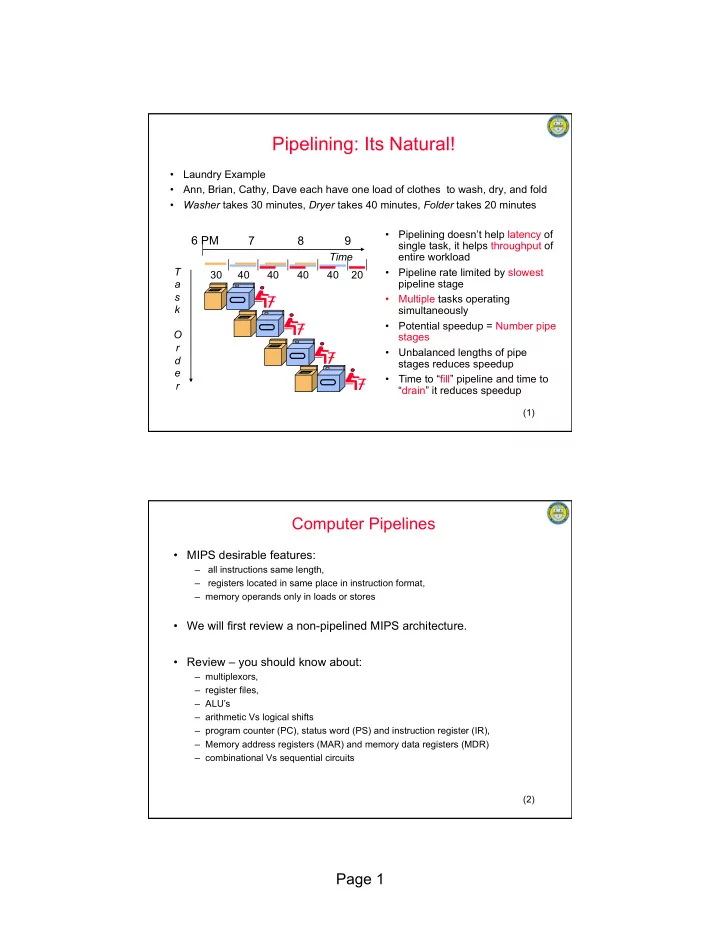
Pipelining: Its Natural! Laundry Example Ann, Brian, Cathy, Dave each have one load of clothes to wash, dry, and fold Washer takes 30 minutes, Dryer takes 40 minutes, Folder takes 20 minutes Pipelining doesnt help latency of 6


slide-1
SLIDE 1

Page 1

(1)

Pipelining: Its Natural!

  • Laundry Example
  • Ann, Brian, Cathy, Dave each have one load of clothes to wash, dry, and fold
  • Washer takes 30 minutes, Dryer takes 40 minutes, Folder takes 20 minutes

6 PM 7 8 9

T a s k O r d e r Time 30 40 40 40 40 20

  • Pipelining doesn’t help latency of

single task, it helps throughput of entire workload

  • Pipeline rate limited by slowest

pipeline stage

  • Multiple tasks operating

simultaneously

  • Potential speedup = Number pipe

stages

  • Unbalanced lengths of pipe

stages reduces speedup

  • Time to “fill” pipeline and time to

“drain” it reduces speedup

(2)

Computer Pipelines

  • MIPS desirable features:

– all instructions same length, – registers located in same place in instruction format, – memory operands only in loads or stores

  • We will first review a non-pipelined MIPS architecture.
  • Review – you should know about:

– multiplexors, – register files, – ALU’s – arithmetic Vs logical shifts – program counter (PC), status word (PS) and instruction register (IR), – Memory address registers (MAR) and memory data registers (MDR) – combinational Vs sequential circuits

slide-2
SLIDE 2

Page 2

(3)

Implementing the MIPS architecture

Arithmetic/logic instructions 1) fetch instruction 2) read registers 3) compute (use ALU) 4) write to register Memory instructions 1) fetch instruction 2) read registers 3) compute address (use ALU) 4) write/read to/from memory 5) write to register (for load) Branch instructions 1) fetch instruction 2) read registers 3) compute branch address (use ALU) 4) evaluate branch condition 5) update the PC (condition satisfied) Increment the PC

(4)

Instruction fetch

Add

PC

Instruction memory (cache) 4

N P C IR

Instruction memory (cache) Data out address

IR Mem[PC] NPC PC + 4

data memory (cache) Data out address Data in

slide-3
SLIDE 3

Page 3

(5)

64

Register read

Add

PC

Instruction memory 4

N P C IR

Register file

A B

Register file Read address 1 Read address 2 Write address Write data Read data 1 Read data 2 To decoder (control) Sign extend

5 5 5 16 6

A Regs[IR6..10] B Regs[IR11..15] Imm (IR16)48 ## IR16..31

Imm

(6)

Use ALU and evaluate branch condition

Add

PC

Instruction memory 4

N P C IR

Register file

A B

Sign extend

5 5 5 16 Imm

M U X

ALU

M U X

ALU

  • ut

cond Zero? 64

(the multiplexors settings and ALU function depend on the op-code) =

slide-4
SLIDE 4

Page 4

(7)

Use memory

Add

PC

Instruction memory 4

N P C IR

Register file

A B

Sign extend

5 5 5 16 Imm

M U X

ALU

M U X

ALU

  • ut

cond Zero?

M U X

data memory

LMD 64

(8)

Write to register

Add

PC

Instruction memory 4

N P C IR

Register file

A B

Sign extend

5 5 5 16 Imm

M U X

ALU

M U X

ALU

  • ut

cond Zero?

M U X

data memory

LMD

M U X

. . . . .

64

slide-5
SLIDE 5

Page 5

(9)

The control signals

Add

PC

Instruction memory 4

N P C IR

Register file

A B

Sign extend

5 5 5 16 Imm

M U X

ALU

M U X

ALU

  • ut

cond Zero?

M U X

data memory

LMD

M U X

. . . . .

64

X1 X2 X3 OP L1 L2 L3 L4 L5

(10)

The control signals

  • X1, X2, X3 = select multiplexor input (one bit each)
  • L1 = set if the instruction is a branch (one bit)
  • L2 = loads the PC (one bit)
  • L3 = read the instruction memory (one bit)
  • L4 = read/write register (two bits)

00 = no-op, 01 = read, 10 = write

  • L5 = read/write the data memory (two bits)

00 = no-op, 01 = read, 10 = write

  • OP = ALU control (?? Bits)

0..0 = no-op, 1..1 = add, 10.. = others

M U X M U X

X=0 X=1

slide-6
SLIDE 6

Page 6

(11)

Pipelining MIPS

Add

PC

Instruction memory 4 Register file Sign extend

5 5 5 16

M U X

ALU

M U X

Zero?

M U X

data memory

M U X

. . . . .

64

IF/ID ID/EX EX/MEM MEM/WB (12)

Add

PC

Instruction memory 4 Register file Sign extend

5 5 5 16

M U X

ALU

M U X

Zero?

M U X

data memory

M U X

. . . .

64

IF/ID ID/EX EX/MEM MEM/WB

slide-7
SLIDE 7

Page 7

(13)

Visualizing pipelining

Reg IM DM Reg Reg IM DM Reg Reg IM DM Reg Reg IM DM Reg Clock cycles Instruction

  • rder

CC1 CC2 CC3 CC4 CC5 CC6 Pipelining puts additional demands on memory bandwidth,

(14)

Visualizing pipelining

Clock cycles CC1 CC2 CC3 CC4 CC5 CC6 IM Reg Alu Mem WB IM Reg Alu Mem WB IM Reg Alu Mem WB

lw add sw IM Reg Alu Mem WB

lw lw lw lw lw add add add add add sw sw sw sw Clock cycles

slide-8
SLIDE 8

Page 8

(15)

  • Hazards prevent next instruction from executing during its designated

clock cycle – Structural hazards: HW cannot support a combination of instructions. – Data hazards: Instruction depends on result of prior instruction still in

the pipeline.

– Control hazards: Pipelining of branches & other instructions stall the

pipeline until the hazard bubbles in the pipeline

Limits to pipelining:

(16)

Structural Hazards (assuming a single memory)

Reg IM DM Reg Reg IM DM Reg Reg IM DM Reg Reg IM DM Reg Clock cycles CC1 CC2 CC3 CC4 CC5 CC6 Load add add add

slide-9
SLIDE 9

Page 9

(17)

Structural Hazards (assuming a single memory)

Reg IM DM Reg Reg IM DM Reg Reg IM DM Reg Reg IM DM Reg Clock cycles CC1 CC2 CC3 CC4 CC5 CC6 Load add add add

(18)

Reg Reg

Structural hazard in register file

Reg IM DM Reg IM DM Reg Reg IM DM Reg IM DM Reg Clock cycles CC1 CC2 CC3 CC4 CC5 CC6 Load add add add

slide-10
SLIDE 10

Page 10

(19)

Speed Up Equation for Pipelining

CPIpipelined = Ideal CPI + stall cycles per instruction

CPIunpipelined Clock Cycleunpipelined CPIpipelined Clock Cyclepipelined x Speedup =

  • Machine A: pipelined (with some depth) and dual ported memory
  • Machine B: pipelined (same depth as A), but single ported memory,

and a 1.05 times faster clock rate

  • Ideal CPI = 1 for both, and loads are 40% of instructions executed

SpeedUpA = Pipeline Depth

SpeedUpB = (Pipeline Depth/1.4) x 1.05 = 0.75 x Pipeline Depth SpeedUpA / SpeedUpB = 1.33

Example:

(20)

Reg

Register-to-register data Hazards

Reg IM DM Reg Reg IM DM Reg Reg IM DM Reg Reg IM DM Reg IM DM Reg

Add R1, R2, R3 Sub R4, R1, R4 And R5, R1, R5 Add R6, R1, R6 Add R7, R1, R7 Dependence: add produces R1 consumed by following instructions

slide-11
SLIDE 11

Page 11

(21)

Three types of Data Dependence

Instri is later in the pipeline than Instrj j depends on i for operand R

  • 1. Read After Write (RAW)

Instrj tries to read operand before Instri writes it

  • 2. Write After Read (WAR)

Instrj tries to write operand before Instri reads it

– Gets wrong operand – Can’t happen in MIPS 5 stage pipeline (why?)

  • 3. Write After Write (WAW)

Instrj tries to write operand before Instri writes it

– Leaves wrong result

– Can’t happen in MIPS 5 stage pipeline (why?)

Will see WAR and WAW in later more complicated pipes

(22)

Reg Reg Reg

Forwarding to Avoid Data Hazard

Reg IM DM Reg IM DM Reg Reg IM DM Reg IM DM Reg IM DM Reg

Add R1, R2, R3 Sub R4, R1, R4 And R5, R1, R5 Add R6, R1, R6 Add R7, R1, R7

slide-12
SLIDE 12

Page 12

(23)

M U X

ALU

M U X

data memory

M U X

.

ID/EX EX/MEM MEM/WB

HW Change for Forwarding

PC

IF/ID

Register file

5 5 5

(25)

ALU data memory M u x M u x

ID/EX EX/MEM MEM/WB A B

s t t d t d d

Forwarding Control

Forwarding Paths

slide-13
SLIDE 13

Page 13

(26) Src Type Detection Condition Input Action Priority R-R EX/MEM.rd == ID/EX.rs Mux A 1 1 R-R EX/MEM.rd == ID/EX.rt Mux B 1 1 R-R MEM/WB.rd == ID/EX.rs Mux A 2 2 R-R MEM/WB.rd == ID/EX.rt Mux B 2 2 Imm EX/MEM.rt == ID/EX.rs Mux A 1 1 Imm EX/MEM.rt == ID/EX.rt Mux B 1 1 Imm MEM/WB.rt == ID/EX.rs Mux A 2 2 Imm MEM/WB.rt == ID/EX.rt Mux B 2 2 Ld MEM/WB.rt == ID/EX.rs Mux A 3 2 Ld MEM/WB.rt == ID/EX.rs Mux B 3 2

Detection & Activation for Forwarding Control

Src Type = Producer instruction opcode type Action = Mux setting; if no match, then Mux selection is 0 Priority = Which detection condition takes precedence (note, multiple can match) (27)

Reg Reg Reg IM DM Reg IM DM Reg Reg IM DM Reg IM DM Reg

lw r1, 0(r2) sub r4,r1,r6 and r6,r1,r7

  • r r8,r1,r9

Data Hazard Even with Forwarding

Cannot travel back in time. Need to stall (interlock) the pipe if: The instruction in ID/EX is a lw

The instruction in IF/ID uses register Rs1 and/or Rs2 Rd for the instruction in ID/EX = Rs1 or Rs2

How can we interlock (stall) the pipeline?

slide-14
SLIDE 14

Page 14

(28)

Interlock on Load-Use

  • Detect a load followed by a dependent use
  • Insert the bubble on detection

– Disable write (no updates): PC, ID/IF register – Clear the ID/EX register (inserting a nop)

Src Type Dst Type Condition Ld Register-Register ID/EX.rt == IF/ID.rs Ld Register-Register ID/EX.rt == IF/ID.rt Ld Immediate ID/EX.rt == IF/ID.rs (29)

Try producing fast code for a = b + c; d = e – f; assuming a, b, c, d ,e, and f in memory.

Slow code:

LW Rb,b LW Rc,c ADD Ra,Rb,Rc SW a,Ra LW Re,e LW Rf,f SUB Rd,Re,Rf SW d,Rd

Software Scheduling to Avoid Load Hazards

Fast code:

LW Rb,b LW Rc,c LW Re,e ADD Ra,Rb,Rc LW Rf,f SW a,Ra SUB Rd,Re,Rf SW d,Rd

slide-15
SLIDE 15

Page 15

(30)

Add

PC

Instruction memory 4 Register file Sign extend

5 5 5 16

M U X

ALU

M U X

Zero?

M U X

data memory

M U X

. . . .

64

IF/ID ID/EX EX/MEM MEM/WB

Control Hazard on Branches

(31)

Control Hazard on Branches

IM Reg Alu Mem WB

beqz beqz beqz beqz beqz add add add add add sw sw sw sw Clock cycles sub sub sub sub sub sw

slide-16
SLIDE 16

Page 16

(32)

Branch Stall Impact

  • If CPI = 1, 10% branch, Stall 3 cycles => new CPI = 1.3
  • Two part solution:
  • 1. Determine branch taken or not sooner, AND
  • 2. Compute taken branch address earlier
  • MIPS branch tests if two registers are equal
  • MIPS solution

– Move Zero test to ID/EX stage – Adder to calculate branch target address in ID/EX stage – 1 clock cycle penalty for branch versus 3

(33)

Early determination of Branch condition and target

Add

PC

Instruction memory 4 Register file Sign extend

5 5 5 16

ALU

M U X

Zero?

M U X

data memory

M U X

. . .

32

IF/ID ID/EX EX/MEM MEM/WB

Add

=

slide-17
SLIDE 17

Page 17

(34)

Four Branch Hazard Alternatives

#1: Stall until branch direction is clear #2: Predict Branch Not Taken

– Execute successor instructions in sequence – “Squash” instructions in pipeline if branch actually taken (how?) – Advantage of late pipeline state update – 47% MIPS branches not taken on average – PC+4 already calculated, so use it to get next instruction

#3: Predict Branch Taken

– 53% MIPS branches taken on average – But haven’t calculated branch target address in MIPS » MIPS still incurs 1 cycle branch penalty » Other machines: branch target known before outcome

(35)

Four Branch Hazard Alternatives

#4: Delayed Branch

– Define branch to take place AFTER a following instruction branch instruction sequential successor1 sequential successor2 ........ sequential successorn branch target if taken – 1 slot delay allows proper decision and branch target address in 5 stage pipeline – Delay Slot Instruction (DSI) – MIPS uses this Branch delay of length n

slide-18
SLIDE 18

Page 18

(36)

Example of DSI

top:lw R1,0(R2) lw R3,4(R2) add R1,R1,R3 sw R1,0(R2) addiR2,R2,4 addiR5,R5,-1 bne R5,R0,top delay slot instruction add ...

  • (37)

Example of DSI

top:lw R1,0(R2) lw R3,4(R2) add R1,R1,R3 sw R1,0(R2) addiR2,R2,4 addiR5,R5,-1 bne R5,R0,top nop add ... Dependence chain

slide-19
SLIDE 19

Page 19

(38)

Example of DSI

top:lw R1,0(R2) lw R3,4(R2) add R1,R1,R3 sw R1,0(R2) addiR2,R2,4 addiR5,R5,-1 bne R5,R0,top nop add ...

  • Dependence chain

(39)

Example of DSI

top:lw R1,0(R2) lw R3,4(R2) add R1,R1,R3 sw R1,0(R2) addiR2,R2,4 addiR5,R5,-1 bne R5,R0,top nop add ...

  • Dependence chain
slide-20
SLIDE 20

Page 20

(40)

Example of DSI

top:lw R1,0(R2) lw R3,4(R2) add R1,R1,R3 sw R1,0(R2) addiR5,R5,-1 bne R5,R0,top addiR2,R2,4 add ...

  • Dependence chain

(41)

Example of DSI

top:lw R1,0(R2) lw R3,4(R2) add R1,R1,R3 sw R1,0(R2) addiR2,R2,-4 bne R2,R0,top nop add ...

  • Can we move the addi?
slide-21
SLIDE 21

Page 21

(42)

  • Where do we get instructions to fill branch delay slot?

– Before branch instruction – From the target address: should repeat instruction for correctness – From fall through: correct if R7 is dead after the branch

(44)

Multi-cycle pipelines

  • Assume
  • 4-stage, pipelined, FP add
  • 7-stage, pipelined, FP multiply
  • 25 stage, non-pipelined divide unit

IF ID

Ex Int.

Mem WB

FP mult. FP add Div. FP mult. FP mult. FP add

  • Latency of an instruction, I, in a pipeline, P, is the number of bubbles

that has to exist in P if the instruction following I wants to use the result

  • f I.
slide-22
SLIDE 22

Page 22

(45)

  • Two divide instructions will stall the pipe (structural hazards).
  • May have more than one register write in one cycle (why?)
  • increase number of ports, or stall the pipeline (interlock)
  • May have WAW hazard (why?)
  • Out-of-order completion causes problems with exceptions,
  • The long pipes causes more RAW hazards (why?)

Hazards: To deal with structural Hazards:

  • Stall a conflicting instruction at the ID stage
  • Use a shift register to keep track of the utilization of a stage

that may suffer from structural hazard (ex. Input ports of registers)

  • Stall a conflicting instruction when entering the Mem stage
  • may give priority to longer instructions to reduce RAW hazards.

(46)

MEM

  • EX

ID

  • IF

S.D F2, 0(R2) MEM A4 A3 A2 A1

  • ID
  • IF

Add.D F2, F0, F8 WB MEM M7 M6 M5 M4 M3 M2 M1

  • ID

IF Mul.D F0, F4, F6 WB MEM EX ID IF L.D F4, 0(R2) 17 16 15 14 13 12 11 10 9 8 7 6 5 4 3 2 1 Instruction

Stall due to RAW hazards

Examples

instruction 1 2 3 4 5 6 7 8 9 10 11 MUL.D F0,F4,F6 IF ID M1 M2 M3 M4 M5 M6 M7 Mem WB … IF ID EX Mem WB … IF ID EX Mem WB Add.D F2,F4,F6 IF ID A1 A2 A3 A4 Mem WB … IF ID EX Mem WB … IF ID EX Mem WB L.D F2, 0(R2) IF ID Ex Mem WB

Structural hazards

WB

slide-23
SLIDE 23

Page 23

(47)

To deal with WAW:

  • WAW occurs only if a useless instruction is executed
  • If there is a use in between the writes, then a RAW will stall the

pipe (if no forwarding is used -- in this case forwarding is not possible)

  • May detect hazard and hold the second instruction,
  • May detect hazard and prevent the first instruction from writing
  • May detect hazard and replace the first instruction with a no-op

Can all hazards be detected at the ID stage?

To maintain precise exceptions:

  • May ignore the problem, or
  • buffer the results and enforce the order of writes, or
  • let the trap handling routine enforce the preciseness (software

approach), or

  • delay the issue (stall the pipe) to enforce in-order completion.

(48)

Instruction set design and pipelining

  • Variable instruction length and execution time leads to
  • imbalance among stages,
  • complicate hazard detection and precise exceptions
  • Caches have similar effects (imbalance pipes)
  • may freeze the entire pipeline on a cache miss
  • Complex addressing modes
  • may change register values
  • may require multiple memory access
  • self modifying instructions causes pipeline problems
  • Implicitly set condition codes complicates pipeline control hazards
slide-24
SLIDE 24

Page 24

(49)

The MIPS R4000

  • 64-bit instruction set (MIPS-3 ISA)
  • Decomposes memory access into stages (super-pipelining)
  • Uses a deeper pipeline

– IF -- first half of instruction fetch – IS -- second half of instruction fetch – RF - instruction decode and register fetch (and check cache tag) – EX - execution: effective address calculation, ALU operation, branch target computation, branch condition evaluation – DF - first half of data fetch – DS - second half of data fetch – TC - check cache tag (to determine if it is a hit) – WB write back

(50)

Forwarding from memory output is required to instructions that are 3 or 4 cycles later (sooner instructions have to stall)

slide-25
SLIDE 25

Page 25

(51)

The MIPS R4000 pipeline

  • Branch delay is 3 cycles
  • The architecture supports a single-cycle delayed branch

The floating-point pipeline:

  • Three units: adder (5 stages), divider(36 non-pipelined stages) and

multiplier (9 stages)

  • Eight hardware units are shared among stages

– A (add mantissa), – D (divide), – E(exception test), – M and N (first and second stages of multiplier), – R (rounding), – S (shift), – U (unpack)