
SLIDE 1
Pin Power Reconstruction with Leakage-corrected Embedded Calculation in PWRs
Hwanyeal Yu*, Seongdong Jang*, and Yonghee Kim* *Korea Advanced Institute of Science and Technology, 219 Daehak-ro, Daejeon, 34141, Republic of Korea Corresponding author: yongheekim@kaist.ac.kr
- 1. Introduction
In modern reactor analysis, simplified equivalence theory (SET) [1] based two-step nodal analysis has been widely used for light water reactor (LWR). Although this nodal analysis has acceptable results in terms of fuel assembly (FA) level, such as FA power distribution, the pin level results are essential for reactor safety analysis. To estimate the pin power distribution, the pin power reconstruction (PPR) method based on form function (FF) [2] is a common way. In this FF-based PPR, the homogeneous FA power obtained from two-step nodal analysis is multiplied by predetermined heterogeneous pin level FFs from the lattice calculations. In our previous study [3], we adopted the PPR based
- n embedded calculation [4], named ‘embedded PPR’
to consider neighboring effect. In this work, we apply two leakage correction methods, APEC (albedo- corrected parameterized equivalence constants) method [5] and GPS (GET Plus SPH) method [6] to improve accuracy of embedded PPR. In this study, DeCART2D code [7] was used for the lattice and reference core
- calculation. Embedded PPRs were calculated by in-
house NEM based pin-wise nodal code.
- 2. Embedded PPR and Leakage Correction Method
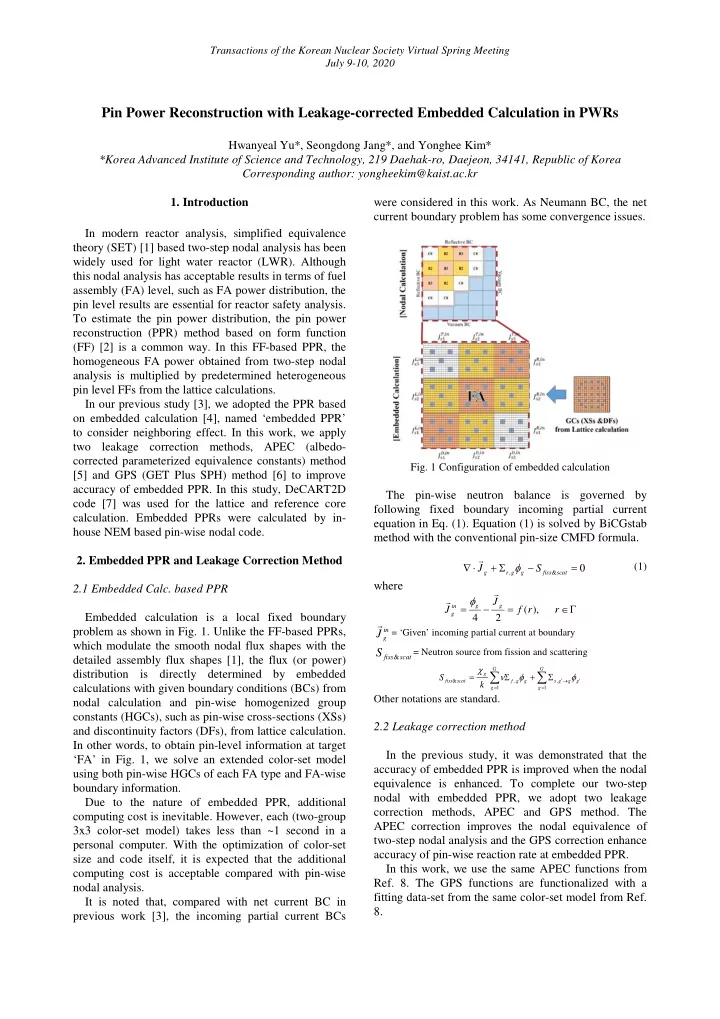
2.1 Embedded Calc. based PPR Embedded calculation is a local fixed boundary problem as shown in Fig. 1. Unlike the FF-based PPRs, which modulate the smooth nodal flux shapes with the detailed assembly flux shapes [1], the flux (or power) distribution is directly determined by embedded calculations with given boundary conditions (BCs) from nodal calculation and pin-wise homogenized group constants (HGCs), such as pin-wise cross-sections (XSs) and discontinuity factors (DFs), from lattice calculation. In other words, to obtain pin-level information at target ‘FA’ in Fig. 1, we solve an extended color-set model using both pin-wise HGCs of each FA type and FA-wise boundary information. Due to the nature of embedded PPR, additional computing cost is inevitable. However, each (two-group 3x3 color-set model) takes less than ~1 second in a personal computer. With the optimization of color-set size and code itself, it is expected that the additional computing cost is acceptable compared with pin-wise nodal analysis. It is noted that, compared with net current BC in previous work [3], the incoming partial current BCs were considered in this work. As Neumann BC, the net current boundary problem has some convergence issues.
- Fig. 1 Configuration of embedded calculation
The pin-wise neutron balance is governed by following fixed boundary incoming partial current equation in Eq. (1). Equation (1) is solved by BiCGstab method with the conventional pin-size CMFD formula.
& ,
= − Σ + ⋅ ∇
scat fiss g g r g
S J φ (1)
where
Γ ∈ = − = ), ( 2 4 r r f J J
g g in g
φ
in g
J
= ‘Given’ incoming partial current at boundary
scat fiss
S
&
= Neutron source from fission and scattering
∑ ∑
= ′ → ′ =
Σ + Σ =
G g g g g s G g g g f g scat fiss
k S
1 , 1 , &
φ φ ν χ
Other notations are standard.
2.2 Leakage correction method In the previous study, it was demonstrated that the accuracy of embedded PPR is improved when the nodal equivalence is enhanced. To complete our two-step nodal with embedded PPR, we adopt two leakage correction methods, APEC and GPS method. The APEC correction improves the nodal equivalence of two-step nodal analysis and the GPS correction enhance accuracy of pin-wise reaction rate at embedded PPR. In this work, we use the same APEC functions from
- Ref. 8. The GPS functions are functionalized with a