Pilot Project: Cash for Self-Help Shelter- Rehabilitation Ein El - - PowerPoint PPT Presentation

pilot project cash for self help shelter rehabilitation
SMART_READER_LITE
LIVE PREVIEW

Pilot Project: Cash for Self-Help Shelter- Rehabilitation Ein El - - PowerPoint PPT Presentation

Federal Department of Foreign Affairs FDFA Swiss Agency for Development and Cooperation SDC SKH/Humanitarian Aid Paul Metzener Pilot Project: Cash for Self-Help Shelter- Rehabilitation Ein El Hilweh Camp, Lebanon Presentation SDC Cash Workshop


slide-1
SLIDE 1

Federal Department of Foreign Affairs FDFA Swiss Agency for Development and Cooperation SDC

SKH/Humanitarian Aid – Paul Metzener
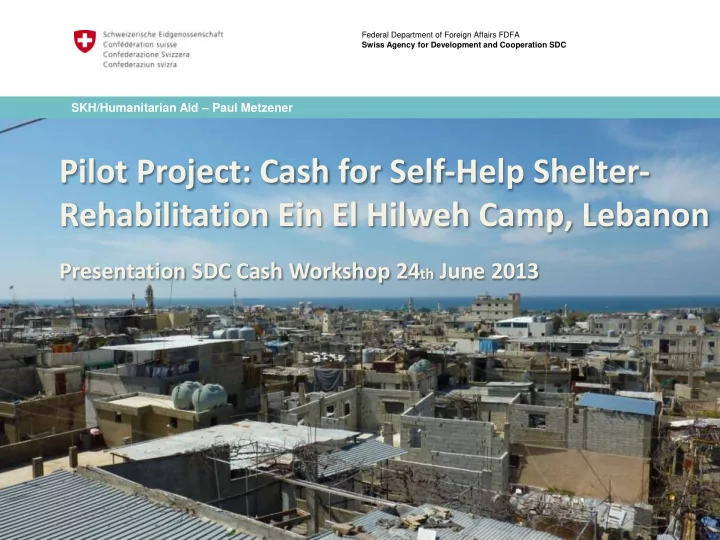
Pilot Project: Cash for Self-Help Shelter- Rehabilitation Ein El Hilweh Camp, Lebanon

Presentation SDC Cash Workshop 24th June 2013

slide-2
SLIDE 2

Project ...

... initated by SDC program office Beirut ... funded by SDC, total cost CHF 615‘000.- ... implemented by UNRWA, field office Beirut ... timeframe Feb 2011 – Nov 2011 my role: junior cash expert

2

slide-3
SLIDE 3

Context

 Palestine people became refugees 63 years ago  11 camps with 450‘000 refugees in Lebanon  Palestines have no rights and are not allowed to work in Lebanon  UNRWA, the UN Relief and Work Agency for Palestines  99% of UNRWA employees are Palestine

3

slide-4
SLIDE 4

Project goals  Improve the living conditions for most vulerable palestine refugees through healthy and hygienic accommodation  Pilot project for the „Self Help approach“  Reduction of the overall renovation cost for UNRWA  Capacity building  Conditional cash project

4

slide-5
SLIDE 5

Ein El Hilweh Camp, Saida Area

 Approximately 65‘000 palestine refugees on one square kilometre > high density  High unemployment, 85%  Extreme poverty  Factional differences  No construction by UNRWA for 7 years

5

slide-6
SLIDE 6

Project schedule

6

 Beneficiary selection  Detailed evaluation  Definition individual project  Material and cost calculation  Beneficiary agreement  Payments  Construction phase  Final evaluation

slide-7
SLIDE 7

Beneficiary selection

 Based on the poverty study of AUB 311 families have been selected for a first evaluation, including technical and socio-economic criteria  The 36 most vulnerable families were included in the shortlist for a detailed evaluation  9 families had to be excluded ,14 families were added to the program  A total of 41 families including 178 individuals are finally selected

7

slide-8
SLIDE 8

Technical criteria

8

slide-9
SLIDE 9

Many structures are in a bad shape; soaked concrete slabs with corroded steel reinforcement are dangerous and bad for the health...

9

slide-10
SLIDE 10

Hot in summer, cold and wet in winter; leaking zinc roofs have to be replaced by concrete slab supported by new columns

10

slide-11
SLIDE 11

Kitchen and toilets are often in bad condition and need to be repaired

  • r replaced

11

slide-12
SLIDE 12

To improve the quality of living we decided to include one boiler per family; cost approx. USD 200.- This kitchen serves a family with 4 children.

12

slide-13
SLIDE 13

Socio-economic criteria

13

slide-14
SLIDE 14

Different family types are included in the project; here for example a father (blind on one eye) with his son; the shelter is in bad condition and can be repaired for USD 5’300.-

14

slide-15
SLIDE 15

This family, 2 adults with 4 children is living in only 1 room. According to UNRWA standards they are entitled to 3 rooms. The shelter will be partially reconstructed for an amount of USD 13’400.-

15

slide-16
SLIDE 16

This woman is disabled and has not left her shelter (2nd floor) for 7 years. She lives in one room together with her husband and 1 son (14). The shelter is in rather good condition and can be repaired for USD 3’400.-

16

slide-17
SLIDE 17

Planning + Individual Project

17

slide-18
SLIDE 18

Highlight 1: Signing beneficiary agreements

18

slide-19
SLIDE 19

19

slide-20
SLIDE 20

Highlight 2: 1st Payment after 4 months of hard work

20

slide-21
SLIDE 21

Highlight 3: Construction

21

slide-22
SLIDE 22

Self help ...

22

slide-23
SLIDE 23

Priorities set by the beneficiaries...

23

slide-24
SLIDE 24

Achievements

 38 families (96%) changed their lives dramatically; they now live in a save, healthy and clean shelter  The self-help approach works in this complex context  All expectations of UNRWA and SDC are exceeded  Total cost per shelter USD 8’250.- > 8% lower than planned and 50% lower compared with the contractor approach  An upscale project with 736 families is funded by the EU  Lessons learnt are an important value for the planned upscale

24

slide-25
SLIDE 25

Before- After

slide-26
SLIDE 26

Positive observations, my view...

 Good cooperation between SDC and UNRWA  UNRWA staff well qualified, valuable output on working level  Motivation and team spirit  Project team includes engineers and social workers  Cash expert integrated on working level, 60 days in camp  Contribution to capacity building and lessons learnt  Beneficiaries like self-help approach

26

slide-27
SLIDE 27

Positive side effects

 The beneficiaries experienced self-efficacy (Selbstwirksamkeit), self-esteem and self-respect  All beneficiaries contributed to their success with own work  Most families organized additional funds (10 to 20%), which shows the high grade of motivation to improve their desperate situation  The family and the role of the women were strengthened  more than 60% of the money stays in the camp and strengthens the micro-economy

27

slide-28
SLIDE 28

Challenges

 Receive Lebanese Army Forces approval for material import  Support beneficiary families during execution of works in technical and organizational matters  Ensure construction safety standards  Budget control (for families)  Upscale to a 700 shelter program

28

slide-29
SLIDE 29

Essentials for an upscale Increase social competences of UNRWA staff Implement a database management Sufficient personnel ressources Adapt UNRWA internal proceedures to self- help-approach Coaching

29

slide-30
SLIDE 30

What else did we learn ?

30

 To fully include the beneficiaries in all project steps is a key success factor  Women know their needs and how to solve their problems; they are very reasonable  Including female social workers in the project team created confidence and continuity  Support the beneficiaries during all phases

slide-31
SLIDE 31

Go to the people, pay them respect, work with them, learn from them,build

  • n what they have

31