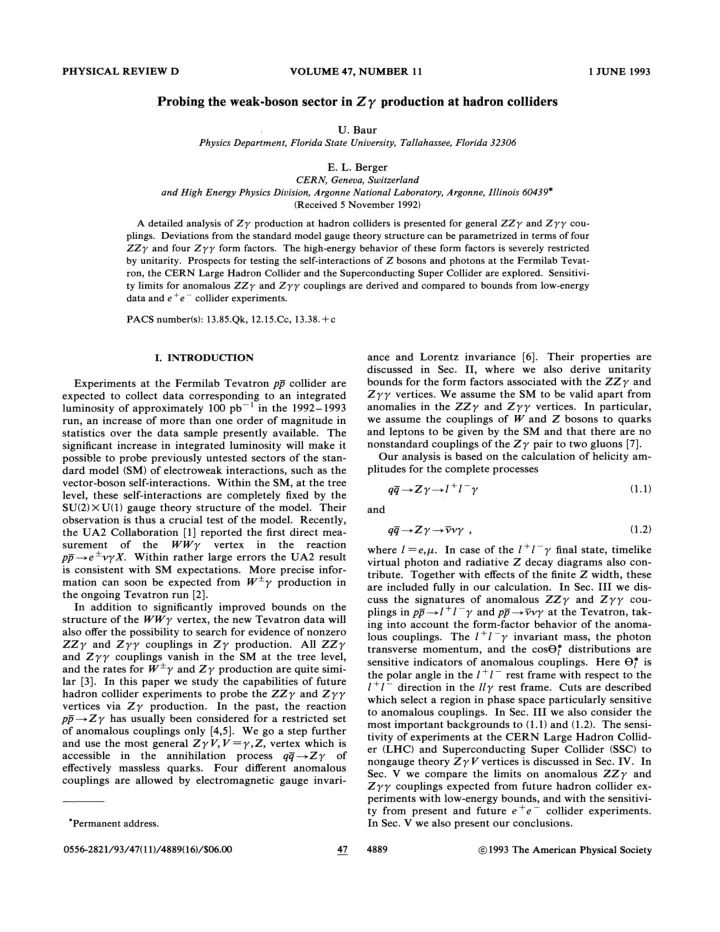
PHYSICAL REVIEW 0 VOLUME 47, NUMBER 11 1 JUNE 1993 sector in Zy - - PDF document

physical review 0
SMART_READER_LITE
LIVE PREVIEW

PHYSICAL REVIEW 0 VOLUME 47, NUMBER 11 1 JUNE 1993 sector in Zy - - PDF document

PHYSICAL REVIEW 0 VOLUME 47, NUMBER 11 1 JUNE 1993 sector in Zy production Probing the weak-boson at hadron colliders U. Baur Florida State University, Florida 32306 Physics Department, Tallahassee, E. L. Berger CERN, Geneva, Switzerland Illinois


slide-1
SLIDE 1

PHYSICAL REVIEW 0 VOLUME 47, NUMBER 11

1 JUNE 1993

Probing the weak-boson sector in Zy production at hadron colliders

  • U. Baur

Physics Department,

Florida State University, Tallahassee, Florida 32306

  • E. L. Berger

CERN, Geneva, Switzerland and High Energy Physics Division, Argonne National Laboratory,

Argonne,

Illinois 60439 (Received 5 November 1992) A detailed analysis of Zy production at hadron colliders is presented for general ZZy and Zyy cou- plings. Deviations from the standard model gauge theory structure can be parametrized in terms of four

ZZy and four Zyy form factors.

The high-energy behavior of these form factors is severely restricted

by unitarity.

Prospects for testing the self-interactions

  • f Z bosons and photons

at the Fermilab Tevat- ron, the CERN Large Hadron Collider and the Superconducting Super Collider are explored.

Sensitivi- ty limits for anomalous

ZZy and Zyy couplings

are derived and compared to bounds from low-energy data and e+e collider experiments. PACS number(s):

13.85.Qk, 12.15.Cc, 13.38.+c

  • I. INTRODUCTION

Experiments at the Fermilab Tevatron pp collider are expected to collect data corresponding to an integrated luminosity

  • f approximately

100 pb

in the 1992—

1993

run, an increase of more than one order of magnitude in statistics

  • ver the data sample

presently available.

The

significant increase in integrated luminosity

will make it

possible to probe previously untested sectors of the stan- dard model (SM) of electroweak interactions, such as the vector-boson self-interactions. Within the SM, at the tree level, these self-interactions are completely fixed by the SU(2) XU(1) gauge theory structure

  • f the model.

Their

  • bservation

is thus a crucial test of the model.

Recently, the UA2 Collaboration

[1] reported

the first direct mea- surement

  • f

the

8'8'y

vertex

in

the reaction

pp~e —

vyX.

Within rather large errors the UA2 result is consistent with SM expectations. More precise infor- mation can soon be expected from 8'— y production

in

the ongoing Tevatron run [2]. In addition

to significantly

improved bounds

  • n the

structure of the 8'8 y vertex, the new Tevatron data will also offer the possibility to search for evidence of nonzero

ZZy

and Zyy couplings in Zy production. All ZZy and Zyy couplings vanish in the SM at the tree level, and the rates for 8'*y and Zy production are quite simi- lar [3]. In this paper

we study

the capabilities

  • f future

hadron collider experiments

to probe the ZZy and Zyy

vertices via Zy production. In the past, the reaction pp —

+Zy has usually

been considered

for a restricted

set

  • f anomalous

couplings

  • nly [4,5]. We go a step further

and use the most general Zy V, V =y, Z, vertex which is accessible in the annihilation process

qq —

+Zy

  • f

effectively massless quarks.

Four

different anomalous couplings are allowed by electromagnetic gauge invari-

*Permanent address.

ance

and

Lorentz invariance

[6]. Their

properties are discussed

in

  • Sec. II, where

we also derive unitarity bounds for the form factors associated with the ZZy and

Zyy vertices. We assume the SM to be valid apart from

anomalies in the ZZy and Zyy vertices. In particular, we assume the couplings

  • f 8' and Z bosons to quarks

and leptons to be given by the SM and that there are no nonstandard couplings of the Zy pair to two gluons [7]. Our analysis is based on the calculation

  • f helicity am-

plitudes for the complete processes

qq~Zy~l

I

y

and

qq ~Zy ~Vvy,

where I =e,p. In case of the l+/

y final state, timelike

virtual photon and radiative Z decay diagrams also con- tribute. Together with effects of the finite Z width, these are included

fully in our calculation.

In Sec. III we dis-

cuss the signatures

  • f anomalous

ZZy

and Zyy

cou-

plings in pp —

+l+t'

y and pp —

+Vvy at the Tevatron,

tak-

ing into account the form-factor

behavior

  • f the anoma-

lous couplings.

The l+I y invariant

mass, the photon transverse momentum, and the coseI distributions are sensitive indicators

  • f anomalous

couplings. Here

GI* is

the polar angle in the I

I

rest frame with respect to the

l+ l

direction

in the ll y rest frame.

Cuts are described which select a region in phase space particularly sensitive to anomalous couplings. In Sec. III we also consider the most important backgrounds to (1.1) and (1.2). The sensi- tivity of experiments at the CERN Large Hadron Collid- er (LHC) and Superconducting Super Collider (SSC) to nongauge theory Zy V vertices is discussed

in Sec. IV. In

  • Sec. V we compare

the limits

  • n anomalous

ZZy

and

Zyy

couplings expected from future hadron collider ex- periments with low-energy bounds, and with the sensitivi- ty from present and future e+e collider experiments. In Sec. V we also present our conclusions. 0556-2821/93/47(11)/4889(16)/$06. 00 47 4889

1993 The American

Physical Society

slide-2
SLIDE 2

4890

  • U. BAUR AND E. L. BERGER
  • II. ZZy AND Zyy COUPLINGS

At the parton

level, the reaction pp ~l+/

y proceeds via the Feynman graphs

shown in Figs. 1 and 2. Figure

1

displays the full set of SM diagrams, whereas the contri- butions from anomalous

ZZy

and Zyy couplings are shown in Fig. 2. For pp — +Vvy, only the timelike virtual

Z diagrams

  • f Figs. 1(a) and 1(b) and Fig. 2(a) contribute.
I

In both processes the timelike

virtual photon and/or

Z

boson couples to essentially massless fermions, which en- sures that effectively B„V"=0, V =y, Z. This together with gauge invariance

  • f the on-shell photon restricts the

tensor structure

  • f the Zy V vertex

sufficiently

to allow just four free parameters. The most general

anomalous

ZyZ vertex function

(see Fig. 3 for notation) is given by

I z~"z(q„q2, P)=

A

h, (qI2g

~

qzg—

"~)+

P [(P q2)g"~

q~zP—

~]+h& e" ~~q2 +

P e"~~ P q2,

(2.1) mz

m'

where mz is the Z-boson mass.

The most general Zyy vertex function can be obtained from Eq. (2.1) by the fol-

lowing replacements:

P2

q2 and h, —

+h,i', i =1, . . . , 4 . (2.2) mz mz Terms proportional

to P" and

q& have been omitted

in

  • Eq. (2.1) since they do not contribute

to the cross section.

Without loss of generality

we have

chosen the overall

ZZy and Zyy coupling

constant to be Rzzr

zrr =e,

(2.3)

where e is the charge of the proton.

The overall factor

(P q, ) in E—

q. (2.1) is a result

  • f Bose symmetry,

whereas the factor P in the Zyy vertex function

  • rigi-

nates from electromagnetic gauge invariance. As a result the Zyy vertex function vanishes identically

if both pho-

tons are on shell [8]. The form factors h, are dimensionless functions of q &, q2, and P . All couplings are C odd; h

& and h2 violate

  • CP. Combinations
  • f h 3 (h, ) and h~ (h 2 ) correspond

to

the electric (magnetic) dipole and magnetic (electric) quadrupole transition moment. h2 and h4 receive

  • nly

contributions from operators

  • f dimension
  • 8. Within

the SM, at tree level,

all couplings h,

  • vanish.

At the

  • ne-loop

level, only the CP-conserving couplings

h 3 and h & are nonzero.

For h 3, for example,

  • ne finds [9]

2.2 X 10

+ h 3 + 2. 5 X 10

(2.4) for a top-quark

mass m, in the range between

100 and 200 GeV. In Eq. (2.1), without

loss of generality, we have chosen the Z boson mass mz as the energy scale in the denomi-

nator of the overall factor and the terms proportional to

h& 4. For a different

mass scale M all subsequent results can be obtained by scaling

h

& 3 (h z & ) by a factor M /mz

(M /m

). Tree-level unitarity restricts the ZZy and Zyy cou-

plings uniquely

to their SM values at asymptotically

high energies

[10]. This implies

that the Zy V couplings

h, ~

have to be described by form factors h, (q &, q 2,P

) which

vanish when

q &, qz, or P

becomes large. In Zy produc- tion q z =0 and q, =mz even when

finite Z width effects

are taken into account. However, large values of P =s

will be probed in future hadron

collider experiments, and the s dependence has to be included

in order to avoid un-

physical results that would violate unitarity.

The values

h, 0 =h; (mz, 0,0) of the form factors at low

energy (at s =0) are constrained by partial-wave unitarity

  • f the inelastic vector-boson

pair production amplitude in fermion antifermion annihilation at arbitrary center-of- mass energies. Since the couplings

h; do not contribute

to ff +ZZ [6], it is suffi—

cient to consider partial-wave unitarity for ff~Zy

  • nly. In deriving

unitarity limits

a) b)

  • FIG. 1. Feynman

graphs for the tree-level processes contrib- uting to pp —

+l+I

y in the SM.

  • FIG. 2.

Contributions

  • f ZZy

and

Zy y

diagrams

to

qq ~l+l

y.

slide-3
SLIDE 3

PROBING THE %'EAK-BOSON SECTOR IN Zy PRODUCTION. . .

iel'

(q,q, P)

at a time, one finds, for A ))mz,

( 2~)ll

3

fh „/, )h3o/ (

2n—

1 " )n

5

20

&

40

2 n —

5 /2

—,

'n —

1 "

  • 0. 126 TeV

A

  • 2. 1X10

TeV

(2.9)

  • FIG. 3. Feynman

rule for the general Zy V, V=Z, y vertex.

The vertex function I is given in Eq. 4'2. 1). e is the charge of the proton.

= —

v'2e g vff

1—

s — mv

Xd'

(e),

0 —

a, A'z ~r

mz

g

O'

AzA

s

r

r

(2.5)

where

  • ., o. and kz, A, & denote

the helicities of the parti- cles involved, and g2 f is the Vff SM coupling constant. The dependence

  • n the center-of-mass

scattering angle 8

is given by the conventional

d functions

[12]. All terms

involving the anomalous

Z

V couplings

are absorbed

in

the reduced amplitudes

3 & &, which we have calculated

z r'.

for the vertex function (2.1) using the helicity techniques

  • f Ref. [13].

Partial-wave unitarity then leads

to the

following bounds on the reduced amplitudes in the limit s &)mz.

1/2

zr

g

10 z r

and

4 sinO~ cosO~ (2.6)

X

ZA

(—

[—

', (3—

6sin 8~+8sin g~)]'r2,

1

3

CX

(2.7) where a=—

„', is the elec2tromagnetic

coupling constant, and O~ the Weinberg angle.

To transform

the inequali- ties (2.6) and (2.7) into bounds

  • n the h, o's, assumptions
  • n the form-factor

behavior have to be made.

For devia-

tions of the Zy V couplings from zero which are pro- duced by some novel interactions

  • perative

at a scale A,

  • ne should

expect that the form factors stay essentially constant for s &(A and start decreasing

  • nly when

the scale A is reached or surpassed, very much like the well- known nucleon form factors. With this example

in mind, we shall use generalized dipole form factors of the form

p V

h; (m, O,s)= (1+s/A )"

(2.8)

Assuming

that

  • nly one anomalous

coupling is nonzero

for the h;o's, we follow the strategy

employed in Ref. [11].

The contribution

  • f the Zy V diagram

to the

f (cr )f(o )~Z(Az)y(A

)

helicity amplitudes can be written as

bA, (cro, Azar)

~hfo

~hKo~(

', n —

1"

  • 0. 151 TeV

A

/hgo/, /h4o/ ( 5"

( —

'n)"

5

2.5X10

TeV

(2.10) The bounds listed in (2.9) and (2.10) have been computed with mz=91. 1 GeV and sin 0~=0.23. They are in agreement with those derived

in Ref. [14].

Tree-level unitarity

is satisfied

throughout the entire s range

when

the limits of (2.9) and (2.10) are observed.

For the

more likely case that several anomalous cou- plings contribute, cancellations may

  • ccur

and the bounds are weaker than those listed in Eqs. (2.9) and (2.10). From the

n dependent

factors in (2.9) and (2.10)

  • ne observes that

n ) —,

' for h, 3, and

n ) —,

' for h 2 4 in or-

der to satisfy unitarity. This is a direct consequence

  • f

the high-energy behavior of the anomalous contributions

to

the

Z y

helicity amplitudes, which grow like

(+s /mz)

for h, 3, and (Vs /mz

) for h 2 4.

Inspection

  • f the anomalous

contributions

to the heli-

city amplitudes also reveals that the dominant terms

in the very-high-energy limit all

  • riginate

from

DAN, (oo,O+).

Anom.

alous

ZZy

and

Zyy

couplings therefore lead to an enhanced production

  • f longitudinal

Z bosons

in the final state which

can be detected

in the angular distribution

  • f the

final-state charged leptons. We shall come back to this point in Sec. III B. The vertex function (2.1), augmented

by

the form-

factor ansatz (2.8), represents

a self-consistent model of anomalous

ZZy

and Zyy

interactions, as long as the

bounds

(2.9) and (2.10) are respected. This statement be- comes transparent

if one

notes that the momentum dependence

  • f the couplings

h,

can also be viewed as an effect of higher-order loop corrections

involving anoma- lous

ZZy

  • r

Zyy

interactions. These corrections

effectively give rise

to

higher-dimensional

  • perators,

which

can be summed and absorbed

in the vertex func- tion (2.1). As a result, the couplings h,

become momen- tum dependent form factors. All details of the underly-

ing model are contained in the specific functional

form of the form factor and its scale A. The unitarity bounds shown

in (2.9) and (2.10) depend

strongly

  • n the scale A. This strong

dependence

  • rigi-

nates from the overall factors (P

q& )Imz and P I—

mz,

respectively, which, in turn, are responsible for a factor

1/A

in the

unitarity limits. Unlike Wy production, where form-factor effects do not play a crucial role, these A dependent effects cannot be ignored in Zy production at Tevatron energies. Unless stated

  • therwise,

we shall assume

that

n =3 for h, 3, and n =4 for h24.

These

slide-4
SLIDE 4

4892

  • U. BAUR AND E. L. BERGER

47

choices guarantee that unitarity

is preserved and

that terms proportional to h2o 4o have the same

high-energy behavior as those proportional

to h

&Q 3o

Furthermore,

if

exponents

sufficiently

above the minimum values of —,

' and

are selected,

  • ne

ensures

that

Zy

production

is suppressed

at energies +s ))A))mz, where novel phe- nomena such as multiple weak boson, or resonance pro- duction, are expected to dominate.

  • III. SIGNATURES OF ANOMALOUS

ZZy AND Zyy COUPLINGS AT THE TEVATRON

  • A. Preliminaries

We shall now discuss the signatures

  • f anomalous

cou-

plings at the Tevatron.

The signal consists of an isolated

high transverse momentum (pT ) photon and a Z boson which may decay hadronically

  • r leptonically.

The ha- dronic Z decay modes

will be difFicult to observe

due to the

QCD jjy

background

[15]. In the

following we

therefore focus on the leptonic decay modes of the Z bo- son.

If the Z decays

into a e+e

  • r p+p

pair

(we

neglect the r decay mode), the signal is pp ~l+l y,

(3.1)

where I =e,p. The process (3.1) will be considered in de- tail in Sec. III B. In addition

to the Feynman

graphs for

Zy production

[Figs. 1(a), 1(b), and 2(a)], timelike virtual photon

graphs and final-state bremsstrahlungs diagrams

[Figs. 1(c), 1(d), and 2(b)] also contribute to this reaction. We incorporate their effects in our numerical

simulations, together with the finite Z-boson width.

Matrix elements are calculated

using the helicity technique

described in

  • Ref. [13],and cross sections and dynamical

distributions are evaluated using a parton level Monte Carlo program.

If the Z boson decays into a pair of neutrinos,

the ex- perimental

signal is

pP ~yPT

~

(3.2)

ARly=[(b@(

) +(bq(y) ]'~ )0,7 .

(3.3)

We also impose a cut

  • n

the invariant mass

  • f the

charged lepton pair of m&& ) 10 GeV, and pseudorapidity cuts of

~rjr~ &3 and ~rjl

~ &3.5 on the

photon and the charged leptons, respectively. Without

finite mII, pT~, pTI, and

AR&

cuts, the cross section for (3.1) would diverge,

due to the various collinear and infrared singu- with the missing transverse momentum

PT resulting from the nonobservation

  • f the neutrino

pair.

Only the dia- grams of Figs. 1(a), 1(b), and 2(a) contribute

to (3.2). This process

will be investigated in Sec. IIIC. In Sec. IIID we shall derive sensitivity

limits for anomalous

ZZy and Zyy couplings

from Tevatron experiments.

In our calculations

we simulate

the finite acceptance of detectors

by cuts imposed

  • n observable

particles

in the final state.

In this section, unless otherwise stated explic-

itly, we require a photon transverse momentum

  • f

pT&) 10 GeV, a charged lepton pT ofpTI ) 15 GeV, and a

charged lepton-photon separation

in the pseudorapidity- azimuthal angle plane of larities present at the order in which we are working.

The transverse

momentum and pseudorapidity cuts listed above approximate the phase-space region covered by the Collider

Detector at Fermilab (CDF) and

DO

detector at the Tevatron

[16,17]. The requirements

  • n

the charged leptons may appear

to be somewhat

loose, but relaxing the pTI and gl cuts as much as possible

may be advantageous in the search for anomalous

ZZy

and

Zyy

couplings. We shall discuss this point in more de- tail in Sec. III B. Uncertainties in the energy measurements

  • f the

charged leptons and the photon are taken into account in

  • ur numerical

simulations by gaussian smearing

  • f the

particle momenta

with standard deviation

0.135/+ET&0.02

for

~q~ & 1.1,

= '0.28/+E 630.02

for 1. 1 &

~ q ~ & 2.4,

E

0.25/&E e0.02

for 2.4& ~g~ &4.2, (3.4) corresponding to the CDF detector resolution

[16]. E (ET) in Eq. (3.4) is the energy

(transverse energy) of the particle, and the symbol

EB that the constant

term is add- ed in quadrature

in the resolution.

The only visible effect

  • f the

finite energy resolution in the figures presented below arises in regions of phase

space where the cross section changes

very rapidly,

e.g., around

the Z-boson peak. The resolution

  • f the

DO detector

[18] is better

than that

  • f the CDF detector.

Smearing effects are therefore less pronounced

if the DO parametrization

for

  • ./E is used.

We shall assume

in all our calculations below

that leptons and photons can be detected

with

100% efficiency in the phase-space

region allowed by the

cuts. The SM

parameters used

in

  • ur

calculations are

a=a(mz)= —

„'„a,

(mz)=0. 12 [19],mz=91. 1 GeV, and

sin 0~=0.23. For the parton distribution functions we used the updated leading

  • rder Duke-Owens

(DO) set

1

(DO1.1) [20] with

the scale Q

given by

the parton center-of-mass squared,

  • s. We make

no attempt

to in-

clude the effects

  • f next-to-leading-log

(NLL) QCD corrections to qq ~Zy, or the contributions

from gluon fusion, gg ~Zy, into

  • ur

calculations.

NLL QCD

corrections to qq~Zy

have been calculated recently in the framework

  • f the SM for a stable,
  • n-shell Z boson

[21]. At Tevatron

energies they increase the cross section by typically

20—

30%. For pT&) 10 GeV and

~r)z~ &3,

gluon fusion contributes less than 0.2% to the total Zy

cross section at &s =1.8 TeV [22], and

thus it can be neglected at current hadron collider energies.

The Feynman

diagrams shown in Fig. 1 can be divided into four gauge-invariant subsets. Timelike virtual pho- ton and Z-boson graphs are separately gauge invariant. Furthermore, the diagrams

  • f Figs. 1(a), 1(b) and Figs.

1(c), 1(d) form gauge-invariant subsets. This separation

greatly facilitates comparing

  • ur results

in the SM case with results published in the literature.

For example, our

squared matrix element

for final-state

bremsstrahlung

[Figs. 1(c) and l(d)] agrees

numerically completely with

that of Ref. [23]. The two diagrams

  • f Fig. 2 are also in-

dividually gauge

invariant.

It is therefore

sensible

to

slide-5
SLIDE 5

47

PROBING THE WEAK-BOSON SECTOR IN Zy PRODUCTION. . . 4893 display the contribution induced

by nonzero

ZZy

  • r

Zyy

couplings separately from the SM and the total re- sult.

In order to study the effects of anomalous

couplings

  • n various

distributions,

we shall make use of this possi- bility in some of the figures below. &

pP ~l+l X

In the

qq —

+Zy

subprocess the effects of anomalous

ZZy and Zyy couplings

are enhanced at large energies.

If the Z boson decays into a pair of charged

leptons,

a

typical signal for nonstandard couplings

will be a broad

increase in the invariant mass distribution

do /dmr&~

  • f

the final state I+I y system at large values of mII . This result is demonstrated in Fig. 4, which shows the

eely

in- variant mass distribution

for the cuts described

in Sec.

III A. Here, and in all subsequent

figures of this subsec-

tion, we shall

always sum over electron and muon final

states. The solid line gives the result of the full set of SM Feynman diagrams. Because of the finite detector resolu- tion effects, the Z-boson resonance

is broadened, and the peak cross section is significantly reduced.

The sharp dip at mlI~=100 GeV is due to the pT~ & 10 GeV cut. In the

vicinity

  • f the Z peak,

the cross section is completely dominated

by radiative Z decays (dashed line), whereas at large invariant masses Zy production

(dotted curve) pre- vails. Timelike virtual photon diagrams dominate

  • nly

below the Z resonance, accounting

for the difference

below the resonance between the solid and dashed curves.

At large values of m&&r they contribute

about 20—

30% to

the cross section for the set of cuts chosen. Because of the finite pT and separation cuts imposed, the cross sec- tion drops rapidly below an invariant mass of 60 GeV. The dash dotted

line in Fig. 4 shows the contribution

  • f the diagram

shown in Fig. 2(a) to the lip invariant mass distribution

for h30=2 and a form-factor scale

A=0. 75 TeV.

This rather large

value of h3O which is

just below the unitarity

limit, Eq. (2.9), has been chosen

to demonstrate the increase in cross section with

mII

~ At

large invariant masses the anomalous contributions dom- inate, whereas they are approximately two orders of mag- nitude smaller than the SM terms in the region around the Z peak. The strong dip present in the dash dotted curve at mli&= 100 GeV originates from the interplay be- tween the Breit-Wigner form of the s-channel

Z boson

and the growth

  • f the nonstandard

amplitude, propor- tional to (+s /mz

) at large energies.

The information

  • btained

from the

m&&z distribution

is supplemented by that from the invariant mass spectrum

  • f the charged

lepton pair,

der/dm&&,

which is shown in

  • Fig. 5. For the cuts chosen, the peak of the final state Z

boson is clearly

visible in the full SM distribution (solid line).

The dip at m&&=80 GeV originates

from the finite pT cut on the photon. In the region 20 GeV~mII ~80 GeV, the contribution from radiative

Z decays

(dashed line) dominates.

Because of the infrared

singularity, the lepton pair invariant mass distribution in Z —

+I+l

y peaks close to the upper kinematical

limit of mt&. Time- like virtual photon diagrams

contribute primarily at low invariant masses, due to the 1/m&I mass singularity

in the squared

matrix element of the timelike virtual y graphs, and above the Z resonance peak. Nonstandard couplings affect primarily the Z peak region, as demonstrated by the dash dotted line for h 3o 2 and A=0. 75 TeV. Anomalous couplings contribute

  • nly via the s-channel

Z and timelike

virtual photon graphs of Fig. 2, and hence

  • nly to the J=1 partial

wave when fermion masses are

neglected. Nonstandard contributions are therefore al-

I I I I I

vp

10—

1

10 00

I I

I I

j

I I I I

j

I I I I

j

I I

I

100 10—

1

I I I I

j

I I I I j

I

I I

I

j

I I

I I j

I I I I

j

I

Ip

us

= 1.8 TeV

10—

2

'd b

10

/

~

Z ~lly

/

I l

4

I

l l
  • j

I

50 100 150 200 250 300

m„(aeV)

  • FIG. 4.

Invariant mass distribution

  • f the lip

system in pp ~l+l y at the Tevatron.

The solid curve shows the result

  • f the

full

SM set of tree-level diagrams. The dashed

line displays

the portion from radiative Z decays [final-state brems- strahlung,

  • Figs. 1(c) and 1(d)], whereas

the dotted line gives the result of the SM qq~Zy, Z~l+1 diagrams [Figs. 1(a) and

1(b)]. The dash-dotted

curve,

finally, shows the invariant mass

distribution

  • btained

from the diagram

  • f Fig. 2(a) for h3Q

2 and A=0. 75 TeV. The cuts used are detailed in Sec. III A.

b

10

10 4

I I

I I j I

20

Z ~1+ly Zy.

I I

j

I I

I

I

j

I

I I

I j I I

I I

j

I I I I

40 60 80 100 120

m„(Gev)

  • FIG. 5. Charged

lepton pair invariant mass distribution

for the process pp ~l+ l y at the Tevatron. The solid curve shows the result of the full SM set of tree-level

diagrams. The dashed line displays the portion from radiative

Z decays

[final-state bremsstrahlung,

  • Figs. 1(c) and

1(d)], whereas the dotted

line gives the result of the SM qq~Zy, Z~l l diagrams

[Figs.

1(a) and 1(b)]. The dash-dotted curve, finally, shows the invari- ant mass distribution

  • btained

from the diagram of Fig. 2(a) for

h3Q

2 and A=0. 75 TeV. The cuts used are described in Sec.

III A.

slide-6
SLIDE 6

4894

  • U. BAUR AND E. L. BERGER

47

3.0

I I I I I

I

I I

I

I

I

II

Vs = 1.8 TeV

I I I I I 1

i

I

2.0

I

I

'l

Z

hqo = 2

most isotropic

in the center-of-mass frame and lead to a sharp

peak

in the charged

lepton-photon separation at AR&y=~. In Fig. 6 we compare the AR&+ distribution resulting from the diagram

  • f Fig. 2(a) for 6 30 =2 and

A=0. 75 TeV (dash

dotted

line) with the SM charged

lepton-photon separation spectrum (solid

line)

for the cuts described in Sec. III A. The ARlr )0.'7 cut is seen to

have almost no effect on the signal from anomalous

cou- plings. In the SM, the AR, + distribution exhibits a sharp rise at small separation, and a pronounced peak at larger

values of AR&+ . Both structures arise from the

I r

collinear singularities present for final-state bremsstrah-

lung (dashed

curve). The peaking

  • f the cross section at

small lepton-photon

separation reflects the singularity which is present

when the photon is radiated

from the l+ line. The maximum at larger values of ARI+

  • riginates

I r

from the collinear singularity for photon radiation from the I

  • leg. At very large values of AR, +, the SM distri-

y~

bution is dominated by the contribution from

qq ~Zy,

Z~l

l

(dotted line), which exhibits a rather flat max- imum at AR + =m. The distribution

  • f the I

y separa-

. I r

tion is identical to do. /d 4R&+ .

I y

The large separation

induced by the anomalous cou- plings suggests that the final-state photon and Z boson are produced primarily

back to back for anomalous

ZZy

and Zyy couplings, and with large average transverse momentum.

This feature is visible

in Fig. 7, where we show the pT spectrum

for the cuts discussed

in Sec.

III A. Anomalous

couplings lead to a very broad photon transverse momentum distribution, as exemplified for

h3n=2 and A=0. 75 TeV (dash dotted

curve). The SM

pz-r

spectrum,

  • n the other

hand, falls steeply, and is

$00

I (

I I 1 I ) I I I I ~ I

I

I

I I I I I I

10 fp

2

10

sp-4

C4

  • jp-5

gp —

6

50

|00

p„(aev)

I

I

I I I

I I I I I I

150 200 250

  • FIG. 7.

Photon transverse

momentum distribution in pp —

+I+I

y at the Tevatron. The solid curve shows the result

  • f the

full

SM set of tree-level diagrams. The

dashed line displays the portion from radiative

Z decays [final-state

brems- strahlung,

  • Figs. 1(c) and 1(d)], whereas

the dotted line gives the result of the SM qq~Zy, Z~l I diagrams

[Figs. 1(a) and 1(b)]. The dash-dotted curve, finally,

shows the pT distribution

  • btained

from the diagram of Fig. 2(a) for h 3o 2 and A=0. 75

  • TeV. The cuts used are described

in Sec. III A.

dominated

at

low (high) transverse momenta by the

Z~l

l

y

(qq —

+Zy, Z~I+I

)

contribution.

It

is

clear from Fig. 7 that the transverse

momentum

cut of p Tr) 10 GeV

will

not affect the

  • bservability
  • f

anomalies in the ZZy and Zyy vertices.

In Figs. 4— 7 we have shown results

  • nly for the anom-

alous ZZy coupling

h 3. Qualitatively

similar results can be obtained

for other ZZy

as well as Zyy couplings.

For nonstandard Zyy

couplings, the diagram shown in

  • Fig. 2(a) dominates

at large invariant masses. In the vi- cinity of the Z peak and for

m&& &60 GeV, on the other

hand, the graph of Fig. 2(b) accounts for the largest part

  • f the anomalous

contribution to the cross section. The results

shown so far suggest

that large invariant

mass cuts of

m„r +100 GeV,

mII &5Q GeV,

(3.5) 1.0

b

0.5 0.0 0

  • FIG. 6. Distribution
  • f the I+y separation,
  • do. /dhR +, in

I +

pp ~I+I y at the Tevatron. The solid curve shows the result of the full SM set of tree-level diagrams.

The dashed

line displays

the portion from radiative Z decays [final-state bremsstrahlung,

  • Figs. 1(c) and 1(d)], whereas

the dotted

line gives the result of

the SM qq~Zy, Z~l+l diagrams [Figs. 1(a) and 1(b)]. The dash-dotted curve,

finally, shows

the hR + distribution

  • b-

I+

tained from the diagram

  • f Fig. 2{a) for h 30 =2 and A =0.75
  • TeV. The cuts used are detailed in Sec. III A.

would select a region in phase-space particularly sensitive

to nonstandard

ZZy and Zyy vertices.

We shall impose these cuts, in addition to those described

in Sec. III A, for

the following more detailed investigation. In the SM the subprocess qq~Zy, Z —

+l+l

is the dominant

contribu- tion to qq —

+I+l

y in the selected region of phase space. Effects of nongauge theory trilinear

ZZy

and Zyy couplings are expected

to be almost isotropic

in

the center-of-mass frame, and thus should populate primarily the central region

in photon

rapidity. Figure

8 demon-

strates that this is indeed the case. With exception of the photon rapidity cut, the cuts applied are those described

in Sec. III A and Eq. (3.5). The dashed line shows the photon rapidity distribution

for h3o=1, A=0. 75 TeV,

while the solid line gives the SM result.

The full set of Feynman

graphs shown in Figs.

1 and 2 was used to ob-

tain the dashed curve. Figure

8 also

shows

that the

slide-7
SLIDE 7

47

PROBING THE WEAK-BOSON SECTOR IN Zy PRODUCTION. . .

4895

0.5

pp ~ I+I y

04

Ws = 1.8 TeV

0.3

Z

) hqo = 1

0.2

'e

b

0.1 0.0

I I I

I

I I I I I I I I I I

i

I

gular distribution

for various lepton transverse

momen- tum and pseudorapidity

cuts.

All other cuts are as de- scribed before.

It is evident

that the charged lepton an-

gular distribution in the SM is quite sensitive to the cuts imposed. Increasing the pTI cut to 20 GeV, for example, starts to cut away the "wings" (dashed line). For a more stringent rapidity cut of ~il&~ (2 the cos6&* distribution shows almost no trace of the

( I +cos 6&' ) form

(dotted line). Relaxing the pT and rapidity cuts on the charged leptons as much as possible

will therefore help to make

the lepton angular distribution a useful tool in discrim- inating between the SM and anomalous

ZZ"' or Zyy

couplings.

It is interesting

to note that the shape

is changed less if only one of the leptons is required

to be

  • FIG. 8. Photon

rapidity distribution in pp~l+l y at the Tevatron. The solid curve shows the result of the full SM set of tree-level diagrams. The dashed line shows do. /dg for h 3o 1, r

A=0. 75 TeV. The cuts used are described

in the text.

1.2 0.8

I I I I

i

I

hM = 1, full

Z

pp ~ I+I y

1.8 TeV effects of the anomalous couplings extend out to ~il

f =3.

r

For a cut more stringent

than

~il~~ (3 a significant

part

  • f the signal would be lost.

As mentioned

in Sec. II, anomalous

ZZy

and Zyy couplings lead to primarily longitudinally polarized Z bo- sons in the final state.

The polarization

  • f the Z boson

manifests itself in the angular distribution

der/d cos6* cos

  • f the charged

leptons, which thus

acts as an effective

spin analyzer of the Z boson.

Here 6I* is the polar angle

in the l+ l

rest frame with respect to the l+ l direction

in the lly

rest frame. Since the Z-boson coupling

to

charged leptons

is almost purely axial vector, transverse

Z bosons produce

a (1+cos 6I* ) distribution, while the angular distribution

for longitudinal Z's is proportional to sin 6&. Keeping

this in mind,

  • ne recognizes

from Fig. 9(a) that the angular distribution

  • f the final-state

charged leptons

in pp —

+l+I

y provides an excellent SM test. The cos6,* distribution clearly exhibits the dominance

  • f

transverse

Z bosons

in the SM (solid line).

The rapid drop of the cross section for

~cos6&'

~ )0.9 originates

from the finite transverse momentum and rapidity cuts

  • n the charged

leptons (see below). In the presence

  • f

anomalous couplings, the minimum

at cos6&* =0 is par-

tially filled in. This point is illustrated by the dashed line which shows

  • do. /d cos6

for h3o=1, A=0. 75 TeV.

l

The dotted

line, finally, displays the contribution from

the nonstandard coupling alone, exhibiting the form of an almost perfect sin 6, curve. The charged lepton accep- tance cuts are seen to reduce the signal of new physics

  • nly insignificantly.

The l+ angular distribution

is iden-

tical to do. /d cos6* in its form.

1

The apparent

shape difference between the cos6* di- is tribution in the presence of anomalous couplings and for the SM depends, however,

to a large extent

  • n the

e PTI and

g& cut imposed.

This dependence

is illustrated in

  • Fig. 9(b), where

we compare

the SM charged lepton an-

I

0.6 0.4 0.2

Z

hso

0.0

I i i j

I

I

I I I

I

0.5 0.5

cos 8 y-

0.8 0.6

I 1 I I I

I

I I I I

pp

I+I y

1.8 TeV

b

0.2

eV, min

0.0

I I I I I

— 0.5

cos ei-

I

I I I I

I

I

0.5

  • FIG. 9. Polar angle distribution
  • f the charged lepton, l, in

pp ~

y at the Tevatron. See the text for the definition

  • f

~I+I 8,

. (a) Comparison

  • f der/d cose*

in the SM (solid curve)

I

and for an anomalous

ZZy

coupling

  • f h 30

1, A=0. 75 TeV (dashed line). The dotted line shows the angular distribution for the anomalous diagram,

  • Fig. 2(a), only.

The cuts described

in

  • Sec. III A

and

  • Eq. (3.5) are

imposed.

(b) Dependence

  • f
  • do. /d cose,* on the charged

lepton transverse momentum and rapidity cuts in the SM. All other cuts are as in part (a) of the figure.

slide-8
SLIDE 8

4896

  • U. BAUR AND E. L. BERGER

47

central. This point

is illustrated by

the dash-dotted curve, where

we have required

that one of the two lep- tons be in the range

~rjt

~ (1. For the CDF case, this con-

dition must be satisfied for muon triggers. So far, we have shown the effects of anomalous cou- plings for a single type of coupling h3 and

  • ne form-

factor scale A only. In Fig. 10 we investigate

in more de-

tail the inAuence

  • f the form-factor

behavior, as well as the effect of other anomalous couplings,

  • n the Ily invari-

ant mass distribution

for the cuts of (3.5) and Sec. III A. In Fig. 10(a) we compare the SM mass

spectrum with that of h3o=1, and h40=0. 05 for A=0. 75 TeV. Only

  • ne coupling

at a time is chosen

different from its zero

SM value. Both coupling constants are approximately a factor 2 below the unitarity

limit of Eq. (2.9). Since h~ receives contributions

  • nly

from operators with dimen- sion 8, terms in the helicity amplitudes proportional

to it grow like (+s /mz) . Deviations

  • riginating

from h4, therefore, start at higher invariant masses and rise much faster than contributions from couplings such as

h 3

which correspond

to dimension 6 operators.

For equal coupling

strengths, the numerical results ob- tained for the Zyy couplings

h ( and h 4i' are about 20%

below those obtained

for h 3 and

h 4 in the region where

anomalous coupling effects dominate

  • ver the SM cross

section. Results for the CP-violating

couplings

h, 2,

V=Z, y are virtually

identical to those obtained for the same values of h 3 4 Whereas

h

& 3 and

h 2 4 can be dis-

tinguished from their different impact

  • n the I+I

y in- variant mass distribution, it

will

be more

difficult

to

separate CP-conserving and CP-violating couplings,

  • r

ZZy and Zyy couplings

at hadron colliders. A potentially

serious background

to pp~l+I y may

arise from I+l j production with the jet (j) misidentified as a photon. Such misidentifications

  • riginate

primarily from jets hadronizing with a leading

m, which

carries

away most of the jet energy.

The probability Pz&. that a

jet fakes

a photon has so far not been determined

in

Tevatron experiments. In order to get an idea how severe the l+ I j background

may be, we make use of the recent measurement

  • f I'

z in pp ~e —

vy by UA2 [1]. It can be parametrized in the form

b b

a

] 0

2

10— 4 10 10—

1

10 10— 4

10-5

10 10 10

I I

(

I I I

I

(

I I I I ( I I I I I I I I I I I

I

I I I I

100 200 300 400 500

m„„(Gev)

I I

I I ( I I I I ( I ~ 3 1 I

I I I

I I ( I I I I

— (b)

PP "~+~V

I I I I I I I I I I I I I I

(

I I I I

I i I I

= (c)

PP

&&7

I I I I I I I I i ( I I I I

I t I

I I I I I I I

100 200 300 400 500

m„„(Gev)

PUA2

pe

~Tj

(3.6)

with

A =0.039+0.0013 and P=0. 153+0.004 GeV

pT

in Eq. (3.6) denotes

the jet transverse momentum.

For large values of pT, P

&

becomes extremely small.

To remain

  • n the

safe side,

we therefore

introduce a cutoff of 1 X 10 for P~&~ and use

P„,=max(P"„",

', 1X10-') .

(3.7) The matrix elements for qq ~I+1 g and qg ~I+l

q, in-

cluding timelike virtual photon diagrams,

can be calcu- lated with helicity techniques. The result of our numeri- cal simulation

is shown by the dash dotted line in Fig.

10(a). We conclude that, if Pr& is less than a few percent at small pT, and ~(10

) at large transverse

momenta, the I+I j background does not severely limit the sensi- tivity of the ll y invariant mass distribution

to anomalous

coupling s. 10— 4 10

I I I I I I

I I

I I I I I I I

I I I I I

I

100 200 300 400 500

mii„( Gev)

  • FIG. 10. Invariant

mass distribution

  • f the

llew system at the

Tevatron for the cuts listed

in Eq. (3.5) and Sec. IIIA. (a)

  • do. /dm&I~ for the SM (solid line) and two anomalous

ZZy cou-

plings with A=0.75 TeV. The dash dotted line represents

the l l j background with the probability for a jet faking a photon

given by Eqs. {3. 6) and (3.7). (b) invariant mass spectrum

for the SM (solid line) and two ZZy couplings

with two choices of the

form-factor scale A. (c) do. /dmII~ for the SM {solid curve) and two Zyy couplings

with A=0.75 TeV and two choices of the

form-factor power

n [see Eq. (2.8) for definition of n].

slide-9
SLIDE 9

PROBING THE WEAK-BOSON SECTOR IN Zy PRODUCTION. . . 4897 In Figs. 10(b) and 10(c) we investigate the dependence

  • f the effects of anomalous

ZZy and Zyy

couplings

  • n

the scale and the power of the form factor Eq. (2.8). One

  • bserves

that results

depend significantly

  • n the scale A

chosen.

For A=1 TeV the two couplings

chosen in Fig. 10(b) are approximately at the unitarity limit. The power

  • f the form factor in Fig. 10(b) was chosen to be n =3

(n =4) for h 3 (h f ), as in all previous figures. As expect- ed, the effects of anomalous couplings grow with increas- ing A. Similarly, a less drastic cutoff of n =2 (n =3) leads to additional events at large invariant masses, as shown in Fig. 10(c) for h ( and h 4r with A =0.75 TeV.

  • C. pg~?'Pr

If the Z boson produced

in qq ~Zy decays into neu-

trinos, the signal consists of a high pT photon accom- panied

by a large amount

  • f missing

transverse momen- tum, PT. Since the neutrinos escape undetected, the final state invariant mass cannot be reconstructed, and the

  • nly distribution

sensitive to nonstandard

Zy V couplings

is the photon

pT spectrum. Compared to the charged lepton decay mode of the Z boson, the decay Z —

+vv

  • ffers potential

advantages. Because of the larger Z~vv branching ratio, the differential cross section

is about a

factor

3

larger than that for

qq ~e +e

y and

qq ~p p

y combined. Furthermore, fina1-state brems- strahlung and timelike virtual photon diagrams do not contribute

for the vvy

final state.

On the other hand, there are several potentially serious background processes which contribute

to pp —

+ygfT, but not to the l+l

y final state. The two most important background processes are prompt photon production,

pp ~yj, with the jet rapidity

  • utside the range covered by the detector and thus "fak-

ing" missing

transverse momentum, and two jet produc- tion where

  • ne of the jets is misidentified

as a photon while the other disappears through the beam hole. For a realistic assessment

  • f both backgrounds,

a full-Aedged Monte Carlo simulation is required. Here, for a first rough estimate,

we use a simple parton level calculation.

For a jet, i.e., a quark

  • r gluon, to be misidentified

as gfz.

at the Tevatron,

we shall require

that the jet pseudorapi- dity be ~r)J

~ )4. The CDF hadron

calorimeter, for exam- ple, covers the region

~rI~ &4.2 [24]. QCD jets typically

have a "width" of Arj=0. 25 at the Tevatron

[24], and

thus contribute significantly

to the PT in an event for

~g~ )4. For the probability

I'r&

that a jet fakes a pho- ton, we shall use Eqs. (3.6) and (3.7). Our results for signal and backgrounds are summa- rized in Fig. 11 for pT&) 10 GeV and a cut on the photon rapidity

  • f ~gr~ &3. The solid line displays

the SM pre- diction for der/dpTr The da.shed (dotted) curve shows the expectation for an anomalous

ZZy coupling

h3p =1

(h4o =0.05) with A=0. 75 TeV. As in Fig. 10, only one coupling

at a time is chosen

different from its zero SM value. One observes that the yj (dash dotted line) and jj (long dashed line) backgrounds are both much larger than the

@AT signal

at small photon

transverse momentum. Because of kinematical constraints, however, they drop rapidly with pT. In a more complete treatment in which 100

I I I I I I I I I I I I

10—

1

10 2 10 10—

4.

C4

b 1O 5

rj

I jj fake bgd.

50

I

100 150

I »

(Gev)

I I I I I I

200 250

  • FIG. 11. Transverse

momentum distribution

  • f the photon

in

pP~ygfr

at the Tevatron. The solid line gives the SM predic- tion. The dashed (dotted) curve shows do./dp» for an anoma- lous ZZy coupling h3O=1 (h4o=0. 05) with A=0.75 TeV. Background cross sections are indicated

by the long dashed

(jj),

dash dotted (yj), and dot-dot dashed (Zj) curves. The photon is required

to have prr ) 10 GeV and

~ gr ~ & 3.
  • D. Sensitivity

limits from Tevatron experiments

As we have demonstrated so far, the

mII&, pT&, and

d o /d cose&*

distributions are sensitive indicators

  • f

anomalous couplings. We now want to make this state- ment more quantitative by deriving those values of h;p, V =y, Z, which would give rise to a deviation from the SM at the level of one or two standard deviations

(68%%uo

  • r 95% confidence

level) in der/dm&&r

for pp~l+l

y,

and in do/dpTr

for pp~yPT.

We have chosen the in- variant mass distribution for the charged lepton

final

soft

gluon

and/or quark radiation and hadronization effects are included,

  • ne expects that the photon pT dis-

tribution

will be somewhat

harder for the background processes, especially at high transverse momenta.

It is in-

teresting

to note that,

although

P

&

is typically

a few

X10

in the low pT range, the jj background is larger

than that

  • riginating

from prompt photon production. The relatively larger 2 jet production rate is due primari-

ly to the larger QCD coupling

constant,

and the much larger number of subprocesses which contribute

to jj pro-

duction. The dot-dot dashed line, finally, shows the back- ground from pp ~Zj with the jet misidentified as a pho- ton in the region

where

  • Eq. (3.6) is meaningful.

This background does not pose a serious problem. Our

simulation

  • f the

yj and jj backgrounds

in

pp~yPz.

suggests

that those backgrounds can be elim- inated

effectively by requiring a sufficiently large trans- verse momentum

for the photon. The exact value can be

determined

  • nly from a full Monte Carlo study.

The par- ton level simulation

we performed suggests

that pT&) 30 GeV will be sufhcient. Since nonstandard

ZZy and Zyy

couplings lead to large deviations from the SM only in the region pTr )40 GeV (see Fig. 11), essentially no sensi- tivity is lost by imposing

a pT&)30 GeV cut.

slide-10
SLIDE 10

4898

  • U. BAUR AND E. L. BERGER

47

mII & 100 GeV, m(( & 50 GeV,

p» & 10 GeV,

~g~~ &3,

p,(»5 «&,

(3.8) hR) &0.7 .

state since its shape is less sensitive to higher-order QCD corrections than the photon pT distribution

[21]. The

shape

  • f the

angular distribution

  • f the

final-state charged leptons depends too strongly

  • n the cuts imposed

in order to be useful for the extraction of sensitivity lim-

  • its. We assume

an integrated luminosity

  • f jX dt =100

pb

' at the Tevatron,

and the following set of cuts for the I+I y final state: which is then used to compute confidence levels is given by

"o (N —

fN')'

+(n~ —

1),

;=I

fÃ;

(3.10)

where

nD

is the number

  • f bins, X; is the number
  • f

events for anomalous couplings, and N; is the number of events in the SM, in the ith bin. f rellects the uncertainty in the normalization

  • f the SM cross section within

the allowed range, and is determined

by minimizing y:

(1+6JV)

' for f &(1+hJV)

f = 'f

for (1+6,

JV)

' &f & 1+6,JV

(3.11)

1+6.

A' for f & 1+hJV In pp ~yp'T we require

(3.9)

with

1

1

D

'

nD ~2

X&'

X

(3.12)

Within these cuts one expects about 90 l+l y and 60

AT SM events for 100 pb

The statistical

significance is calculated by splitting the

mII& and pT& distributions

into five bins, each with more than five events typically. In each bin the Poisson statis- tics is approximated

by a Gaussian

distribution. In order

to achieve a sizable counting rate in each bin, all events

with

m&I& & 220 GeV and pT& & 70 GeV are collected into

a single bin. In our calculation, this procedure

guaran- tees that a high statistical significance cannot arise from a single event at high

mI&z or pT& where

the SM predicts, for example,

  • nly 0.01 events.

In order to derive realistic

limits we allow for a normalization uncertainty hJV of the

SM cross section of b,JV=50%. The cuts summarized

in

  • Eqs. (3.8) and

(3.9) select

a phase-space region where backgrounds are small

(see Secs. III B and III C). Back- ground contributions

are therefore not included in our derivation

  • f sensitivity

limits. The expression for y The calculation

  • f sensitivity

bounds is facilitated by the

  • bservation

that the CP-conserving couplings h34 and the CP-violating couplings

h, 2 do not

interfere. Furthermore, cross sections and sensitivities are nearly identical for equal values of h ~p 2p and

h 30 4p

In the fol-

V

lowing we shall therefore

concentrate

  • n h34

It turns

  • ut that ZZy and Zyy couplings

interfere

  • nly very lit-

tle with each other. This result

is demonstrated in Fig.

12, where

we show the lo. (dashed lines) and 2o (solid lines) limit contours,

  • btained

using

the procedure

  • ut-

lined above,

for pp —

+I+l

y and

all possible combina- tions of h 3Q 4Q vs h (Q 4Q. Here we used our standard set of

form-factor parameters,

n =3 for h3 and n =4 for h4,

and a cutoff scale of A=0. 5 TeV. In each graph,

  • nly

those couplings plotted against each other are assumed to be different from their zero SM values. The contour lines show that interference effects are small; the extrema

  • f

the

  • lo. and
  • 2o. curves

are always quite close to those

1 0

I I

~ I

I I

0.5

I I

~ I ~

I I

I

0.2 0.1

I

I I I I I

vs = 1.8

I I

I

I I

I ~

TeV

0.2

I I I ~

0.1

Q, Q

— 0.1 — 0.5

Z

h40 = hJ

— 1.0—

1

— 0.5

I

h~ 0.5

I I I I

~

A = 0.5 TeV

— 0.1 0.2 0.1

~

I I I I

l Z

h~ = h47o

A 0.0

— 0.1 — 0.2

I

I I I I

— 0.5

h4o

Z

I ~ I I I I

hso

=0—

0.5

~ \ I

I

~ I
  • FIG. 12. Shown

are the

  • 1o. (dashed

lines) and 2' (solid lines) limit contours of all com- binations

  • f h3p 4p vs

hl'p

4p derived

from the

m»~ distribution in pp~l

l y at the Teva-

tron.

An integrated luminosity

  • f 100 pb

and a form-factor scale of A=0. 5 TeV have been assumed.

In each graph,

  • nly those cou-

plings which are plotted against each other are assumed

to be different from their zero SM

values. —

0.2

80

Z

I

= hq7o =

I

0,2

— 0.1

Z

~

I

0.1 0.2 — 0.2 ~,

.

I

— 0.5

hso

~ .

I

0,5

slide-11
SLIDE 11

47 PROBING THE WEAK-BOSON SECTOR IN Zy PRODUCTION. . . 4899

0.4 0.2

PP

Vs

I I I I I

A

0.0

0.2

TeV

— 0.4

values

  • btained

by setting

  • ne of the varied

couplings equal to zero. For example,

for h 3o vs h (o (top left plot),

the 2o limits are h (o =+0.77 for arbitrary values of h 3o, whereas h(o =+0.72 for h3Q=0. Plots similar

to those

shown in Fig. 12 can be obtained for different values of A, as well as for pp ~yPT. Non-negligible interference effects are found between h3 and h4, V=Z, y. As a result, different anomalous

contributions

to the helicity

amplitudes may cancel par- tially, resulting in weaker bounds than if only one cou- pling at a time is allowed

to deviate

from its SM value. The

  • lo. and
  • 2o. limit

contours for

h30 and

h4& from

pp~l

l

y and pp~yPT are shown

in Fig,s. 13 and 14. Sensitivity limits

are displayed for two

values

  • f the

form-factor scale, A=0. 5 and

1 TeV. Since interference

effects between

ZZy

and Zyy couplings are small, we have assumed

that h( =h4~ =0 in Fig. 13. Similarly,

we have taken

h& =h4 =0 in Fig. 14. Several observations

can be made from the two figures. (1) The limits found for Zyy couplings are about

3—

5% weaker

than those

for the corresponding

ZZy

coupling.

(2) The bounds

  • btained

from pp~yPT are approxi- mately a factor 1.5 better than those from pp ~l+l

y.

(3) The sensitivity limits depend significantly

  • n the.

form-factor scale A. In Table I we 1ist the lo. and 2o.

limits for h 3 and h4 from pp ~ygfT at the Tevatron.

The

bounds

  • n h 3o(h 4o ) imProve by about a factor 3 (6) if A is

increased from 0.5 to 1 TeV.

(4) The limits depend

  • nly marginally
  • n the sign of the

various anomalous couplings (see Table I).

0.4 0.2

PP

Ms

0.0

eV

0.4

0.4

0.2

PP

Ms

1.8 TeV

pT„ & 30 GeV Q.Q

0.2

TeV

— 0.4

Z

hso

z

h40 —

—0

I I I I I I

2

hso

y

  • FIG. 14. Shown are the 1o. (dashed lines) and 2o. (solid lines)

limit contours

for h (~ vs h

4~Q from pp ~1

1 y and pp ~ygfr at

the Tevatron. The sensitivity bounds are displayed for an in- tegrated luminosity

  • f 100 pb

' and two choices of the form-

factor cutoff scale: A =0.5 and

1 TeV. The two other couplings

h 3Q and h 4Q are assumed to be zero.

The dependence

  • f the limits on the cutoff scale A in

the form factor can be understood easily from Fig. 10(b). The improvement in sensitivity with increasing A is due

to the additional

events

at large

m&I& or pT& which

are suppressed

by the form factor if the scale A has a smaller value.

To a lesser degree, the bounds

also depend

  • n the

power

n in the form factor.

In Figs. 13 and 14, and also

in Table I, we have taken

n =3 for h 3 and n =4 for h 4.

For this choice, the high-energy

behavior

  • f terms pro-

portional

to h3

and h4 in the amplitudes is the same, thus maximizing interference effects. Had we instead chosen the same power

n for both

h3 and

h4,

the

0.2

A

0.0

— 0.2

hs~o

PP

ydT Vs =18

& 30 GeV

TeV

TABLE I.

Sensitivities achievable

at the

  • 1o. and

2o. confidence levels (C.L.) for the anomalous

ZZy

couplings

h3Q

and h 4Q in pp ~ygfr at the Tevatron for an integrated luminosi- ty of 100 pb '. The limits for h 3Q apply for arbitrary values of

h4Q, and vice versa.

For the form factors we use Eq. (2.8) with

n =3 and 4 for h 3Q and h 4~, respectively.

Anomalous

Zyy cou-

plings are assumed to be zero.

— 0.4—

2

hqo

  • FIG. 13. Shown are the

lcm' (dashed

lines) and 2o. (solid lines) limit contours

for h 3Q vs h 4Q from pp ~l+l

y and pp ~year at the Tevatron.

The sensitivity

bounds are displayed

for an in- tegrated

luminosity

  • f 100 pb

' and two choices of the form-

factor cuto6'scale: A=0. 5 and

1 TeV. The two other couplings

h l'Q and h 4~Q are assumed

to be zero.

Coupling

h3Q h4Q

C.L.

A=0. 5 TeV

+0.92 —

0.93

+0.54

0.55

+0.21 —

0.21

+0.12

0.12

A=1 TeV

+0.33 —

0.33

+0.20 —

0.20

+0.033

0.032

+0.020 —

0.020

slide-12
SLIDE 12

4900

  • U. BAUR AND E. L. BERGER

h i0 30 =+3.8 (+2.4) h pa g0 =+0.65 (+0.24)

(3.13) can be reached for A=0. 5 TeV (1 TeV). The limits for

A=1 TeV are already

above those allowed by unitarity.

The present data sample

is sensitive

to a scale of about 900 GeV (700 GeV) for h, 3 (h 2 ~). The sensitivity

bounds shown in Figs. 12— 14 an6 Table

I were derived

without taking into account the change in the shape

  • f do /dm&I&

and

do /dpzz

resulting from higher-order

QCD corrections

[21]. QCD corrections

were found to change the shape of the Zy invariant mass distribution

  • nly very mildly at Tevatron

energies, result- ing in an increase of the differential cross section of about a factor

1.25 at mz =100 GeV,

and

a factor

1.3 at mz&=500 GeV. The sensitivity

limits derived from

m&I

are therefore not expected to change substantially

if QCD

corrections are included

in the analysis.

The bounds

  • b-

tained from the photon transverse momentum distribu- tion, on the other hand, may be somewhat more sensitive different high-energy behavior

  • f the amplitudes

would have prevented large

cancellations between different anomalous contributions. Equations (2.9) and (2.10) show that unitarity forces the low-energy

values

  • f the

form factors to decrease quickly with increasing A, and,

finally,

to become

so small that no deviation from the SM will be observable

in

hadron collider experiments. The maximum scale one can probe at the 95% confidence

level (C.L.) with

h i 3 at

the Tevatron turns

  • ut to be A=2. 1 TeV for the form

factor (2.8) with

n =3 and

an integrated luminosity

  • f

100 pb '. The corresponding

maximal value for h24 is

A=1.2 TeV with

n =4.

The

sensitivity

to anomalous

couplings in qq~Zy stems from regions of phase space where the anomalous contributions

to the cross section are considerably

larger than the SM expectation. As a result, interference effects between the SM amplitude and the anomalous contribu- tions play a minor role, and the limits are almost in- dependent

  • f the sign of the couplings.

Another impor- tant consequence

is that bounds scale essentially like

(fX dt)'

  • There. fore, increasing

the integrated lumi- nosity at the Tevatron to 10 pb

', as foreseen by the end

  • f the decade,

will improve

sensitivity limits of Figs. 13 and 14 by only about a factor 1.8. Similarly, finite experi- mental lepton detection efficiencies are not expected

to

significantly weaken those limits. While

a detailed analysis

  • f Zy

production at the Tevatron requires a minimum integrated luminosity

  • f

the order of 100 pb

', a few t'+l

y events

may already

be found in the available data set. For fX dt =4.7 pb

  • ne expects

approximately four events within the cuts summarized

in

(3.8).

Since the expected number

  • f

I+l

y events

is very small, the only meaningful

  • bserv-

able which can be used to derive bounds

  • n anomalous

couplings from present Tevatron data is the total cross section within

cuts.

Assuming

that the cross section can be

determined within

50%%uo,

the

95% C.L. bounds

(V=y, Z)

to QCD corrections.

Once next-to-leading-log QCD corrections are taken into account, the Zy system can have a nonzero transverse momentum. The shape of the p~ distribution

is therefore affected more by higher-

  • rder QCD effects than do /dmz

. For pz-r =30 GeV the differential cross section increases by about a factor 1.2, and by a factor 1.4 at a photon transverse momentum

  • f

200 GeV [21]. In order to take QCD corrections

into ac- count consistently in the derivation

  • f sensitivity

limits, they must be known for arbitrary

ZZy

and Zyy

cou- plings. The calculation

presently available is valid

  • nly

for SM couplings.

  • IV. SIGNALS OF ANOMALOUS ZZy AND Zyy

COUPLINGS AT THE LHC AND SSC In Sec. III we presented a detailed analysis of the sig- natures

  • f anomalous

ZZy

and Zyy couplings

at the Tevatron. We now repeat the most important

steps of this analysis for the planned hadron supercolliders

LHC

(pp collisions

at Vs =15.4 TeV [25]) and SSC (pp col- lisions at +s =40 TeV). To simulate detector response,

we shall impose the following

set of cuts:

pr )100 Gev,

PTI »0 Ge»

(4, 1)

  • 0. 14/QEr@0. 01 for

~q~ &1.4

= .0.17/+El 830.01 for 1.4 &

~ q~ & 3

0 5/VE

Ee0.05

for 3 & lrII & 5 (4.2) corresponding to the energy resolution foreseen for the Solenoidal Detector Collaboration (SDC) [28]. Here Er

(El ) is the transverse

(longitudinal) component

  • f the en-

ergy E, and the symbol signifies that the constant term is added in quadrature in the resolution. Owing to the extremely large gluon luminosity,

  • ne ex-

pects that

gluon fusion, gg —

+Zy,

contributes more

significantly

at the LHC and SSC than the Tevatron

ener-

  • gies. For the photon

transverse momentum and rapidity cut of (4.1) one finds that the gg~Zy cross section

is

about 6% (14%) of the qq ~Zy cross section at the LHC (SSC) [22]. It is thus much smaller than next-to-leading- log QCD corrections, which amount

to about 50% of the Born cross section

[21]. As

in our

discussion for the Tevatron,

we shall not include NLL QCD effects nor the

contribution from

gluon fusion in

  • ur

subsequent analysis.

The signals

  • f anomalous

couplings

at the LHC and SSC are quahtatively the same as at the Tevatron.

One expects a broad enhancement

  • f the cross section at large

mII & 50 GeV,

ARly) 0.7 .

The large photon transverse

momentum

cut automatical-

ly selects a region of phase space in which Zy production

dominates. Moreover, in this region the photon

jet

misidentification probability is small

[26,27].

Energy mismeasurements

in the detector are simulated by Gauss- ian smearing

  • f the charged lepton and photon

rnomenta with standard deviation

slide-13
SLIDE 13

47

PROBING THE WEAK-BOSON SECTOR IN Zy PRODUCTION. . . 4901

10

10-4

I I I I I I I

(a)

I I I I I I I I

vv

15.4 TeV

TeV

10 10—

6 2 10

values of mI&z and at large photon transverse

momenta. The effects of anomalous couplings

  • n the Ily invariant

mass distribution

at the LHC and SSC are illustrated

in

  • Fig. 15 for h3o =0.02 (dashed

line) and

h4o =2X10

(dotted line), and a form-factor cutoff scale of A=2 TeV. Only one coupling at a time is chosen different from its zero SM value. Furthermore,

we have summed

  • ver elec-

tron

and muon final

states. Figure

15 shows

that the large photon transverse

momentum

cut of pT&) 100 GeV

has no appreciable effect on the observability

  • f anoma-

lous ZZy and Zyy couplings.

The LHC and SSC will be

sensitive

to much

smaller values of anomalous couplings than the Tevatron. Taking into account the form-factor behavior will be absolutely essential at hadron supercol- liders, even for small anomalous couplings.

If the photon jet misidentification

probability

P

&

is

10, or smaller

for pT&&100 GeV, as suggested

by present studies

[26,27], the background

from l+I j pro- duction is small. Backgrounds arising from

jets

misidentified as isolated electrons should be even smaller

[27]. For pp ~yP'T, prompt

photon and 2 jet production are expected to be a problem at small photon transverse momenta.

If the region out to

~ri~ =5 is covered

by the hadron

calorimeter

[28], a parton

level study suggests

that a cut of pT&) 200 GeV is sufFicient to eliminate the

yj and jj background.

Sensitivity bounds can be calculated

for anomalous

ZZy and Zyy couplings

at the LHC or SSC based on a procedure

analogous

to that in Sec. III0. We illustrate the

sensitivities achievable at hadron supercolliders in

  • Fig. 16 where we plot the lo (dashed

lines) and 2o (solid lines) limit contours

for h 3Q vs h„~ obtained from the in-

variant mass distribution in pp ~l+l

y, imposing

the cuts summarized

in Eq. (4.1). The

m&&r distribution

is split into 7 (8) bins

at the LHC (SSC). To achieve a

sufhcient number

  • f events

in each bin, all events with

m&1 ) 1.4 TeV (1.7 TeV) are combined

in a single bin.

We assume

an integrated

cross section of JX dt =10

pb ' for both LHC and SSC, and allow for a normaliza- tion uncertainty

B,JV of

the SM cross section

  • f

b,N=50%.

Contours are shown for A=2 and 3 TeV.

For convenience,

the lo. and 2o. limits are also collected

in Table II.

For

equal integrated luminosities, the sensitivities which can be reached at the SSC are a factor 1.5— 3 better than those achievable

at the LHC. Comparison

with Figs. 13 and 14 shows that hadron supercolliders

can improve the measurement

  • f the ZZy and Zyy vertices by up to

three

  • rders
  • f magnitude

beyond

that expected from Tevatron experiments. In spite of the high sensitivity to the anomalous

couplings h;, V=y, Z, neither the LHC nor the SSC will be able to test the radiative

corrections to these quantities

in the SM, which are at best of —

10

[see Eq. (2.4)]. In the SM, the form factors vary

  • n a

scale given by the masses of particles in the loop dia-

I

I 1

I

I I I I I I I I I I

I

I

10

0.0001 1O-8

1000 2000

m„„(Gev)

3000 4000

0.0000

10-4

I I I I I I I I I I

f I

I

I I I I I 1 I I

)

Ip "] ~V

us = 40 TeV

A = 2 TeV

— 0.0001 0.0001

I I I I I I I

1O-5

.h40 —

—2 10

0.0000

3 TeV

b

10

I i I I I

h

I

— 0.0001

7

7 h~0 = h40 = 0

I I

I I

I

I

I

I

I l I I

1

I

— 0.01 — 0.005

I

l I I

I I

0.005

2CT

10

I

0.01

1000 2000 3000 4000 5000

m„„(Gev)

  • FIG. 15. The distribution
  • do. /dm»~

at (a) the LHC and (b) the SSC. The curves are for the SM (solid curve), h30=0. 02 (dashed line), and h 40 =2 X 10 (dotted line). For the form fac-

tor we have chosen Eq. (2.8) with A=2 TeV, and

n =3 (n =4)

for h 3 (h 4 ). Cuts are specified in Eq. (4.1).

Z .so

  • FIG. 16. Shown are the lo. (dashed lines) and 2o. (solid lines)

limit contours for h3o vs h40 from pp~l

l y at the LHC and

  • SSC. The sensitivity

bounds are displayed

for an integrated

luminosity

  • f 10 pb

' and two choices of the form-factor cutoff

scale: A=2 and 3 TeV. The two other conplings h(0 and

h40

are assumed to be zero.

slide-14
SLIDE 14

4902

  • U. BAUR AND E. L. BERGER

47

TABLE II.

Sensitivities achievable at the

1o

and 2o. confidence levels (C.L.) for the anomalous

ZZy

couplings

h3o

and

h4o in pp~l+l

y at the LHC and SSC for an integrated luminosity

  • f 10 pb '. The limits for h3o apply

for arbitrary

values of h4o, and vice versa.

For the form factors we use Eq.

(2.8) with

n =3 and 4 for h 3o and h4.o, respectively.

Anomalous

Zyy

couplings are assumed

to be zero.

(a) LHC bounds,

&s =15.4TeV. (b) SSCbounds, &s =40TeV.

Coupling

h 3o

Z

C.L.

A=2 TeV

(a)

+1.1X10-' —

1.1X10-'

+6.8X 10

6.9X10-'

A=3 TeV

+5.2X10-'

5.2X 10

+3.3X10-' —

3.3X10-'

h4o

+1.4X10-" —

1.4X 10

+8.6X10-'

8.8X10

+3.7X10-' —

3.7X10-'

+2.4X 10

2.4X10-'

h 3o (b)

+7.0 X 10-' —

7.0X10-'

+4.5 X10-'

4.5X 10

+3.0X 10-' —

3.0X 10

+1.9X 10 —

1.9X 10

h4o

+7.8 X10-'

7.7X 10

+5.0X10-'

4.9X 10

+1.7X10 ' —

1.7X10-'

+1.1X10-' —

1.1X10-' grams,

e.g., the

weak-boson masses

  • r the

top-quark mass. These are in the few hundred GeV range, and ac- cording to Table II, future pp colliders are not able to limit anomalous

ZZy and Zyy couplings

to better than

10 for scales in this range. The much larger

energies available

at the LHC and SSC also mean that higher scales A can be probed. Sa- turating the unitarity

limits and using the form factor

(2.8), we find that the maximum scale accessible

(95% C.L.) for h, 3 with

n =3 at the LHC (SSC) is about ll

TeV (18 TeV), and approximately 6 TeV (10 TeV) for h 2 4

with

n =4. Z photon

production at hadron supercollid- ers thus provides a tool to investigate the properties

  • f

the weak-boson sector

well

above the few TeV region where the production

  • f new particles

may yield a more

direct signature. We

have not considered in detail the sensitivities achievable in pp~ygfT

at supercollider energies.

If this

reaction can be utilized, it should

yield limits slightly

better than those derived from pp —

+l+l

y, due to the

larger Z~vv branching

ratio. The limits

shown in Fig.

16 and Table II do not incorporate the effects of NLL QCD corrections. These corrections are

much more significant

at LHC and SSC energies than at the Tevatron

[21]. Our sensitivity

bounds should be regarded therefore

  • nly as illustrations
  • f the capabilities
  • f future

hadron supercollider s.

  • V. DISCUSSION AND CONCLUSIONS

In Secs. III and IV we described the signatures that anomalies

in the ZZy and Zyy vertex would produce in

qq~l+1

y, l =e,p, and qq~yp'T

at the Tevatron, the LHC, and the SSC. The I +I y invariant

mass spectrum, the photon transverse momentum and the coseI* distri- butions were found to be sensitive indicators

  • f anoma-

lous couplings.

In addition,

we determined how large de- viations

from the SM must be in order to yield visible effects. Our analysis improves

  • n the existing

literature [4,5] in that

we include

the full set of anomalous cou- plings allowed

by Lorentz and electromagnetic gauge in-

variance. We also take into account the form-factor effects of the nonstandard

ZZy and Zyy couplings.

Fur- thermore,

we use the full set of tree level Feynman

dia- grams, including timelike virtual photon and final-state bremsstrahlung diagrams, and derive realistic sensitivity limits.

It is interesting

to compare the sensitivity

  • f hadron

collider experiments

with existing low-energy limits

  • n

anomalous couplings and with the sensitivity

to nongauge

theory

ZZy

and Zyy vertices accessible

in e+e

col- lisions. In contrast with the direct measurement

  • f trilin-

ear gauge boson couplings

in collider experiments, low- energy bounds

  • n

nonstandard trilinear vector boson couplings are model dependent and controversial at present [29—

31]. In particular,

constraints from quanti- ties which

naively depend quadratically,

  • r on a higher

power, on the cutoff scale that regularizes the loop diver- gencies seem to be very sensitive

to assumptions about the symmetries

  • f the underlying

model and their realiza-

tion. Limits based on quantities that depend

  • nly loga-

rithmically

  • n the cutoff scale such

as the anomalous magnetic moment

  • f the

muon

(g —

2)„, on the other

hand, appear to be more robust and less sensitive

to de-

tails, and thus are more reliable. Bounds on anomalous

ZZy

and Zyy couplings from (g —

2)„have been con-

sidered

in Ref. [32]. It turns

  • ut that
  • nly Zyy

cou-

plings give

a nonzero contribution. From present (g —

2)„data one obtains, for h

~~ =0,

A

h( ln

mz

&9,

(5.1)

Z~l+t'

y and Z~vvy .

(5.2) The limit

  • n non-SM

contributions

to the Z —

+e

e

y branching ratio from LEP data is [34]

8(Z~e+e y)(5.2X10

(5.3)

where A is the loop cutoff scale. Limits which can be ob- tained from the present

CDF data set are already

com- petitive

with the bound shown in (5.1) [see Eq. (3.13)]. It will be possible

to improve

this limit significantly with the data sample expected from the new round of experi- ments. The situation is less clear for the CP-violating couplings h, z. It is conceivable that contributions

to the electric

dipole moment

  • f the neutron

yield extremely

strong limits

  • n h

& 2, similar to the bounds

  • btained

for the CP-violating WWy

couplings

K and

A, [33]. So far,

these contributions have not been calculated. Experiments at the CERN e+e collider LEP and the

SLAC Linear Collider (SLC) are also able to probe anom-

alous ZZy and Zyy interactions via radiative Z decays:

slide-15
SLIDE 15

PROBING THE WEAK-BOSON SECTOR IN Zy PRODUCTION. . . 4903

ih Pp gp

i (23

ih

&p po

i & 14

h 2o, 4o ( 62

I h (o,4o

I

(5.4) at 95% C.L.

Somewhat better limits can be obtained from Z~vvy for the ZZy couplings.

From the mea-

sured e+e

~vvy

cross section [35] at the Z peak

we

And the

95%%uo C.L. bounds

lhto, so (5 and

h2o, co~ +13

(5.5)

where we have again varied

  • nly one coupling

at a time. Much higher sensitivities are expected from LEP II or an

e+e

collider with &s =500 GeV [Next Linear Collider

(NLC)]. Studies have found [36— 38]

0.3

at LEP II

  • ol

at NIC (5.6) at 95% C.L. Integrated

luminosities

  • f 500 pb

' for

LEP II, and 10 pb

' for the NLC were assumed.

The Tevatron

will be able to provide limits on anoma-

lous ZZy and Zyy couplings which are comparable

to

Similar limits are also

  • btained

for Z~p

p

y

and

Z —

+r+r

y [34]. In Fig. 4 we see that even large anoma- lous couplings contribute

  • nly

at the 1% level to the cross section around the Z peak

in pp~l+l

  • y. It is

therefore not surprising that the upper bound (5.3) translates into rather poor limits

  • n h; . Assuming

that

  • nly
  • ne anomalous

coupling

is non-zero

at a time,

we

  • btain

those expected from LEP II. Similarly, bounds from the

NLC and the LHC or SSC will be competitive

if the form

factor scale A is in the few TeV region.

For larger values

  • f A the higher

energy of the hadron colliders provides a

clear advantage

  • ver

an e e collider with

&s =500

  • GeV. In view of our present

poor knowledge

  • f the po-

tential self-interactions

  • f Z bosons

and photons, the direct measurement

  • f

the

Zy V couplings

h; via

pp~l+1

y and pp — +yPT at the Tevatron

will constitute

major progress and represent an important step towards a highly precise test of trilinear vector-boson couplings at the LHC and SSC. ACKNOWLEDGMENTS We are very grateful to S. Errede for many stimulating discussions

and for providing us with details of the CDF

detector

and the CDF pp ~Zy analysis. We would like

to thank J. Bagger, F. Boudjema, J. Elias, D. Errede, S. Godfrey,

  • K. Hagiwara,
  • S. Kuhlmann,
  • D. London,

T.

Muller, J. Ohnemus,

  • R. D. Peccei, G. Valencia, R. G.

Wagner, and D. Zeppenfeld for useful discussions. We also acknowledge the assistance

  • f H. Wahl and J. Wo-

mersley in obtaining information about the DO detector. One of us (U.B.) would like to thank the High Energy Physics Division, Argonne National

Laboratory,

where part of the work was done, for its warm hospitality.

This research

was supported in part by the U.S. Department

  • f Energy

under

Contract

  • Nos. W-31-109-ENG-38 and

DE-FG05-87ER40319.

[1]UA2 Collaboration,

  • J. Alitti et a/. , Phys. Lett. B 277, 194

(1992). [2] U. Baur and E. L. Berger, Phys. Rev. D 41, 1476 (1990). [3]R. W. Brown, K. O. Mikaelian,

and D. Sahdev, Phys. Rev.

D 20, 1164 (1979);K. O. Mikaelian,

  • M. A. Samuel, and D.

Sahdev, Phys. Rev. Lett. 43, 746 (1979);F. Renard, Nucl.

  • Phys. B196, 93 (1982); E. Eichten, I. Hinchliffe, K. Lane,

and C. Quigg, Rev. Mod. Phys. 56, 579 (1984); 58, 1065(E)

(1986).

[4] H. Baer, V. Barger, and K. Hagiwara,

  • Phys. Rev. D 30,

1513 (1984). [5] Z. Ryzak, Nucl. Phys. B289, 301 (1987). [6] K. Hagiwara

et al. , Nucl. Phys. B282, 253 (1987). [7] R. Barbieri, H. Harari, and M. Leurer, Phys. Lett. 141B, 455 (1985). [8] C. N. Yang, Phys. Rev. 77, 242 (1950).

[9]A. Barroso, F. Boudjema, J. Cole, and N. Dombey, Z.

  • Phys. C 28, 149 (1985).

[10]J. M. Cornwall,

  • D. N. Levin,

and G. Tiktopoulos, Phys.

  • Rev. Lett. 30, 1268 (1973); Phys. Rev. D 10, 1145 (1974);
  • C. H. Llewellyn

Smith, Phys. Lett. 46B, 233 (1973); S. D. Joglekar, Ann. Phys. (N.Y.) 83, 427 (1974).

[11]U. Baur and D. Zeppenfeld,

  • Phys. Lett. B 201, 383 (1988).

[12]Particle Data Group, K. Hikasa

et al. , Phys. Rev. D 45,

S1 (1992).

[13]K. Hagiwara

and D. Zeppenfeld, Nucl. Phys.

B274,

1

(1986). [14]H. Czyz, K. Kolodziej, and M. Zralek, Z. Phys. C 43, 97 (1989). [15]F. A. Berends

et al. , Phys. Lett. 103B, 124 (1981); P. Aurenche et aI. , ibid. 140B, 87 (1984); Nucl. Phys. B286, 553 (1987); V. Barger, T. Han, J. Ohnemus, and D. Zep- penfeld, Phys. Lett. B 232, 371 (1989).

[16]CDF Collaboration,

  • F. Abe et al. , Phys. Rev. D 45, 3921

(1992). [17]S. Errede (private communication);

  • H. Wahl (private com-

munication).

[18]J. Womersley

(private communication).

[19]S. Bethke and S. Catani,

in QCD and High

Energy Ha dronic Interactions, Proceedings of the XXVIIth Recontre de Moriond, Les Arcs, France,

1992, edited

by J. Tran Thanh Van (Editions Frontieres,

Gif-sur-Yvette, 1992), p. 203. [20] J.F. Owens, Phys. Lett. B 266, 126 (1991). [21]J. Ohnemus,

  • Phys. Rev. D 47, 940 (1993).

[22] V. Constantini,

  • B. de

Tollis,

and

  • G. Pistoni,

Nuovo Cimento A 2, 733 (1971);E. W. N. Glover and J. J. van der Bij, Phys. Lett. B 206, 701 (1988). [23] F. A. Berends and R. Kleiss, Z. Phys. C 27, 365 (1985). [24] CDF Collaboration,

  • F. Abe et al. , Phys. Rev. D 45, 2249

(1992). [25] The LHC Study Group, "Design Study of the Large Had-

ron Collider, " CERN Report

  • No. 91-03, 1991 (unpub-

lished). [26] Y. Morita, in Physics of the Superconducting Supercollider, Snowmass,

1986, Proceedings

  • f the

Summer Study, Snowmass, Colorado,

1986, edited by R. Donaldson

and J. Marx (Division of Particles and Fields of the APS, New

slide-16
SLIDE 16

4904

  • U. BAUR AND E. L. BERGER

York, 1987), p. 194. [27] R. Zhu, Report No. CALT-68-1777 (unpublished);

  • R. Zhu

and H. Yamamoto,

Report No. CALT-68-1802 {unpub-

lished). [28] SDC Collaboration,

  • E. L. Berger et al. , SDC Technical

Design Report, SDC-92-201, 1992 (unpublished). [29] A. de Rujula, M. B. Gavela, P. Hernandez, and E. Masso,

  • Nucl. Phys. B384, 3 {1992).

[30]K. Hagiwara,

  • S. Ishihara,
  • R. Szalapski,

and D. Zeppen- feld, Phys. Lett. B 283, 353 (1992).

[31]C. P. Burgess and D. London, Report No. McGill-92/04

(unpublished);

Report

  • No. McGill-92/05

(unpublished);

  • Phys. Rev. Lett. 69, 3428 (1992).

[32] P. Mery, S. E. Moubarik,

  • M. Perrottet,

and F. M. Renard,

  • Z. Phys. C 46, 229 (1990).

[33]W. J. Marciano

and A. Queijeiro,

  • Phys. Rev. D 33, 3449

(1986); F. Boudjema, K. Hagiwara,

  • C. Hamzaoui,

and K. Numata, ibid. 43, 2223 (1991).

[34] OPAL Collaboration,

  • P. Acton et al. , Phys. Lett. B 273,

338 (1991). [35]OPAL Collaboration,

  • M. Z. Akrawy

et al. , Z. Phys. C 50,

373 (1991);L3 Collaboration,

  • B. Adeva et al., Phys. Lett.

B 275, 209 (1992);S. Gentile, in Proceedings of the XXVIth

International Conference

  • n High Energy

Physics,

Dallas, Texas, 1992, edited

by J. Sanford,

AIP Conf. Proc. No.

272 {AIP, New York, 1993); L3 Collaboration,

  • O. Adriani

et al. , Phys. Lett. B 292, 463 (1992).

[36] P. Mery, M. Perrottet,

and F. M. Renard, Z. Phys. C 38,

579 (1988). [37] A. Barroso and L. Bento, Phys. Rev. D 38, 2742 (1988). [38]F. Boudjetna et al. , in Proceedings

  • f e+e

Collisions

at 500 GeV:

The Physics Potential, edited by P. Zerwas

{DES Y Report No. 92-123A,B, Hamburg,

Germany, 1992), Pt. B, p. 717.