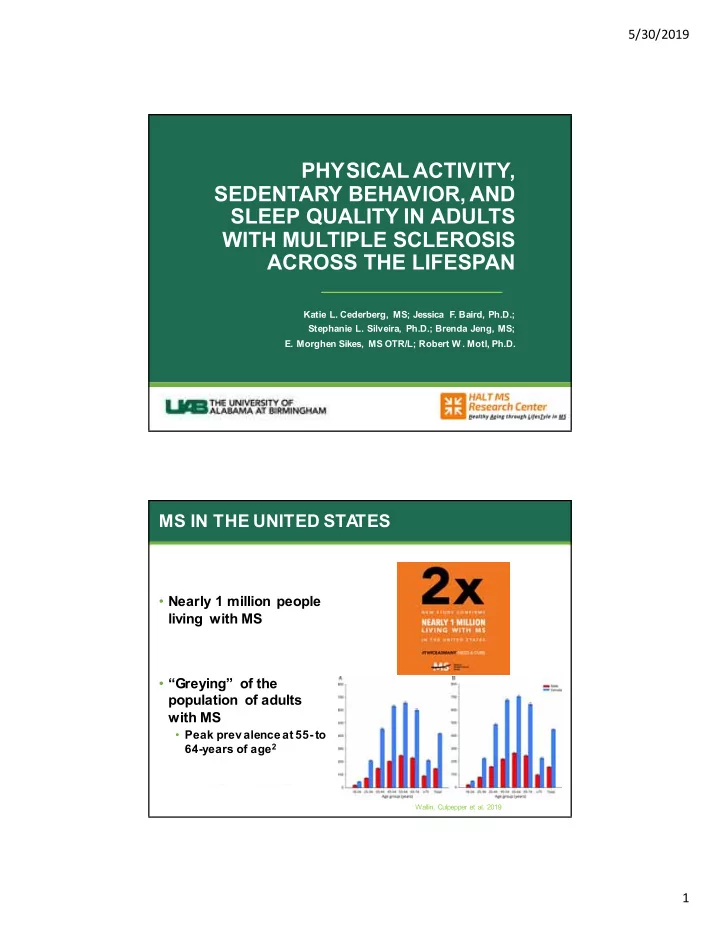
PHYSICAL ACTIVITY, SEDENTARY BEHAVIOR, AND SLEEP QUALITY IN ADULTS - - PDF document

physical activity sedentary behavior and sleep quality in
SMART_READER_LITE
LIVE PREVIEW

PHYSICAL ACTIVITY, SEDENTARY BEHAVIOR, AND SLEEP QUALITY IN ADULTS - - PDF document

5/30/2019 PHYSICAL ACTIVITY, SEDENTARY BEHAVIOR, AND SLEEP QUALITY IN ADULTS WITH MULTIPLE SCLEROSIS ACROSS THE LIFESPAN Katie L. Cederberg, MS; Jessica F. Baird, Ph.D.; Stephanie L. Silveira, Ph.D.; Brenda Jeng, MS; E. Morghen Sikes, MS


slide-1
SLIDE 1

5/30/2019 1

PHYSICAL ACTIVITY, SEDENTARY BEHAVIOR, AND SLEEP QUALITY IN ADULTS WITH MULTIPLE SCLEROSIS ACROSS THE LIFESPAN

Katie L. Cederberg, MS; Jessica F. Baird, Ph.D.; Stephanie L. Silveira, Ph.D.; Brenda Jeng, MS;

  • E. Morghen Sikes, MS OTR/L; Robert W . Motl, Ph.D.

MS IN THE UNITED STA TES

  • Nearly 1 million people

living with MS

  • “Greying” of the

population of adults with MS

  • Peak prevalence at 55- to

64-years of age2

Wallin, Culpepper et al. 2019

slide-2
SLIDE 2

5/30/2019 2

SLEEP IN MS

  • Fourfold increase in the prevalence of sleep problems in

persons with MS1

  • 60% of persons with MS report sleep abnormalities1
  • Reduced sleep quality may worsen other symptoms and

consequences of MS

  • Cognitive function, depression, perception of pain, fatigue,

quality of life2

  • Sleep quality may impaired in older adults with MS3
  • 1. Sakkas, Giannaki et al. 2019; 2. Attarian 2019; 3. Garland, Scurrey et al. 2017

PHYSICAL ACTIVITY FOR MANAGING SLEEP

Physical activity (PA) may directly or indirectly benefit sleep in MS

  • Higher levels of PA

are associated with better sleep quality in older women who were postmenopausal1

  • Increases in PA

improves many symptoms and consequences of MS

  • Depression, anxiety, pain, fatigue

2-3

  • 1. Creasy et al 2019; 2. Motl 2014; 3. Motl and Sandroff 2015
slide-3
SLIDE 3

5/30/2019 3

SEDENTARY BEHA VIOR

  • 1. Sasaki, Motl et al. 2018; 2. Kakinami et al 2016
  • Sedentary behavior is very prevalent in MS1
  • Higher levels of sedentary behavior associated

with poorer sleep quality in young adults2 The rate and distribution of PA and sedentary behavior might be associated sleep quality in persons with MS across the lifespan

PRESENT STUDY

Purpose

Examined associations among physical activity, sedentary behavior, and sleep quality among adults with MS across the lifespan

Hypotheses

Sleep quality in older adults PA in older adults PA associated with sleep quality Sedentary behavior associated with sleep quality

slide-4
SLIDE 4

5/30/2019 4

PARTICIPANTS

  • Inclusion Criteria

a) Between ages of 20-79 b) Ambulatory with or without assistance c) Relapse free for at least 30 days

  • Assessed for Eligibility: 279
  • Enrolled: 192
  • Completed: 122
  • Y
  • ung Adults (ages 20-39)
  • Middle-aged Adults (ages 40-59)
  • Older Adults (ages 60-79)

MEASURES

  • Physical Activity/Sedentary Behavior
  • Participants wore an ActiGraph GT3X+

accelerometer during waking hours for a 7- day period (min/day)

  • Troiano (2007) algorithm for estimating w

ear time

  • Valid day

= 10 hours (i.e., 600 min)

  • Cut-point for MVP

A = 1,584 counts/minute and 1

  • Cut-point for LP

A vs sedentary behavior = 100 counts/minute 1

  • Disability Status
  • Patient Determined Disease Steps (PDDS)2
  • Ranging betw

een 0 (normal) and 8 (bedridden)

  • 1. Sandroff, Motl et al. 2012; 2. Hohol, Orav et al. 1995, Hohol, Orav et al. 1999
slide-5
SLIDE 5

5/30/2019 5

MEASURES

Sleep Quality

  • Pittsburgh Sleep Quality Index (PSQI)1
  • 7 Component Scores ranging between 0 (not during past month)

and 3 (three or more times a week)

1. Subjective Sleep Quality 2. Sleep Latency 3. Sleep Duration 4. Habitual Sleep Efficiency 5. Frequency

  • f Sleep Disturbance

6. Frequency

  • f Sleep Medication Use

7. Day time Dy sfunction

  • Scores are summed into Global Sleep Quality Score
  • Range betw

een 0 and 21 (higher = w

  • rse sleep quality

)

  • PSQI greater than 5 = “poor sleeper” 1
  • 1. Buysse, Reynolds et al. 1989

PROCEDURE

  • IRB approval and written informed consent
  • Single session in a laboratory setting
  • Measures of sleep quality and disability status
  • Provided accelerometer and instructions
  • Returned via USPS
  • Participants were compensated for completing all

measures and returning the accelerometer

slide-6
SLIDE 6

5/30/2019 6

STA TISTICAL ANALYSES

  • SPSS Statistics, Version 25
  • Descriptive Statistics as mean and standard deviation (SD),

unless otherwise noted (e.g., median and interquartile range [IQR] or number and percentage).

  • One-way Analysis of Variance (ANOVA) or Chi-square analysis

for differences among groups.

  • Spearman rho correlation analysis (ρ) for associations among

PA, sedentary behavior, and sleep quality

  • Correlation coefficients of 0.1, 0.3, and 0.5 were interpreted as small,

moderate, and large, respectively1

  • 1. Cohen 1988

Young Adults (n = 37) Middle-aged Adults (n = 45) Older Adults (n = 40)

P

Age (y ears)

33.2 (4.9) 49.4 (5.9) 66.0 (4.2) 0.000abc

Sex (n (%))

29 (78) F / 8 (22) M 32 (71) F / 13 (29) M 30 (75) F / 10 (25) M 0.752+

MS Ty pe (n (%))

0.882+

Relapsing Remitting

32 (87) 38 (84) 34 (85)

Secondary Progressive

2 (5) 2 (4) 3 (8)

Primary Progressive

1 (3) 3 (7) 1 (3)

Benign

0 (0.0) 1 (2) 1 (3)

Disease Duration (y r)

6.0 (5.3) 11.6 (6.3) 21.7 (10.1) 0.000abc

PDDS (median (IQR))

0.0 (2.5) 1.0 (3.0) 2.0 (4.0) 0.040b

a Difference between young and middle; b Difference between young and older; c Difference between middle and older; + Chi Square Test. MS multiple sclerosis; PDDS Patient Determined Disease Status; IQR interquartile range.

RESULTS: SAMPLE CHARACTERISTICS

slide-7
SLIDE 7

5/30/2019 7 RESULTS: SLEEP , PA, AND SEDENTARY BEHAVIOR

Y

  • ung

A dults (n = 37) Middle-aged A dults (n = 45) Older A dults (n = 40) P

Average W ear Time (min/day ) 824.7 (102.9) 822.9 (84.2) 798.3 (107.3) 0.407 MVP A (min/day ) 22.9 (16.1) 25.0 (22.8) 12.8 (16.0) 0.008bc LP A (min/day ) 316.1 (101.7) 301.0 (75.7) 299.2 (93.5) 0.668 Sedentary Behavior (min/day ) 485.7 (108.0) 496.8 (86.6) 486.4 (96.0) 0.838 PSQI Global Score 7.4 (3.6) 8.1 (4.1) 8.8 (4.1) 0.288 Poor Sleepers (n (%)) 28 (76%) 36 (80%) 34 (85%) 0.588+

a Difference between young and middle; b Difference between young and older; c Difference between middle and older; + Chi Square Test. MS multiple sclerosis; PSQI Pittsburgh Sleep Quality Index; LPA light physical activity; MVPA

moderate-to-vigorous physical activity.

RESULTS: CORRELA TION ANALYSIS

Global PSQI Y

  • ung Adults

(n = 37) MVP A

  • 0.194

LP A 0.029 Sedentary Behavior

  • 0.075

Middle-aged Adults (n = 45) MVP A

  • 0.134

LP A 0.030 Sedentary Behavior

  • 0.204

Older Adults (n = 40) MVP A 0.241 LP A 0.114 Sedentary Behavior

  • 0.025
slide-8
SLIDE 8

5/30/2019 8

RESULTS: CORRELA TION ANALYSES

MVPA LPA Sedentary Behavior

Y

  • ung

A dults Middle- A ged A dults Older A dults

PSQI PSQI PSQI

DISCUSSION

This is the first study to examine the relationship among physical activity, sedentary behavior, and sleep quality across the lifespan in adults with MS

  • No significant differences among age groups for global

sleep quality

  • No evidence for associations among sleep, PA, or

sedentary behavior in any age group

slide-9
SLIDE 9

5/30/2019 9

DISCUSSION

  • Older adults spent less time in MVPA

compared with young and middle-aged adults

  • MVPA

may influence other symptoms and consequences of MS in this age group

DISCUSSION

  • Significantly increased physical activity following a 6-month

behavioral intervention

  • Significant improvements in MS-related symptoms (i.e., fatigue,

depression, anxiety)

  • Nonsignificant improvements in sleep quality (p = 0.06)

Improvements in MS-related symptoms with PA may indirectly benefit sleep quality

slide-10
SLIDE 10

5/30/2019 10

LIMITA TIONS

  • Cross-sectional design
  • Did not include non-MS control group
  • Single measure of sleep: self-report in nature
  • Our sample included a high percentage of poor sleepers
  • Primarily RRMS (72%)

CONCLUSIONS

  • There were no apparent relationships among PA,

sedentary behavior, or sleep quality in our sample of adults with MS across the lifespan

  • Future research should further evaluate the

relationships among PA, sedentary behavior and sleep using different, multifaceted approaches that may improve sleep quality among adults with MS

slide-11
SLIDE 11

5/30/2019 11

THANK YOU