PHP Arrays Arrays in PHP are quite versa1le See - - PowerPoint PPT Presentation

php arrays
SMART_READER_LITE
LIVE PREVIEW

PHP Arrays Arrays in PHP are quite versa1le See - - PowerPoint PPT Presentation

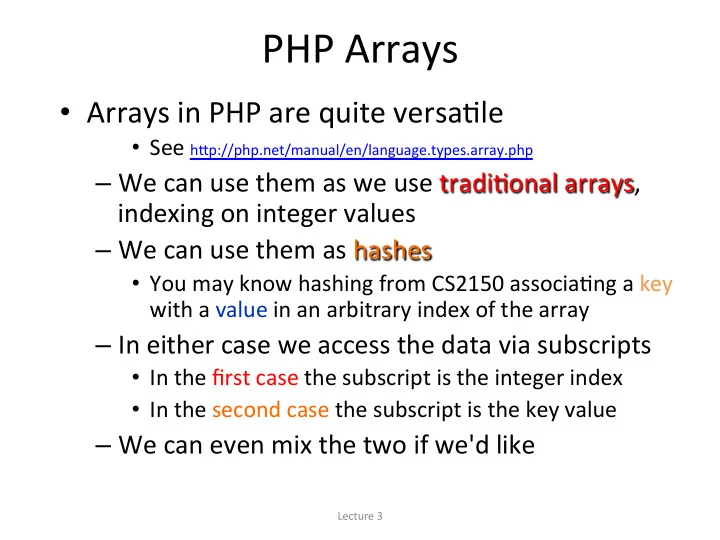
PHP Arrays Arrays in PHP are quite versa1le See h5p://php.net/manual/en/language.types.array.php We can use them as we use tradi1onal arrays, indexing


slide-1
SLIDE 1

1 ¡

PHP ¡Arrays ¡

  • Arrays ¡in ¡PHP ¡are ¡quite ¡versa1le ¡
  • See ¡h5p://php.net/manual/en/language.types.array.php ¡ ¡

– We ¡can ¡use ¡them ¡as ¡we ¡use ¡tradi1onal ¡arrays, ¡ indexing ¡on ¡integer ¡values ¡ – We ¡can ¡use ¡them ¡as ¡hashes ¡ ¡

  • You ¡may ¡know ¡hashing ¡from ¡CS2150 ¡associa1ng ¡a ¡key ¡

with ¡a ¡value ¡in ¡an ¡arbitrary ¡index ¡of ¡the ¡array ¡

– In ¡either ¡case ¡we ¡access ¡the ¡data ¡via ¡subscripts ¡

  • In ¡the ¡first ¡case ¡the ¡subscript ¡is ¡the ¡integer ¡index ¡
  • In ¡the ¡second ¡case ¡the ¡subscript ¡is ¡the ¡key ¡value ¡

– We ¡can ¡even ¡mix ¡the ¡two ¡if ¡we'd ¡like ¡

Lecture ¡3 ¡

slide-2
SLIDE 2

2 ¡

PHP ¡Arrays ¡

  • Crea1ng ¡Arrays ¡

– PHP ¡Arrays ¡can ¡be ¡created ¡in ¡a ¡number ¡of ¡ways ¡

  • Explicitly ¡using ¡the ¡array() ¡construct ¡
  • Implicitly ¡by ¡indexing ¡a ¡variable ¡

– Since ¡PHP ¡has ¡dynamic ¡typing, ¡you ¡cannot ¡iden1fy ¡a ¡ variable ¡as ¡an ¡array ¡except ¡by ¡assigning ¡an ¡actual ¡ array ¡to ¡it ¡ – If ¡the ¡variable ¡is ¡already ¡set ¡to ¡a ¡string, ¡indexing ¡will ¡ have ¡undesirable ¡results ¡– ¡indexes ¡the ¡string! ¡ – However, ¡we ¡can ¡unset() ¡it ¡and ¡then ¡index ¡it ¡ » We ¡can ¡test ¡a ¡variable ¡to ¡see ¡if ¡it ¡is ¡set ¡(isset() ¡

and ¡if ¡it ¡is ¡an ¡array ¡(is_array()) ¡among ¡other ¡things ¡

  • Size ¡will ¡increase ¡dynamically ¡as ¡needed ¡

Lecture ¡3 ¡

slide-3
SLIDE 3

3 ¡

More ¡on ¡PHP ¡Arrays ¡

  • Accessing ¡Arrays ¡– ¡can ¡be ¡done ¡in ¡many ¡ways ¡

– We ¡can ¡use ¡direct ¡access ¡to ¡obtain ¡a ¡desired ¡item ¡

  • Good ¡if ¡we ¡are ¡using ¡the ¡array ¡as ¡a ¡hash ¡table ¡or ¡if ¡we ¡

need ¡direct ¡access ¡for ¡some ¡other ¡reason ¡

  • We ¡provide ¡the ¡key ¡and ¡retrieve ¡the ¡value ¡

– For ¡sequen-al ¡access, ¡the ¡foreach ¡loop ¡was ¡ designed ¡to ¡work ¡with ¡arrays ¡

  • Iterates ¡through ¡the ¡items ¡in ¡two ¡different ¡ways ¡

foreach ($arrayvar as $key => $value) » Gives ¡both ¡the ¡key ¡and ¡value ¡at ¡each ¡itera1on ¡ foreach ($arrayvar as $value) » Gives ¡just ¡the ¡next ¡value ¡at ¡each ¡itera1on ¡

Lecture ¡3 ¡

slide-4
SLIDE 4

4 ¡

PHP ¡Arrays ¡

  • How ¡can ¡these ¡both ¡be ¡done ¡efficiently? ¡

– PHP ¡arrays ¡are ¡not ¡implemented ¡in ¡the ¡tradi1onal ¡way ¡

  • Ex: ¡In ¡Java ¡or ¡C++ ¡the ¡array ¡is ¡a ¡con1guous ¡collec1on ¡of ¡

memory ¡loca1ons ¡

– PHP ¡arrays ¡more ¡resemble ¡a ¡linked ¡list ¡But ¡wouldn't ¡ this ¡not ¡allow ¡direct ¡access? ¡ – The ¡loca1ons ¡are ¡also ¡hashed ¡

  • The ¡"key" ¡in ¡PHP ¡arrays ¡is ¡actually ¡a ¡hash ¡value ¡

– So ¡sequen1al ¡access ¡follows ¡the ¡linked ¡list ¡ – Direct ¡access ¡accesses ¡via ¡the ¡hash ¡value ¡

Lecture ¡3 ¡

slide-5
SLIDE 5

Lecture ¡3 ¡ 5 ¡

( ¡Figure ¡9.3 ¡in ¡Sebesta ¡text) ¡

slide-6
SLIDE 6

44 ¡

More ¡on ¡PHP ¡Arrays ¡

  • Be ¡careful ¡– ¡itera1on ¡via ¡foreach ¡is ¡in ¡the ¡order ¡

the ¡data ¡has ¡been ¡generated, ¡not ¡by ¡index ¡

  • rder ¡

– i.e. ¡it ¡follows ¡the ¡linked ¡list ¡

– Thus, ¡even ¡arrays ¡with ¡iden1cal ¡keys ¡and ¡values ¡can ¡have ¡ different ¡orderings ¡

– Items ¡accessed ¡in ¡the ¡arrays ¡using ¡foreach ¡are ¡ copies ¡of ¡the ¡data, ¡not ¡references ¡to ¡the ¡data ¡

– So ¡changing ¡the ¡loop ¡control ¡variable ¡in ¡the ¡foreach ¡loop ¡in ¡ PHP ¡does ¡NOT ¡change ¡the ¡data ¡in ¡the ¡original ¡array ¡ – To ¡do ¡this ¡we ¡must ¡change ¡the ¡value ¡using ¡indexing ¡

– A ¡regular ¡for ¡loop ¡can ¡also ¡be ¡used, ¡but ¡due ¡to ¡the ¡ non-­‑sequen1al ¡requirement ¡for ¡keys, ¡this ¡does ¡not ¡

  • ien ¡give ¡the ¡best ¡results ¡

Lecture ¡3 ¡

slide-7
SLIDE 7

7 ¡

More ¡on ¡PHP ¡Arrays ¡

  • The ¡data ¡in ¡the ¡array ¡is ¡not ¡con1guous, ¡so ¡

incremen1ng ¡a ¡counter ¡for ¡the ¡next ¡access ¡will ¡not ¡ work ¡correctly ¡unless ¡the ¡array ¡index ¡values ¡are ¡ used ¡in ¡the ¡"tradi1onal" ¡way ¡

for (int $i = 0; $i < count($A); $i++): echo “$A[$i] <br/>”; endfor;

– We ¡know ¡that ¡there ¡are ¡count($A) ¡items ¡in ¡$A ¡

  • What ¡we ¡do ¡NOT ¡know, ¡is ¡under ¡which ¡indices ¡they ¡are ¡being ¡

stored ¡

– There ¡is ¡no ¡requirement ¡that ¡they ¡have ¡to ¡start ¡at ¡0 ¡or ¡even ¡be ¡ integers ¡at ¡all ¡

  • See ¡ex7.php ¡

Lecture ¡3 ¡

slide-8
SLIDE 8

More ¡on ¡PHP ¡Arrays ¡

  • In ¡addi1on ¡to ¡foreach, ¡we ¡there ¡are ¡other ¡

array ¡iterators ¡that ¡we ¡can ¡use ¡

– Ex: ¡Using ¡next ¡to ¡access ¡the ¡array ¡elements ¡

  • The ¡next() ¡func1on ¡gives ¡us ¡the ¡next ¡value ¡in ¡the ¡array ¡

with ¡each ¡call; ¡end ¡of ¡list ¡returns ¡false ¡

– It ¡moves ¡to ¡the ¡next ¡item, ¡then ¡returns ¡it, ¡so ¡we ¡must ¡get ¡the ¡ first ¡item ¡with ¡a ¡separate ¡call ¡(ex: ¡use ¡current()) ¡

$curr = current($a1); while ($curr): echo "\$curr is $curr <br/>\n"; $curr = next($a1); endwhile;

8 ¡

Lecture ¡3 ¡

slide-9
SLIDE 9

9 ¡

More ¡on ¡PHP ¡Arrays ¡

  • Ex: ¡Using ¡each ¡to ¡iterate: ¡

– The ¡each() ¡func1on ¡returns ¡a ¡pair ¡with ¡each ¡call ¡

  • A ¡key ¡field ¡for ¡the ¡current ¡key ¡
  • A ¡value ¡field ¡for ¡the ¡current ¡value ¡
  • It ¡returns ¡the ¡next ¡(key,value) ¡pair, ¡then ¡moves, ¡so ¡the ¡first ¡

item ¡is ¡no ¡longer ¡a ¡special ¡case

while ($curr = each($a1)): $k = $curr["key"]; $v = $curr["value"]; echo "key is $k and value is $v <BR />\n"; endwhile;

  • This ¡func1on ¡may ¡be ¡preferable ¡to ¡next() ¡if ¡it ¡is ¡possible ¡that ¡

FALSE ¡or ¡an ¡empty ¡string ¡or ¡0 ¡could ¡be ¡in ¡the ¡array ¡

– The ¡loop ¡on ¡the ¡previous ¡slide ¡will ¡stop ¡for ¡any ¡of ¡those ¡values ¡

Lecture ¡3 ¡

slide-10
SLIDE 10

10 ¡

More ¡on ¡PHP ¡Arrays ¡

  • Both ¡of ¡these ¡itera1on ¡func1ons ¡operate ¡similar ¡

to ¡the ¡Iterator ¡interface ¡in ¡Java ¡

– Iterate ¡through ¡the ¡data ¡in ¡the ¡collec1on ¡without ¡ requiring ¡us ¡to ¡know ¡how ¡that ¡data ¡is ¡actually ¡

  • rganized ¡

– However, ¡unlike ¡in ¡Java, ¡if ¡the ¡array ¡is ¡changed ¡during ¡ the ¡itera1on ¡process, ¡the ¡current ¡itera1on ¡is ¡NOT ¡ invalidated ¡

  • Since ¡new ¡items ¡are ¡always ¡added ¡at ¡the ¡"end" ¡of ¡the ¡array ¡

(from ¡an ¡iterator’s ¡point ¡of ¡view) ¡adding ¡a ¡new ¡item ¡during ¡ an ¡itera1on ¡does ¡not ¡cause ¡any ¡data ¡validity ¡problems ¡

  • However, ¡we ¡need ¡to ¡be ¡careful ¡if ¡doing ¡this ¡– ¡can ¡lead ¡to ¡an ¡

infinite ¡itera1on ¡

Lecture ¡3 ¡

slide-11
SLIDE 11

11 ¡

Sor1ng ¡PHP ¡Arrays ¡

  • There ¡are ¡various ¡predefined ¡sort ¡func1ons ¡

in ¡PHP ¡

– sort ¡(rsort ¡for ¡reverse) ¡

  • Sorts ¡arrays ¡of ¡numbers ¡numerically ¡
  • Sorts ¡arrays ¡of ¡strings ¡alphabe1cally ¡
  • If ¡mixed, ¡the ¡strings ¡count ¡as ¡0 ¡compared ¡to ¡numbers ¡
  • Reindexes ¡array ¡so ¡that ¡keys ¡start ¡at ¡0 ¡and ¡increment ¡

from ¡there ¡

– asort ¡

  • Same ¡as ¡sort ¡but ¡retains ¡the ¡original ¡key ¡values ¡

(arsort ¡for ¡reverse) ¡

Lecture ¡3 ¡

slide-12
SLIDE 12

Sor1ng ¡PHP ¡Arrays ¡

  • PHP ¡uses ¡Quicksort ¡to ¡sort ¡arrays ¡

– This ¡means ¡that ¡PHP ¡sor1ng ¡is ¡NOT ¡STABLE ¡ – What ¡does ¡it ¡mean ¡for ¡a ¡sort ¡to ¡be ¡STABLE? ¡

  • Given ¡equal ¡keys ¡K1 ¡and ¡K2, ¡their ¡rela1ve ¡order ¡before ¡and ¡

aier ¡the ¡sort ¡will ¡be ¡the ¡same ¡

– Due ¡to ¡data ¡movement ¡during ¡par11on, ¡Quicksort ¡is ¡ not ¡stable ¡

  • Implica1ons? ¡
  • If ¡we ¡want ¡stability, ¡we ¡will ¡have ¡to ¡do ¡it ¡ourselves ¡

– See ¡Web ¡for ¡some ¡solu1ons ¡

– See ¡ex8.php ¡

12 ¡

Lecture ¡3 ¡

slide-13
SLIDE 13

13 ¡

Two-­‑dimensional ¡Arrays ¡

  • Array ¡values ¡can ¡be ¡any ¡legal ¡PHP ¡type ¡

– This ¡includes ¡the ¡array ¡type, ¡and ¡allows ¡for ¡ arbitrary ¡dimensional ¡arrays ¡ – We ¡may ¡think ¡of ¡them ¡as ¡"arrays ¡of ¡arrays" ¡ – It ¡seems ¡odd ¡but ¡once ¡you ¡know ¡the ¡array ¡syntax ¡ it ¡follows ¡quite ¡naturally ¡

$a[0] ¡= ¡array(1,2,3,4); ¡ $a[1] ¡= ¡array(5,6,7,8); ¡ $a[2] ¡= ¡array(9,10,11,12); ¡

Lecture ¡3 ¡

slide-14
SLIDE 14

14 ¡

Two-­‑dimensional ¡Arrays ¡

  • In ¡fact ¡Java ¡2-­‑D ¡arrays ¡are ¡implemented ¡in ¡a ¡

similar ¡way ¡

– Although ¡in ¡Java ¡they ¡must ¡be ¡homogeneous ¡ – We ¡can ¡also ¡use ¡"normal" ¡indexing ¡for ¡2-­‑D ¡PHP ¡arrays ¡

  • Keep ¡in ¡mind ¡that ¡the ¡key ¡values ¡are ¡s1ll ¡arbitrary, ¡so ¡we ¡

need ¡to ¡be ¡careful ¡

  • The ¡standard ¡nested ¡i, ¡j ¡loops ¡that ¡work ¡in ¡Java ¡and ¡C++ ¡may ¡

not ¡be ¡appropriate ¡here ¡

– They ¡will ¡only ¡work ¡if ¡we ¡use ¡the ¡arrays ¡in ¡the ¡"normal" ¡way ¡ consistently ¡

  • More ¡general ¡access ¡can ¡be ¡done ¡via ¡iterators ¡or ¡recursive ¡

func1ons ¡– ¡we ¡will ¡see ¡this ¡soon ¡

  • See ¡ex9.php ¡

Lecture ¡3 ¡

slide-15
SLIDE 15

15 ¡

Func1ons ¡and ¡Parameters ¡

  • General ¡syntax: ¡

function name ( params ) { // statements // optional return statement }

– Parameters ¡are ¡op1onal ¡ – Note ¡that ¡there ¡is ¡no ¡return ¡type ¡in ¡the ¡header ¡

  • If ¡no ¡return ¡statement ¡is ¡used, ¡the ¡func1on ¡will ¡return ¡

NULL ¡

  • If ¡return ¡is ¡done, ¡type ¡could ¡be ¡anything ¡

– Cannot ¡overload ¡func1on ¡names ¡

  • Dynamic ¡typing ¡does ¡not ¡allow ¡for ¡disambigua1on ¡

Lecture ¡3 ¡

slide-16
SLIDE 16

16 ¡

Func1ons ¡and ¡Parameters ¡

– By ¡default, ¡parameters ¡are ¡passed ¡by ¡value ¡

  • Formal ¡parameter ¡is ¡a ¡copy ¡of ¡the ¡actual ¡parameter ¡
  • Changes ¡to ¡formal ¡parameter ¡do ¡not ¡affect ¡the ¡actual ¡

parameter ¡

– If ¡we ¡add ¡an ¡ampersand ¡before ¡the ¡formal ¡ parameter, ¡we ¡change ¡it ¡to ¡pass ¡by ¡reference ¡

  • Like ¡in ¡C++, ¡but ¡not ¡an ¡op1on ¡in ¡Java ¡
  • Formal ¡parameter ¡is ¡another ¡name ¡for ¡the ¡actual ¡

parameter ¡

  • Changes ¡to ¡the ¡formal ¡parameter ¡also ¡change ¡the ¡

actual ¡parameter ¡

Lecture ¡3 ¡

slide-17
SLIDE 17

17 ¡

Value ¡vs. ¡Reference ¡Parameters ¡

  • Let's ¡discuss ¡this ¡a ¡bit ¡

– Java ¡has ¡only ¡value ¡parameters ¡

  • This ¡means ¡we ¡cannot ¡alter ¡the ¡data ¡stored ¡in ¡the ¡

actual ¡parameter ¡within ¡the ¡func1on ¡

  • However, ¡in ¡many ¡cases ¡the ¡data ¡passed ¡into ¡the ¡

func1on ¡is ¡itself ¡a ¡reference ¡

– This ¡allows ¡us ¡to ¡change ¡the ¡object ¡that ¡the ¡reference ¡refers ¡ to, ¡but ¡we ¡cannot ¡reassign ¡the ¡reference ¡to ¡a ¡new ¡object ¡

X ¡ data ¡in ¡object ¡

can ¡change ¡ this ¡ (mutate) ¡ reference ¡

cannot ¡change ¡ this ¡

Lecture ¡3 ¡

slide-18
SLIDE 18

18 ¡

Value ¡vs. ¡Reference ¡Parameters ¡

– Reference ¡parameters ¡allow ¡the ¡data ¡in ¡the ¡object ¡ to ¡be ¡changed ¡

  • Assuming ¡the ¡parameter ¡is ¡a ¡reference ¡to ¡an ¡object ¡

– They ¡also ¡allow ¡the ¡reference ¡to ¡be ¡reassigned ¡so ¡ that ¡the ¡actual ¡parameter ¡can ¡reference ¡a ¡ different ¡object ¡

X ¡

  • ld ¡
  • bject ¡

can ¡change ¡ this ¡ (mutate) ¡ reference ¡

can ¡also ¡be ¡ reassigned ¡

new ¡

  • bject ¡

Lecture ¡3 ¡

slide-19
SLIDE 19

Value ¡vs. ¡Reference ¡Parameters ¡

– Implica1ons: ¡

  • In ¡Java ¡we ¡can ¡alter ¡objects, ¡including ¡the ¡contents ¡of ¡

arrays, ¡via ¡parameters ¡

– However, ¡the ¡argument ¡itself ¡(either ¡a ¡primi1ve ¡value ¡or ¡a ¡ reference) ¡cannot ¡change ¡ – If ¡we ¡want ¡to ¡reassign ¡a ¡variable ¡within ¡a ¡method ¡what ¡can ¡we ¡ do? ¡ » Use ¡instance ¡variables ¡ » Pass ¡them ¡in ¡via ¡an ¡array ¡(i.e. ¡hack) ¡

  • In ¡PHP ¡we ¡CAN ¡reassign ¡a ¡reference ¡with ¡a ¡func1on ¡if ¡

we ¡want ¡

– Be ¡careful ¡if ¡you ¡choose ¡to ¡do ¡this ¡ » Avoid ¡inadvertent ¡changes ¡to ¡arguments ¡

19 ¡

Lecture ¡3 ¡

slide-20
SLIDE 20

20 ¡

Func1ons ¡and ¡Parameters ¡

– Variables ¡within ¡func1ons ¡by ¡default ¡are ¡local ¡to ¡ the ¡func1on ¡

  • Like ¡method ¡variables ¡in ¡Java ¡or ¡automa1c ¡variables ¡in ¡

C++ ¡

  • We ¡can ¡use ¡the ¡global ¡declara1on ¡to ¡state ¡that ¡a ¡

variable ¡used ¡in ¡a ¡func1on ¡is ¡a ¡global ¡rather ¡than ¡a ¡local ¡ variable ¡

– See ¡ex10.php ¡ ¡

Lecture ¡3 ¡