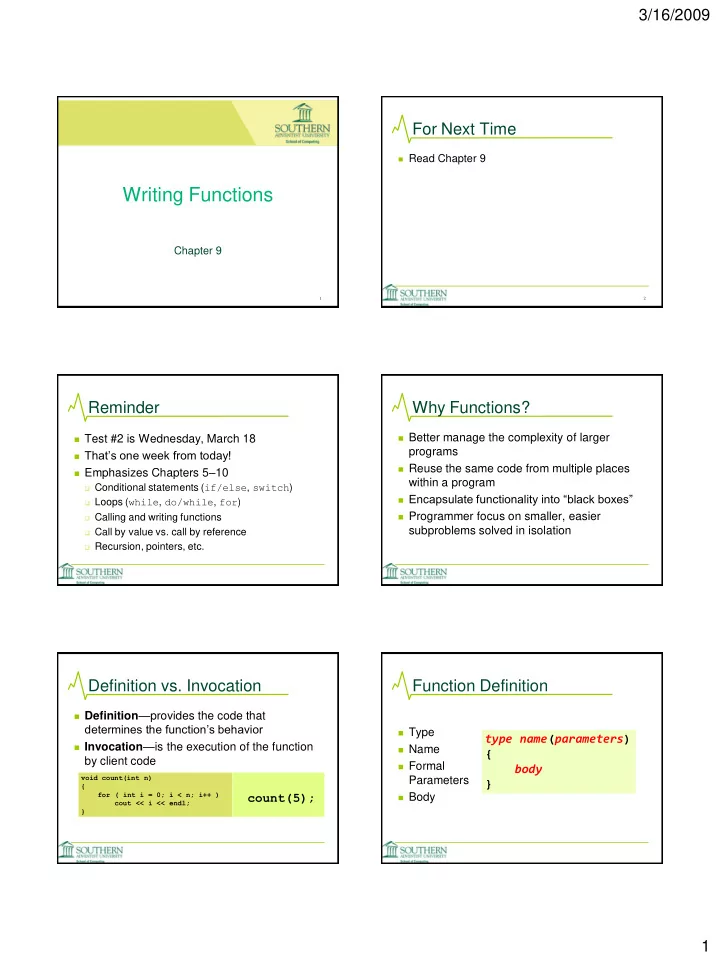
Writing Functions Chapter 9 1 2 Reminder Why Functions? Better - - PDF document

writing functions
SMART_READER_LITE
LIVE PREVIEW

Writing Functions Chapter 9 1 2 Reminder Why Functions? Better - - PDF document

3/16/2009 For Next Time Read Chapter 9 Writing Functions Chapter 9 1 2 Reminder Why Functions? Better manage the complexity of larger Test #2 is Wednesday, March 18 programs Thats one week from today! Reuse the same


slide-1
SLIDE 1

3/16/2009 1

1

Writing Functions

Chapter 9

2

For Next Time

 Read Chapter 9

Reminder

 Test #2 is Wednesday, March 18  That’s one week from today!  Emphasizes Chapters 5–10

 Conditional statements (if/else, switch)  Loops (while, do/while, for)  Calling and writing functions  Call by value vs. call by reference  Recursion, pointers, etc.

Why Functions?

 Better manage the complexity of larger

programs

 Reuse the same code from multiple places

within a program

 Encapsulate functionality into ―black boxes‖  Programmer focus on smaller, easier

subproblems solved in isolation

Definition vs. Invocation

 Definition—provides the code that

determines the function’s behavior

 Invocation—is the execution of the function

by client code

void count(int n) { for ( int i = 0; i < n; i++ ) cout << i << endl; }

count(5);

Function Definition

 Type  Name  Formal

Parameters

 Body

type name(parameters) { body }

slide-2
SLIDE 2

3/16/2009 2 Function Type

 Type can be any

C++ type plus void

 The void type

means the function does not return a value to the client

type name(parameters)

{ body }

Function Name

 An identifier  Should accurately

describe the purpose

  • f the function

type name(parameters) { body }

Function Parameters

 Comma-

separated list of parameter declarations

 May be

empty

type name(parameters) { body }

Function Parameters

 List of statements

the function is to execute

 May declare its own

local variables

type name(parameters) {

body

}

Function Parameters

 Formal parameters

 Parameters in the function definition

 Actual parameters

 Parameters (or arguments) provided by the

client

 May be variables, literal values, constants,

and expressions

Call by Value

 Actual parameters are assigned to the formal

parameters when the client calls the function

 This assignment is performed automatically and

does not appear in your code

 Since the function works on copies of the

actual parameters, the function cannot directly affect the actual parameters

 A variable local to the client may be modified

via the function’s return type

slide-3
SLIDE 3

3/16/2009 3 Local Variables

 Variables declared within a function are local

to that function

 Local variables are not visible to code outside

that function definition

 The name of a local variable can be the same

as the name of a local variable in another function—they are different variables

 Formal parameters are local to function

definitions

Function Documentation

 Essential information

 Purpose  Role of each parameter  Nature of return value

 Other helpful information

 Author  Date  References

15

Next . . .

More on functions