Photospheric thermal radiation from GRB collapsar jets 1.Gamma-ray - - PowerPoint PPT Presentation

photospheric thermal radiation from grb collapsar jets
SMART_READER_LITE
LIVE PREVIEW

Photospheric thermal radiation from GRB collapsar jets 1.Gamma-ray - - PowerPoint PPT Presentation

Photospheric thermal radiation from GRB collapsar jets 1.Gamma-ray burst (GRB) Akira MIZUTA(KEK) 2.Model 3.Hydrodynamics AM, Nagataki, Aoi 4.Thermal radiation (ApJ, 732 26, 2011) Light curve, spectrum, 5.Amati relation AM, Nagataki, Ioka


slide-1
SLIDE 1

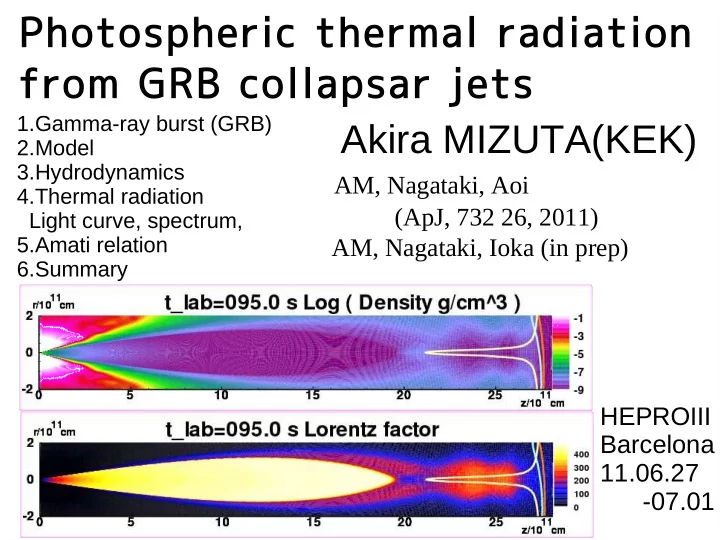
Photospheric thermal radiation from GRB collapsar jets

Akira MIZUTA(KEK) AM, Nagataki, Aoi

(ApJ, 732 26, 2011) AM, Nagataki, Ioka (in prep)

1.Gamma-ray burst (GRB) 2.Model 3.Hydrodynamics 4.Thermal radiation Light curve, spectrum, 5.Amati relation 6.Summary

HEPROIII Barcelona 11.06.27

  • 07.01
slide-2
SLIDE 2

Long GRB-SN connection

Association long duration GRB-SN is

  • bserved.
  • ex. GRB980425/SN1998bw,

GRB030329/SN2003dh XRF060218/SN2006aj. GRB091127/SN2009nz XRF100316D/SN2010bh The explosion energy of most SN-GRB is 10 times higher than that

  • f normal Sne (HyprenovaeE=1052erg)

power law : afterglow SN component appears

Spectrum :after a few days ~ after a month from the burst

time

Progenitor mass Explosion energy

λ(A)

Mazzali et al. (2006)

slide-3
SLIDE 3

GRB090902B Ryde et al (2010) thermal component was found.

Spectrum of GRB prompt emission Band function: Broken power-law

α~-1

Band function Band et al.(1993)

β~ -2.3

Briggs et al. (1999)

ν

ν3

ν-0.5

Plankian

How can the photospheric thermal radiation be seen ? light curve, spectrum viewing angle effect

  • -jet like explosion

Non-thermal radiation is expected. There is no theoretical model to explain the index for low energy band.

slide-4
SLIDE 4

Method : Hydrodynamics

Model

Jet : t [0:100s] Power: 5.5x1050 erg/s Lorentz factor :Γ0 = 5 specific internal energy : ε0/c2=80 half opening angle : θ0= 10/ 5 degrees Very low density wind ρ r ∝

  • 2

Progenitor surface

Radial mass profile

Progenitor: Model 16TI Woosley & Heger (2006) 14 solar mass at pre-SN stage. Radius:4x1010cm Outside progenitor: Wind like distribution ρ r ∝

  • 2

very low density : optically thin Computational Domain : 2D (r x θ) spherical (109cm<r<3x1013cm 0<θ<π/2) (c.f. jet formation ~10^7cm

equatorial plane symmetry

2D-relativistic hydrodynamic code(constant specific heat ratio=4/3) approximate Riemann solver, 2nd order accuracy in space & time Mizuta et al. (2004,2006)

1.e12 r (cm) 1.e11 1.e10 1.e9

Log ρ

slide-5
SLIDE 5

movie

slide-6
SLIDE 6

internal shocks Backflow

Interaction between jet and progenitor envelopes. High pressure cocoon confinement and a bent backflow enhance the appearance

  • f internal oblique

shocks. The jet includes knotty structure.

log10(ρ/cm^3) Γ

Shock-break

AM, Kino, Nagakura('10)

slide-7
SLIDE 7

progenitor Expanding envelopes

jet

Expanding cocoon Jet propagation ~c Expansion of cocoon, and shocked envelopes ~c_s(~0.5c) The head of the jet is

  • Relaxed. Lateral

Expansion is observed. The density and Pressure of the Expanding envelopes Decrease, as time goes

  • n.

Free expansion is possible for the jets injected later.

log10(ρ/cm^3) Γ

After shock-break I r~10^11cm

slide-8
SLIDE 8

Maximum Lorentz factor appears in the free expansion region ~500 (=Γ0*h0=533) Hot Bubble dissipated Cold Bullet free expansion no dissiparion

log10(ρ/cm^3) Γ

After shock-break II r~10^12 cm

Recollimation shock

slide-9
SLIDE 9

Method : Thermal Radiation from the jet.

  • Step1. Remapping 2D hydor-data into 3D box using the assumption
  • f axisymmetry
  • Step2. Assuming the observer is at infinity, prepare a screen outside

the computational box and consider photon rays perpendicular to the screen Step.3 calculate the optical depth along the photon rays until τ becomes unity where is the photo-sphere for Thomson scattering. (Abramowicz et al.1991) is unit vector which is parallel to LOS n : electron number density 2 ρ/m_He

  • Step4. Calculate the blackbody

luminosity for each elements And integrate them

T is the local temperature derived from p=aT4/3 (τ=1)

1/beaming factor ~ 1/Γ (for β // n: LOS)

slide-10
SLIDE 10

Mass density, Lorentz factor, and photosphere contours.

Γ Γ Γ

log10(ρ) log10(ρ)

Since the denisty is low And the beaming factor Is high near the jet axis, The photospere is quite Concave shape. The arrival time of the Radiation from inner Photosphre to the observer Is expected to delay in the light curve

~c

log10(ρ) Γ

slide-11
SLIDE 11

Light curve

Duration of light curve ~ jet injection. A few seconds time variability In early phase caused by Internal discontinuity in the jet.

Dissipated region Free expanding region Morsony et al..’07 Lazzati et al.‘11

slide-12
SLIDE 12

Spectrum

Constructed by superposition of Plankian (local temp.) boosted by beaming factor δ (relativistic effect) Peak energy shifts to low energy band, as the observer moves to off-axis. Multicolor contribution can be applied to explain this property

  • cf. multicolor model

applied to accretion disk model Up-scattering via Inverse Compton Is necessary GRB090926B? Rayleigh-Jeans tail

slide-13
SLIDE 13

Cold Bullet free expansion The length of both cold bullet and hot bubble does not change so Much at the scale of 1012-13cm dissipated (hot bubble) region length/c ~ bright phase in light curve θ0=10degrees Γ θ0=5degrees Γ

Cold bullet should be short for larger radiative efficiency. Stray bullet problem?

Cold Bullet free expandion

slide-14
SLIDE 14

ε0,Γ0,dE/dt constant  4 times dense model θ0=10 defrees top θ0=5 2degrees bottom

OA10 OA05

slide-15
SLIDE 15

Lazzati et al. (2011) also observes same trend

θv small

Lazzati et al. ‘11 ApJ submitted

Amati Relation (Amati 2002,2006)

05

slide-16
SLIDE 16

Conclusion

  • Light curves and spectrum of photospheric thermal radiation

is derived from numerical hydrodynamic simulations of relativistic jets from collapsars.

  • Isotropic luminosity is comparable to GRB prompt emission.

time variability in a few seconds is observed.

  • spectrum has a peak energy and spectrum power law index

is much softer than that of single temperature single Plank distribution, i.e., “multi-colored”. The index is comparable for

  • ff-axis cases and 2.0-2.5 for on-axis case (θv~0-2 degrees).
  • We observed “numerical” Amati relation relation.

It is interesting to extend jet parameters and to develop theoretical models.