
SLIDE 1
Small-scale fluctua-ons of ICM proper-es and AGN Feedback Eugene - - PowerPoint PPT Presentation
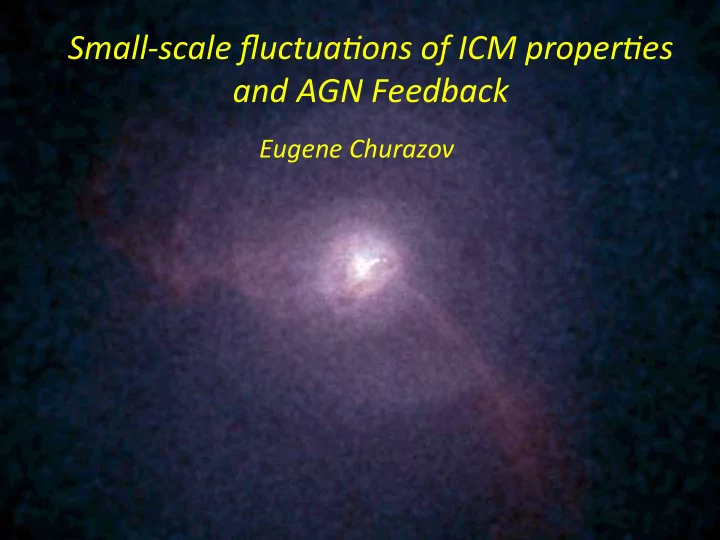
Small-scale fluctua-ons of ICM proper-es and AGN Feedback Eugene Churazov Chandra images showing signs of AGN Feedback Jones Blanton Fabian Forman F.E),?()>#&)>(,&),.),?()CFG) ) H?#,)D&),?()4?I&D'&).0)#''5(-./G)
K.&#,UFK1)D"#>().0),?()V(5&(+&)'$+&,(5)
:.5)</.E/)4.E(5)–),?()&D@().0),?();+;;$(&)D&)6(,(5"D/(6)A#$+().0)!" :.5)</.E/)!)–),?()&D@().0),?();+;;$(&)D&)6(,(5"D/(6);I)4.E(5)
LAGN, M ! LX >> LAGN,R
=/(5>I)D&),5#/&0(55(6),.)123)6+5D/>),?()5D&() N#/6)(A(/,+#$$I)6D&&D4#,(6O) ) =/(5>I)'./&(5A#-./)$#E)XY)Z[[\)(]'D(/,) (/(5>I)(L,5#'-./)05.");+;;$(&) Z^! 789)&$.E$I)D/*#,(&);+;;$(&)) ) ) ) 9.)?(#-/>).0),?()123)&.)0#5_) ) `^)C+;;$(&)5D&();+.I#/,$I)
) )8+$$)#/6)9.5,?.A(5P)ab)
)
E = 1 ! !1PV + PV
#$%" !?.'<) F.,)V$#&"#) 3DLD/>) 123) F.,)V$#&"#) 3DLD/>) !.+/6) E#A(&) V5.4#>#-./) JD&&D4#-./) 2K)D/)123) C+.I#/,)5D&() >%E#A(&)c) ,+5;+$(/'() JD&&D4#-./)
C+;;$(&)2K) !,5(#"D/>)
Z[[\) Z[[\) Z[[\) !" !"
1/3
Sedov-Taylor phase + sound wave with 12.5% of energy
No shock-heated gas – 0% of energy in sound waves Tang & EC, 17 See also EC+00,01; Forman+17, Zhuravleva+16
Upper limit on the energy of sound waves is 12.5% (spherical explosion)
1) Test I: Measure gas veloci-es (subsonic veloci-es) 2) Test II: Measure thermodynamic proper-es of perturba-ons in the ICM (isobaric perturba-ons) 3) Test III: Es-mate dissipa-on rate (hea-ng ~ cooling?)
1/'5(#&D/>)A($.'D,I)
d(&,)1)e)&+;&./D')A($.'D-(&)
2D(k) = C × P 3D(k) ⇒ δρ
Zhuravleva+,14b EC+, 2012; Arevalo+, 2012; Gaspari+,2014; Zhuravleva+, 2014a,b
&'()"*+,)-.)/0",/012.3+-0)1"4)5,+4",/"0()".61)"67"0()"8)1-)+-".3+-0)19"
'()":,064,".6332;612<6/="%20+1)=">?@A"
“line-of-sight velocity dispersion of 164±10 km/s” “gradient in the line-of-sight velocity of 150±70 km/s across the 60 kpc”
@ABC@?"D4E-" F"G?HB?"DI."
>?@B" >?@A"
i?+5#A$(A#cPZn;)
EC+, 2016; Arevalo+, 2016; Zhuravleva+, 2016
2345 &67)-0-89& &343& &:$(*+"#,-.& &;43& &:$(0-#)9&
&;43 &67)-0-89& &34?& &:$(*+"#,-.& &343& &:$(0-#)9&
Cooling=n2!(T) Heating = C!V
1,k 3 k
i?+5#A$(A#cPZn;)
In cluster cores mechanical AGN Feedback has efficiency ~100% It drives subsonic mo-ons that can offset gas cooling losses AGN radia-ve output is small In CGM mechanical AGN Feedback can have similar efficiency It may operate at low accre-on rates (no bright AGN) Does not (directly) affect the ISM but affects CGM
R
From clusters to galaxies Churazov+,2005