Photoinduced Ele lectron Transfer in in Porp rphyrin-Fullerene - - PowerPoint PPT Presentation

photoinduced ele lectron transfer in in porp rphyrin
SMART_READER_LITE
LIVE PREVIEW

Photoinduced Ele lectron Transfer in in Porp rphyrin-Fullerene - - PowerPoint PPT Presentation

Photoinduced Ele lectron Transfer in in Porp rphyrin-Fullerene Dyads : : Computational Study Morteza M.Waskasi April 2015 Outline Porphyrin-Fullerene Dyad Aim of research challenge in Porphyrin-Fullerene Dyad The energy level


slide-1
SLIDE 1

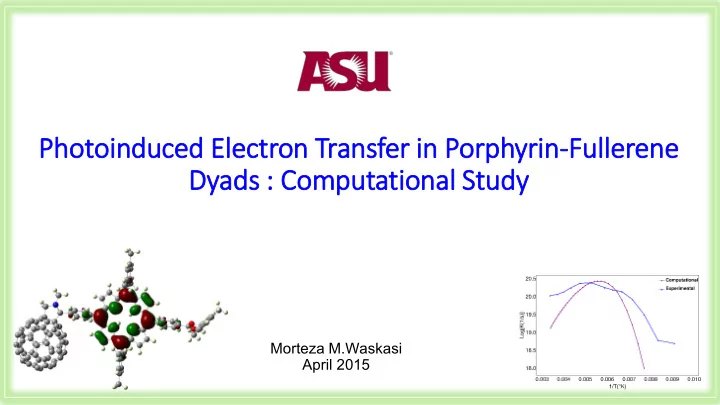
Photoinduced Ele lectron Transfer in in Porp rphyrin-Fullerene Dyads : : Computational Study

Morteza M.Waskasi April 2015

slide-2
SLIDE 2

Outline

 Porphyrin-Fullerene Dyad  Aim of research –challenge in Porphyrin-Fullerene Dyad  The energy level of charge separated state as function of polarity of solvents.  Marcus approach to calculate the ET rate  Charge recombination Rate in 2-MeTHF and PhCN and comparison with experimental results  Summary and future work. 2

slide-3
SLIDE 3

Porphyrin-Fullerene Dyad

Porphyrin  Similar to natural chlorophyllide chromophores. Extensive conjugated 𝞺-system. Favourable oxidation potential. Large extinction coefficients in visible region. Fullerene Good combination with porphyrins as a strong electron acceptor. Remarkable electron acceptors due to their large symmetrical shape and delocalized 𝞺 -system. Fullerenes are light absorber in the visible region. Small reorganization energy. 3

  • H. Imahori, K. Hagiwara .Journal of the American Chemical Society 118, 11771–11782 (1996).
slide-4
SLIDE 4

Challenges in in ET in in Porp rphyrin-Fullerene Dyad

Char arge recombin ination is is in in in inverted regime Charge separation is in the normal regime

  • Create long-lived charge separated state
  • Retarding charge recombination

4 Charge recombination and charge separation occur in inverted or normal regime ? BELIEVED AIM Prove or

  • r dis

isprove

slide-5
SLIDE 5

Methods

5

Gaussian 09:

Optimization Charge Internal reorganization energy

Qchem:

Optimization of Charge Separated State Charge Calculation at Separated State Electronic Coupling

Solv lvMol: :

Solvent reorganization Energy Solvent Free Energy Correction to the experimental free energy

D.Matyushov, Chemical Physics , 324, 172-194(2006).

slide-6
SLIDE 6

Donor and A Acceptor

6

slide-7
SLIDE 7

The ET rate constant calc lculation: : Semiclassical Marcus equation

∆𝙷 =∆𝙷 𝘩𝘣𝘵 + + ∆𝙷 𝘵 ∆𝙷 𝘩𝘣𝘵 ~1.0 .01 eV

7

V~0.0 .0002 eV λ~0.5 .56 eV

  • A. Nitzan, Chemical Dynamics in Condensed Phases (Oxford University Press, 2006) p. 744.
slide-8
SLIDE 8

Kodis, G.; Liddell, P. A.; Moore, A. L.; Moore, T. A.; Gust, D. J. Phys. Org. Chem., 2004, 17, 724-734.

Ph

C60

Ph

C60

Ph

C60

1.01 0.78 0.78

  • 0. 34

0.26

0.14 0.56 0.56 1.39 1.53

  • ∆G

λ

Energy Level dia iagram in in gas and polar solv lvents

1.91 eV

∆G

Gas THF MTHF PhCN DMF

8

slide-9
SLIDE 9

The ET rate constant calc lculation: : Marcus equation

λᵥ~0.146 eV

R.C Energy

9

P.Barbara, T.Meyer, M. Ratner. J. Phys. Chem. 100, 13148-13168(1996)

slide-10
SLIDE 10

Solvent Reorganization and Free Energy in in MTHF

μ= 1.38 D α= 10 (Å)³ ε = 7.6

10

slide-11
SLIDE 11

Energy Gap in in MTHF

11

slide-12
SLIDE 12

Dri riving Force and Reorganization Energy

  • ∆G

λ

12

slide-13
SLIDE 13

Recombination Rate in in 2-MeTHF

Inverted regime Normal regime

Inverted regime Normal regime

  • ∆G

Bent Coplanar

Experimental result by Gerdenis Kodis ,EFRC.

13

Energy Gap=0

Energy Gap=0

slide-14
SLIDE 14

Kodis, G.; Liddell, P. A.; Moore, A. L.; Moore, T. A.; Gust, D. J. Phys. Org. Chem., 2004, 17, 724-734.

P

C60

P

C60

P

C60

1.01 1.58

  • 0. 34

0.14

  • 1.39
  • ∆G

λ

CS and CR in in PhCN PhCN solv lvent: : In Inverted or r Normal regime?

1.91 eV

∆G

Gas Exp PhCN

14

slide-15
SLIDE 15

P

C60

P

C60

P

C60

1.01 1.58

  • 0. 34

CS and CR in in PhCN PhCN solv lvent: : In Inverted or r Normal regime?

1.91 eV

∆G

Gas Exp Emp

15

P

C60

P

C60

P

C60

P

C60 ∆Gcs ∆Gg

slide-16
SLIDE 16

Summary ry

 Temperature dependence of charge recombination rate.  Same trend of K ET for both experimental and computational approaches.  Solvent reorganization energy increase and driving force decrease by increasing polarity of the solvents.  The lifetime of charge separated states vary as a function of polarity of solvents and temperature.  Solvent reorganization energy and driving force rush in opposite way by increasing T in 2-MeTHF.  Good agreement between calculated and the experimental rate is found for P-C60 in 2-MeTHF solvent.

17

Inverted regime Normal regime

slide-17
SLIDE 17

Future work

  • Finding other conformers of porphyrin-fullerene Dyad.
  • Investigation of charge separation rate vs. temperature.
  • Make a model for forward and back ET for porphyrin fullerene

dyad and then extend it for other artificial reaction centers to predict the electron transfer rate as function of temperature and polarity of solvent.

  • T. Karilainen, O. Cramariuc , J of Computational Chemistry 36, 612–621 (2015)

18