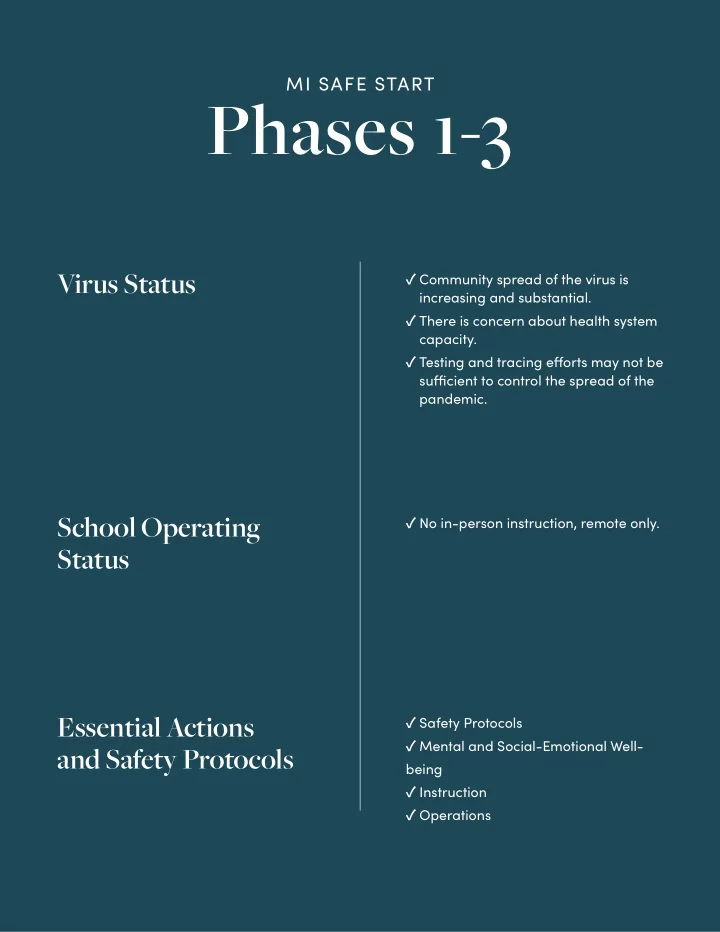
Phases 1-3 Virus Status Community spread of the virus is - - PDF document

phases 1 3
SMART_READER_LITE
LIVE PREVIEW

Phases 1-3 Virus Status Community spread of the virus is - - PDF document

Governor Gretchen Whitmer MI SAFE START Phases 1-3 Virus Status Community spread of the virus is increasing and substantial. There is concern about health system capacity. Testing and tracing efgorts may not be


slide-1
SLIDE 1

14 Governor Gretchen Whitmer

MI SAFE START

Phases 1-3

Virus Status School Operating Status Essential Actions and Safety Protocols

✓ Community spread of the virus is increasing and substantial. ✓ There is concern about health system capacity. ✓ Testing and tracing efgorts may not be suffjcient to control the spread of the pandemic. ✓ No in-person instruction, remote only. ✓ Safety Protocols ✓ Mental and Social-Emotional Well- being ✓ Instruction ✓ Operations

slide-2
SLIDE 2

15 Governor Gretchen Whitmer

Personal Protective Equipment and Hygiene

ɑ Schools are closed for in-person instruction.

Spacing and Movement

ɑ Schools are closed for in-person instruction. ɑ School buildings may continue to be used by licensed child care providers, if providers follow all emergency protocols identifjed by the state. ɑ School employees and contractors are permitted to be physically present in school buildings for the purposes of conducting basic school operations, including remote live instruction, as determined by school administrators.

Screening Students

ɑ Schools are closed for in-person instruction.

Responding to Positive Tests Among Stafg and Students

ɑ Schools are closed for in-person instruction.

MI Safe Start | Phases 1-3

Safety Protocols

✓ All safety protocols are REQUIRED in MI Safe Start Phases 1-3

Food Service, Gathering and Extracurricular Activities

ɑ Schools enact food distribution programs. ɑ All inter-school activities are discontinued. ɑ After-school activities are suspended.

Athletics

ɑ All athletics are suspended.

Cleaning

ɑ Schools are closed for in-person instruction, and cleaning practices are adjusted to maintain school building functional order.

Busing and Student Transportation

ɑ All busing operations are suspended. Required Strongly Recommended Not Applicable N/A Blank : Keep As Is

slide-3
SLIDE 3

21 Governor Gretchen Whitmer

MI SAFE START

Phase 4

Virus Status How to Keep School Communities Safe School Operating Status Essential Actions and Safety Protocols

✓ The number of new cases and deaths has fallen for a period of time, but overall case levels are still high. ✓ Most new outbreaks are quickly identifjed, traced, and contained due to robust testing infrastructure and rapid contact tracing. ✓ Health system capacity can typically handle these new outbreaks, and therefore case fatality rate does not rise above typical levels. ✓ The overall number of infected individuals still indicate the need for distancing to stop transmission and move to the next phase. ✓ School preparedness and response activities continue - conducting ongoing surveillance and executing a series of active mitigation measures. ✓ Schools should be prepared to implement social distancing measures. ✓ Short-term dismissals and suspension of extracurricular activities should be expected for cleaning and contact tracing purposes. ✓ Schools must consider the judgment of the local health department for the sub-region (i.e., county or ISD) of concern. ✓ In-person instruction is permitted with required safety protocols. ✓ Safety Protocols ✓ Mental and Social-Emotional Well-being ✓ Instruction ✓ Operations

slide-4
SLIDE 4

22 Governor Gretchen Whitmer

Personal Protective Equipment

REQUIRED

ɑ

Facial coverings must always be worn by stafg except for meals. Facial coverings may be homemade or disposable level-one (basic) grade surgical masks. Any stafg member who cannot medically tolerate a facial covering must not wear one. Any stafg member that is incapacitated or unable to remove the facial covering without assistance, must not wear a facial covering. ɑ PreK-5 and special education teachers should consider wearing clear masks. ɑ Homemade facial coverings must be washed daily. ɑ Disposable facial coverings must be disposed

  • f at the end of each day.

ɑ Facial coverings must be worn by preK-12 students, stafg, and bus drivers during school transportation. Any stafg or student that is unable to medically tolerate a facial covering must not wear one. Any stafg or student that is incapacitated or unable to remove the facial covering without assistance, must not wear one. Facial coverings may be homemade or disposable level-one (basic) grade surgical masks. ɑ Facial coverings must always be worn in hallways and common areas by preK-12 students in the building except for during meals. Any student that is unable to medically tolerate a facial covering must not wear

  • ne. Any student that is incapacitated or unable to

remove the facial covering without assistance, must not wear one. Facial coverings may be homemade or disposable level-one (basic) grade surgical masks. ɑ Homemade facial coverings must be washed daily. ɑ Disposable facing coverings must be disposed

  • f at the end of each day.

ɑ Note: Students with signifjcant disabilities preventing the use of facial coverings are referred to forthcoming guidance from MDE. ɑ Facial coverings must be worn in classrooms by all students grades 6-12. Any student who cannot medically tolerate a facial covering must not wear

  • ne. Any student who is incapacitated, or unable to

remove the facial covering without assistance, must not wear one. ɑ All students in grades K-5 must wear facial coverings unless students remain with their classes throughout the school day and do not come into close contact with students in another class.

Strongly Recommended

ɑ Facial coverings should be considered for K-5 students and students with special needs in class- rooms. ɑ Facial coverings should be considered for preK students and students with special needs in hallways and common areas. ɑ Facial coverings are not recommended for use in classrooms by children ages 3 and 4. ɑ Facial coverings should never be used on children under age 2.

Hygiene

REQUIRED

ɑ Provide adequate supplies to support healthy hygiene behaviors (including soap, hand sanitizer with at least 60% alcohol for safe use by stafg and students, paper towels, tissues, and signs reinforcing proper handwashing techniques). ɑ Teach and reinforce handwashing with soap and water for at least 20 seconds and/or the safe use of hand sanitizer that contains at least 60% alcohol.

Strongly Recommended

ɑ Educate stafg and students on how to cough and sneeze into their elbows, or to cover with a tissue. Used tissues should be thrown in the trash and hands washed immediately using proper hand hygiene techniques.

MI Safe Start | Phase 4

Safety Protocols

Required Strongly Recommended Blank : Keep As Is Black: Not Applicable N/A

slide-5
SLIDE 5

23 Governor Gretchen Whitmer

MI Safe Start | Phase 4

ɑ Systematically and frequently check and refjll soap and hand sanitizers. ɑ Students and teachers must have scheduled handwashing with soap and water every 2-3 hours. ɑ Limit sharing of personal items and supplies such as writing utensils. ɑ Keep students’ personal items separate and in individually labeled cubbies, containers, or lockers. ɑ Limit use of classroom materials to small groups and disinfect between use, or provide adequate supplies to assign for individual student use. ɑ Procure portable handwashing and/or hand sanitizing stations to set up throughout school buildings.

Spacing, Movement and Access

Strongly Recommended

ɑ Space desks six feet apart in classrooms. Class sizes should be kept to the level afgorded by necessary spacing requirements. ɑ In classrooms where large tables are utilized, space students as far apart as feasible. ɑ As feasible, arrange all desks facing the same direction toward the front of the classroom. ɑ Teachers should maintain six feet of spacing between themselves and students as much as possible. ɑ Family members or other guests are not allowed in the school building except under extenuating circumstances determined by district and school

  • ffjcials.

ɑ Post signage to indicate proper social distancing. ɑ Floor tape or other markers should be used at six- foot intervals where line formation is anticipated. ɑ Provide social distancing fmoor/seating markings in waiting and reception areas. ɑ Post signs on the doors of restrooms to indicate proper social distancing and hand hygiene techniques. ɑ Adult guests entering the building should be screened for symptoms, wear a facial covering, and wash/sanitize hands prior to entering. Strict records, including date and time, should be kept

  • f non-school employees or other visitors entering

and exiting the building.

Recommended

ɑ If a classroom has windows that can open, they should be open as much as possible, weather

  • permitting. Considerations should be made for

students with allergy-induced asthma. ɑ As able and appropriate, schools should try to cohort groups of students to isolated hallways

  • r areas that can be monitored (PreK-4).

ɑ As able, “specials” (like art, music, and library) should be brought to the classrooms instead

  • f having students move to different locations

(K-4). ɑ If all students cannot fjt in the classroom space available, a school may consider implementing a staggered school schedule that incorporates alternative dates of attendance or use of virtual

  • teaching. If a staggered school schedule is

adopted, schools should partner with community

  • rganizations to identify safe spaces where

children can engage virtually, especially if family members work and children cannot be home alone. ɑ Efforts should be made to keep six feet of distance between people in the hallways. Staggered movements at incremental intervals should be used if feasible to minimize the number of persons in the hallways as able.

Safety Protocols

slide-6
SLIDE 6

24 Governor Gretchen Whitmer

MI Safe Start | Phase 4

ɑ Have stafg monitor arrival and dismissal to discourage congregating and ensure students go straight from a vehicle to their classrooms and vice-versa. ɑ Where possible, physical education should be held

  • utside and social distancing of six feet should be

practiced. ɑ Boarding schools should seek guidance from MDHHS regarding spacing, movement, and facility access. ɑ Flow of foot traffjc should be directed in only

  • ne direction, if possible. If one-way fmow is not

possible, hallways should be divided with either side following the same direction. ɑ Entrances and exits should be kept separate to keep traffjc moving in a single direction.

Screening Students and Stafg

REQUIRED

ɑ Schools must cooperate with the local public health department regarding implementing protocols for screening students and stafg.

Strongly Recommended

ɑ Every school should identify and designate a quarantine area and a stafg person to care for students who become ill at school. ɑ Students who become ill with symptoms of COVID-19 should be placed in an identifjed quarantine area with a surgical mask in place until they can be picked up. Identifjed school stafg caring for these children should wear a surgical mask, with the exception of students with special needs requiring aerosolized procedures in which an N95 mask is required. ɑ Symptomatic students sent home from school should be kept home until they have tested negative or have completely recovered according to CDC guidelines. ɑ Stafg should conduct daily self-examinations, including a temperature check, prior to coming to work. If they exhibit any respiratory or gastrointestinal symptoms, or have a temperature

  • f 100.4 or greater, they should stay home.

Recommended

ɑ A monitoring form (paper or electronic) for screening employees should be developed. ɑ Families are encouraged to check their child’s temperature at home every morning using oral, tympanic, or temporal scanners; students with a temperature of 100.4 or greater should stay home and consider coronavirus testing if symptoms of COVID-19 are present. ɑ Families are encouraged to monitor their children for symptoms of COVID-19. The presence of any symptoms, including cough or shortness of breath, should prompt the family to keep the student home from school and to follow up with a primary care provider.

Safety Protocols

slide-7
SLIDE 7

25 Governor Gretchen Whitmer

MI Safe Start | Phase 4

Testing Protocols for Students and Stafg and Responding to Positive Cases

REQUIRED

ɑ Schools must cooperate with the local public health department regarding implementing protocols for screening students and stafg.

Strongly Recommended

ɑ Students who develop a fever or become ill with COVID-19 symptoms at school should wear a mask and be transported by their parent or guardian, emergency contact, or ambulance if clinically unstable, for ofg-site testing. ɑ Stafg who develop a fever or become ill with COVID-19 symptoms at school should wear a mask and be transported for ofg-site testing. ɑ Symptomatic students and stafg sent home from school should be kept home until they have tested negative for COVID-19, or have been released from isolation according to CDC guidelines. ɑ Families should be notifjed of the presence of any laboratory positive or clinically diagnosed cases

  • f COVID-19 in the classroom and/or school to

encourage closer observation for any symptoms at home. (PreK-8 Classroom/Team & School Building; 9-12 School Building) ɑ In the event of a lab or clinically diagnosed case

  • f COVID-19, immediate efforts should be made to

contact any close contacts (those who spent more than 15 minutes less than six feet in close proximity to the student or staff member) so that they can be quarantined for 14 days at home. Students and staff should be closely monitored for any symptoms of COVID-19. At this time, empiric testing of all students or staff members in the class is not recommended. Only those that develop symptoms require testing for COVID-19.

Recommended

ɑ Parents and guardians are encouraged to check students’ temperature at home every morning using oral, tympanic (ear), or temporal scanners; students with a temperature of 100.4 or greater must stay home and consider coronavirus testing. ɑ Parents and guardians are encouraged to monitor for symptoms of COVID-19. The presence of any unexplained symptoms, including cough or shortness of breath, should prompt the parent or guardian to keep the student home from school and to follow up with their primary care provider.

Responding to Positive Tests Among Stafg and Students

REQUIRED

ɑ All schools, public and private, must cooperate with the local public health department if a confjrmed case of COVID-19 is identifjed, and in particular, must collect the contact information for any close contacts of the afgected individual from two days before he or she showed symptoms to the time when he or she was last present at the school.

Strongly Recommended

ɑ Notify local health offjcials, stafg, and students immediately of any possible case of COVID-19 while maintaining confjdentiality consistent with the Americans with Disabilities Act (ADA) and other applicable federal and state privacy laws. ɑ The Local Health Department will initiate contact tracing, following regular public health practice. Anyone who was within close contact of the case (less than six feet apart for 15+ minutes) will be asked to self quarantine for up to 14 days after exposure. Local health offjcials, depending on the situation, may identify other contacts who

Safety Protocols

slide-8
SLIDE 8

26 Governor Gretchen Whitmer require quarantine. Schools can help the local health department by collecting data and contact information of those exposed. ɑ Note: schools should provide stafg with guidance on confjdentiality laws and statutes that protect student and stafg health information. Student communicable disease related information is protected health information. (Even if a family/ student acknowledges and publicly discloses a positive test, school stafg and

  • ffjcials must not participate in discussions
  • r acknowledge a positive test).

ɑ Employees with a confjrmed case of COVID-19 should only return to the workplace after they are no longer infectious. Local health offjcials will provide instruction about return to work, using the most current guidelines from the CDC for this determination. ɑ Cleaning stafg should wear a surgical mask, gloves, and a face shield when performing cleaning of these areas. ɑ If possible, smaller areas such as individual classrooms should be closed for 24 hours before cleaning to minimize the risk of any airborne particles.

Food Service, Gathering, and Extracurricular Activities

REQUIRED

ɑ Prohibit indoor assemblies that bring together students from more than one classroom.

Recommended

ɑ Classrooms or outdoor areas should be used for students to eat meals at school, if distancing

MI Safe Start | Phase 4

guidelines cannot be met. ɑ If cafeterias must be used, meal times should be staggered to create seating arrangements with six feet of distance between students. ɑ Serving and cafeteria stafg should use barrier protection including gloves, face shields, and surgical masks. ɑ Students, teachers, and food service stafg should wash hands before and after every meal. ɑ Students, teachers, and stafg should wash hands before and after every event. ɑ Large scale assemblies of more than 50 students are suspended. ɑ Ofg-site fjeld trips that require bus transportation to an indoor location are suspended. ɑ Recess should be conducted outside whenever possible with appropriate social distancing and cohorting of students. If more than one class is

  • utside, students should wear facial coverings.

ɑ If possible, school-supplied meals should be delivered to classrooms with disposable utensils. ɑ If possible, schools should ofger telecasting of assemblies and other school-sanctioned events. ɑ Extracurricular activities may continue with the use

  • f facial coverings.

Safety Protocols

slide-9
SLIDE 9

27 Governor Gretchen Whitmer

Athletics

REQUIRED

ɑ Comply with all guidance published by Michigan High School Athletic Association (MHSAA) and the National Federation of State High School Associations (NFHS). ɑ Students, teachers, and stafg must use proper hand hygiene techniques before and after every practice, event, or other gathering. Every participant should confjrm that they are healthy and without any symptoms prior to any event. ɑ All equipment must be disinfected before and after use. ɑ Inter-school competitions may be held provided that, facial coverings are worn if school transportation is provided. Buses must be cleaned and disinfected before and after every use, as detailed in the subsequent “Busing and Student Transportation” section. ɑ Spectators are allowed provided that facial coverings are used by observers and six feet of social distancing can be maintained at all times. Attention must given to entry and exit points to prevent crowding. ɑ Each participant must use a clearly marked water bottle for individual use. There should be no sharing of this equipment. ɑ Handshakes, fjst bumps, and other unnecessary contact must not occur. ɑ Indoor weight rooms and physical conditioning activities that require shared equipment are

  • suspended. Outdoor physical conditioning activities

are allowed while maintaining social distancing. ɑ Large scale indoor spectator events are suspended. Large scale outdoor spectator or stadium events are limited to 100 people, and people not part

  • f the same household must maintain six feet of

distance from one another.

MI Safe Start | Phase 4

Cleaning

REQUIRED

ɑ Frequently touched surfaces including light switches, doors, benches, bathrooms, must undergo cleaning at least every four hours with either an EPA-approved disinfectant or diluted bleach solution. ɑ Libraries, computer labs, arts, and other hands-

  • n classrooms must undergo cleaning after

every class period with either an EPA-approved disinfectant or diluted bleach solution. ɑ Student desks must be wiped down with either an EPA-approved disinfectant or diluted bleach solution after every class period. ɑ Playground structures must continue to undergo normal routine cleaning, but using an EPA- approved disinfectant is unnecessary. ɑ Ensure safe and correct use and storage of cleaning and disinfection products, including storing products securely away from children, and with adequate ventilation when stafg use products. ɑ Stafg must wear gloves, surgical mask, and face shield when performing all cleaning activities.

Safety Protocols

slide-10
SLIDE 10

28 Governor Gretchen Whitmer

MI Safe Start | Phase 4

Busing and Student Transportation

REQUIRED

ɑ Require the use of hand sanitizer before entering the bus. Hand sanitizer must be supplied on the bus. ɑ The bus driver, stafg, and all students in grades preK-12, if medically feasible, must wear facial coverings while on the bus. Note: there may be situations where it is not safe for the bus driver to wear a facial covering. Decisions about these situations should be made on a case-by-case basis with local public health offjcials. ɑ Clean and disinfect transportation vehicles before and after every transit route. Children must not be present when a vehicle is being cleaned. ɑ Clean and disinfect frequently touched surfaces in the vehicle (e.g., surfaces in the driver’s cockpit, hard seats, arm rests, door handles, seat belt buckles, light and air controls, doors and windows, and grab handles) prior to morning routes and prior to afternoon routes. ɑ Clean, sanitize, and disinfect equipment including items such as car seats, wheelchairs, walkers, and adaptive equipment being transported to schools daily. ɑ Create a plan for getting students home safely if they are not allowed to board the vehicle. ɑ If a student becomes sick during the day, they must not use group transportation to return home and must follow protocols outlined above. If a driver becomes sick during the day, they must follow protocols for sick stafg outlined above and must not return to drive students. ɑ Weather permitting, keep doors and windows open when cleaning the vehicle and between trips to let the vehicles thoroughly air out. ɑ Weather permitting, consider keeping windows

  • pen while the vehicle is in motion to help reduce

spread of the virus by increasing air circulation, if appropriate and safe.

Medically Vulnerable Students and Stafg

Strongly Recommended

ɑ Systematically review all current plans (e.g. Individual Healthcare Plans, Individualized Education Programs, Individualized Family Service Plans, or 504 plans) for accommodating students with special healthcare needs and update their care plans as needed to decrease their risk for exposure to COVID-19. ɑ Create a process for students/families and stafg to self-identify as high-risk for severe illness due to COVID-19 and have a plan in place to address requests for alternative learning arrangements or work reassignments.

Recommended

ɑ Pertaining to medically vulnerable students, revise the school’s remote learning plan to incorporate feedback and input from teachers, families, students, and school leaders and improve its efgectiveness. Share it with all involved stakeholders. ɑ Stafg caring for children and providing any medical care that include aerosol generating procedures (e.g., nebulizers) should have N95 masks. ɑ Enable stafg who are high-risk for severe illness to minimize face-to-face contact and to allow them to maintain a distance of six feet from others, modify job responsibilities that limit exposure risk, or to telework if possible. Meaningfully engage and consult with local bargaining units.

Safety Protocols

slide-11
SLIDE 11

37 Governor Gretchen Whitmer

MI SAFE START

Phase 5

Virus Status How to Keep School Communities Safe School Operating Status Essential Actions and Safety Protocols

✓ New cases and deaths continue to decrease for an additional period of time. ✓ At this point, the number of active cases has reached a point where infection from other members of the community is less common. ✓ With widespread testing, positivity rates often fall much lower than earlier phases. ✓ Rapid case investigation, contact tracing, and containment strategies cause new cases to continue to fall. ✓ School preparedness and response activities around surveillance and active mitigation continue from Phase 4 with loosening of required safety protocols. ✓ Schools should remain prepared to implement social distancing measures. ✓ Short-term dismissals and suspension of extracurricular activities remain possible for cleaning and contact tracing purposes. ✓ Students and teachers at increased risk of severe illness should remain prepared to implement remote teaching and learning modalities. ✓ Schools must consider the judgment of the local health department for the sub-region of concern. ✓ Schools open for in-person instruction with minimal required safety protocols. ✓ Safety Protocols ✓ Mental and Social-Emotional Wellbeing ✓ Instruction ✓ Operations

slide-12
SLIDE 12

38 Governor Gretchen Whitmer 38 Governor Gretchen Whitmer MI Safe Schools Roadmap

MI Safe Start | Phase 5

Personal Protective Equipment

Strongly Recommended

ɑ Facial coverings should always be worn by stafg except for meals. Facial coverings may be homemade or disposable level-one (basic) grade surgical masks. Any stafg member who cannot medically tolerate a facial covering should not wear one. Any stafg member that is incapacitated

  • r unable to remove the facial covering without

assistance, should not wear a facial covering. ɑ PreK-5 and special education teachers should consider wearing clear masks. ɑ Homemade facial coverings should be washed daily. ɑ Disposable facial coverings should be disposed of at the end of each day. ɑ Facial coverings should always be worn in hallways and common areas by preK-12 students in the building except for during meals. Any student that is unable to medically tolerate a facial covering should not wear one. Any student that is incapacitated or unable to remove the facial covering without assistance, should not wear one. Facial coverings may be homemade or disposable level-one (basic) grade surgical masks. If social distancing and cohorting is practiced and enforced, facial coverings for students in grades preK-5 are encouraged but not required. ɑ Homemade facial coverings should be washed daily. ɑ Disposable facing coverings should be disposed of at the end of each day.

Recommended

ɑ Facial coverings should be considered for preK students and students with special needs in hallways and common areas. ɑ Facial coverings are not recommended for use in classrooms by children ages 3 and 4. ɑ Facial coverings should never be used on children under age 2. ɑ Facial coverings should be considered for K-5 students and students with special needs in classrooms, especially if students and teachers are not placed in cohorts. ɑ Facial coverings should be worn in classrooms by grades 6-12 students. Any student who cannot medically tolerate a facial covering must not wear

  • ne. Any student that is incapacitated or unable

to remove the facial covering without assistance, must not wear one. ɑ Gloves are not required except for custodial stafg

  • r teachers cleaning their classrooms.

Hygiene

Strongly Recommended

ɑ Provide adequate supplies to support healthy hygiene behaviors (including soap, hand sanitizer with at least 60% alcohol for safe use by stafg and students, paper towels, tissues, and signs reinforcing proper handwashing techniques). ɑ Teach and reinforce handwashing with soap and water for at least 20 seconds and/or the safe use of hand sanitizer that contains at least 60% alcohol. ɑ Educate stafg and students to cough and sneeze into their elbows, or to cover with a tissue. Used tissues should be thrown in the trash and hands washed immediately using proper hand hygiene techniques. ɑ Students should wash their hands or use hand sanitizer after changing any classroom; teachers

Safety Protocols

Required Strongly Recommended Not Applicable N/A Blank: Keep As Is

slide-13
SLIDE 13

39 Governor Gretchen Whitmer Governor Gretchen Whitmer

MI Safe Start | Phase 5

in the classroom should wash their hands or use sanitizer every time a new group of students enters their room.

Recommended

ɑ Systematically and frequently check and refjll soap and hand sanitizers. ɑ Students and teachers should have scheduled handwashing with soap and water every 2-3 hours. ɑ Limit sharing of personal items and supplies such as writing utensils. ɑ Keep students’ personal items separate and in individually labeled cubbies, containers, or lockers. ɑ Limit use of classroom materials to small groups and disinfect between uses or provide adequate supplies to assign for individual student use. ɑ Procure portable handwashing and/or hand sanitizing stations to set up throughout school buildings.

Spacing, Movement and Access

Recommended

ɑ Spacing is six feet between desks to the extent that it is feasible. ɑ Class sizes should be kept to the level afgorded by necessary spacing decisions. ɑ In classrooms where tables are utilized, space students as far apart as feasible. ɑ Arrange all desks facing the same direction toward the front of the classroom. ɑ Teachers should try to maintain six feet of spacing between themselves and students as much as possible. ɑ Post signage to indicate proper social distancing. ɑ Floor tape or other markers should be used at six-foot intervals where line formation is anticipated. ɑ Provide social distancing fmoor/seating markings in waiting and reception areas. ɑ Post signs on the doors of restrooms to indicate proper social distancing and hand hygiene techniques. ɑ Post signs on the doors of restrooms to indicate proper social distancing. ɑ If a classroom has windows that can open, they should be open as much as possible, weather

  • permitting. Considerations should be made for

students with allergy-induced asthma. ɑ As able, schools should try to cohort groups of students to isolated hallways or areas that can be monitored for positive cases if there is a COVID-19 exposure. ɑ As able, “specials” (like art, music, and library) should be brought to the classrooms instead of having students move to difgerent locations. ɑ Flow of foot traffjc should be directed in only one direction, if possible. If one-way fmow is not possible, hallways can be divided with either side following the same direction. ɑ Efgorts should be made to keep six feet of distance between people in the hallways. Staggered movements at incremental intervals should be used if feasible to minimize the number of persons in the hallways as able. ɑ Have stafg monitor arrival and dismissal to discourage congregating and ensure students go straight from a vehicle to their classrooms and vice-versa. ɑ Boarding schools should seek guidance from MDHHS regarding spacing, movement, and facility access.

Safety Protocols

K-4 5-12

slide-14
SLIDE 14

40 Governor Gretchen Whitmer

Screening Students, Stafg, and Guests

Strongly Recommended

ɑ Every school should identify and designate a quarantine area and a stafg person to care for children who become ill at school. ɑ Students who become ill with symptoms of COVID-19 at school should be placed in an identifjed quarantine area with a surgical mask in place until they can be picked up. Identifjed school stafg caring for these children should wear a surgical mask, with the exception of students with special needs requiring aerosolized procedures in which an N95 mask is required. ɑ Symptomatic students sent home from school should be kept home until they have tested negative or have completely recovered according to CDC guidelines. ɑ Strict records, including date and time, should be kept of non-school employees or other visitors entering and exiting the building.

Recommended

ɑ Stafg should conduct daily self-examinations, including a temperature check, prior to coming to work. If they exhibit any respiratory or gastrointestinal symptoms, or have a temperature

  • f 100.4 or greater, they should stay home.

ɑ Any parents or guardians entering the building should wash or sanitize hands prior to entry. ɑ Parents or guardians are not allowed in the school building except under extenuating circumstances as determined by school offjcials. Only one parent

  • r guardian per child should be allowed to enter

except under extenuating circumstances as determined by school offjcials. ɑ Parents or guardians are encouraged to check their children’s temperature at home every morning using oral, tympanic (ear), or temporal scanners;

MI Safe Start | Phase 5

students with a temperature of 100.4 or greater should stay home and consider coronavirus testing if no other explanation is available. ɑ Parents or guardians are encouraged to ask their children or monitor for symptoms of COVID-19, including cough, congestion, shortness of breath,

  • r gastrointestinal symptoms every morning. Any

positives should prompt parents or guardians to keep the student home from school. ɑ Entrances and exits should be kept separate to keep traffjc moving in a single direction.

Testing Protocols for Students and Stafg and Responding to Positive Cases

Strongly Recommended

ɑ Students who develop fever or become ill with symptoms of COVID-19 at school should wear a mask and be transported by their parent/guardian, emergency contact, or ambulance, if clinically unstable, for ofg-site testing. ɑ Stafg who develop fever or become ill with symptoms of COVID-19 at school should wear a mask and should be transported for ofg-site testing. ɑ Parents and guardians should be notifjed of the presence of any laboratory positive or clinically diagnosed cases in the classroom and/or school to encourage closer observation for any symptoms at home. ɑ Symptomatic students and stafg sent home from school should be kept home until they have tested negative or have been released from isolation according to CDC guidelines.

Safety Protocols

slide-15
SLIDE 15

41 Governor Gretchen Whitmer

MI Safe Start | Phase 5

ɑ In the event of a lab or clinically diagnosed case

  • f COVID-19, immediate efgorts should be made

to contact any close contacts (those who spent more than 15 minutes within six feet to the student

  • r stafg member) so that they can be quarantined

at home. Classmates should be closely monitored for any symptoms. At this time, empiric testing of all students in the class is not recommended. Only those that develop symptoms require testing.

Recommended

ɑ Parents or guardians are encouraged to check student’s temperature at home every morning using oral, tympanic, or temporal scanners; students with a temperature of 100.4 greater must stay home and consider COVID-19 testing if no

  • ther explanation is available.

ɑ Parents or guardians are encouraged to monitor for symptoms of COVID-19, including any cough, congestion, shortness of breath, or gastrointestinal symptoms every morning. Any positives should prompt the parent or guardian to keep the student home from school and seek out testing.

Responding to Positive Tests Among Stafg and Students

Strongly Recommended

ɑ Notify local health offjcials, stafg, and students immediately of any possible case of COVID-19 while maintaining confjdentiality consistent with the Americans with Disabilities Act (ADA) and other applicable federal and state privacy laws. ɑ The Local Health Department will initiate contact tracing, following regular public health practice. Anyone who was within close contact of the case (less than six feet apart for 15+ minutes) will be asked to self quarantine for up to 14 days after exposure. Local health offjcials, depending on situation, may identify other contacts who require quarantine. Schools can help the local health department by collecting data and contact information of those exposed. ɑ Note: schools should provide stafg with guidance on confjdentiality laws and statutes that protect student and stafg health information. Student communicable disease related information is protected health information. (Even if a family/ student acknowledges and publicly discloses a positive test, school stafg and

  • ffjcials must not participate in discussions
  • r acknowledge a positive test).

ɑ Employees with a confjrmed case of COVID-19 should only return to the workplace after they are no longer infectious. Local health offjcials will provide instruction about return to work, using the most current guidelines from the CDC for this determination.

Recommended

ɑ If possible, smaller areas such as individual classrooms should be closed for 24 hours before cleaning to minimize the risk of any airborne particles.

Safety Protocols

slide-16
SLIDE 16

42 Governor Gretchen Whitmer

MI Safe Start | Phase 5

ɑ Cleaning stafg should wear a surgical mask when performing cleaning of these areas along with gloves and face shield.

Food Service, Gathering, and Extracurricular Activities

Strongly Recommended

ɑ Serving and cafeteria stafg should use barrier protection including gloves, face shields, and surgical masks. ɑ Students, teachers, and cafeteria stafg wash hands before and after every meal. ɑ All gatherings, including those that occur outdoors (e.g., graduations) should comply with current and future executive orders that set caps on congregations of people. ɑ If fjeld trips occur, they should comply with transportation guidelines within this document, including mandatory facial covering.

Recommended

ɑ If possible, classrooms should be used for eating in place, taking into consideration food allergies. ɑ If cafeterias need to be used, meal times should be staggered to create seating arrangements with six feet of distance between students. ɑ If possible, school-supplied meals should be delivered to classrooms with disposable utensils. ɑ Schools should ofger telecasting of assemblies and

  • ther school-sanctioned events if able.

ɑ Students and teachers should wash hands before and after every event.

ɑ

After-school programs may continue with the use

  • f facial coverings.

Athletics

Strongly Recommended

ɑ Indoor spectator events are limited to 50 people. Large scale outdoor spectator or stadium events are limited to 250 people. Spectators not part of the same household must always maintain six feet

  • f distance from one another.

ɑ Students, teachers, and stafg must use proper hand hygiene techniques before and after every practice, event, or other gathering. Every participant should confjrm that they are healthy and without any symptoms prior to any event. ɑ All equipment must be disinfected before and after use. ɑ Buses must be cleaned and disinfected before and after every use, as detailed in the subsequent “Busing and Student Transportation” section. ɑ Each participant should use a clearly marked water bottle for individual use. There should be no sharing of this equipment.

Recommended

ɑ Indoor weight rooms and physical conditioning activities are allowed. Social distancing of six feet between participants should be maintained while indoors and sharing equipment should be avoided. ɑ Handshakes, fjst bumps, and other unnecessary contact should not occur.

Safety Protocols

slide-17
SLIDE 17

43 Governor Gretchen Whitmer

MI Safe Start | Phase 5

Cleaning

Strongly Recommended

ɑ Frequently touched surfaces including lights, doors, benches, and bathrooms should undergo cleaning at least every four hours with either an EPA- approved disinfectant or diluted bleach solution. ɑ Libraries, computer labs, arts, and other hands-

  • n classrooms should undergo cleaning after

every class period with either an EPA-approved disinfectant or diluted bleach solution. Efgorts must be made to minimize sharing of materials between students, as able. ɑ Student desks should be wiped down with either an EPA-approved disinfectant or diluted bleach solution after every class period. ɑ Playground structures should continue to undergo normal routine cleaning, but using an EPA- approved disinfectant is unnecessary. ɑ Athletic equipment can be cleaned with either an EPA-approved disinfectant or diluted bleach solution before and after each use. ɑ Ensure safe and correct use and storage of cleaning and disinfection products, including storing products securely away from children, and with adequate ventilation when stafg use such products.

Recommended

ɑ Stafg should wear gloves, surgical masks, and face shield when performing all cleaning activities.

Busing and Student Transportation

Strongly Recommended

ɑ Strongly encourage the use of hand sanitizer before entering the bus. Hand sanitizer should be supplied on the bus. ɑ The bus driver, stafg, and all students in grades preK-12, if medically feasible, should wear facial coverings while on the bus. ɑ Clean and disinfect transportation vehicles

  • regularly. Children should not be present when a

vehicle is being cleaned. ɑ Clean and disinfect frequently touched surfaces in the vehicle (e.g., surfaces in the driver’s cockpit, hard seats, arm rests, door handles, seat belt buckles, light and air controls, doors and windows, and grab handles) prior to morning routes and prior to afternoon routes. ɑ Clean, sanitize, and disinfect equipment including items such as car seats and seat belts, wheelchairs, walkers, and adaptive equipment being transported to schools. ɑ Create a plan for getting students home safely if they are not allowed to board the vehicle. ɑ If a student becomes sick during the day, they should not use group transportation to return home and should follow protocols outlined above. ɑ If a driver becomes sick during the day, they should follow protocols for sick stafg outlined above and should not return to drive students.

Recommended

ɑ Weather permitting, keep doors and windows open when cleaning the vehicle and between trips to let the vehicles thoroughly air out. ɑ Weather permitting, consider keeping windows

  • pen while the vehicle is in motion to help reduce

spread of the virus by increasing air circulation, if appropriate and safe.

Safety Protocols
slide-18
SLIDE 18

44 Governor Gretchen Whitmer

MI Safe Start | Phase 5

Medically Vulnerable Students and Stafg

Strongly Recommended

ɑ Systematically review all current plans (e.g., Individual Healthcare Plans, Individualized Education Programs, Individualized Family Service Plans, or 504 plans) for accommodating students with special healthcare needs and updating their care plans as needed to decrease their risk for exposure to COVID-19. ɑ Create a process for students/families and stafg to self-identify as high risk for severe illness due to COVID-19 and have a plan in place to address requests for alternative learning arrangements or work reassignments.

Recommended

ɑ Stafg caring for children and providing any medical care that include aerosol generating procedures (e.g., nebulizers) should wear an N95 mask at the time of delivery. ɑ Enable stafg who self-identify as high risk for severe illness to minimize face-to-face contact and to allow them to maintain a distance of six feet from others, modify job responsibilities that limit exposure risk, or to telework if possible.

Safety Protocols