Petroleum Hydrocarbon Sediment Quality Guidelines Rita Mroz, - - PowerPoint PPT Presentation

petroleum hydrocarbon sediment quality guidelines
SMART_READER_LITE
LIVE PREVIEW

Petroleum Hydrocarbon Sediment Quality Guidelines Rita Mroz, - - PowerPoint PPT Presentation

Petroleum Hydrocarbon Sediment Quality Guidelines Rita Mroz, Environment Canada Ulysses Klee, Stantec Rob Willis, Dillon Consulting Real Property Institute of Canada Federal Contaminated Sites National Workshop Montreal, April 2016 Total


slide-1
SLIDE 1

Petroleum Hydrocarbon Sediment Quality Guidelines

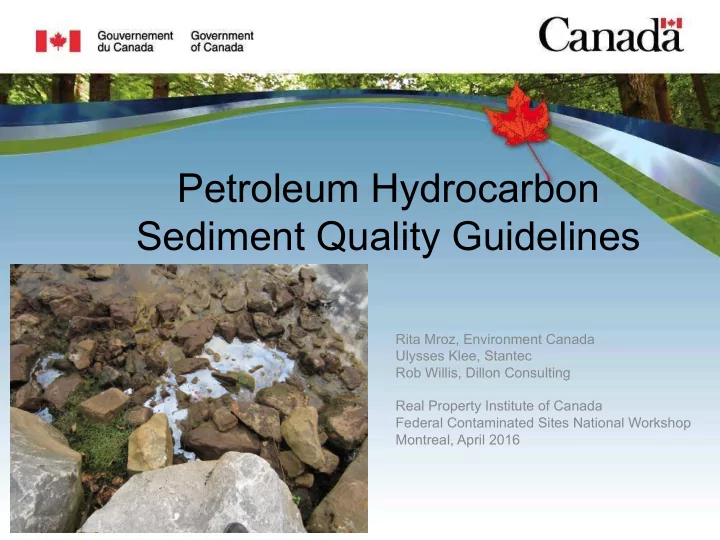
Rita Mroz, Environment Canada Ulysses Klee, Stantec Rob Willis, Dillon Consulting Real Property Institute of Canada Federal Contaminated Sites National Workshop Montreal, April 2016
slide-2
SLIDE 2

Total Petroleum Hydrocarbon (TPH) Sediment Criteria

  • Developed by Atlantic PIRI
  • Released in 2012
  • Today’s presentation:

– How the values were derived – Sediment toxicity testing for validation – Laboratory/analytical considerations

slide-3
SLIDE 3

Background

  • Atlantic PIRI = Atlantic Partners In RBCA Implementation
  • RBCA = Risk Based Corrective Action (ASTM)
  • Established in 1997, it is a partnership between Regulators,

Industry and Consultants

  • Formal MOU between 4 Atlantic Provinces; promotes

harmonization in the assessment and remediation of petroleum hydrocarbon contaminated sites

  • Atlantic PIRI is responsible for Atlantic RBCA implementation

and continuous improvement

slide-4
SLIDE 4

Background

Source: StatsCan, CANSIM tables 128-002 and 128-0009

  • The Atlantic Region

uses more fuel oil than

  • ther regions in Canada

(electricity generation, home heating, etc).

  • As a result of spills,

leaks, etc, provinces and industry were motivated to develop risk-based harmonized remediation criteria

Heavy fuel oil demand

slide-5
SLIDE 5

Background

Canada Wide Standards for Petroleum Hydrocarbons in Soil

  • Issued in 2000; updated

2008

  • Provides soil screening

criteria for human health and ecological receptors

  • Criteria provided as

“fractions” (F1-F4)

Atlantic RBCA

  • Issued in 1998; updated

2003 and 2012

  • Provides soil and

groundwater screening criteria for human health and soil, groundwater, surface water and sediment screening criteria for ecological receptors

  • Criteria provided as

“products” (gas, diesel and lube oil)

slide-6
SLIDE 6

Atlantic RBCA

  • Version 1 (1998) and Version 2 (2003) provided

human health based criteria only

  • Ecological considerations

– Identification of potential ecological concerns addressed via a one page screening form – Questions focused on habitat presence/absence

  • Atlantic PIRI wanted to expand the eco assessment

to include eco-based screening criteria for soil, groundwater, surface water and sediment.

slide-7
SLIDE 7

EcoTask Group

  • Formed in 2006
  • Members:

– Ken Doe, Environment Canada – Ulysses Klee, Stantec (formerly Dillon) – Peter Miasek, Imperial Oil – Rita Mroz, Environment Canada – Malcolm Stephenson, Stantec – Rob Willis, Dillon (formerly Intrinsik) – Affiliate members: Chris Allaway, EC (Ottawa) and Thomas Parkerton, Exxon Mobil

  • Purpose: Update/revise eco-screening checklist in RBCA User

Guidance

– Improve guidance – Include eco-based criteria for soil, sediment, surface water and ground water

slide-8
SLIDE 8

Eco Screening Levels

  • Soil – adopted from CWS, 2008
  • Groundwater to surface water – PETROTOX
  • Shallow groundwater (direct contact) – Alberta

Environment

  • Surface Water – PETROTOX
  • Sediment – PETROTOX & Equilibrium

Partitioning model

slide-9
SLIDE 9

Surface water-Sediment Link

  • Sediment criteria based on

the surface water criteria

  • Next slides explain

derivation of surface water eco screening levels, then sediment

slide-10
SLIDE 10

Surface Water Eco Screening Levels

Protection of aquatic life (plants, fish, invertebrates)

  • CCME does not have surface water criteria for PHCs
  • CCME does have surface water criteria for benzene,

toluene and ethyl benzene but not xylene (late 1990’s)

  • Task Group considered options to derive both BTEX and

PHCs screening values – selected PETROTOX

  • Derived surface water screening criteria for BTEX,

gasoline, diesel and lube using PETROTOX

  • Surface water screening criteria sediment criteria, by

applying the equilibrium partitioning model (EqP)

slide-11
SLIDE 11
slide-12
SLIDE 12

Sediment Eco Screening Levels

  • Protection of aquatic life (plants, fish, invertebrates)
  • Equilibrium partitioning model (EqP)

– Assumes toxicity of a chemical in sediment is the result of chemical concentration in the aqueous phase – Partitioning behaviour of an organic is a function of the chemical’s organic carbon-water partitioning coefficient (Koc) and the sediment’s fraction organic carbon (Foc) – Sediment ESL = surface water ESL x Koc x Foc

  • Allows for adjustments based on Foc

– site-specific Foc (Atlantic RBCA eco screening levels assume default Foc of 0.01) – Maximum of 500 mg/kg TPH (“management limit”)

slide-13
SLIDE 13
slide-14
SLIDE 14

Two sediment categories

  • “Typical”: where sediment is used to support sensitive

components of aquatic ecosystems (e.g. fish spawning, intertidal zones that are important for the preservation of fish & wildlife, etc.)

  • “Other”: for sediments not classified as “typical” (e.g.

ditches, industrial- influenced receiving areas, etc.)

  • FCSAP advises to screen against “typical” screening levels;

site professional must provide sufficient rationale for applying “other”

slide-15
SLIDE 15

Sediment Toxicity Tests - 2009

  • # 2 Oil (Winter Diesel) and # 6 Oil (Bunker C)
  • Hyalella azteca (amphipod) and Chironomus dilutus

(midge)

  • EC methods
  • Artificial Sediment
  • Static and static/renewal
slide-16
SLIDE 16

Results

  • #6 Oil -

200 400 600 800 1000 1200

LC50 (mg/kg)

  • H. azteca - S

PetroTox 200 400 600 800 1000 EC50 (mg/kg)

  • H. azteca - S

Petrotox

slide-17
SLIDE 17

Sediment Toxicity Testing 2015

  • “Real” sediment
  • Sediment from known PHC

contaminated FCSAP site

  • Marine amphipod,

Eohaustorius estuarius

  • Survival, emergence and

re-burial

  • Foc determined = 0.04
  • Product = #6 fuel
slide-18
SLIDE 18

Results

% survival (E. estuarius) TPH concentration

  • - Atlantic PIRI eco screening level,

adjusted for Foc of 0.04 (43 mg/kg x 4 = 172 mg/kg for #6 oil/lube)

Sites

% survival

TPH concentration

slide-19
SLIDE 19

Analytical Considerations for Using PIRI ESLs at Federal Sites

  • Concentrations of PHCs at federal sites most often

reported as CWS fractions (F1-F4).

  • Atlantic PIRI criteria are provided as “modified TPH”

for 3 specific products (gas, diesel and lube).

  • How to use CWS data with Atlantic PIRI criteria?
slide-20
SLIDE 20

Step 1: Calculate a modified TPH value

– Add F1+ F2 + F3 (less BTEX) data to calculate a “Modified TPH” concentration value – Atlantic PIRI criteria includes up to C32 while CCME F3 reports to C34. Not likely to be an issue - uncertainty in 2 carbon units much less than the uncertainty due to overall sample homogeneity and analysis methodologies. – Note: Atlantic PIRI did not derive criteria for products in F4 range (C34-C50). F4 should not be included in the summation for the “Modified TPH” value. If sediment has concentrations in F4 range, alternate methods of screening required.

slide-21
SLIDE 21

Comparison Study (Feb 2016)

slide-22
SLIDE 22

Conclusions of Comparison Study

  • Methods are comparable
  • Despite the difference between analyzing >C32 vs C34,

results are similar

  • General trend that CWS TPH is lower than PIRI TPH could

be due to the silica gel clean-up required in CWS method (reduce the overall TPH value by removing non-petrogenic compounds)

  • Overall, adding CWS F1+ F2+ F3 is a valid recommendation

to generate a modified TPH value

Special “thank you” to A. Stewart, R. Whelan, and B. Loescher, Maxxam Analytics (Bedford/St John’s) for undertaking this study

slide-23
SLIDE 23

Step 2: Product Type

  • To select the appropriate modified TPH

criteria, product type must be determined

  • Gas? Diesel? Lube?
  • Can be done by:

– Site history – Laboratory resemblance comments (CCME Reference Method, 2001; Atlantic PIRI Guidelines for Laboratories, 2016)

slide-24
SLIDE 24

Step 3 Compare to Appropriate Eco Screening Level

  • Example: Sum of F1-F3 is 45 mg/kg, resembles

diesel.

slide-25
SLIDE 25

If Fraction of Organic Carbon is known….

  • Sum of F1-F3 is 45 mg/kg, resembles diesel, with an Foc of 0.02 (2%)
  • Screening level is multiplied by 2 to become 50 mg/kg (as default

ESLs assume Foc is 0.01….if 0.02, than criteria is doubled, so long as to remain below 500 mg/kg)

x 2

slide-26
SLIDE 26

Atlantic PIRI website: http://www.atlanticrbca.com

(User Guidance, Scientific Rationale Document)

slide-27
SLIDE 27

Questions?

slide-28
SLIDE 28

PETROTOX Model

Developed by CONCAWE (Conservation of Clean Air and Water in Europe) Regulatory Developments:

  • REACH legislation in EU
  • Requirement for conducting environmental risk

assessments for petroleum substances

  • New initiatives aimed at avoiding / reducing animal

toxicity testing In Canada: Used by EC/HC for screening assessments for petroleum products as part of the Chemical Management Plan

slide-29
SLIDE 29

PETROTOX Model

  • Calculates toxicity of petroleum products to aquatic organisms
  • Based on quantitative relationships between hydrocarbon

structure and eco-toxicity (QSAR model)

  • Applies target lipid narcosis model
  • Toxicity database for 42 aquatic species (fish, amphibians,

invertebrates and algae) and 1457 hydrocarbons

  • Phys-chem property database for PHCs
  • Assumes hydrocarbon toxicity is additive
  • Estimates predicted-no-effect-concentration (PNECs) for

aquatic species exposed to PHCs (including BTEX, gasoline, diesel, lube oil) based on HC5 (5th percentile) of species sensitivity distributions