What did they find? - They looked at the natural hydrocarbons - - PDF document

what did they find
SMART_READER_LITE
LIVE PREVIEW

What did they find? - They looked at the natural hydrocarbons - - PDF document

R . I . T DUBAI Rochester Institute of Technology THE PERFORMANCE OF a HYDROCARBON MIXTURE REFRIGERANT AS A SUBSTITUTE FOR R22 Firas M. Younis* and Ghalib Y. Kahwaji** * Department of Mechanical Engineering University of Mosul ** Rochester


slide-1
SLIDE 1

1

R.I.T DUBAI

Rochester Institute of Technology

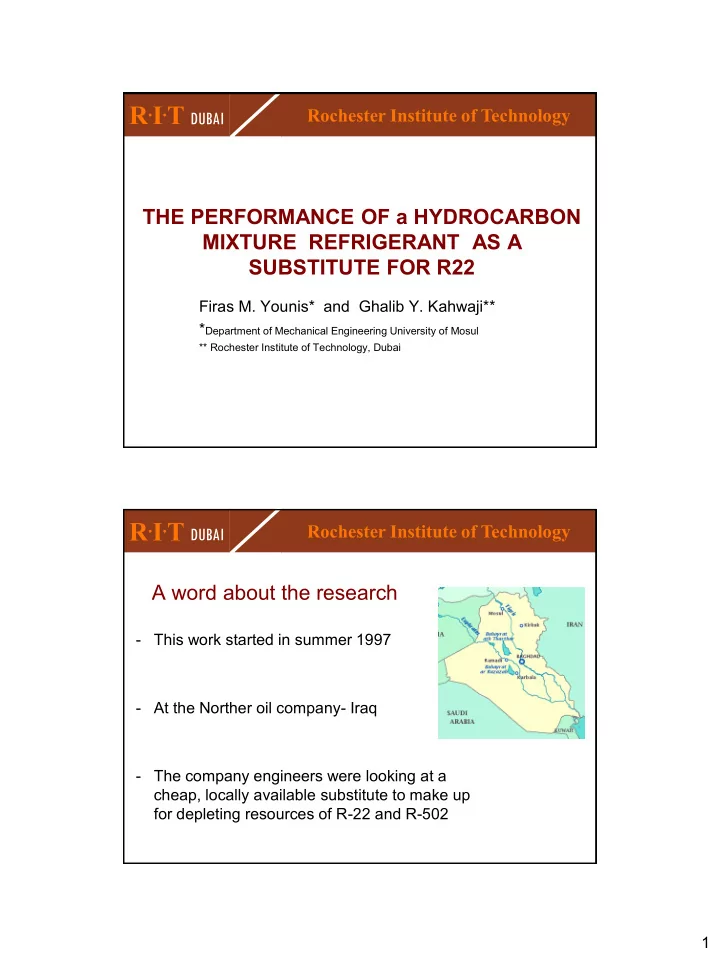
THE PERFORMANCE OF a HYDROCARBON MIXTURE REFRIGERANT AS A SUBSTITUTE FOR R22

Firas M. Younis* and Ghalib Y. Kahwaji** *Department of Mechanical Engineering University of Mosul

** Rochester Institute of Technology, Dubai

R.I.T DUBAI

Rochester Institute of Technology

A word about the research

  • This work started in summer 1997
  • At the Norther oil company- Iraq
  • The company engineers were looking at a

cheap, locally available substitute to make up for depleting resources of R-22 and R-502

slide-2
SLIDE 2

2

R.I.T DUBAI

Rochester Institute of Technology

What did they find?

  • They looked at the natural hydrocarbons available

at their disposal

  • After many trials and properties analyses, they

came up with a mixture of Propane and Isobutene

R.I.T DUBAI

Rochester Institute of Technology

The data….

slide-3
SLIDE 3

3

R.I.T DUBAI

Rochester Institute of Technology

  • In summer 1997, after a quick property analysis, we

started charging 1.5 and 2 TR window type units with the proposed refrigerant. The units performed well. And kept working until 2003. To the best of my knowledge, no accidents were reported.

R.I.T DUBAI

Rochester Institute of Technology

Present research:

  • Later we decided to look at the

performance of refrigerant when used in R-22 systems.

  • Refrigerant properties were

correlated analytically.

  • Modeled a basic 1.5 TR window

type unit with the following:

slide-4
SLIDE 4

4

R.I.T DUBAI

Rochester Institute of Technology

  • Physical data from an existing system were used.
  • Polytropic compression was assumed
  • Three section condenser model.
  • Valve pressure drop and cylinder heating was

considered in volumetric efficiency model.

  • Constant degree of super heat was assumed for

consistency.

  • MatLab- Simulink was used to do the simulation.

R.I.T DUBAI

Rochester Institute of Technology

Results

variable R22 Pd=1.57x10⁻³ HC mix Pd=1.57x10⁻³ HC mix % variation mR 0.03238 0.01569

  • 51.5

Te 5.2 7 34.6 Tc 49.5 47.35

  • 4.3

P2/P1 3.262 2.787

  • 14.6

T2 88.5 68.4

  • 22.7

v

0.866 0.879 1.5 Toe 10.87 11.88 9.3 WC 1315.43 1043.35

  • 20.7

QE 5353.8 4757.67

  • 11.1

COP 4.07 4.56 12.0

slide-5
SLIDE 5

5

R.I.T DUBAI

Rochester Institute of Technology

variable R22 Pd=1.57x10⁻³ HC mix with 120% piston displacement % variation mR 0.03238 0.01809

  • 44.1

Te 5.2 5.85 12.5 Tc 49.5 48.2

  • 2.6

P2/P1 3.262 2.94

  • 9.9

T2 88.5 69.9

  • 21.0

v

0.866 0.871 0.6 Toe 10.87 10.8

  • 0.6

WC 1315.43 1267

  • 3.7

QE 5353.8 5429.14 1.4 COP 4.07 4.285 5.3

Operation with increased piston displacement

R.I.T DUBAI

Rochester Institute of Technology

comparison

variable R-22 HC mix at original piston displacement % variation HC mix with 120% piston displacement % variation mR 0.03238

  • 51.5
  • 44.1

Te 5.2 34.6 12.5 Tc 49.5

  • 4.3
  • 2.6

P2/P1 3.262

  • 14.6
  • 9.9

T2 88.5

  • 22.7
  • 21.0

v

0.866 1.5 0.6 Toe 10.87 9.3

  • 0.6

WC 1315.43

  • 20.7
  • 3.7

QE 5353.8

  • 11.1

1.4 COP 4.07 12.0 5.3

slide-6
SLIDE 6

6

R.I.T DUBAI

Rochester Institute of Technology

Refrigeration applications

  • The same exercise was conducted for a system in

freezing applications.

  • The results were very similar where COP increased by

8% only.

R.I.T DUBAI

Rochester Institute of Technology

Conclusions:

  • Using the HC mix in existing R-22 systems resulted in:
  • 11.1% reduction in the capacity
  • 12% increase in COP
  • 50% less charge
  • 14.6% reduction in the pressure ratio
  • 22.7% decrease in the compressor outlet temp.
  • Increasing the compressor speed by 20% restored the

lost capacity while maintaining the a 3.7% decrease in the compression power.

slide-7
SLIDE 7

7

R.I.T DUBAI

Rochester Institute of Technology

Thanks for your patience R.I.T DUBAI

Rochester Institute of Technology