Pesticide Hazards in Outdoor Marijuana Grows Robert Ford CIH,CSP - - PDF document

pesticide hazards in outdoor marijuana grows
SMART_READER_LITE
LIVE PREVIEW

Pesticide Hazards in Outdoor Marijuana Grows Robert Ford CIH,CSP - - PDF document

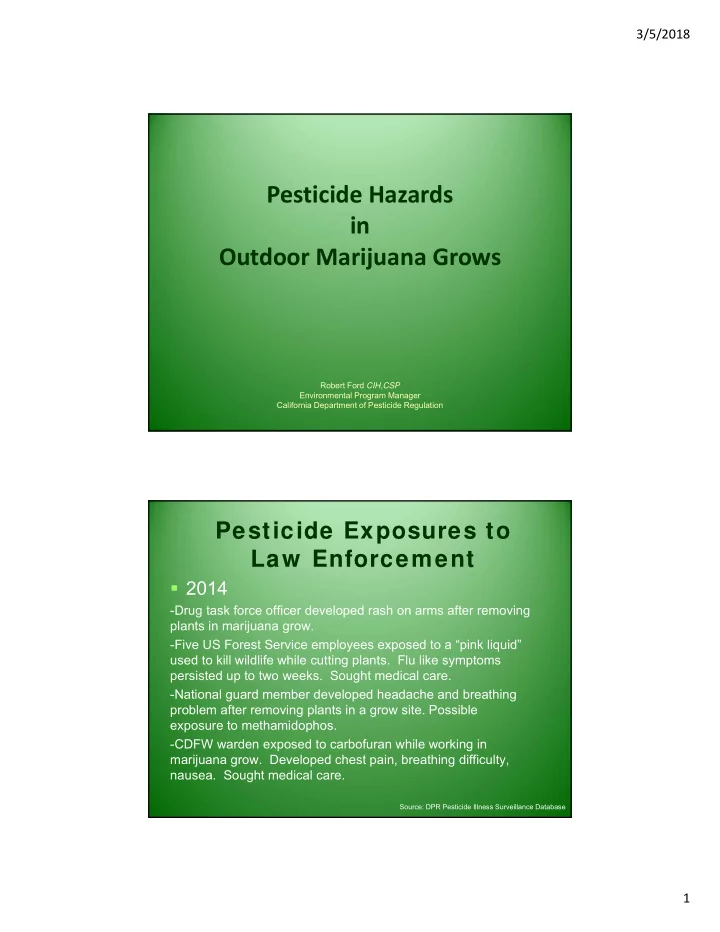
3/5/2018 Pesticide Hazards in Outdoor Marijuana Grows Robert Ford CIH,CSP Environmental Program Manager California Department of Pesticide Regulation Pesticide Exposures to Law Enforcement 2014 -Drug task force officer developed rash on


slide-1
SLIDE 1

3/5/2018 1

Pesticide Hazards in Outdoor Marijuana Grows

Robert Ford CIH,CSP Environmental Program Manager California Department of Pesticide Regulation

Pesticide Exposures to Law Enforcement

  • 2014
  • Drug task force officer developed rash on arms after removing

plants in marijuana grow.

  • Five US Forest Service employees exposed to a “pink liquid”

used to kill wildlife while cutting plants. Flu like symptoms persisted up to two weeks. Sought medical care.

  • National guard member developed headache and breathing

problem after removing plants in a grow site. Possible exposure to methamidophos.

  • CDFW warden exposed to carbofuran while working in

marijuana grow. Developed chest pain, breathing difficulty,

  • nausea. Sought medical care.

Source: DPR Pesticide Illness Surveillance Database

slide-2
SLIDE 2

3/5/2018 2

Photos: CDFW

slide-3
SLIDE 3

3/5/2018 3

  • Entering gardens

recently treated

  • Removing plants with

residual product

  • Cutting/moving drip

lines

  • Dismantling holding

ponds

  • Helicopter down draft
  • Opening containers
  • Searching refuse

Routes for Pesticide Exposure

slide-4
SLIDE 4

3/5/2018 4

Pesticide Labels Signal Words

  • Pesticides have been found with banned or restricted use in

the US

  • Label identification can help specify toxicity

DANGER POISON

Poison in red letters with skull and crossbones

Highly toxic/fatal (taste to 1/8 oz) through inhalation, absorption, ingestion or corrosive to eyes and skin

WARNING

Moderately toxic (1/8 to 1 ounce), severe potential for irritation to skin and eyes (clearing in 8 to 21 days)

CAUTION

Slightly toxic (ounce to pint) through ingestion, moderate potential for skin and eye irritation

Organophosphate Pesticides

Cholinesterase inhibitor

Fat soluble Absorb well through the skin, mucous membranes, eyes, and respiratory system Include: Methyl Parathion

Restricted use pesticide (Metaphos or Metafos) Not registered for Use in California

Methamidophos

Restricted use pesticide (Monitor, Tamaron) Not registered for Use in California

Malathion

Non‐restricted use

slide-5
SLIDE 5

3/5/2018 5

Carbamate Pesticides

Cholinesterase Inhibitor

Include: Carbofuran

Restricted use pesticide (Furadan, Furan) Not registered for Use in California Banned by Federal EPA

Carbaryl

Restricted use pesticide except for home‐use bait formulation (Sevin‐5)

slide-6
SLIDE 6

3/5/2018 6

Of Major Concern

Carbofuran in water bottles Placed in plastic bottles and sprayed on ground and plants to kill wildlife through absorption and ingestion Also highly toxic to responding personnel

Cholinesterase Inhibition

Synaptic Gap

Effect on nervous system synapses in humans, vertebrates, and insects. Stimulating signals are carried across the synapse by acetylcholine. Signals are cancelled by acetylcholinesterase Cholinesterase inhibiting chemicals interfere with the cancelling of the nerve impulse allowing the impulse to continue resulting in uncontrolled rapid twitching of muscles, paralyzed breathing, convulsions, and death to the organism.

slide-7
SLIDE 7

3/5/2018 7

Generalized Symptoms of Exposure

Cholinesterase Inhibiting Pesticides

Mild- tiredness, weakness, dizziness, nausea and blurred vision Moderate- headache, sweating, tearing, drooling, vomiting, tunnel vision, and twitching Severe- abdominal cramps, muscular tremors, pinpoint pupils, abnormally low blood pressure, slow heartbeat, breathing difficulty.

Requirements for Cholinesterase Inhibiting Pesticide Use

  • In agriculture, anyone who regularly mixes,

loads, or applies an OP or carbamate pesticide with the signal words “Danger” or “Warning” must be under a medical supervision program

(CCR T3,§6728)

  • Pre-exposure baseline cholinesterase should be

established for individuals before they come in regular contact with organophosphate and carbamate pesticides.

slide-8
SLIDE 8

3/5/2018 8

Rodenticides

Aluminum and Zinc Phosphide

(Ratone, Commando) Applied as bait or dust Red or pink in color Reactive with water and/or acid “DANGEROUS WHEN WET” Very toxic if swallowed or dust inhaled Not easily absorbed through skin Works by releasing phosphine gas when ingested or inhaled Causes pulmonary edema (fluid buildup) in lungs

slide-9
SLIDE 9

3/5/2018 9

Rodenticides

Symptoms not immediate, may occur up to 24 hours later Exposure symptoms include; ‐”feeling cold” all over ‐chest tightness, abdominal pain Avoid handling containers when possible Do not handle containers or bait with bare hands Wash hands immediately after handling

Rodenticides

Coumarin‐type anticoagulants (TALON G)

  • Grain like, green pellets
  • Designed to cause internal bleeding after

repeated ingestion

  • Does not absorb through skin
  • Do not handle product with bare skin
  • Avoid breathing dust
slide-10
SLIDE 10

3/5/2018 10

Rodenticides

  • Strychnine
  • OSHA exposure limit 0.15 mg/m3
  • Lethal dose in humans ranges from

30 to 120 mg (approx. 15% of 1 lb container)

  • Exposure easily controlled
  • Do not handle containers with bare hands
  • Avoid breathing dust
  • Wash off contamination as soon as possible
slide-11
SLIDE 11

3/5/2018 11

Protecting Yourself

  • Granular Pesticides

Other Solids

Dust mask (N, R, P)

  • Impervious Gloves

(SDS or label)

  • Field sanitation

water for washing rinsing contamination

CCR Title 8, Section 3380 “Personal Protective Devices” Requires employees to use the type of PPE needed that will protect them from the hazards found CCR Title 8, Section 3380 “Personal Protective Devices” Requires employees to use the type of PPE needed that will protect them from the hazards found

This image cannot currently be displayed.
slide-12
SLIDE 12

3/5/2018 12

This image cannot currently be displayed.

Provided as a cooperative agreement between Oregon State University and the U.S. Environmental Protection Agency. 1.800.858.7378 npic@ace.orst.edu

This image cannot currently be displayed.
slide-13
SLIDE 13

3/5/2018 13

Questions?