Pesticide Enforcement Partners Department of Pesticide Regulation - - PDF document

pesticide enforcement partners
SMART_READER_LITE
LIVE PREVIEW

Pesticide Enforcement Partners Department of Pesticide Regulation - - PDF document

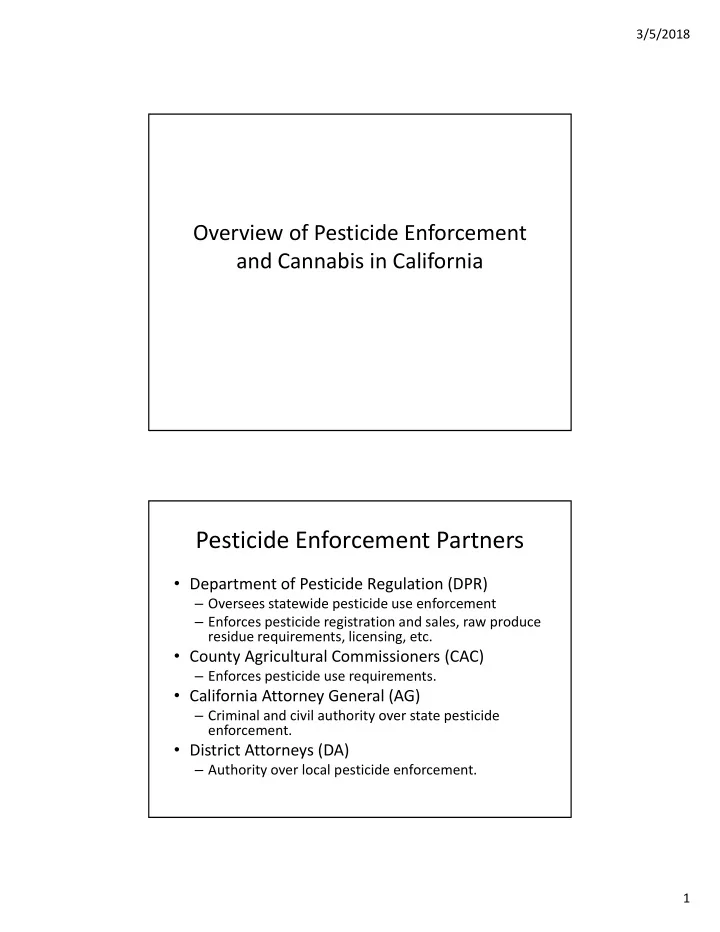
3/5/2018 Overview of Pesticide Enforcement and Cannabis in California Pesticide Enforcement Partners Department of Pesticide Regulation (DPR) Oversees statewide pesticide use enforcement Enforces pesticide registration and sales, raw


slide-1
SLIDE 1

3/5/2018 1

Overview of Pesticide Enforcement and Cannabis in California

Pesticide Enforcement Partners

  • Department of Pesticide Regulation (DPR)

– Oversees statewide pesticide use enforcement – Enforces pesticide registration and sales, raw produce residue requirements, licensing, etc.

  • County Agricultural Commissioners (CAC)

– Enforces pesticide use requirements.

  • California Attorney General (AG)

– Criminal and civil authority over state pesticide enforcement.

  • District Attorneys (DA)

– Authority over local pesticide enforcement.

slide-2
SLIDE 2

3/5/2018 2

County Agricultural Commissioners

  • Each California county has a CAC.
  • Primary local enforcement agents for pesticide

use requirements.

  • Do not have peace officer status.

Role of the CAC’s

  • Investigates complaints and reported

pesticide‐related illnesses

  • Inspects agricultural fields
  • Issues restricted material permits and
  • perator identification numbers
  • Provides compliance assistance, enforces

pesticide use violations through administrative civil penalty actions, or refers cases to the DA.

slide-3
SLIDE 3

3/5/2018 3

Administrative Penalties

  • FAC section 12999.5
  • CAC has exclusive jurisdiction
  • Up to $5,000 administrative civil penalty per

violation

Civil Penalties

  • FAC section 12997
  • In lieu of administrative civil penalty, DPR may

refer cases to the California AG

  • Civil penalty of $1,000 to $10,000
  • Repeat violations ‐or‐ intentional violations

involving human health or environmental hazard subject to civil penalty of $5,000 to $25,000

slide-4
SLIDE 4

3/5/2018 4

Criminal Penalties

  • FAC section 12996
  • Misdemeanor violations

– $500 to $5,000 criminal penalty, and/or – Imprisonment of not more than six (6) months

  • Repeat violations

– $1,000 to $10,000 criminal penalty, and/or – Imprisonment of not more than six (6) months

  • Intentional ‐or‐ negligent violations involving health or

environmental hazards

– $5,000 to $50,000 criminal penalty, and/or – Imprisonment in county jail/state prison of not more than

  • ne (1) year

Pesticide Requirements under MAUCRSA (SB 94)

  • DPR:

– Guidance on legal pest management to growers. – Guidance on pesticide residue levels to the Bureau of Cannabis Control (BCC).

  • Department of Food and Agriculture (CDFA):

– Licenses and regulates cannabis cultivators. – Compliance with pesticide laws as enforced by DPR is a condition of CDFA cannabis cultivation licenses.

  • BCC:

– Licenses and regulates cannabis testing laboratories. – BCC sets allowable levels for pesticide residue (and other contaminants) on processed cannabis/cannabis products after considering the DPR guidance.

slide-5
SLIDE 5

3/5/2018 5

Role of the CAC’s – Legal (Licensed) Cannabis

  • To inspect and investigate licensed cannabis

cultivation operations to determine compliance with California pesticide use requirements.

  • Provide compliance assistance and take

enforcement actions where appropriate.

Role of the CAC’s – Illegal (Unlicensed) Cannabis

  • CAC’s do not generally enter, inspect, or enforce

against illegal cannabis grow sites because they do not enforce criminal violations and do not have peace officer status.

  • DPR is available and encourages CAC’s to be

available to assist law enforcement in case‐ building activities such as identifying, handling, and sampling pesticides found at illegal grows.

slide-6
SLIDE 6

3/5/2018 6

California Pesticide Laws

  • California Food and Agricultural Code (FAC),

Divisions 6 and 7

  • California Code of Regulations (CCR), Title 3

Examples of Pesticide Use Violations

  • FAC section 12973 – Use in conflict with the

label.

  • FAC section 12995 – Possession or use of an

unregistered pesticide.

  • FAC sections 14011; 14015 – Unlawful use or

possession of restricted materials.

  • FAC section 12991(e) – Unlawful pesticide use,

transport, storage, handling, or disposal.

slide-7
SLIDE 7

3/5/2018 7

Examples of Pesticide Use Violations

  • FAC section 12972; 3 CCR 6614 – Pesticide

drift.

  • 3 CCR 6670, et seq. – Storage, transportation,

and disposal of pesticides.

  • 3 CCR 6609; 3 CCR 6800, et seq. – Restrictions
  • n pesticide use near wellheads and

groundwater contamination prevention.

Pesticide use enforcement and Cannabis

  • Under California law, pesticides must be used

consistent with the registered labeling.

  • All pesticides are first registered with the

federal EPA. Because cannabis is illegal federally, there are no pesticides registered for use on “cannabis.”

  • Even under these facts, there are still some

pesticides that are legal to use on cannabis under state law.

slide-8
SLIDE 8

3/5/2018 8

Pesticides that are Legal to Use on Cannabis under State Law

1) Exempt from tolerance requirements AND 2) Exempt from registration, or registered for a use site that is broad enough to include cannabis DPR has released a document discussing legal pest management practices.

Pesticides that cannot be Used on Cannabis

  • DPR has released a document listing

pesticides that DPR has instructed the CAC’s to prioritize enforcement against: ‐Labeled with a “DANGER” signal word; ‐Restricted Materials; ‐Not registered for food uses; ‐Groundwater protection list.

slide-9
SLIDE 9

3/5/2018 9

Contact

  • Daniel Rubin, DPR Staff Attorney

Daniel.Rubin@cdpr.ca.gov (916) 324‐2666

  • Rachel Kubiak, DPR Cannabis Program Supervisor

Rachel.Kubiak@cdpr.ca.gov (916) 445‐5010

  • County Agricultural Commissioners

https://www.cdfa.ca.gov/exec/county/countymap/