Persistence to Graduation Dr. Youngsoo Choi (Niagara) Dr. Dawn - - PowerPoint PPT Presentation

persistence to graduation
SMART_READER_LITE
LIVE PREVIEW

Persistence to Graduation Dr. Youngsoo Choi (Niagara) Dr. Dawn - - PowerPoint PPT Presentation

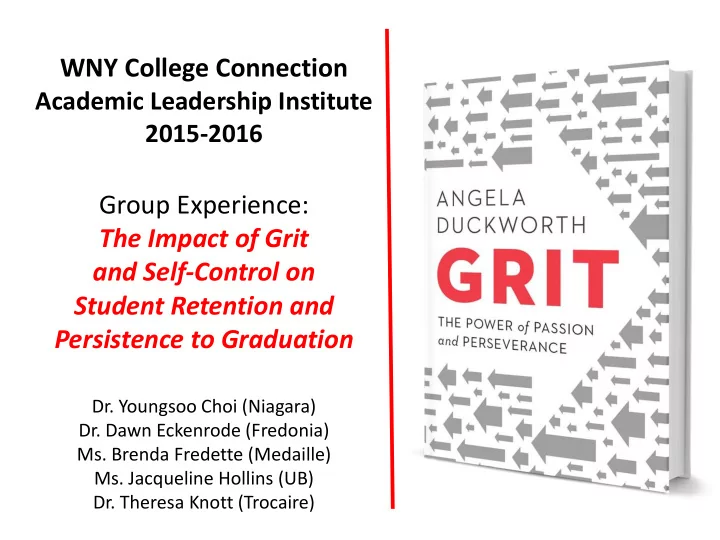
WNY College Connection Academic Leadership Institute 2015-2016 Group Experience: The Impact of Grit and Self-Control on Student Retention and Persistence to Graduation Dr. Youngsoo Choi (Niagara) Dr. Dawn Eckenrode (Fredonia) Ms. Brenda


slide-1
SLIDE 1

WNY College Connection

Academic Leadership Institute 2015-2016

Group Experience: The Impact of Grit and Self-Control on Student Retention and Persistence to Graduation

  • Dr. Youngsoo Choi (Niagara)
  • Dr. Dawn Eckenrode (Fredonia)
  • Ms. Brenda Fredette (Medaille)
  • Ms. Jacqueline Hollins (UB)
  • Dr. Theresa Knott (Trocaire)
slide-2
SLIDE 2

Overview

“Grit is passion and perseverance for very long term goals…”

  • Dr. Angela Duckworth

Ted Talk, April 2013

slide-3
SLIDE 3

Theoretical Framework

  • Grit: A concept in search of a theory
  • Theoretical foundation of grit concept is

RESILIENCE

  • Resilience research has evolved over 40

years beginning with examining the resilience demonstrated by vulnerable children

  • Researchers in the behavioral sciences
  • bserved that some children in high-risk,

chaotic environments excelled cognitively, socially and academically in spite of their environment

slide-4
SLIDE 4

Theoretical Framework

  • RESILIENCE: Positive adaptation despite

adversity (Luthar, 2006)

  • Relative resistance to psychosocial risk

experiences (Rutter, 2000; Sroufe, 2005)

  • Coping response directly & indirectly

related to grit

  • Adaptive coping directly influences grit
  • Coping indirectly influences grit via

protective factors

Indirect relationship between coping and grit

Coping Grit Protective factors

slide-5
SLIDE 5

Assessing Grit: Grit Scale

  • New ideas and projects sometimes distract me

from previous ones.

  • Setbacks don’t discourage me.
  • I have been obsessed with a certain idea or

project for a short time but later lost interest.

  • I am a hard worker.
  • I often set a goal but later choose to pursue a

different one.

  • I have difficulty maintaining my focus on

projects that take more than a few months to complete.

  • I finish whatever I begin.
  • I am diligent.

Duckworth, A.L, & Quinn, P.D. (2009). Development and validation of the Short Grit Scale (Grit-S). Journal of Personality Assessment, 91, 166-174.

slide-6
SLIDE 6

Classroom Application: Six Steps of Teaching for Grit

  • 1. Establish the environment
  • 2. Set the expectations
  • 3. Teach the vocabulary
  • 4. Create the frustration
  • 5. Monitor the experience
  • 6. Reflect and learn

Thomas R. Hoerr Fostering GRIT

slide-7
SLIDE 7

Opportunities What opportunities can you identify for encouraging a growth mindset in students on your campus?

slide-8
SLIDE 8

Recommendations

Applications at K-12 level Growth mind-set (Carol Dweck)

  • Help students aware of the value of

deliberate practice, the kind of effortful practice that really improves skills.

  • Tell students that deliberate practice is not

easy, confusing, frustrating, and boring; learn from mistakes and do things repetitively.

  • Reward kids for efforts and improvements in

class learning activities/assignments(?) Upper Darby (PA) school district

  • A series of professional development

workshops [based on PERMA—Positive Emotions, Engagement, Relationships, Meaning/purpose, and Accomplishments].

  • A daily citizenship class that covers such

topics as how to have good conversations, be an active listener, build meaningful relationships, set goals and pursue them, and recognize the consequences of behavior.

slide-9
SLIDE 9

Recommendations (cont.)

For college admission, retention, and curriculum

  • Traditional criteria + ‘GRIT’ measurements?
  • Purpose of adding ‘GRIT’ measurement?
  • ‘standardized’ tests?
  • Teacher’s report/evaluation on student’s non-

cognitive skills and abilities * Incorporation of socio-demographic, economic, and cultural factors

  • Tutoring/mentoring college students in the

development of non-cognitive skills and characteristics

  • In curriculum: Development of GRIT exercises

accompanies by rubric (feedback to the student work both on content and GRIT component)

slide-10
SLIDE 10

Recommended Readings

The 4-Letter Word That Everybody’s Talking About

http://chronicle.com/blogs/headcount/the-four-letter-word-that-everybodys-talking-about/32102

Higher education: On the lookout for true grit

http://www.nature.com/naturejobs/science/articles/10.1038/nj7480-471a

Improving Student Success through Skill Set and Mindset: A Q&A Session (Part 1)

http://www.pearsoned.com/education-blog/improving-student-success-through-skill-set-and-mindset-a-qa- session-part-1/

Grit: It's what separates the best from the merely good

http://www.apa.org/monitor/nov07/grit.aspx

True Grit

http://www.psychologicalscience.org/index.php/publications/observer/2013/april-13/true-grit.html

5 Characteristics Of Grit: How Many Do you have?

http://www.forbes.com/sites/margaretperlis/2013/10/29/5-characteristics-of-grit-what-it-is-why-you-need-it- and-do-you-have-it/#4f5af9271f76

slide-11
SLIDE 11

Got Grit?

“The only thing that I see that is distinctly different about me is I’m not afraid to die

  • n a treadmill. I will not be outworked,

period. You might have more talent than me, you might be smarter than me, you might be sexier than me, you might be all of those things - - you got it on me in nine categories. But if we get on the treadmill together, there’s two things: You’re getting off first,

  • r I’m going to die. It’s really that

simple…”

Will Smith

Oscar-Nominated Actor Grammy Award-Winning Musician