
SLIDE 1
Performance Evaluation of Mobile Gamma Monitoring System for Direct Measurement and Scanning of Decommissioning Site
Chanki Lee*, Se-Won Park, Hee Reyoung Kim Department of Nuclear Engineering, Ulsan National Institute of Science and Technology lck1992@unist.ac.kr
- 1. Introduction
Decommissioning of nuclear power plants (NPPs) have become important in Korea, so as to ensure public safety until site release. While it was determined that dose rate below 0.1 mSv/y is criteria for releasing decommissioning site, radiological survey is needed to estimate radionuclide concentration on surface materials (e.g., soil, concrete, metal…) throughout the entire
- process. The process includes historical site assessment,
scoping survey, characterization, remedial action support, and final site release. In this case, a mobile system can make survey procedures more effectively and efficiently, by enabling both direct measurement and scanning of wide area of NPP decommissioning
- sites. Therefore, in this study, we develop a mobile
gamma monitoring system, which is suitable to such mission, with large effective area and low cost. Also, we quantitatively assess the system performance by assuming several on-site measurement scenario.
- 2. System design
2.1. Compton suppression spectrometer The gamma spectrometer deployed in mobile gamma system consists of primary detector and guard detector, that is, two NaI(Tl) and three polyvinyltoluene (PVT) scintillators, respectively. Geometry of the scintillators and shield, housing is shown in Fig. 1 [1].
- Fig. 1. Geometry of gamma spectrometer with (a) shield
and housing, and (b) PMTs [1]. By configuring anti-coincidence circuit between the primary and guard detectors, the spectrometer can significantly deny acquisition of counts, which is made from Compton scattering. 2.2. Mobile trailer The Compton suppression spectrometer in Section 2.1, in combination with gross alpha and beta detector made from ZnS(Ag) and PVT, is conveyed on a mobile
- trailer. The trailer can control the height of each
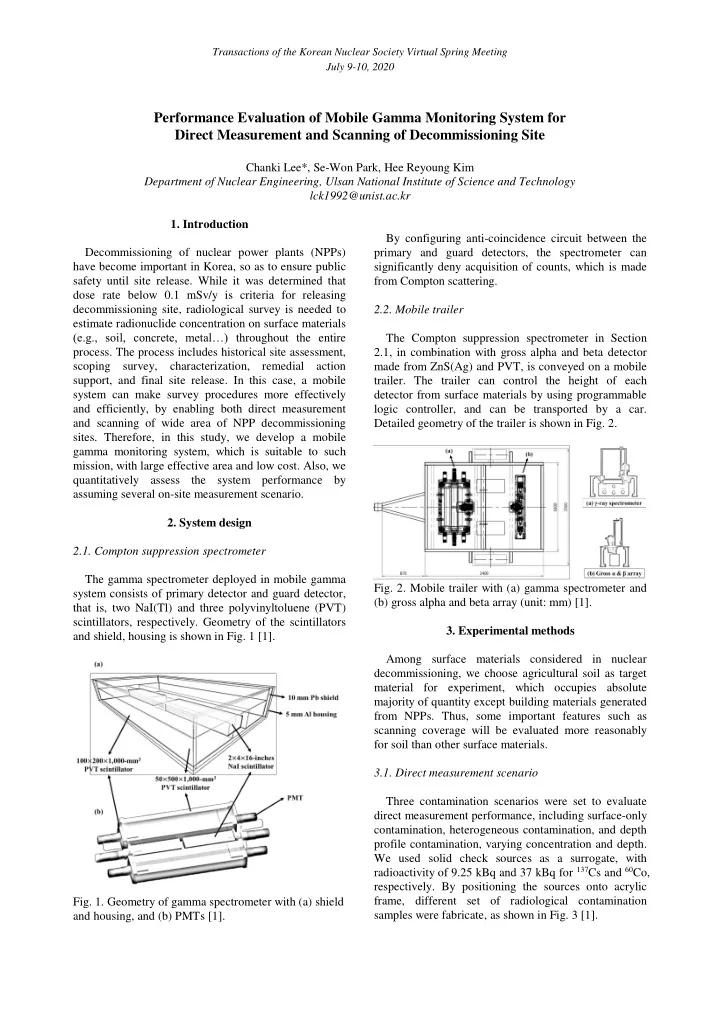
detector from surface materials by using programmable logic controller, and can be transported by a car. Detailed geometry of the trailer is shown in Fig. 2.
- Fig. 2. Mobile trailer with (a) gamma spectrometer and
(b) gross alpha and beta array (unit: mm) [1].
- 3. Experimental methods
Among surface materials considered in nuclear decommissioning, we choose agricultural soil as target material for experiment, which occupies absolute majority of quantity except building materials generated from NPPs. Thus, some important features such as scanning coverage will be evaluated more reasonably for soil than other surface materials. 3.1. Direct measurement scenario Three contamination scenarios were set to evaluate direct measurement performance, including surface-only contamination, heterogeneous contamination, and depth profile contamination, varying concentration and depth. We used solid check sources as a surrogate, with radioactivity of 9.25 kBq and 37 kBq for 137Cs and 60Co,
- respectively. By positioning the sources onto acrylic