Performance Assessment Framework Employment and Social Protection - - PDF document

performance assessment framework
SMART_READER_LITE
LIVE PREVIEW

Performance Assessment Framework Employment and Social Protection - - PDF document

25/09/2019 Performance Assessment Framework Employment and Social Protection 1. PUBLIC BUDGET FOR ACTIVE EMPLOYMENT POLICIES 2. EMPLOYMENT RATE (15+): TOTAL, MEN, WOMEN 3. EMPLOYMENT RATE (20-64): TOTAL, MEN, WOMEN 4. UNEMPLOYMENT RATE (15+):


slide-1
SLIDE 1

25/09/2019 1

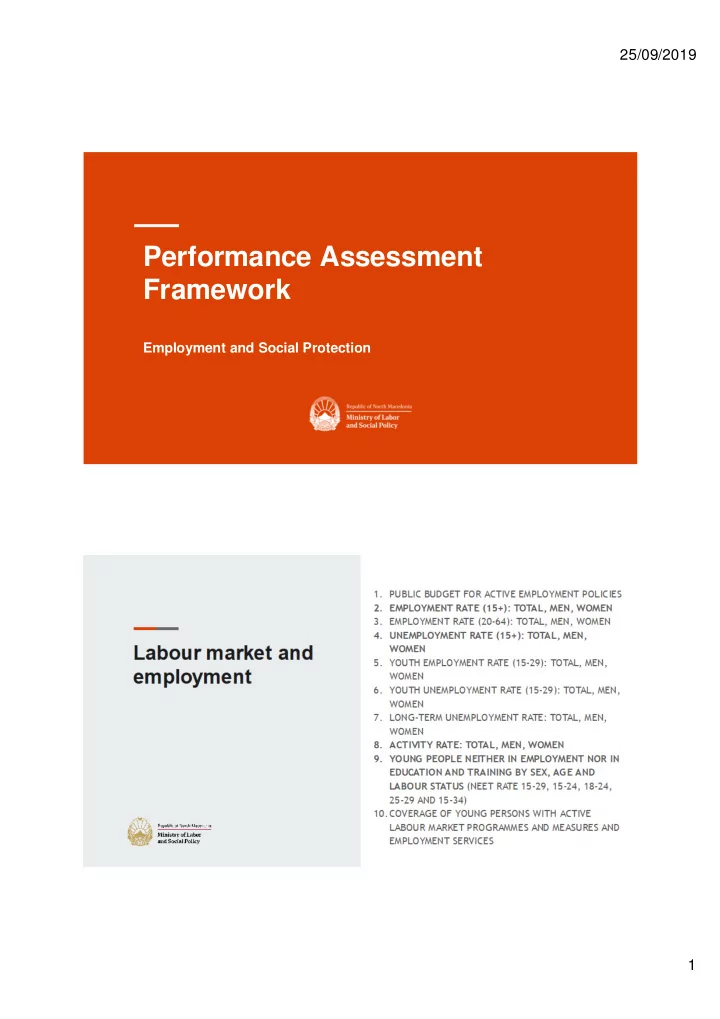
Performance Assessment Framework

Employment and Social Protection

Labour market and employment

  • 1. PUBLIC BUDGET FOR ACTIVE EMPLOYMENT POLICIES
  • 2. EMPLOYMENT RATE (15+): TOTAL, MEN, WOMEN
  • 3. EMPLOYMENT RATE (20-64): TOTAL, MEN, WOMEN
  • 4. UNEMPLOYMENT RATE (15+): TOTAL, MEN,

WOMEN

  • 5. YOUTH EMPLOYMENT RATE (15-29): TOTAL, MEN,

WOMEN

  • 6. YOUTH UNEMPLOYMENT RATE (15-29): TOTAL, MEN,

WOMEN

  • 7. LONG-TERM UNEMPLOYMENT RATE: TOTAL, MEN,

WOMEN

  • 8. ACTIVITY RATE: TOTAL, MEN, WOMEN
  • 9. YOUNG PEOPLE NEITHER IN EMPLOYMENT NOR IN

EDUCATION AND TRAINING BY SEX, AGE AND LABOUR STATUS (NEET RATE 15-29, 15-24, 18-24, 25-29 AND 15-34)

  • 10. COVERAGE OF YOUNG PERSONS WITH ACTIVE

LABOUR MARKET PROGRAMMES AND MEASURES AND EMPLOYMENT SERVICES

slide-2
SLIDE 2

25/09/2019 2

EMPLOYMENT RATE (15+): TOTAL, MEN, WOMEN

Employed people among the population

  • f the age group 15-79

To which extent available labour resources are being used in the country Labour Force Survey, State Statistical Office % Definition Rationale Sources Unit

UNEMPLOYMENT RATE (15+): TOTAL, MEN, WOMEN

Unemployed persons aged 15-74 as a percentage of the labour force, where the later consist of the employed and the unemployed Points to the efficiency and effectiveness

  • f an economy to absorb its labour force

Labour Force Survey, State Statistical Office % Definition Rationale Sources Unit

slide-3
SLIDE 3

25/09/2019 3

ACTIVITY RATE: TOTAL, MEN, WOMEN

Participation of the economically active in the working age population aged 15 years plus Essential in determining the size and composition of a country’s human resources and in making projections of the future supply of labour Labour Force Survey, State Statistical Office % Definition Rationale Sources Unit

YOUNG PEOPLE NEITHER IN EMPLOYMENT NOR IN EDUCATION AND TRAINING (NEET RATE 15-29)

Percentage of the population of a given age group and sex who is not employed (i.e. who are either unemployed or inactive) and not involved in education or training Points to untapped potential of youth who could contribute to national development Labour Force Survey, State Statistical Office % Definition Rationale Sources Unit

slide-4
SLIDE 4

25/09/2019 4

Social protection

  • 1. EXPENDITURE ON ALL TYPES OF SOCIAL PROTECTION

EXPENDITURE AS A SHARE OF GDP

  • 2. AT-THE-RISK POVERTY RATE (AFTER SOCIAL TRANSFERS)

3.

AT-THE-RISK POVERTY RATE (BEFORE SOCIAL TRANSFERS AND BEFORE PENSIONS)

4.

AT-RISK-OF-POVERTY RATE BEFORE SOCIAL TRANSFERS (EXCEPT PENSIONS)

5.

PEOPLE AGED 0-59 LIVING IN HOUSEHOLDS WITH LOW WORK INTENSITY

  • 6. COVERAGE OF SOCIAL ASSISTANCE AMONG THE POOREST

QUINTILE

  • 7. MEDIAN RELATIVE INCOME OF ELDERLY PEOPLE

8.

AGGREGATE REPLACEMENT RATIO FOR PENSIONS (EXCLUDING OTHER SOCIAL BENEFITS) BY SEX

9.

NUMBER OF USERS IN THE RESIDENTIAL SOCIAL PROTECTION INSTITUTIONS

  • 10. NUMBER OF TRANSFORMED RESIDENTIAL SOCIAL

PROTECTION INSTITUTIONS

  • 11. REGIONAL DISTRIBUTION OF LICENSED SERVICE PROVIDERS
  • 12. NUMBER OF USERS OF SOCIAL SERVICES (PER TYPE OF

SERVICE)

  • 13. ROMA PEOPLE INVOLVED IN LABOUR MARKET SERVICES AND

ACTIVE EMPLOYMENT PROGRAMMES

EXPENDITURE ON ALL TYPES OF SOCIAL PROTECTION EXPENDITURE AS A SHARE OF GDP

Budget for expenditures for social protection as a share (%) of Gross Domestic Product (GDP) Measures the size of the public support for social protection which is provided to household and individuals affected by a specific set of social risks and needs: disability, sickness/ health care, old age, survivors, family/children, unemployment, housing and social exclusion ESSPROS, EUROSTAT % Definition Rationale Sources Unit

slide-5
SLIDE 5

25/09/2019 5

AT THE RISK OF POVERTY RATE (AFTER SOCIAL TRANSFERS)

Proportion of the population that has an income level below the national at-risk-of- poverty threshold, set at 60 % of the national median equivalised disposable income (after social transfers) Informs about the monetary dimension of poverty and social exclusion, i.e. the levels

  • f income below which the population is

considered to have relatively low income Survey on Income and Living Conditions, SSO % Definition Rationale Sources Unit

MEDIAN RELATIVE INCOME OF ELDERLY PEOPLE

The ratio between the median equivalised disposable income of persons aged 65 or over and the median equivalised disposable income

  • f persons aged between 0 and 64

Points to the material living conditions of elderly Survey on Income and Living Conditions, EUROSTAT Ratio Definition Rationale Sources Unit

slide-6
SLIDE 6

25/09/2019 6 COVERAGE OF SOCIAL ASSISTANCE AMONG THE POOREST QUINTILE

Share of the poorest quintile receiving social assistance. The indicator measures the effectiveness of social benefits in reducing poverty i.e. if the social protection benefits reach the poor and vulnerable. Survey on Income and Living Conditions, State Statistical Office % Definition Rationale Sources Unit

Pre-school education and care

  • 1. ENROLMENT RATE OF CHILDREN 3 TO 5 IN PRE-

SCHOOL AND CARE

  • 2. PRE-SCHOOL ENROLLMENT RATES FOR CHILDREN 3 TO 6

YEARS OLD WHO BELONG TO THE RECIPIENTS OF THE SOCIAL WELFARE

  • 3. SHARE OF ROMA CHILDREN IN THE TOTAL NUMBER OF

CHILDREN ENROLLMENT IN PRE-SCHOOL AND CARE

  • 4. PRE-SCHOOL STAFF/CHILDREN RATIO
  • 5. NUMBER OF EDUCATORS AND CAREGIVERS INVOL

VED IN PROFESSIONAL DEVELOPMENT TRAININGS DIVIDED BY THE TOTAL NUMBER OF EDUCATORS AND CAREGIVERS

slide-7
SLIDE 7

25/09/2019 7

ENROLMENT RATE OF CHILDREN 3-5 IN PRE-SCHOOL AND CARE

The percentage of children aged 3-5 enrolled in or using pre-school and childcare services Informs about the participation in early childhood education as a foundation for later educational success Publication “Institution of Care and Education of Children” and population estimates, State Statistical Office % Definition Rationale Sources Unit

Thank you