Pennsylvania State University Atrium Medical Corporation - - PowerPoint PPT Presentation

pennsylvania state university atrium medical corporation
SMART_READER_LITE
LIVE PREVIEW

Pennsylvania State University Atrium Medical Corporation - - PowerPoint PPT Presentation

Pennsylvania State University Atrium Medical Corporation Architectural Engineering Table of Contents Headquarters Facility Senior Thesis Final Presentation Title Page Project Information Depth Analysis 1 Depth Analysis 2 Depth Analysis 3


slide-1
SLIDE 1

Jeffrey Martin | Advisor: Dr. Robert Leicht | Final Presentation

Table of Contents

Project Information Depth Analysis 1 Depth Analysis 2 Depth Analysis 3 Conclusion & Recommendations Acknowledgements Title Page

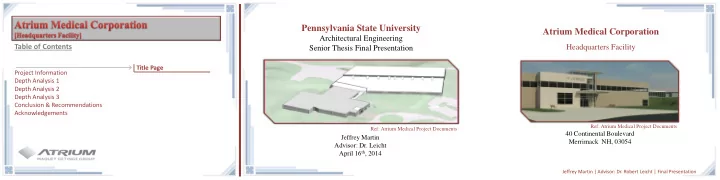
Pennsylvania State University

Architectural Engineering Senior Thesis Final Presentation

Atrium Medical Corporation

Headquarters Facility

40 Continental Boulevard Merrimack NH, 03054 Jeffrey Martin Advisor: Dr. Leicht April 16th, 2014

Ref: Atrium Medical Project Documents Ref: Atrium Medical Project Documents

slide-2
SLIDE 2

Jeffrey Martin | Advisor: Dr. Robert Leicht | Final Presentation

Table of Contents

Title Page Depth Analysis 1 Depth Analysis 2 Depth Analysis 3 Conclusion & Recommendations Acknowledgements Project Information

  • Existing Conditions
  • Owner Information
  • Building Information

Project Information: Existing Conditions

Location: 40 Continental Boulevard, Merrimack, NH 03054 Site Size: 2,367,100 SF Existing Structure: 2 Story building 114,000 SF Previous Owner: Fidelity Investments New Owner: Atrium Medical Corporation/ Maquet Getinge Group Project Scope: Existing Renovation 101,200 SF New Addition Existing 100,000SF Building to be Renovated Proposed 101,200 SF New Addition (Footprint)

Ref: www.google.com/maps

slide-3
SLIDE 3

Jeffrey Martin | Advisor: Dr. Robert Leicht | Final Presentation

Table of Contents

Title Page Depth Analysis 1 Depth Analysis 2 Depth Analysis 3 Conclusion & Recommendations Acknowledgements Project Information

  • Existing Conditions
  • Owner Information
  • Building Information

Project Information: Owner Information

Project Owner: Atrium Medical Corporation/ MAQUET/GETINGE Group Previous Owner: Fidelity Investments Reason for Purchase: Company Expansion Bring all 450 + Employees Into One Facility. Divisions of Work: Manufacturing, Storage, Business Offices, R&D, Engineering Shops

  • Specializes in R&D and Manufacturing
  • Cardiology
  • Radiology
  • Chest Trauma
  • Thoracic Drainage
  • Business unit of MAQUET Cardiovascular

(Structured Alliance)

  • Member of GETINGE Group of companies

Ref: www.classiccapital.net Ref: www.theiddoctor.info

slide-4
SLIDE 4

Jeffrey Martin | Advisor: Dr. Robert Leicht | Final Presentation

Table of Contents

Title Page Depth Analysis 1 Depth Analysis 2 Depth Analysis 3 Conclusion & Recommendations Acknowledgements Project Information

  • Existing Conditions
  • Owner Information
  • Building Information

Project Information: Building Information

  • Project Location:

40 Continental Boulevard, Merrimack, NH 03054

  • Building Size:

101,200 SF

  • Zoning:

I-3 Industrial

  • Description:

Single Story Building Interior Mezzanine

  • CM Firm:

Hutter Construction

  • Architect:

Lavallee Brensinger

  • Structural Engineer:

Foley Buhl Roberts

  • Civil Engineer:

Hayner Swanson Inc.

  • Mechanical Engineer:

Johnson & Jordan Inc.

  • Electrical Engineer:

Gate City Electric

Ref: All Images found on www.google.com/images Ref: Atrium Medical Project Documents

slide-5
SLIDE 5

Jeffrey Martin | Advisor: Dr. Robert Leicht | Final Presentation

Table of Contents

Title Page Project Information Depth Analysis 2 Depth Analysis 3 Conclusion & Recommendations Acknowledgements Depth Analysis 1

  • Problem Statement
  • Proposed Solution
  • Structural Breadth
  • Total Design Summary
  • Analysis Results

Depth Analysis 1: Problem Statement

  • Structure:

Steel Superstructure

  • Beams:

Wide Flange Steel Beams

  • Columns:

Wide Flange Steel Columns

  • Roof Joists:

K-Series Joists

  • Lateral Bracing:

HSS Steel Sections

  • Foundations:

Concrete spread & strip footings and piers Description of Structure: Steel Structure: Atrium Medical Corporation Problem: Owner not utilizing the opportunity to develop a more efficient structure, in regards to either cost or scheduling.

Ref: Atrium Medical Revit Structural Model

slide-6
SLIDE 6

Jeffrey Martin | Advisor: Dr. Robert Leicht | Final Presentation

Table of Contents

Title Page Project Information Depth Analysis 2 Depth Analysis 3 Conclusion & Recommendations Acknowledgements Depth Analysis 1

  • Problem Statement
  • Proposed Solution
  • Structural Breadth
  • Total Design Summary
  • Analysis Results

Sequence of Events: Advantages of Precast Structures: Disadvantages of Precast Structures:

  • Decrease in Project Schedule
  • Saves Space on-site
  • Saves Money (labor)
  • Availability
  • Timing
  • Small Margin of Error
  • High Material Cost

Depth Analysis 1: Proposed Solution

Develop System Design (Precast Concrete) Structural Breadth Select Precast Components Develop Load Cases Size Precast Members Perform Cost Analysis Perform Install. Analysis Results & System Comparison Depth Analysis

Ref: All Images found on www.google.com/images

slide-7
SLIDE 7

Jeffrey Martin | Advisor: Dr. Robert Leicht | Final Presentation

Table of Contents

Title Page Project Information Depth Analysis 2 Depth Analysis 3 Conclusion & Recommendations Acknowledgements Depth Analysis 1

  • Problem Statement
  • Proposed Solution
  • Structural Breadth
  • Developing a Design
  • Determining Loads
  • Sizing Members
  • Total Design Summary
  • Analysis Results

Depth Analysis 1: Structural Breadth: Developing a Design

Double Tee Beam Inverted Tee Beam Ledger Beam Square Concrete Columns

Column Line 6 Column Line 5 Column Line 4 Column Line 3 Column Line 2 Column Line 1

Proposed System Layout

Ref: www.concretetech.com Ref: www.cpm-group.com Ref: www.dynaspan.com Ref: www.timesunion.com Ref: Atrium Medical Project Documents Ref: www.nitterhouse.com/technical-info Ref: www.nitterhouse.com/technical-info Ref: www.nitterhouse.com/technical-info Ref: www.condor-rebar.com

slide-8
SLIDE 8

Jeffrey Martin | Advisor: Dr. Robert Leicht | Final Presentation

Table of Contents

Title Page Project Information Depth Analysis 2 Depth Analysis 3 Conclusion & Recommendations Acknowledgements Depth Analysis 1

  • Problem Statement
  • Proposed Solution
  • Structural Breadth
  • Developing a Design
  • Determining Loads
  • Sizing Members
  • Total Design Summary
  • Analysis Results

Snow Loads:

  • Snow loads from structural

drawings

  • Flat Roof Snow Load = 42

PSF Mechanical Loads

  • Loads due to (8) AHU’s and (4) RTU’s
  • Act as point load(s) throughout roof
  • Maximum AHU load = 9000 lbs.

Snow Drift Loads:

  • Two main roof levels
  • Lower Roof Height = 17’ 0”
  • Higher Roof Height = 27’ 8”
  • Max Surcharge = 92.31 PSF
  • Surcharge Length = 16.94

Member Self Weights & Superimposed Loads

  • Loads from:
  • Double Tees
  • Ledger & Inverted Tee Beams
  • Superimposed Dead = 15 PSF

Depth Analysis 1: Structural Breadth: Determining Loads

Ref: Atrium Medical Project Documents Ref: www.nitterhouse.com/technical-info Ref: www.trane.com

slide-9
SLIDE 9

Jeffrey Martin | Advisor: Dr. Robert Leicht | Final Presentation

Table of Contents

Title Page Project Information Depth Analysis 2 Depth Analysis 3 Conclusion & Recommendations Acknowledgements Depth Analysis 1

  • Problem Statement
  • Proposed Solution
  • Structural Breadth
  • Developing a Design
  • Determining Loads
  • Sizing Members
  • Total Design Summary
  • Analysis Results

Depth Analysis 1: Structural Breadth: Sizing Members

Double Tee Beam Inverted Tee Beam Interior Ledger Beam Concrete Column Loads Exterior Ledger Beam

Column Line # Total Axial Loads Column Line 1 178.4 kips Column Line 2 409.6 kips Column Line 3 426.8 kips Column Line 4 463.1 kips Column Line 5 409.6 kips Column Line 6 178.4 kips Designs Selected For Columns by Column Line Column Line 1 10" x 10" w/ 4 - #5 bars at 17 ft height Column Line 2 10" x 10" w/ 4 - #10 bars at 17 ft height Column Line 3 10" x 10" w/ 4 - #11 bars at 17 ft height Column Line 4 12" x 12" w/ 4 - #8 bars at 27.5 ft height Column Line 5 10" x 10" w/ 4 - #10 bars at 27.5 ft height Column Line 6 10" x 10" w/ 4 - #5 bars at 27.5 ft height

Concrete Column Designs

0.57 k/ft. 9 kips 0.923k/ft. 6.083 k/ft. 4.289 k/ft. 2.875k/ft.

Beam Designs

26”x10’ D.T (No Topping), 26-6.6P Inverted Tee Beam 40IT36-A 32LB28 (SP 13-6-0) (TB 6 - #9) 18LB32 (SP 6-4-0) (TB 4 - #9)

slide-10
SLIDE 10

Jeffrey Martin | Advisor: Dr. Robert Leicht | Final Presentation

Table of Contents

Title Page Project Information Depth Analysis 2 Depth Analysis 3 Conclusion & Recommendations Acknowledgements Depth Analysis 1

  • Problem Statement
  • Proposed Solution
  • Structural Breadth
  • Total Design Summary
  • Cost Summary
  • Installation Summary
  • Analysis Results

Depth Analysis 1: Total Design Summary: Cost Summary

Type Quantity Length Unit Mat'l Cost/Unit Total Mat'l Cost Labor/Equip. Cost/Unit Total Labor/Equip. Cost Double Tee Beam

188 50 LF $18.00 $169,200.00 $700.00 $131,600.00

Inverted Tee Beam

29 40 LF $275.00 $319,000.00 $700.00 $20,300.00

Interior Ledger Beam

10 40 LF $275.00 $110,000.00 $700.00 $7,000.00

Exterior Ledger Beam

28 40 LF $275.00 $308,000.00 $700.00 $19,600.00

Column Line 1

10 17 LF $275.00 $46,750.00 $700.00 $7,000.00

Column Line 2

11 17 LF $275.00 $51,425.00 $700.00 $7,700.00

Column Line 3

11 17 LF $275.00 $51,425.00 $700.00 $7,700.00

Column Line 4

11 27.5 LF $275.00 $83,187.00 $700.00 $7,700.00

Column Line 5

10 27.5 LF $275.00 $75,625.00 $700.00 $7,000.00

Column Line 6

10 27.5 LF $275.00 $75,625.00 $700.00 $7,000.00 Total $1,290,237.00 Total $222,600.00 Total Initial System Cost $1,512,837.00 Footing Type Original Cost Cost Increase (35%) Spread Footings $69,225.81 $24,229.03 Strip Footings $25,675.92 $8,986.57 Additional Concrete Cost $33,216.00

Initial System Cost: $1,512,837.00 + Additional Footing Cost: $33,216.00 = Total System Cost: $1,546,053.00 Additional Footing Cost: Total Precast Cost Summary:

slide-11
SLIDE 11

Jeffrey Martin | Advisor: Dr. Robert Leicht | Final Presentation

Table of Contents

Title Page Project Information Depth Analysis 2 Depth Analysis 3 Conclusion & Recommendations Acknowledgements Depth Analysis 1

  • Problem Statement
  • Proposed Solution
  • Structural Breadth
  • Total Design Summary
  • Cost Summary
  • Installation Summary
  • Analysis Results

Depth Analysis 1: Total Design Summary: Installation Summary

Type Quantity Double Tee Beam 188 Inverted Tee Beam 29 Interior Ledger Beam 10 Exterior Ledger Beam 28 Column Line 1 10 Column Line 2 11 Column Line 3 11 Column Line 4 11 Column Line 5 10 Column Line 6 10 Total Members 318 # Picks per day ~ 6 to 8 Days for completion 40 to 53 Days

Total Precast Installation Summary: Total System Installation Time: 40 to 53 days

Ref: www.timesunion.com Ref: www.dynaspan.com Ref: www.concretetech.com

slide-12
SLIDE 12

Jeffrey Martin | Advisor: Dr. Robert Leicht | Final Presentation

Table of Contents

Title Page Project Information Depth Analysis 2 Depth Analysis 3 Conclusion & Recommendations Acknowledgements Depth Analysis 1

  • Problem Statement
  • Proposed Solution
  • Structural Breadth
  • Total Design Summary
  • Analysis Results

Depth Analysis 1: Analysis Results

Total Cost Installation Time (days) Precast Structural System (Proposed System) $1,546,053.00 53 to 40 Steel Structural System (Original System) $1,273,160.00 45 Difference (+) $272,893.00 (+) 8 to (-) 5

Overall Systems Comparison and Analysis Results: Issues:

  • Cost is too high
  • Schedule decrease not significant

Costs 100 Ton Crane Rental Cost $18,000.00 Add'l Cost of Precast System $272,893.00 Total System Cost $290,893.00 Installation Times Total Steel Member Qty. 318 # Picks per day (one crane) ~6 to 8 # Picks per day (two cranes) ~12 to 16 Total System Installation Time (days) 20 to 26.5

Solution:

  • Add another crane on-site

Adjusted Costs and Installation Times: Revised Precast System Cost: $1,564,053 Revised Precast System Installation Time: 20 to 26.5 days

slide-13
SLIDE 13

Jeffrey Martin | Advisor: Dr. Robert Leicht | Final Presentation

Table of Contents

Title Page Project Information Depth Analysis 2 Depth Analysis 3 Conclusion & Recommendations Acknowledgements Depth Analysis 1

  • Problem Statement
  • Proposed Solution
  • Structural Breadth
  • Total Design Summary
  • Analysis Results

Depth Analysis 1: Analysis Results

Crane 1 Crane 2 Bed Trucks with Precast Members Move Along Building Perimeter for Ease of Access. Truck Truck

  • Project will utilize (2) 100

Ton Crawler Cranes

  • Cranes will move within

building footprint

  • (1) crane in

Manufacturing area

  • (1) crane in Warehouse

Area

  • Movement of work flow from

East to West

  • Gives Total Installation time

= 20 to 26.5 days

Manufacturing Warehouse

Ref: Atrium Medical Project Documents Ref: www.bigge.com

slide-14
SLIDE 14

Jeffrey Martin | Advisor: Dr. Robert Leicht | Final Presentation

Table of Contents

Title Page Project Information Depth Analysis 1 Depth Analysis 3 Conclusion & Recommendations Acknowledgements Depth Analysis 2

  • Problem Statement
  • Proposed Solution
  • Mechanical Breadth
  • Total Design Summary
  • Analysis Results

Depth Analysis 2: Problem Statement

  • Design

Kingspan Micro-Rib Insulated Metal Panels

  • Location:

Exterior Warehouse Area

  • Area (SF)
  • Southern Face:

3,106 SF

  • Eastern Face:

2,788 SF

  • Northern Face:

10,401 SF

  • Western Face:

4,016 SF Description of Envelope: Problem: Owner not utilizing the opportunity to create a more efficient building envelope surrounding the warehouse area.

Ref: www.kingspanpanels.us

slide-15
SLIDE 15

Jeffrey Martin | Advisor: Dr. Robert Leicht | Final Presentation

Table of Contents

Title Page Project Information Depth Analysis 1 Depth Analysis 3 Conclusion & Recommendations Acknowledgements Depth Analysis 2

  • Problem Statement
  • Proposed Solution
  • Mechanical Breadth
  • Total Design Summary
  • Analysis Results

Depth Analysis 2: Proposed Solution

Develop System Design (Precast Insulated Panels) Mech. Breadth Thermal Analysis

  • f Systems

Compare Thermal Efficiency‘s Perform Cost Analysis Perform Install. Analysis Results & System Comparison Depth Analysis

Sequence of Events: Advantages of Precast Insulated Panels: Disadvantages of Precast Insulated Panels:

  • Decrease Time in Project Schedule
  • Versatility
  • Energy & Thermal Efficiency
  • Fire Resistance
  • High Materials Cost
  • Timing

Description of Systems

slide-16
SLIDE 16

Jeffrey Martin | Advisor: Dr. Robert Leicht | Final Presentation

Table of Contents

Title Page Project Information Depth Analysis 1 Depth Analysis 3 Conclusion & Recommendations Acknowledgements Depth Analysis 2

  • Problem Statement
  • Proposed Solution
  • Mechanical Breadth
  • Description of Systems
  • Thermal Analysis &

Results

  • Total Design Summary
  • Analysis Results

Depth Analysis 2: Mechanical Breadth: Description of Systems

Original System: Insulated Metal Panels Proposed System: Precast Insulated Panels

Ref: Atrium Medical Project Documents Ref: www.kingspanpanels.us Ref: www.spancrete.com Ref: www.spancrete.com Ref: www.spancrete.com

slide-17
SLIDE 17

Jeffrey Martin | Advisor: Dr. Robert Leicht | Final Presentation

Insulated Metal Panels

Thermal Analysis: Heat Transfer (Extreme Summer Cond. Int = 64.4◦F, Ext = 104◦F) Outside (Ta)(◦C) = 40 Inside (Td)(◦C) = 18 ∆Ti = U * (Ta-Td) * Ri Conductivit y (k) Thickness (m) Conductance (Ci) Resistance (Ri) ∆T T (◦C) Interior Temp. 18.00

  • Int. Film

N.A. N.A. 8.3 0.120481928 0.6797791 18.68 Metal Panel 18 0.00045466 39,590.02 2.52589E-05 0.0001425 18.68 Insulation 0.02 0.074985 0.27 3.74925 21.153894 39.83 Metal Panel 18 0.00075946 23,701.05 4.21922E-05 0.0002381 39.83

  • Ext. Film

N.A. N.A. 34 0.029411765 0.1659461 40.00 RSI Total = 3.899 R-Value = 22.140 U-Value = 0.256

Table of Contents

Title Page Project Information Depth Analysis 1 Depth Analysis 3 Conclusion & Recommendations Acknowledgements Depth Analysis 2

  • Problem Statement
  • Proposed Solution
  • Mechanical Breadth
  • Description of Systems
  • Thermal Analysis &

Results

  • Total Design Summary
  • Analysis Results

Depth Analysis 2: Mechanical Breadth: Thermal Analysis & Results

Insulated Metal Panels: Summer Conditions Insulated Metal Panels: Winter Conditions

Insulated Metal Panels

Thermal Analysis: Heat Transfer (Extreme Winter Cond. Int = 64.4◦F, Ext = -29◦F) Outside (Ta)(◦C) =

  • 34

Inside (Td)(◦C) = 18 ∆Ti = U * (Ta-Td) * Ri Conductivity (k) Thickness (m) Conductance (Ci) Resistance (Ri) ∆T T (◦C) Interior Temp. 18.00

  • Int. Film

N.A. N.A. 8.3 0.120481928

  • 1.60675

16.39 Metal Panel 18 0.00045466 39,590.02 2.52589E-05

  • 0.00034

16.39 Insulation 0.02 0.074985 0.27 3.74925

  • 50.0001
  • 33.61

Metal Panel 18 0.00075946 23,701.05 4.21922E-05

  • 0.00056
  • 33.61
  • Ext. Film

N.A. N.A. 34 0.029411765

  • 0.39224
  • 34.00

RSI Total = 3.899 R-Value = 22.140 U-Value = 0.256

slide-18
SLIDE 18

Jeffrey Martin | Advisor: Dr. Robert Leicht | Final Presentation

Table of Contents

Title Page Project Information Depth Analysis 1 Depth Analysis 3 Conclusion & Recommendations Acknowledgements Depth Analysis 2

  • Problem Statement
  • Proposed Solution
  • Mechanical Breadth
  • Description of Systems
  • Thermal Analysis &

Results

  • Total Design Summary
  • Analysis Results

Depth Analysis 2: Mechanical Breadth: Thermal Analysis & Results

Precast Insulated Panels

Thermal Analysis: Heat Transfer (Extreme Summer Cond. Int = 64.4◦F, Ext = 104◦F) Outside (Ta)(◦C) = 40 Inside (Td)(◦C) = 18 ∆Ti = U * (Ta-Td) * Ri Conductivity (k) Thickness (m) Conductance (Ci) Resistance (Ri) ∆T T (◦C) Interior Temp. 18.00

  • Int. Film

N.A. N.A. 8.3 0.120481928 0.6326882 18.63 Concrete 0.7 0.1524 4.59 0.217714286 1.1432856 19.78 Insulation 0.02 0.074985 0.27 3.74925 19.688481 39.46 Concrete 0.7 0.0508 13.78 0.072571429 0.3810952 39.85

  • Ext. Film

N.A. N.A. 34 0.029411765 0.1544503 40.00 RSI Total = 4.189 R-Value = 23.788 U-Value = 0.239

Precast Insulated Panels

Thermal Analysis: Heat Transfer (Extreme Winter Cond. Int = 64.4◦F, Ext = -29◦F) Outside (Ta)(◦C) =

  • 34

Inside (Td)(◦C) = 18 ∆Ti = U * (Ta-Td) * Ri Conductivity (k) Thickness (m) Conductance (Ci) Resistance (Ri) ∆T T (◦C) Interior Temp. 18.00

  • Int. Film

N.A. N.A. 8.3 0.120481928

  • 1.49544

16.50 Concrete 0.7 0.1524 4.59 0.217714286

  • 2.70231

13.80 Insulation 0.02 0.074985 0.27 3.74925

  • 46.5364
  • 32.73

Concrete 0.7 0.0508 13.78 0.072571429

  • 0.90077
  • 33.63
  • Ext. Film

N.A. N.A. 34 0.029411765

  • 0.36506
  • 34.00

RSI Total = 4.189 R-Value = 23.788 U-Value = 0.239

Precast Insulated Panels: Summer Conditions Precast Insulated Panels: Winter Conditions

slide-19
SLIDE 19

Jeffrey Martin | Advisor: Dr. Robert Leicht | Final Presentation

Table of Contents

Title Page Project Information Depth Analysis 1 Depth Analysis 3 Conclusion & Recommendations Acknowledgements Depth Analysis 2

  • Problem Statement
  • Proposed Solution
  • Mechanical Breadth
  • Total Design Summary
  • Cost Summary
  • Installation Summary
  • Analysis Results

Depth Analysis 2: Total Design Summary: Cost Summary

Location Area (ft2) Unit Material $/Unit Material $ Southern Face 3106 SF 18 $ 55,908.00 Eastern Face 2788 SF 18 $ 50,184.00 Northern Face 10401 SF 18 $ 187,218.00 Western Face 4016 SF 18 $ 72,288.00 $ 365,598.00 Location Quantity Unit Labor/Equip $/Unit Labor/Equip $ Southern Face 14 Ea. 700 $ 9,800.00 Eastern Face 13 Ea. 700 $ 9,100.00 Northern Face 47 Ea. 700 $ 32,900.00 Western Face 18 Ea. 700 $ 12,600.00 $ 64,400.00 Total Cost $ 429,998.00

Footing Type Original Cost Cost Increase (35%) Spread Footings $40,631.00 $14,221.00 Additional Concrete Cost $14,221.00

Additional Footing Cost: Precast Insulated Panel Cost: Initial System Cost: $429,998.00 + Additional Footing Cost: $14,221.00 = Total System Cost: $444,219.00

slide-20
SLIDE 20

Jeffrey Martin | Advisor: Dr. Robert Leicht | Final Presentation

Table of Contents

Title Page Project Information Depth Analysis 1 Depth Analysis 3 Conclusion & Recommendations Acknowledgements Depth Analysis 2

  • Problem Statement
  • Proposed Solution
  • Mechanical Breadth
  • Total Design Summary
  • Cost Summary
  • Installation Summary
  • Analysis Results

Depth Analysis 2: Total Design Summary: Installation Summary

Location Area (ft2) Member Area (ft2) Quantity (Area/Member Area) Southern Face 3106 221.36 14 Eastern Face 2788 221.36 13 Northern Face 10401 221.36 47 Western Face 4016 221.36 18 Total Quantity 92 # Picks per Day ~6 to 8 Total Installation Time 12 to 15

Total System Installation Time: 12 to 15 days Precast Insulated Panel Install Time:

Ref: www.spancrete.com Ref: www.spancrete.com

slide-21
SLIDE 21

Jeffrey Martin | Advisor: Dr. Robert Leicht | Final Presentation

Table of Contents

Title Page Project Information Depth Analysis 1 Depth Analysis 3 Conclusion & Recommendations Acknowledgements Depth Analysis 2

  • Problem Statement
  • Proposed Solution
  • Mechanical Breadth
  • Total Design Summary
  • Analysis Results

Depth Analysis 2: Analysis Results

Insulated Metal Panel System Cost Subtotal $354,400.00 HSS Framing Cost (+) $46,355.00 Metal Panel Cost (-) $31,007.00 Total System Cost $369,748.00 Total Wall Panel System Installation Time = 67 Days System Type Area (ft^2) % of Install. Time Total Install. Time (days) Metal Wall Panels 7,112 26% 17 Insulated Metal Panels 20,311 74% 50 Total = 27,423 100% 67

Total Cost Installation Time (days) Precast Insulated Panels $444,219.00 12 to 15 Insulated Metal Panels $369,748.00 50 Difference (+) $74,471 (-) 38 to (-) 35

Insulated Metal Panel Costs: Insulated Metal Panel Installation Time: Overall Systems Comparison and Analysis Results:

Ref: www.bossteel.com Ref: www.bossteel.com

slide-22
SLIDE 22

Jeffrey Martin | Advisor: Dr. Robert Leicht | Final Presentation

Table of Contents

Title Page Project Information Depth Analysis 1 Depth Analysis 2 Conclusion & Recommendations Acknowledgements Depth Analysis 3

  • Problem Statement
  • Proposed Solution
  • PtD Industry
  • System Selection
  • Typical Steel Connections
  • NISD Details
  • Analysis Results

Depth Analysis 3: Problem Statement

Problem: Owner not utilizing the opportunity to plan and design for safety consideration prior to project’s construction.

  • Formal safety plan for field and office

staff during construction

  • Superintendents have OSHA 30-Hour

training

  • All other employees have OSHA 10-

Hour training.

  • Weekly toolbox talks
  • Basic construction safety (i.e. PPE,
  • Equip. Safety etc.)

“Training is an integral part of Hutter’s safety

  • commitment. In addition to the traditional weekly

toolbox talks, ongoing safety training is regularly provided by outside professionals. Among the topics continually addressed: competent persons, confined space, boom lifts, forklifts, snorkel lifts, CPR and first

  • aid. All of our employees, including project managers

have received the OSHA 10-Hour certified training and new employees receive the training within 30 days of hire. All of our superintendents have received OSHA 30-Hour training.” Hutter Construction on Safety: Summary of Safety Plan:

Ref: www.hutterconstruction.com

slide-23
SLIDE 23

Jeffrey Martin | Advisor: Dr. Robert Leicht | Final Presentation

Table of Contents

Title Page Project Information Depth Analysis 1 Depth Analysis 2 Conclusion & Recommendations Acknowledgements Depth Analysis 3

  • Problem Statement
  • Proposed Solution
  • PtD Industry
  • System Selection
  • Typical Steel Connections
  • NISD Details
  • Analysis Results

Depth Analysis 3: Proposed Solution

PtD Industry Typical Steel Connections NISD Details System Selection Based on Risk Analysis Results

Sequence of Events: Benefits of Implementing a Design Guide: Barriers of Implementing a Design Guide:

  • Increase Safety Consideration
  • Increase in Quality Control
  • Reduce Delays
  • Increase in Productivity
  • Increase Collaboration between

Designer & Constructors

  • Designer’s Liability
  • Additional Costs
  • Lack of Expertise
slide-24
SLIDE 24

Jeffrey Martin | Advisor: Dr. Robert Leicht | Final Presentation

Table of Contents

Title Page Project Information Depth Analysis 1 Depth Analysis 2 Conclusion & Recommendations Acknowledgements Depth Analysis 3

  • Problem Statement
  • Proposed Solution
  • PtD Industry
  • System Selection
  • Typical Steel Connections
  • NISD Details
  • Analysis Results
  • Industry developed to prevent

hazards from occurring during construction

  • Began in late 90’s
  • Construction tasks & processes

viewed during conceptual and design phase

  • Ensures safety of workers

during construction

Depth Analysis 3: Prevention through Design Industry

Prevention through Design (PtD): As the timeline of the project schedule increase, the ability to influence safety on the project decreases. Prevention through Design Process:

Ref: www.asse.org Ref: www.asse.org Ref: www.lhsfna.org Ref: www.designforconstructionsafety.org Ref: www.elcosh.org

slide-25
SLIDE 25

Jeffrey Martin | Advisor: Dr. Robert Leicht | Final Presentation

Table of Contents

Title Page Project Information Depth Analysis 1 Depth Analysis 2 Conclusion & Recommendations Acknowledgements Depth Analysis 3

  • Problem Statement
  • Proposed Solution
  • PtD Industry
  • System Selection
  • Typical Steel Connections
  • NISD Details
  • Analysis Results

Depth Analysis 3: System Selection

System Name Safety Risk Risk Percentage Foundation 4% Structural Frame 28% Exterior Enclosure 18% Roof 15% Interiors 5% Plumbing 1% HVAC 17% Electrical 13%

SliDeRulE Results SliDeRulE Information:

  • Safety in Design Risk Evaluator
  • Program designed to interpret the level of

construction safety risk for a particular project.

  • This program is used primarily for:
  • Determining the level of safety risk for an

entire building and each system within that building

  • Comparing designs based on risks
  • Learning about design features that could

potentially increase or decrease risk

  • Creating building designs that minimize the

risk of injury for construction workers

Ref: www.constructionsliderule.org

slide-26
SLIDE 26

Jeffrey Martin | Advisor: Dr. Robert Leicht | Final Presentation

Table of Contents

Title Page Project Information Depth Analysis 1 Depth Analysis 2 Conclusion & Recommendations Acknowledgements Depth Analysis 3

  • Problem Statement
  • Proposed Solution
  • PtD Industry
  • System Selection
  • Typical Steel Connections
  • NISD Details
  • Analysis Results

Depth Analysis 3: Typical Steel Connections

Ref: All Snips from Atrium Medical Project Documents Ref: Atrium Medical Project Documents

slide-27
SLIDE 27

Jeffrey Martin | Advisor: Dr. Robert Leicht | Final Presentation

Table of Contents

Title Page Project Information Depth Analysis 1 Depth Analysis 2 Conclusion & Recommendations Acknowledgements Depth Analysis 3

  • Problem Statement
  • Proposed Solution
  • PtD Industry
  • System Selection
  • Typical Steel Connections
  • NISD Details
  • Analysis Results

Depth Analysis 3: NISD Industry Standard Details

Ref: www.NISD.org Ref: www.NISD.org Ref: www.NISD.org Ref: www.NISD.org

slide-28
SLIDE 28

Jeffrey Martin | Advisor: Dr. Robert Leicht | Final Presentation

Table of Contents

Title Page Project Information Depth Analysis 1 Depth Analysis 2 Conclusion & Recommendations Acknowledgements Depth Analysis 3

  • Problem Statement
  • Proposed Solution
  • PtD Industry
  • System Selection
  • Typical Steel Connections
  • NISD Details
  • Analysis Results

Depth Analysis 3: NISD Industry Standard Details

Ref: www.NISD.org Ref: www.NISD.org Ref: www.NISD.org Ref: www.NISD.org

slide-29
SLIDE 29

Jeffrey Martin | Advisor: Dr. Robert Leicht | Final Presentation

Table of Contents

Title Page Project Information Depth Analysis 1 Depth Analysis 2 Conclusion & Recommendations Acknowledgements Depth Analysis 3

  • Problem Statement
  • Proposed Solution
  • PtD Industry
  • System Selection
  • Typical Steel Connections
  • NISD Details
  • Analysis Results

Depth Analysis 3: Analysis Results

  • Developed to ensure safety of workers

during construction

  • If properly implemented, problems can be

foreseen and therefore prevented

  • Encourages collaboration between designer

and constructor

  • Creates a better working relationship,

less “lost in translation” incidents

  • Ensures quality control, as issues during

design can be managed and adjusted if necessary Overall Benefits of a Design Guide

Ref: www.NISD.org

slide-30
SLIDE 30

Jeffrey Martin | Advisor: Dr. Robert Leicht | Final Presentation

Table of Contents

Title Page Project Information Depth Analysis 1 Depth Analysis 2 Depth Analysis 3 Acknowledgements Conclusions & Recommendations

Conclusions & Recommendations

Depth Analysis 1: Depth Analysis 2: Depth Analysis 3:

Conclusion

  • Precast structural system imposed a $1,564,053.00 cost, with the use of (2)

100 ton crawler cranes and 20 to 26.5 days for installation

  • Cost is $290,893.00 greater than original steel structure
  • 18.5 to 25 days less than structural steel installation

Recommendation

  • Install the precast concrete structure, to save time on the critical path of

the project schedule Conclusion

  • Precast insulated panels cost a total of $444,219.00, and require 12 to 15 days

for installation. The panels also have a thermal efficiency (R-Value) of 23.78

  • Cost is $74,471.00 greater than original envelope system
  • Installation time is 35 to 38 days less than original envelope
  • R-Value of this system is 1.64 greater than original envelope

Recommendation

  • Install the precast insulated panels to save time during installation

Conclusion

  • Design guide focused on basic steel installation/connection issues, as well as

specific details pertaining to connections typically found within Atrium Medical Recommendation

  • Pay the additional upfront fee to hire design professionals and implement a

design guide

slide-31
SLIDE 31

Jeffrey Martin | Advisor: Dr. Robert Leicht | Final Presentation

Table of Contents

Title Page Project Information Depth Analysis 1 Depth Analysis 2 Depth Analysis 3 Conclusion & Recommendations Acknowledgements

Acknowledgments

Industry Acknowledgements Thank you: David Lage Les Somero Bill Moyer Daniel Zartman Sean Landry Academic Acknowledgements Thank you:

  • Dr. Robert M Leicht
  • Dr. Ali M. Memari, P.E.

Moses D.F. Ling, P.E., RA Special Thanks to: Alyssa Stangl - fellow AE student/girlfriend Garrett Schwier – fellow AE student/chair All of my family and friends

slide-32
SLIDE 32

Jeffrey Martin | Advisor: Dr. Robert Leicht | Final Presentation

Table of Contents

Title Page Project Information Depth Analysis 1 Depth Analysis 2 Depth Analysis 3 Conclusion & Recommendations

Acknowledgements

Questions?