Pediatric Formulation Development Industry Perspective on - - PowerPoint PPT Presentation

pediatric formulation development industry perspective on
SMART_READER_LITE
LIVE PREVIEW

Pediatric Formulation Development Industry Perspective on - - PowerPoint PPT Presentation

Pediatric Formulation Development Industry Perspective on Palatability Challenges & Opportunities Jeremy A. Bartlett, Ph.D. Pfizer Inc. Pharmaceutical Sciences Drug Product Design Groton, CT USA Email: jeremy.a.bartlett@pfizer.com


slide-1
SLIDE 1

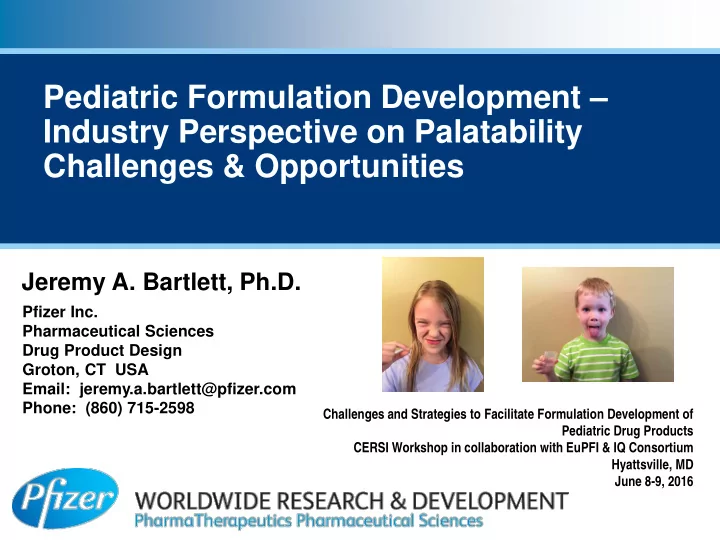
Pediatric Formulation Development – Industry Perspective on Palatability Challenges & Opportunities

Pfizer Inc. Pharmaceutical Sciences Drug Product Design Groton, CT USA Email: jeremy.a.bartlett@pfizer.com Phone: (860) 715-2598

Challenges and Strategies to Facilitate Formulation Development of Pediatric Drug Products CERSI Workshop in collaboration with EuPFI & IQ Consortium Hyattsville, MD June 8-9, 2016

Jeremy A. Bartlett, Ph.D.

slide-2
SLIDE 2

Acknowledgements

Pfizer UK

  • Cram, Anne

– EuPFI

  • Coupe, Alastair

– Innovate UK Pediatric Consortium

  • Bennett, Jo
  • Carmody, Alan
  • McGovern, James
  • Contreras, Lourdes
  • Turnbull, Neil
  • English, Cheryl
  • Ogilvie, Ron
  • Simmons, Joanna
  • Forbes, Claire

Pfizer US

  • Santangelo, Matt
  • Herbig, Scott M
  • Shanker, Ravi M
  • Heimlich, John H
  • Hausberger, Angie

Pfizer US

  • Murdande, Sharad
  • Prpich, Andrew
  • Ciringh, Yangzhen
  • Nixon, Phil
  • Korsmeyer, Richard
  • Thombre, Avi
  • Sagawa, Kazuko

Pfizer Global Pediatric Center of Excellence

  • Thompson, Charlie
  • Darsey, Edress

Institute of Pediatric Innovation (IPI)

Others I am sure I have missed…

slide-3
SLIDE 3

Outline

  • Why is palatability important?
  • What makes developing a palatable

formulation challenging?

  • What can be done?

3

slide-4
SLIDE 4

Why is palatability important? Bartlett Household Example 1

slide-5
SLIDE 5

Why is palatability important? Bartlett Household Example 2

slide-6
SLIDE 6

6

Why is Taste of Medicines

Important?

  • Even the best medicine won’t work unless the child

takes it!

  • A 2003 survey of pediatricians conducted by the

American Association of Pediatrics found

– Unpleasant taste was the biggest barrier for completing treatments in pediatrics1

  • Average compliance rate in children is ~58%, with

major factors attributed to formulation and palatability2

2Matsui, D. (2007). "Current issues in pediatric medication adherence." Paediatr Drugs 9(5): 283-288. 1Ayenew, Z., V. Puri, L. Kumar and A. K. Bansal (2009). "Trends in pharmaceutical taste masking technologies: a patent review."

Recent Pat. Drug Delivery Formulation 3(1): 26-39.

slide-7
SLIDE 7

Outline

7

  • Why is palatability important?
  • What makes developing a palatable

formulation challenging?

  • What can be done?
slide-8
SLIDE 8

Challenges in developing pediatric formulations

  • Diverse patient group

– Birth to age ~ 18 – Size/Weight change over 20 fold – Dose adjustment >3-4 fold – Ability to take and preference of dosage form varies across the wide age range

  • Palatability

– Cultural and geographical preferences – Restrictions related to use of excipients (type and quantity) – Taste assessment vs. compliance

  • How do you know when you are “good enough?”

– What palatability information should you use to drive formulation development?

  • Adult Healthy Volunteers
  • Trained Adult Taste Panel
  • Pediatric Patients
  • In vitro
  • Keeping in mind, palatability is only one part of dosage form

acceptability!

8

slide-9
SLIDE 9

Outline

9

  • Why is palatability important?
  • What makes developing a palatable

formulation challenging?

  • What can be done?
slide-10
SLIDE 10

Pediatric Oral Dosage Form Decision Tree

Target Product Profile

Dose Flexibility Required?

Yes No

API soluble at required dose?

Yes No

Oral Solid: Taste- masked Microspheres Sachet or Sprinkle Oral Suspension Oral Solution Acceptable Taste?

Yes No

Stability? Yes  RTU

No  POS

Acceptable Taste?

Yes No

Chewable Tablet or Oral Disintegrating Tablet Oral Solid: Taste-masked Microspheres ODT, Sachet

  • r Sprinkle

Walsh, J., A. Cram, K. Woertz, J. Breitkreutz, G. Winzenburg, R. Turner and C. Tuleu (2014). "Playing hide and seek with poorly tasting paediatric medicines: Do not forget the excipients." Adv. Drug Delivery Rev. 73: 14-33.

slide-11
SLIDE 11

Pediatric Dosage Form Technologies: Small Molecule Pediatric Products -- oral

Ready to Use (RTU) Oral Solution or Oral Suspension Dosed using a syringe, dosing cup, or dosing spoon Powder for Oral Solution or Powder for Oral Suspension (POS) Constituted with water by the Pharmacist Dosed using a syringe, dosing cup, or dosing spoon Taste-masked Microspheres

  • Prevent drug release until the microspheres clear the mouth –

achieve “taste neutral” profile

  • Spherical coated multiparticulates
  • Stability in Zone 4 (global)
  • Reduce/Eliminate the need for flavors, sugars, preservatives
  • Packaging include bottles, sachet, capsules (other presentations

are also possible)

  • Potential dosing with or without water

11

Being implemented!

slide-12
SLIDE 12

Pediatric Multiparticulate Platform Summary

  • Oral Multiparticulates provide an

excellent platform for pediatric medicines

– Ideal substrate for taste masking – Dose Flexibility – Reduce/Eliminate need for preservatives, sweeteners, flavorants, dyes, etc – May be dosed w/wo water

  • To be successful three main

focus areas

a) Multiparticulate b) Barrier Coating c) Dosing and Administration, Device/Packaging

  • Running Open Innovation Challenge to

generate ideas on the best way to accurately dispense and administer the multiparticulates

Step 1. Make the multiparticulate Step 2. Barrier coat the multiparticulate Step 3. Process and Package into the final drug product

12

slide-13
SLIDE 13

Institute of Pediatric Innovation and Pfizer collaborate

  • n open innovation pediatric device challenge

www.pfizer.com/responsibility/grants_contributions/device_challenge

Expect to announce awardee ~ August 2016

13

slide-14
SLIDE 14

Conclusions & Opportunities

  • Connecting taste assessment evaluations with

compliance data would be very helpful

  • Providing taste evaluation feedback early in adult

clinical development can help guide technology selection

  • Oral Multiparticulates provide an excellent platform

for pediatric medicines

  • Still working on –

– What is the “ideal” barrier membrane? – What is the “best” way to dispense and administer a free flowing, non gritty, tasteless powder?

14