PCMH Model and the Foundational Building Blocks Steve Bromer, MD - - PDF document

pcmh model and the foundational building blocks
SMART_READER_LITE
LIVE PREVIEW

PCMH Model and the Foundational Building Blocks Steve Bromer, MD - - PDF document

6/27/2014 PCMH Model and the Foundational Building Blocks Steve Bromer, MD Department of Family and Community Medicine UCSF Joint Principles of the Patient Centered Medical Home February 2007 American Academy of Family Physicians American


slide-1
SLIDE 1

6/27/2014 1

PCMH Model and the Foundational Building Blocks

Steve Bromer, MD Department of Family and Community Medicine UCSF

Joint Principles of the Patient Centered Medical Home February 2007

American Academy of Family Physicians American Academy of Pediatrics American College of Physicians American Osteopathic Association

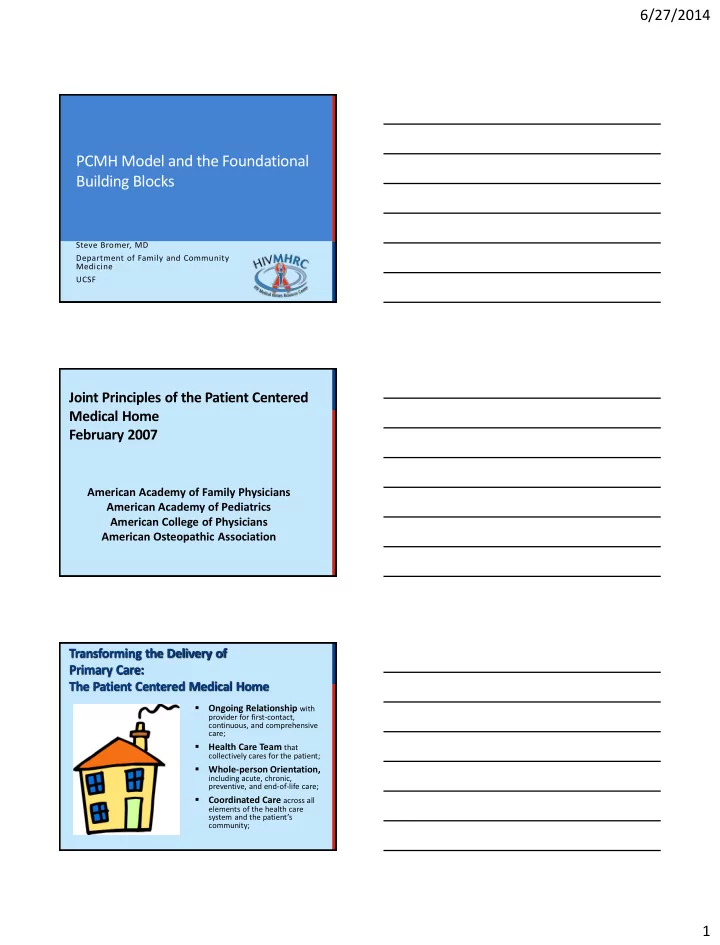
Transforming the Delivery of Primary Care: The Patient Centered Medical Home

  • Ongoing Relationship with

provider for first-contact, continuous, and comprehensive care;

  • Health Care Team that

collectively cares for the patient;

  • Whole-person Orientation,

including acute, chronic, preventive, and end-of-life care;

  • Coordinated Care across all

elements of the health care system and the patient’s community;

slide-2
SLIDE 2

6/27/2014 2

Transforming the Delivery of Primary Care: The Patient Centered Medical Home

  • Quality and Safety through

evidence-based medicine and clinical decision-support tools, information technology, registries, and continuous quality improvement;

  • Enhanced Access, achieved

through such systems as open scheduling, expanded hours, and new options for communication between patients, their physician, and practice staff; and

  • Payment Reform to reflect the

added value that a PCMH provides to patients.

HIV Medical Homes Resource Center

Continuous

First Contact

Comprehensive Coordinated

Patient Centered Medical Home

Evidence on Value of New Primary Care Models: Case Study of Group Health Cooperative of Puget Sound

  • Patient Centered Medical Home model piloted at
  • ne site in 2007
  • Avg PCP panel size reduced from 2327 to 1800
  • Longer face-to-face visits and scheduled time for

phone and email encounters

  • Increased team staffing and teamwork
  • HIT
  • Panel management
slide-3
SLIDE 3

6/27/2014 3

Group Health PCMH Pilot:

Controlled Evaluation 12 Month Outcomes

  • Improved continuity of care
  • Better patient experiences (6 of 7 measures)
  • Better composite quality of care score
  • Reductions in ED visits and Ambulatory Care

Sensitive Hospitalizations

  • No difference in total costs at year 1 (lower total

costs by year 2)

Source: R Reid et al. Am J Managed Care 2009;15:e71

Group Health PCMH Pilot: Effect on Clinic Staff

34.5% 30.0% 33.3% 9.7% 0% 5% 10% 15% 20% 25% 30% 35% 40% Control Sites PCMH Site Percent with High Level Emotional Exhaustion Baseline 12 Months p=.02

slide-4
SLIDE 4

6/27/2014 4

Change Concepts for the PCMH

  • Engaged Leadership
  • Quality Improvement Strategy
  • Empanelment
  • Continuous and Team-based Healing Relationship
  • Organized, Evidence-Based Care
  • Patient-Centered Interactions
  • Enhanced Access
  • Care Coordination

Wagner, EH et al, Guiding Transformation: How Medical Practices Can Become Patient-Centered Medical Homes; February, 2012

The Building Blocks of High-Performing Primary Care: lessons from the field

  • 23 high-performing practices
  • Intensive visits to 7 West Coast practices
  • Discussions with and observations of

clinicians, RNs, MAs, front desk, leaders

  • High-performing practices look about the

same, with variation in the details

  • 10 building blocks -- the foundation of these

practices

Willard R, Bodenheimer T: CHCF April 2012

Building Blocks of High-Performing Primary Care: Share-the-CareTM Model

slide-5
SLIDE 5

6/27/2014 5

Change Concepts Building Blocks NCQA Recognition Engaged Leadership Data for Improvement Enhance Access/Continuity Quality Improvement Strategy Empanelment, Panel size management Identify/Manage Patient Populations Empanelment Team-based Care Plan/Manage Care Continuous and Team-based Healing Relationships Population Management Provide Self-Care Support/Community Resources Organized Evidence-based Care Continuity of Care Track/Coordinate Care Patient-Centered Interaction Prompt Access to Care Measure/Improve Performance Enhanced Access Expanded Access Template Care Coordination Mission with objectives and goals Care coordination with Medical Neighborhood Trained Leaders

DATA/Quality Improvement Strategy

HIV Medical Homes Resource Center

Formal QI process Defined metrics Optimized HIT Robust data collection Reporting systems to share data Strategic decisions about metrics Are we Data Driven

  • rganizations?

Do we use real-time data on important clinical/operational data to guide day-to- day actions? Grant requirement to have CQI, robust metrics, early adopter

  • f registry, variable

HIT capacity

Empanelment

HIV Medical Homes Resource Center

Prioritizes patients seeing own PCP Clear denominator at panel level Empanelment not specific grant requirement, often happens because of structure of practice Is empanelment a deliberate process where we can use provider panels for quality data , proactive care and to actively manage supply and demand? Assign all patients to provider panel Balance supply and demand Use panel data to manage population

slide-6
SLIDE 6

6/27/2014 6

Team-Based Care

HIV Medical Homes Resource Center

Patients are connected to a Care Team Roles/tasks defined Culture shift to share-the-care. Flexible, functional teams, with clearly defined roles Multi-disciplinary Teams are central to

RWCA

Are our teams organized around getting the work done with an explicit vision and clear principles? With defined workflows, skills training and ground rules?

Team-based Care

Why does team- based care matter?

 Align roles to meet population needs  Build capacity to make timely access possible  Non-clinician team- members contribute to continuous healing relationship  Foundation for the Template of the future

  • 4. Team-based Care
slide-7
SLIDE 7

6/27/2014 7

Traditional Methods of Managing Work Flow

Provider Chronic Disease Monitoring Preventive Med Intervention Mental Health Provider Referral to Specialist after Assessment Medication Refill New Acute Complaint Certified Medical Assistant Case Manager Test Results Healthcare Support Team

slide-8
SLIDE 8

6/27/2014 8

Team-based care

  • Culture shift: share the care

 Stable teamlets

  • Co-location

 Staffing ratios  Standing orders/protocols

  • Defined workflows and roles – workflow mapping
  • Training, skills checks, and cross training
  • Ground rules
  • Communication – healthy huddles, terrific team

meetings and constant conversation

Team-based care: stable teamlets

Patient panel

1 team, 3 teamlets

Clinician/MA MA teamlet Patient panel Clinician/MA MA teamlet Patient panel Clinician/MA MA teamlet

Health coach, behavioral health professional, social worker, RN, pharmacist, panel manager, complex care manager

Prompt Access to Care

HIV Medical Homes Resource Center

24/7 access to care team, patient-centered scheduling options, address barriers to access Balance supply and demand, open access, multiple channels of access Do we have a patient- centered approach to access? After hours coverage, +/- use of advanced access tools

slide-9
SLIDE 9

6/27/2014 9

http://www.careinnovations.org/knowledge-center/knowledge-centerwest-county-health- center-video/

Population Management/Panel Management

HIV Medical Homes Resource Center

Plan care according to need, manage high-risk patients, point-of-care reminders Robust population management, Self- management, Complex Case management, planned visits Case Management key feature of RWCA, client level data, self- management support Are we able to focus at the population level and proactively assign resources where needed? Is data used in day-to-day care?

Care Coordination

HIV Medical Homes Resource Center

Link patient with community resources, referral tracking, coordination of specialty care Management of care transitions, behavioral health services, communication of results Comprehensive model of care, often under one-roof, expectation that transitions are tracked How good are we at managing the care that happens outside of our four walls?

slide-10
SLIDE 10

6/27/2014 10

Conscious Trained Leadership/Values and Mission Statement

HIV Medical Homes Resource Center

10 20 30 40 50 60 70 80 90 100 Series 3 Series 2 Series 1

Vital Signs: HIV Prevention Through Care and Treatment -- United States. MMWR December 2, 2011/60(47);1618-1623

Engagement in HIV Care

=Access =Care Co-ordination =Population Management

P C C C C P P P

Summary

  • Both Primary Care and the RWCA are at a

crossroad

  • PCMH is one model of transformation
  • RWCA clinics have many components of PCMH
  • There is much to learn from PCMH model and

high performing primary care

  • Our health care system will have to change to

meet our goal of an AIDS Free Generation

HIV Medical Homes Resource Center

slide-11
SLIDE 11

6/27/2014 11

Roadmap for Medical Home Resource Center

PCMH concepts in RWCA Clinics– Action Planning Change Management of Improvement Opportunities PCMH Certification Strategic Planning Workshops TA and Virtual Learning Community for practice change TA to support certification Year 1 Year 2 Year 3