SLIDE 1
Pavel Buividovich
(Regensburg, Germany) [in collaboration with M. Hanada, A. Schäfer]
Gaussian state approximation for real- time dynamics of gauge theories: Lyapunov exponents and entanglement entropy
SLIDE 2 Motivation Glasma state at early stages of HIC Overpopulated gluon states Almost “classical” gauge fields
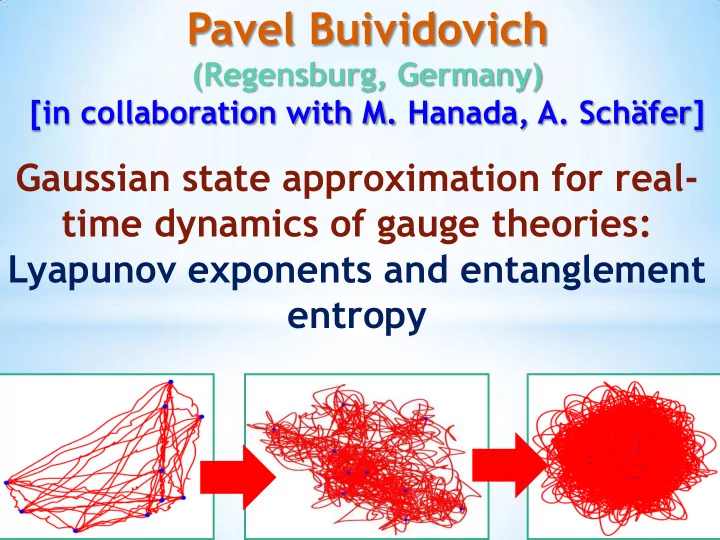
Chaotic Classical Dynamics [Saviddy,Susskind…]
exponents
initial conditions …but is it enough for Thermalization?
SLIDE 3 Motivation
Thermalization for quantum systems?
- Quantum extension of Lyapunov
exponents - OTOCs <[P(0),X(t)]2>
- Generation of entanglement
between subsystems Timescales: quantum vs classical? QFT tools extremely limited beyond strong-field classic regime… …Holography provides intuition
SLIDE 4 Bounds on chaos
Reasonable physical assumptions Analyticity of OTOCs
[Maldacena Shenker Stanford’15]
- Holographic models with black
holes saturate the bound(e.g. SYK)
classical YM What happens at low T ??? (QGP ~0.1 fm/c)
SLIDE 5 N=1 Supersymmetric Yang-Mills in D=1+9: Reduce to a single point = BFSS matrix model
[Banks, Fischler, Shenker, Susskind’1997]
N x N hermitian matrices Majorana-Weyl fermions, N x N hermitian
Motivation
System of N D0 branes joined by
- pen strings [Witten’96]:
- Xii
μ = D0 brane positions
μ = open string excitations
SLIDE 6 Stringy interpretation:
- Dynamics of gravitating D0 branes
- Thermalized state = black hole
- Classical chaos = info scrambling
Expected to saturate the MSS bound at low temperatures!
Classical chaos and BH physics
SLIDE 7
In this talk:
Numerical attempt to look at the real-time dynamics of BFSS and bosonic matrix models Of course, not an exact simulation, but should be good at early times Approximating all states by Gaussians
SLIDE 8 Gaussian state approximation
Simple example: Double-well potential
Heisenberg equations
Also, for example
SLIDE 9
Next step: Gaussian Wigner function
Assume Gaussian wave function at any t Simpler: Gaussian Wigner function
For other correlators: use Wick theorem!
Derive closed equations for x, p, σxx , σxp , σpp
SLIDE 10
Origin of tunnelling
Positive force even at x=0 (classical minimum) Quantum force causes classical trajectory to leave classical minimum
SLIDE 11 Gaussian state vs exact Schrödinger
σ2=0.02 σ2=0.1 σ2=0.2 σ2=0.5
- Early-time evolution OK
- Tunnelling period qualitatively OK
SLIDE 12
2D potential with flat directions
(closer to BFSS model) We start with a Gaussian wave packet at distance f from the origin (away from flat directions) Classic runaway along x=0 or y=0 Classically chaotic!
SLIDE 13
Gaussian state vs exact Schrödinger
SLIDE 14
Gaussian state approximation Is good for at least two classical Lyapunov times Maps pure states to pure states Allows to study entanglement Closely related to semiclassics Is better for chaotic than for regular systems [nlin/0406054] Is likely safe in the large-N limit X Is not a unitary evolution
SLIDE 15
BFSS matrix model: Hamiltonian formulation a,b,c – su(N) Lie algebra indices Heisenberg equations of motion
SLIDE 16 GS approximatio for BFSS model
- CPU time ~ N^5 (double commutators)
- RAM memory ~ N^4
- SUSY broken, unfortunately …
SLIDE 17 Ungauging the BFSS model
- Gauge constraints
- For Gaussian states we can only have a
weaker constraint
- We work with ungauged model
[Maldacena,Milekhin’1802.00428]
(e.g. LGT with unit Polyakov loops)
- Ungauging preserves most of the
features of the original model [1802.02985]
SLIDE 18 Equation of state and temperature
- Consider mixed Gaussian states with
fixed energy E = <H>
- Maximize entropy w.r.t. <xx>,<pp>
- Calculate temperature using
- Can be done analytically using
rotational and SU(N) symmetries
SLIDE 19 “Thermal” initial conditions
- At T=0 pure “ground” state
with minimal <pp>,<xx>
- At T>0 mixed states, interpret as
mixture of pure states, shifted by “classical” coordinates with dispersion <xx>-<xx>0
non-unitary evolution
state at fixed classical coordinates
SLIDE 20
Energy vs temperature
MC data from [Berkowitz,Hanada, Rinaldi, Vranas, 1802.02985], we agree for pure gauge
SLIDE 21
<1/N Tr(Xi
2)> vs temperature
MC data from [Berkowitz,Hanada, Rinaldi, Vranas, 1802.02985], we agree for pure gauge
SLIDE 22 Real-time evolution: <1/N Tr(Xi
2)>
Wavepacket spread vs classical shrinking For BFSS <1/N Tr(Xi
2)> grows, instability?
SLIDE 23
Entanglement vs time
Late-time saturation = information scrambling Entanglement entropy ~ subsystem size
SLIDE 24
Lyapunov distances vs time
Early times: Very similar to classical dynamics Late times: significantly slower growth
SLIDE 25 Lyapunov vs entanglement: bosonic MM
Entanglement saturates much faster than Lyapunov time, at high T – classical Lyapunov MSS: λL<2πT λL
0~T1/4
SLIDE 26 Bosonic MM vs BFSS
- No strong statements at low T: loss of SUSY
- Non-chaotic confinement regime absent
- Shortest timescale still for entanglement
MSS: λL<2πT
???
SLIDE 27 Summary
- Longer quantum Lyapunov times vs.
classical, important for MSS bound
- “Confining” regime non-chaotic
- Full BFSS model chaotic at all T
- “Scrambling” behavior for entanglement
entropy
- Entanglement timescale is the shortest
- At high T governed by classic Lyapunov
SLIDE 28 Summary
- Gaussian state approximation: ~V2
scaling of CPU time for QCD/ Yang-Mills
- Feasible on moderately large lattices
- Quantum effects on thermalization?
- Topological transitions in real time