Zamolodchikov periodicity and integrability Pavel Galashin MIT - - PowerPoint PPT Presentation

zamolodchikov periodicity and integrability
SMART_READER_LITE
LIVE PREVIEW

Zamolodchikov periodicity and integrability Pavel Galashin MIT - - PowerPoint PPT Presentation

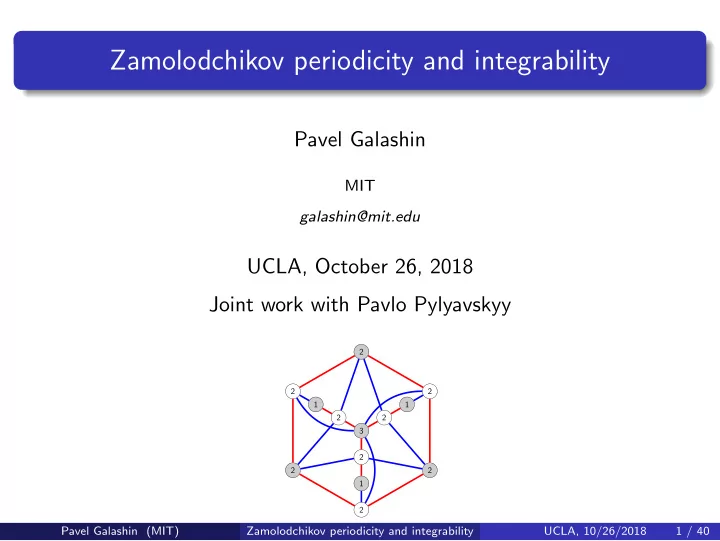
Zamolodchikov periodicity and integrability Pavel Galashin MIT galashin@mit.edu UCLA, October 26, 2018 Joint work with Pavlo Pylyavskyy 2 2 2 1 1 2 2 3 2 2 2 1 2 Pavel Galashin (MIT) Zamolodchikov periodicity and integrability


slide-1
SLIDE 1

Zamolodchikov periodicity and integrability

Pavel Galashin

MIT galashin@mit.edu

UCLA, October 26, 2018 Joint work with Pavlo Pylyavskyy

1 2 1 2 3 2 1 2 2 2 2 2 2

Pavel Galashin (MIT) Zamolodchikov periodicity and integrability UCLA, 10/26/2018 1 / 40

slide-2
SLIDE 2

Part 1: T-systems

slide-3
SLIDE 3

General T-systems (Nakanishi, 2011)

Q

1 2 3 4 5 x1 x2 x3 x4 x5 2 3 4 5 1 x1 x2 x3 x4 x5

Pavel Galashin (MIT) Zamolodchikov periodicity and integrability UCLA, 10/26/2018 3 / 40

slide-4
SLIDE 4

General T-systems (Nakanishi, 2011)

Q µ1(Q)

1 2 3 4 5 x1 x2 x3 x4 x5 2 3 4 5 1 x1 x2 x3 x4 x5

Pavel Galashin (MIT) Zamolodchikov periodicity and integrability UCLA, 10/26/2018 3 / 40

slide-5
SLIDE 5

General T-systems (Nakanishi, 2011)

Q µ1(Q)

1 2 3 4 5 x1 x2 x3 x4 x5 2 3 4 5 1 x1 x2 x3 x4 x5

Pavel Galashin (MIT) Zamolodchikov periodicity and integrability UCLA, 10/26/2018 3 / 40

slide-6
SLIDE 6

General T-systems (Nakanishi, 2011)

Q µ1(Q)

1 2 3 4 5 x1 x2 x3 x4 x5 2 3 4 5 1 x1 x2 x3 x4 x5

Pavel Galashin (MIT) Zamolodchikov periodicity and integrability UCLA, 10/26/2018 3 / 40

slide-7
SLIDE 7

General T-systems (Nakanishi, 2011)

Q µ1(Q)

1 2 3 4 5 x1 x2 x3 x4 x5 2 3 4 5 1 x1 x2 x3 x4 x5

Pavel Galashin (MIT) Zamolodchikov periodicity and integrability UCLA, 10/26/2018 3 / 40

slide-8
SLIDE 8

General T-systems (Nakanishi, 2011)

Q µ1(Q)

1 2 3 4 5 x1 x2 x3 x4 x5 2 3 4 5 1

x3x4+x2x5 x1

x2 x3 x4 x5

Pavel Galashin (MIT) Zamolodchikov periodicity and integrability UCLA, 10/26/2018 3 / 40

slide-9
SLIDE 9

Bipartite recurrent quivers

w1 v w2 . . . wk w′

k

. . . w′

2

u w′

1

Pavel Galashin (MIT) Zamolodchikov periodicity and integrability UCLA, 10/26/2018 4 / 40

slide-10
SLIDE 10

Bipartite T-system

a b c d e f

Pavel Galashin (MIT) Zamolodchikov periodicity and integrability UCLA, 10/26/2018 5 / 40

slide-11
SLIDE 11

Bipartite T-system

a b c d e f

− →

b+c a

b c

c+bf d c+f e

f

Pavel Galashin (MIT) Zamolodchikov periodicity and integrability UCLA, 10/26/2018 5 / 40

slide-12
SLIDE 12

Bipartite T-system

b+c a b+c a

+ c+bf

d b b+c a c+f e

+ c+bf

d c c+bf d c+f e c+f e

+ c+bf

d f b+c a

b c

c+bf d c+f e

f

Pavel Galashin (MIT) Zamolodchikov periodicity and integrability UCLA, 10/26/2018 5 / 40

slide-13
SLIDE 13

Four classes of quivers

“(finite, finite)” “(affine, finite)” “(affine, affine)” “wild”

Pavel Galashin (MIT) Zamolodchikov periodicity and integrability UCLA, 10/26/2018 6 / 40

slide-14
SLIDE 14

Example: (finite, finite)

1 1 1 1

Pavel Galashin (MIT) Zamolodchikov periodicity and integrability UCLA, 10/26/2018 7 / 40

slide-15
SLIDE 15

Example: (finite, finite)

1 1 1 1 2 1 1 2

Pavel Galashin (MIT) Zamolodchikov periodicity and integrability UCLA, 10/26/2018 7 / 40

slide-16
SLIDE 16

Example: (finite, finite)

1 1 1 1 2 1 1 2 2 4 4 2

Pavel Galashin (MIT) Zamolodchikov periodicity and integrability UCLA, 10/26/2018 7 / 40

slide-17
SLIDE 17

Example: (finite, finite)

1 1 1 1 2 1 1 2 2 4 4 2 4 4 4 4

Pavel Galashin (MIT) Zamolodchikov periodicity and integrability UCLA, 10/26/2018 7 / 40

slide-18
SLIDE 18

Example: (finite, finite)

1 1 1 1 2 1 1 2 2 4 4 2 4 2 2 4 4 4 4 4

Pavel Galashin (MIT) Zamolodchikov periodicity and integrability UCLA, 10/26/2018 7 / 40

slide-19
SLIDE 19

Example: (finite, finite)

1 1 1 1 2 1 1 2 2 4 4 2 1 2 2 1 4 2 2 4 4 4 4 4

Pavel Galashin (MIT) Zamolodchikov periodicity and integrability UCLA, 10/26/2018 7 / 40

slide-20
SLIDE 20

Four classes of quivers

“(finite, finite)” “(affine, finite)” “(affine, affine)” “wild” periodic

Pavel Galashin (MIT) Zamolodchikov periodicity and integrability UCLA, 10/26/2018 8 / 40

slide-21
SLIDE 21

Example: (affine, finite)

x1 x2

Pavel Galashin (MIT) Zamolodchikov periodicity and integrability UCLA, 10/26/2018 9 / 40

slide-22
SLIDE 22

Example: (affine, finite)

x1 x2

x2

2+1

x1

x2

Pavel Galashin (MIT) Zamolodchikov periodicity and integrability UCLA, 10/26/2018 9 / 40

slide-23
SLIDE 23

Example: (affine, finite)

1 1

Pavel Galashin (MIT) Zamolodchikov periodicity and integrability UCLA, 10/26/2018 9 / 40

slide-24
SLIDE 24

Example: (affine, finite)

1 1 2 1

Pavel Galashin (MIT) Zamolodchikov periodicity and integrability UCLA, 10/26/2018 9 / 40

slide-25
SLIDE 25

Example: (affine, finite)

1 1 2 1 2 5

Pavel Galashin (MIT) Zamolodchikov periodicity and integrability UCLA, 10/26/2018 9 / 40

slide-26
SLIDE 26

Example: (affine, finite)

1 1 2 1 2 5 13 5

Pavel Galashin (MIT) Zamolodchikov periodicity and integrability UCLA, 10/26/2018 9 / 40

slide-27
SLIDE 27

Example: (affine, finite)

1 1 2 1 2 5 13 5 13 34

Pavel Galashin (MIT) Zamolodchikov periodicity and integrability UCLA, 10/26/2018 9 / 40

slide-28
SLIDE 28

Example: (affine, finite)

1 1 2 1 2 5 13 5 13 34 89 34

Pavel Galashin (MIT) Zamolodchikov periodicity and integrability UCLA, 10/26/2018 9 / 40

slide-29
SLIDE 29

Example: (affine, finite)

1 1 2 1 2 5 13 5 13 34 89 34 89 233

Pavel Galashin (MIT) Zamolodchikov periodicity and integrability UCLA, 10/26/2018 9 / 40

slide-30
SLIDE 30

Example: (affine, finite)

1 1 2 1 2 5 13 5 13 34 89 34 89 233 610 233

Pavel Galashin (MIT) Zamolodchikov periodicity and integrability UCLA, 10/26/2018 9 / 40

slide-31
SLIDE 31

Example: (affine, finite)

1 1 2 1 2 5 13 5 13 34 89 34 89 233 610 233

. . .

Pavel Galashin (MIT) Zamolodchikov periodicity and integrability UCLA, 10/26/2018 9 / 40

slide-32
SLIDE 32

Example: (affine, finite)

1 1 2 1 2 5 13 5 13 34 89 34 89 233 610 233

. . .

xn+1 = 3xn − xn−1

Pavel Galashin (MIT) Zamolodchikov periodicity and integrability UCLA, 10/26/2018 9 / 40

slide-33
SLIDE 33

Four classes of quivers

“(finite, finite)” “(affine, finite)” “(affine, affine)” “wild” periodic linearizable

Pavel Galashin (MIT) Zamolodchikov periodicity and integrability UCLA, 10/26/2018 10 / 40

slide-34
SLIDE 34

Example: (affine, affine)

1 1 1 1

Pavel Galashin (MIT) Zamolodchikov periodicity and integrability UCLA, 10/26/2018 11 / 40

slide-35
SLIDE 35

Example: (affine, affine)

1 1 1 1 2 1 1 2

Pavel Galashin (MIT) Zamolodchikov periodicity and integrability UCLA, 10/26/2018 11 / 40

slide-36
SLIDE 36

Example: (affine, affine)

1 1 1 1 21 1 1 21 21 23 23 21

Pavel Galashin (MIT) Zamolodchikov periodicity and integrability UCLA, 10/26/2018 11 / 40

slide-37
SLIDE 37

Example: (affine, affine)

1 1 1 1 21 1 1 21 21 23 23 21 26 23 23 26

Pavel Galashin (MIT) Zamolodchikov periodicity and integrability UCLA, 10/26/2018 11 / 40

slide-38
SLIDE 38

Example: (affine, affine)

1 1 1 1 21 1 1 21 21 23 23 21 26 210 210 26 26 23 23 26

Pavel Galashin (MIT) Zamolodchikov periodicity and integrability UCLA, 10/26/2018 11 / 40

slide-39
SLIDE 39

Example: (affine, affine)

1 1 1 1 21 1 1 21 21 23 23 21 215 210 210 215 26 210 210 26 26 23 23 26

Pavel Galashin (MIT) Zamolodchikov periodicity and integrability UCLA, 10/26/2018 11 / 40

slide-40
SLIDE 40

Example: (affine, affine)

1 1 1 1 21 1 1 21 21 23 23 21 215 210 210 215 26 210 210 26 26 23 23 26

2(n

2)

Pavel Galashin (MIT) Zamolodchikov periodicity and integrability UCLA, 10/26/2018 11 / 40

slide-41
SLIDE 41

Four classes of quivers

“(finite, finite)” “(affine, finite)” “(affine, affine)” “wild” periodic linearizable grows as exp(t2)

Pavel Galashin (MIT) Zamolodchikov periodicity and integrability UCLA, 10/26/2018 12 / 40

slide-42
SLIDE 42

Example: wild

x1 x2

Pavel Galashin (MIT) Zamolodchikov periodicity and integrability UCLA, 10/26/2018 13 / 40

slide-43
SLIDE 43

Example: wild

x1 x2

x3

2+1

x1

x2

Pavel Galashin (MIT) Zamolodchikov periodicity and integrability UCLA, 10/26/2018 13 / 40

slide-44
SLIDE 44

Example: wild

1 1

Pavel Galashin (MIT) Zamolodchikov periodicity and integrability UCLA, 10/26/2018 13 / 40

slide-45
SLIDE 45

Example: wild

1 1 2 1

Pavel Galashin (MIT) Zamolodchikov periodicity and integrability UCLA, 10/26/2018 13 / 40

slide-46
SLIDE 46

Example: wild

1 1 2 1 2 9

Pavel Galashin (MIT) Zamolodchikov periodicity and integrability UCLA, 10/26/2018 13 / 40

slide-47
SLIDE 47

Example: wild

1 1 2 1 2 9 365 9

Pavel Galashin (MIT) Zamolodchikov periodicity and integrability UCLA, 10/26/2018 13 / 40

slide-48
SLIDE 48

Example: wild

1 1 2 1 2 9 365 9 365 5403014

Pavel Galashin (MIT) Zamolodchikov periodicity and integrability UCLA, 10/26/2018 13 / 40

slide-49
SLIDE 49

Example: wild

1 1 2 1 2 9 365 9 365 5403014 432130991537958813 5403014

Pavel Galashin (MIT) Zamolodchikov periodicity and integrability UCLA, 10/26/2018 13 / 40

slide-50
SLIDE 50

Example: wild

1 1 2 1 2 9 365 9 365 5403014 432130991537958813 5403014

Pavel Galashin (MIT) Zamolodchikov periodicity and integrability UCLA, 10/26/2018 13 / 40

slide-51
SLIDE 51

Four classes of quivers

“(finite, finite)” “(affine, finite)” “(affine, affine)” “wild” periodic linearizable grows as exp(t2) grows as exp(exp(t))

Pavel Galashin (MIT) Zamolodchikov periodicity and integrability UCLA, 10/26/2018 14 / 40

slide-52
SLIDE 52

Part 2: The master conjecture

slide-53
SLIDE 53

ADE Dynkin diagrams

Name Finite diagram Affine diagram Name An

1 1 1 1 1 1

ˆ An−1 Dn

1 1 2 2 2 1 1

ˆ Dn−1 E6

1 2 1 2 3 2 1

ˆ E6 E7

2 1 2 3 4 3 2 1

ˆ E7 E8

3 2 4 6 5 4 3 2 1

ˆ E8

Pavel Galashin (MIT) Zamolodchikov periodicity and integrability UCLA, 10/26/2018 16 / 40

slide-54
SLIDE 54

(affine, finite) quivers

“(affine, finite) quiver”

Pavel Galashin (MIT) Zamolodchikov periodicity and integrability UCLA, 10/26/2018 17 / 40

slide-55
SLIDE 55

(affine, finite) quivers

  • Bipartite recurrent quiver

“(affine, finite) quiver”

Pavel Galashin (MIT) Zamolodchikov periodicity and integrability UCLA, 10/26/2018 17 / 40

slide-56
SLIDE 56

(affine, finite) quivers

  • Bipartite recurrent quiver
  • All red components are affine Dynkin diagrams

“(affine, finite) quiver”

Pavel Galashin (MIT) Zamolodchikov periodicity and integrability UCLA, 10/26/2018 17 / 40

slide-57
SLIDE 57

(affine, finite) quivers

  • Bipartite recurrent quiver
  • All red components are affine Dynkin diagrams
  • All blue components are finite Dynkin diagrams

“(affine, finite) quiver”

Pavel Galashin (MIT) Zamolodchikov periodicity and integrability UCLA, 10/26/2018 17 / 40

slide-58
SLIDE 58

(affine, finite) quivers

  • Bipartite recurrent quiver
  • All red components are affine Dynkin diagrams
  • All blue components are finite Dynkin diagrams

“(affine, finite) quiver”

Pavel Galashin (MIT) Zamolodchikov periodicity and integrability UCLA, 10/26/2018 17 / 40

slide-59
SLIDE 59

Four classes of quivers

“(finite, finite)” “(affine, finite)” “(affine, affine)” “wild” periodic linearizable grows as exp(t2) grows as exp(exp(t))

Pavel Galashin (MIT) Zamolodchikov periodicity and integrability UCLA, 10/26/2018 18 / 40

slide-60
SLIDE 60

Master conjecture

Conjecture (G.-Pylyavskyy, 2016)

Pavel Galashin (MIT) Zamolodchikov periodicity and integrability UCLA, 10/26/2018 19 / 40

slide-61
SLIDE 61

Master conjecture

Conjecture (G.-Pylyavskyy, 2016)

(finite, finite) ⇐ ⇒ periodic

Pavel Galashin (MIT) Zamolodchikov periodicity and integrability UCLA, 10/26/2018 19 / 40

slide-62
SLIDE 62

Master conjecture

Conjecture (G.-Pylyavskyy, 2016)

(finite, finite) ⇐ ⇒ periodic (affine, finite) ⇐ ⇒ linearizable, but not periodic

Pavel Galashin (MIT) Zamolodchikov periodicity and integrability UCLA, 10/26/2018 19 / 40

slide-63
SLIDE 63

Master conjecture

Conjecture (G.-Pylyavskyy, 2016)

(finite, finite) ⇐ ⇒ periodic (affine, finite) ⇐ ⇒ linearizable, but not periodic (affine, affine) ⇐ ⇒ grows as exp(t2)

Pavel Galashin (MIT) Zamolodchikov periodicity and integrability UCLA, 10/26/2018 19 / 40

slide-64
SLIDE 64

Master conjecture

Conjecture (G.-Pylyavskyy, 2016)

(finite, finite) ⇐ ⇒ periodic (affine, finite) ⇐ ⇒ linearizable, but not periodic (affine, affine) ⇐ ⇒ grows as exp(t2) wild ⇐ ⇒ grows as exp(exp(t))

Pavel Galashin (MIT) Zamolodchikov periodicity and integrability UCLA, 10/26/2018 19 / 40

slide-65
SLIDE 65

Results

Pavel Galashin (MIT) Zamolodchikov periodicity and integrability UCLA, 10/26/2018 20 / 40

slide-66
SLIDE 66

Results

Theorem (G.-Pylyavskyy, 2016)

Periodic ⇐ ⇒ (finite, finite)

Pavel Galashin (MIT) Zamolodchikov periodicity and integrability UCLA, 10/26/2018 20 / 40

slide-67
SLIDE 67

Results

Theorem (G.-Pylyavskyy, 2016)

Periodic ⇐ ⇒ (finite, finite)

Theorem (G.-Pylyavskyy, 2016)

Linearizable = ⇒ (affine, finite) or (finite, finite)

Pavel Galashin (MIT) Zamolodchikov periodicity and integrability UCLA, 10/26/2018 20 / 40

slide-68
SLIDE 68

Results

Theorem (G.-Pylyavskyy, 2016)

Periodic ⇐ ⇒ (finite, finite)

Theorem (G.-Pylyavskyy, 2016)

Linearizable = ⇒ (affine, finite) or (finite, finite)

Theorem (G.-Pylyavskyy, 2017)

Grows slower than exp(exp(t)) = ⇒ (affine, affine), (affine, finite), or (finite, finite)

Pavel Galashin (MIT) Zamolodchikov periodicity and integrability UCLA, 10/26/2018 20 / 40

slide-69
SLIDE 69

Results

Theorem (G.-Pylyavskyy, 2016)

Periodic ⇐ ⇒ (finite, finite)

Theorem (G.-Pylyavskyy, 2016)

Linearizable = ⇒ (affine, finite) or (finite, finite)

Theorem (G.-Pylyavskyy, 2017)

Grows slower than exp(exp(t)) = ⇒ (affine, affine), (affine, finite), or (finite, finite)

What is left:

Conjecture (G.-Pylyavskyy, 2017)

(affine, finite) = ⇒ linearizable (affine, affine) = ⇒ grows as exp(t2)

Pavel Galashin (MIT) Zamolodchikov periodicity and integrability UCLA, 10/26/2018 20 / 40

slide-70
SLIDE 70

Tensor product

D5 ⊗ A3

Pavel Galashin (MIT) Zamolodchikov periodicity and integrability UCLA, 10/26/2018 21 / 40

slide-71
SLIDE 71

Tensor product

D5 ⊗ A3

Pavel Galashin (MIT) Zamolodchikov periodicity and integrability UCLA, 10/26/2018 21 / 40

slide-72
SLIDE 72

Tensor product

D5 ⊗ A3

Pavel Galashin (MIT) Zamolodchikov periodicity and integrability UCLA, 10/26/2018 21 / 40

slide-73
SLIDE 73

Zamolodchikov periodicity

Theorem (B. Keller, 2013)

Tensor product of finite Dynkin diagrams = ⇒ the T-system is periodic.

Pavel Galashin (MIT) Zamolodchikov periodicity and integrability UCLA, 10/26/2018 22 / 40

slide-74
SLIDE 74

Zamolodchikov periodicity

Theorem (B. Keller, 2013)

Tensor product of finite Dynkin diagrams = ⇒ the T-system is periodic. Zamolodchikov (1991): Λ ⊗ A1 (conjectured);

Pavel Galashin (MIT) Zamolodchikov periodicity and integrability UCLA, 10/26/2018 22 / 40

slide-75
SLIDE 75

Zamolodchikov periodicity

Theorem (B. Keller, 2013)

Tensor product of finite Dynkin diagrams = ⇒ the T-system is periodic. Zamolodchikov (1991): Λ ⊗ A1 (conjectured); Ravanini-Tateo-Valleriani (1993): Λ ⊗ Λ′ (conjectured);

Pavel Galashin (MIT) Zamolodchikov periodicity and integrability UCLA, 10/26/2018 22 / 40

slide-76
SLIDE 76

Zamolodchikov periodicity

Theorem (B. Keller, 2013)

Tensor product of finite Dynkin diagrams = ⇒ the T-system is periodic. Zamolodchikov (1991): Λ ⊗ A1 (conjectured); Ravanini-Tateo-Valleriani (1993): Λ ⊗ Λ′ (conjectured); Frenkel-Szenes (1995): An ⊗ A1;

Pavel Galashin (MIT) Zamolodchikov periodicity and integrability UCLA, 10/26/2018 22 / 40

slide-77
SLIDE 77

Zamolodchikov periodicity

Theorem (B. Keller, 2013)

Tensor product of finite Dynkin diagrams = ⇒ the T-system is periodic. Zamolodchikov (1991): Λ ⊗ A1 (conjectured); Ravanini-Tateo-Valleriani (1993): Λ ⊗ Λ′ (conjectured); Frenkel-Szenes (1995): An ⊗ A1; Fomin-Zelevinsky (2003): Λ ⊗ A1;

Pavel Galashin (MIT) Zamolodchikov periodicity and integrability UCLA, 10/26/2018 22 / 40

slide-78
SLIDE 78

Zamolodchikov periodicity

Theorem (B. Keller, 2013)

Tensor product of finite Dynkin diagrams = ⇒ the T-system is periodic. Zamolodchikov (1991): Λ ⊗ A1 (conjectured); Ravanini-Tateo-Valleriani (1993): Λ ⊗ Λ′ (conjectured); Frenkel-Szenes (1995): An ⊗ A1; Fomin-Zelevinsky (2003): Λ ⊗ A1; Volkov (2005): An ⊗ Am;

Pavel Galashin (MIT) Zamolodchikov periodicity and integrability UCLA, 10/26/2018 22 / 40

slide-79
SLIDE 79

Zamolodchikov periodicity

Theorem (B. Keller, 2013)

Tensor product of finite Dynkin diagrams = ⇒ the T-system is periodic. Zamolodchikov (1991): Λ ⊗ A1 (conjectured); Ravanini-Tateo-Valleriani (1993): Λ ⊗ Λ′ (conjectured); Frenkel-Szenes (1995): An ⊗ A1; Fomin-Zelevinsky (2003): Λ ⊗ A1; Volkov (2005): An ⊗ Am;

Pavel Galashin (MIT) Zamolodchikov periodicity and integrability UCLA, 10/26/2018 22 / 40

slide-80
SLIDE 80

History of cluster algebras

Cluster algebras were invented by Fomin–Zelevinsky in 2000.

Pavel Galashin (MIT) Zamolodchikov periodicity and integrability UCLA, 10/26/2018 23 / 40

slide-81
SLIDE 81

History of cluster algebras

Cluster algebras were invented by Fomin–Zelevinsky in 2000. Motivation:

Pavel Galashin (MIT) Zamolodchikov periodicity and integrability UCLA, 10/26/2018 23 / 40

slide-82
SLIDE 82

History of cluster algebras

Cluster algebras were invented by Fomin–Zelevinsky in 2000. Motivation: Lusztig’s canonical bases

Pavel Galashin (MIT) Zamolodchikov periodicity and integrability UCLA, 10/26/2018 23 / 40

slide-83
SLIDE 83

History of cluster algebras

Cluster algebras were invented by Fomin–Zelevinsky in 2000. Motivation: Lusztig’s canonical bases Total positivity

Pavel Galashin (MIT) Zamolodchikov periodicity and integrability UCLA, 10/26/2018 23 / 40

slide-84
SLIDE 84

History of cluster algebras

Cluster algebras were invented by Fomin–Zelevinsky in 2000. Motivation: Lusztig’s canonical bases Total positivity Zamolodchikov periodicity

Pavel Galashin (MIT) Zamolodchikov periodicity and integrability UCLA, 10/26/2018 23 / 40

slide-85
SLIDE 85

History of cluster algebras

Cluster algebras were invented by Fomin–Zelevinsky in 2000. Motivation: Lusztig’s canonical bases Total positivity Zamolodchikov periodicity

Definition

A cluster algebra is of finite type if it has finitely many cluster variables.

Pavel Galashin (MIT) Zamolodchikov periodicity and integrability UCLA, 10/26/2018 23 / 40

slide-86
SLIDE 86

History of cluster algebras

Cluster algebras were invented by Fomin–Zelevinsky in 2000. Motivation: Lusztig’s canonical bases Total positivity Zamolodchikov periodicity

Definition

A cluster algebra is of finite type if it has finitely many cluster variables.

Theorem (Fomin–Zelevinsky (2003))

Cluster algebras of finite type ← → finite Dynkin diagrams

Pavel Galashin (MIT) Zamolodchikov periodicity and integrability UCLA, 10/26/2018 23 / 40

slide-87
SLIDE 87

History of cluster algebras

Cluster algebras were invented by Fomin–Zelevinsky in 2000. Motivation: Lusztig’s canonical bases Total positivity Zamolodchikov periodicity

Definition

A cluster algebra is of finite type if it has finitely many cluster variables.

Theorem (Fomin–Zelevinsky (2003))

Cluster algebras of finite type ← → finite Dynkin diagrams ← → finite root systems Φ

Pavel Galashin (MIT) Zamolodchikov periodicity and integrability UCLA, 10/26/2018 23 / 40

slide-88
SLIDE 88

History of cluster algebras

Cluster algebras were invented by Fomin–Zelevinsky in 2000. Motivation: Lusztig’s canonical bases Total positivity Zamolodchikov periodicity

Definition

A cluster algebra is of finite type if it has finitely many cluster variables.

Theorem (Fomin–Zelevinsky (2003))

Cluster algebras of finite type ← → finite Dynkin diagrams ← → finite root systems Φ Cluster variables ↔ almost positive roots Φ≥−1 := Φ+ ⊔ (−Π)

Pavel Galashin (MIT) Zamolodchikov periodicity and integrability UCLA, 10/26/2018 23 / 40

slide-89
SLIDE 89

History of cluster algebras

Cluster algebras were invented by Fomin–Zelevinsky in 2000. Motivation: Lusztig’s canonical bases Total positivity Zamolodchikov periodicity

Definition

A cluster algebra is of finite type if it has finitely many cluster variables.

Theorem (Fomin–Zelevinsky (2003))

Cluster algebras of finite type ← → finite Dynkin diagrams ← → finite root systems Φ Cluster variables ↔ almost positive roots Φ≥−1 := Φ+ ⊔ (−Π) Explicitly, the above bijection sends α ∈ Φ≥−1 to the unique cluster variable with denominator xα.

Pavel Galashin (MIT) Zamolodchikov periodicity and integrability UCLA, 10/26/2018 23 / 40

slide-90
SLIDE 90

History of cluster algebras

Theorem (Fomin–Zelevinsky (2003))

Cluster algebras of finite type ← → finite Dynkin diagrams ← → finite root systems Φ Cluster variables ↔ almost positive roots Φ≥−1 := Φ+ ⊔ (−Π) Explicitly, the above bijection sends α ∈ Φ≥−1 to the unique cluster variable with denominator xα.

Pavel Galashin (MIT) Zamolodchikov periodicity and integrability UCLA, 10/26/2018 23 / 40

slide-91
SLIDE 91

History of cluster algebras

Theorem (Fomin–Zelevinsky (2003))

Cluster algebras of finite type ← → finite Dynkin diagrams ← → finite root systems Φ Cluster variables ↔ almost positive roots Φ≥−1 := Φ+ ⊔ (−Π) Explicitly, the above bijection sends α ∈ Φ≥−1 to the unique cluster variable with denominator xα.

Theorem (Fomin–Zelevinsky (2003))

Zamolodchikov periodicity conjecture holds for Λ ⊗ A1.

Pavel Galashin (MIT) Zamolodchikov periodicity and integrability UCLA, 10/26/2018 23 / 40

slide-92
SLIDE 92

History of cluster algebras

Theorem (Fomin–Zelevinsky (2003))

Cluster algebras of finite type ← → finite Dynkin diagrams ← → finite root systems Φ Cluster variables ↔ almost positive roots Φ≥−1 := Φ+ ⊔ (−Π) Explicitly, the above bijection sends α ∈ Φ≥−1 to the unique cluster variable with denominator xα.

Theorem (Fomin–Zelevinsky (2003))

Zamolodchikov periodicity conjecture holds for Λ ⊗ A1.

Proof.

Use the above bijection and then prove periodicity for the tropical dynamics on Φ≥−1.

Pavel Galashin (MIT) Zamolodchikov periodicity and integrability UCLA, 10/26/2018 23 / 40

slide-93
SLIDE 93

Example: A2

x1 x2

Pavel Galashin (MIT) Zamolodchikov periodicity and integrability UCLA, 10/26/2018 24 / 40

slide-94
SLIDE 94

Example: A2

x1 x2 x1

Pavel Galashin (MIT) Zamolodchikov periodicity and integrability UCLA, 10/26/2018 24 / 40

slide-95
SLIDE 95

Example: A2

x1 x2 x1 x2

Pavel Galashin (MIT) Zamolodchikov periodicity and integrability UCLA, 10/26/2018 24 / 40

slide-96
SLIDE 96

Example: A2

x1 x2 x1 x2 x2 + 1 x1

Pavel Galashin (MIT) Zamolodchikov periodicity and integrability UCLA, 10/26/2018 24 / 40

slide-97
SLIDE 97

Example: A2

x1 x2 x1 x2 x2 + 1 x1 x1 + x2 + 1 x1x2

Pavel Galashin (MIT) Zamolodchikov periodicity and integrability UCLA, 10/26/2018 24 / 40

slide-98
SLIDE 98

Example: A2

x1 x2 x1 x2 x2 + 1 x1 x1 + x2 + 1 x1x2 x1 + 1 x2

Pavel Galashin (MIT) Zamolodchikov periodicity and integrability UCLA, 10/26/2018 24 / 40

slide-99
SLIDE 99

Example: A2

x1 x2 x1 x2 x2 + 1 x1 x1 + x2 + 1 x1x2 x1 + 1 x2 x1

Pavel Galashin (MIT) Zamolodchikov periodicity and integrability UCLA, 10/26/2018 24 / 40

slide-100
SLIDE 100

Example: A2

x1 x2 x1 x2 x2 + 1 x1 x1 + x2 + 1 x1x2 x1 + 1 x2 x1 x2

Pavel Galashin (MIT) Zamolodchikov periodicity and integrability UCLA, 10/26/2018 24 / 40

slide-101
SLIDE 101

Example: A2

x1 x2 x1 x2 x2 + 1 x1 x1 + x2 + 1 x1x2 x1 + 1 x2 x1 x2 . . .

Pavel Galashin (MIT) Zamolodchikov periodicity and integrability UCLA, 10/26/2018 24 / 40

slide-102
SLIDE 102

Example: A2

x1 x2 x1 x2 x2 + 1 x1 x1 + x2 + 1 x1x2 x1 + 1 x2 x1 x2 . . . α1 α2 α1 + α2 −α2 −α1

Pavel Galashin (MIT) Zamolodchikov periodicity and integrability UCLA, 10/26/2018 24 / 40

slide-103
SLIDE 103

Zamolodchikov periodicity

Theorem (B. Keller, 2013)

Tensor product of finite Dynkin diagrams = ⇒ the T-system is periodic. Zamolodchikov (1991): Λ ⊗ A1 (conjectured); Ravanini-Tateo-Valleriani (1993): Λ ⊗ Λ′ (conjectured); Frenkel-Szenes (1995): An ⊗ A1; Fomin-Zelevinsky (2003): Λ ⊗ A1; Volkov (2005): An ⊗ Am;

Pavel Galashin (MIT) Zamolodchikov periodicity and integrability UCLA, 10/26/2018 25 / 40

slide-104
SLIDE 104

ADE Dynkin diagrams

Name Finite diagram h Affine diagram Name An n + 1

1 1 1 1 1 1

ˆ An−1 Dn 2n − 2

1 1 2 2 2 1 1

ˆ Dn−1 E6 12

1 2 1 2 3 2 1

ˆ E6 E7 18

2 1 2 3 4 3 2 1

ˆ E7 E8 30

3 2 4 6 5 4 3 2 1

ˆ E8

Pavel Galashin (MIT) Zamolodchikov periodicity and integrability UCLA, 10/26/2018 26 / 40

slide-105
SLIDE 105

Zamolodchikov periodicity

Theorem (B. Keller, 2013)

Tensor product of finite Dynkin diagrams = ⇒ the T-system is periodic with period dividing 2(h + h′).

Pavel Galashin (MIT) Zamolodchikov periodicity and integrability UCLA, 10/26/2018 27 / 40

slide-106
SLIDE 106

Example: A2 ⊗ A2

1 1 1 1 2 1 1 2 2 4 4 2 1 2 2 1 4 2 2 4 4 4 4 4

Pavel Galashin (MIT) Zamolodchikov periodicity and integrability UCLA, 10/26/2018 28 / 40

slide-107
SLIDE 107

Example: A2 ⊗ A2

1 1 1 1 2 1 1 2 2 4 4 2 1 2 2 1 4 2 2 4 4 4 4 4

6 steps! 12

Pavel Galashin (MIT) Zamolodchikov periodicity and integrability UCLA, 10/26/2018 28 / 40

slide-108
SLIDE 108

Example: A2 ⊗ A2

1 1 1 1 2 1 1 2 2 4 4 2 1 2 2 1 4 2 2 4 4 4 4 4

6 steps! 12

Pavel Galashin (MIT) Zamolodchikov periodicity and integrability UCLA, 10/26/2018 28 / 40

slide-109
SLIDE 109

Results

Theorem (G.-Pylyavskyy, 2016)

Periodic ⇐ ⇒ (finite, finite)

Theorem (G.-Pylyavskyy, 2016)

Linearizable = ⇒ (affine, finite) or (finite, finite)

Theorem (G.-Pylyavskyy, 2017)

Grows slower than exp(exp(t)) = ⇒ (affine, affine), (affine, finite), or (finite, finite)

What is left:

Conjecture (G.-Pylyavskyy, 2017)

(affine, finite) = ⇒ linearizable (affine, affine) = ⇒ grows as exp(t2)

Pavel Galashin (MIT) Zamolodchikov periodicity and integrability UCLA, 10/26/2018 29 / 40

slide-110
SLIDE 110

(finite, finite) quivers

h = 9 + 1 = 12 − 2 = 10; h′ = 5 + 1 = 8 − 2 = 6; Period = 32

Pavel Galashin (MIT) Zamolodchikov periodicity and integrability UCLA, 10/26/2018 30 / 40

slide-111
SLIDE 111

(finite, finite) quivers

h = 9 + 1 = 12 − 2 = 10; h′ = 5 + 1 = 8 − 2 = 6; Period = 32

Pavel Galashin (MIT) Zamolodchikov periodicity and integrability UCLA, 10/26/2018 30 / 40

slide-112
SLIDE 112

(finite, finite) quivers

h = 9 + 1 = 12 − 2 = 10; h′ = 5 + 1 = 8 − 2 = 6; Period = 32

Pavel Galashin (MIT) Zamolodchikov periodicity and integrability UCLA, 10/26/2018 30 / 40

slide-113
SLIDE 113

(finite, finite) quivers

h = 9 + 1 = 12 − 2 = 10; h′ = 5 + 1 = 8 − 2 = 6; Period = 32

Pavel Galashin (MIT) Zamolodchikov periodicity and integrability UCLA, 10/26/2018 30 / 40

slide-114
SLIDE 114

(finite, finite) quivers

h = 9 + 1 = 12 − 2 = 10; h′ = 5 + 1 = 8 − 2 = 6; Period = 32

Pavel Galashin (MIT) Zamolodchikov periodicity and integrability UCLA, 10/26/2018 30 / 40

slide-115
SLIDE 115

(finite, finite) quivers

h = 9 + 1 = 12 − 2 = 10; h′ = 5 + 1 = 8 − 2 = 6; Period = 32

Pavel Galashin (MIT) Zamolodchikov periodicity and integrability UCLA, 10/26/2018 30 / 40

slide-116
SLIDE 116

(finite, finite) quivers

h = 9 + 1 = 12 − 2 = 10; h′ = 5 + 1 = 8 − 2 = 6; Period = 32

Pavel Galashin (MIT) Zamolodchikov periodicity and integrability UCLA, 10/26/2018 30 / 40

slide-117
SLIDE 117

(finite, finite) quivers

h = 9 + 1 = 12 − 2 = 10; h′ = 5 + 1 = 8 − 2 = 6; Period = 32

Pavel Galashin (MIT) Zamolodchikov periodicity and integrability UCLA, 10/26/2018 30 / 40

slide-118
SLIDE 118

(finite, finite) quivers

h = 9 + 1 = 12 − 2 = 10; h′ = 5 + 1 = 8 − 2 = 6; Period = 32

Pavel Galashin (MIT) Zamolodchikov periodicity and integrability UCLA, 10/26/2018 30 / 40

slide-119
SLIDE 119

Part 3: The classification

slide-120
SLIDE 120

(finite, finite) classification (Stembridge, 2010)

5 infinite families and 8 exceptional quivers

Pavel Galashin (MIT) Zamolodchikov periodicity and integrability UCLA, 10/26/2018 32 / 40

slide-121
SLIDE 121

(finite, finite) classification (Stembridge, 2010)

5 infinite families and 8 exceptional quivers

Pavel Galashin (MIT) Zamolodchikov periodicity and integrability UCLA, 10/26/2018 32 / 40

slide-122
SLIDE 122

(finite, finite) classification (Stembridge, 2010)

5 infinite families and 8 exceptional quivers

Pavel Galashin (MIT) Zamolodchikov periodicity and integrability UCLA, 10/26/2018 32 / 40

slide-123
SLIDE 123

(affine, finite) classification 15 infinite families and 4 exceptional cases ˆ Dn+1 ∗ ˆ D3n−1 ˆ A3 ∗ ˆ D5 for n = 3

Pavel Galashin (MIT) Zamolodchikov periodicity and integrability UCLA, 10/26/2018 33 / 40

slide-124
SLIDE 124

(affine, finite) classification 15 infinite families and 4 exceptional cases ˆ Dn+1 ∗ ˆ D3n−1 ˆ A3 ∗ ˆ D5 for n = 3

Pavel Galashin (MIT) Zamolodchikov periodicity and integrability UCLA, 10/26/2018 33 / 40

slide-125
SLIDE 125

(affine, finite) classification 15 infinite families and 4 exceptional cases ˆ Dn+1 ∗ ˆ D3n−1 ˆ A3 ∗ ˆ D5 for n = 3

Pavel Galashin (MIT) Zamolodchikov periodicity and integrability UCLA, 10/26/2018 33 / 40

slide-126
SLIDE 126

(affine, finite) classification 15 infinite families and 4 exceptional cases ˆ Dn+1 ∗ ˆ D3n−1 ˆ A3 ∗ ˆ D5 for n = 3

Pavel Galashin (MIT) Zamolodchikov periodicity and integrability UCLA, 10/26/2018 33 / 40

slide-127
SLIDE 127

(affine, affine) quivers

Pavel Galashin (MIT) Zamolodchikov periodicity and integrability UCLA, 10/26/2018 34 / 40

slide-128
SLIDE 128

Toric quivers

Pavel Galashin (MIT) Zamolodchikov periodicity and integrability UCLA, 10/26/2018 35 / 40

slide-129
SLIDE 129

(affine, affine) classification: 40 infinite, 13 exceptional

3 2 4 6 5 4 3 2 1 3 2 4 6 5 4 3 2 1 2 1 2 3 4 3 2 1 2 2 4 4 2 2 1 2 1 2 3 2 1 2 2 2 2 2 2 1 1 2 2 2 1 1 2 2 2 2 1 1 2 1 1 2 2

Pavel Galashin (MIT) Zamolodchikov periodicity and integrability UCLA, 10/26/2018 36 / 40

slide-130
SLIDE 130

(affine, affine) classification: 40 infinite, 13 exceptional

3 2 4 6 5 4 3 2 1 3 2 4 6 5 4 3 2 1 2 1 2 3 4 3 2 1 2 2 4 4 2 2 1 2 1 2 3 2 1 2 2 2 2 2 2 1 1 2 2 2 1 1 2 2 2 2 1 1 2 1 1 2 2

Pavel Galashin (MIT) Zamolodchikov periodicity and integrability UCLA, 10/26/2018 36 / 40

slide-131
SLIDE 131

(affine, affine) classification: 40 infinite, 13 exceptional

3 2 4 6 5 4 3 2 1 3 2 4 6 5 4 3 2 1 2 1 2 3 4 3 2 1 2 2 4 4 2 2 1 2 1 2 3 2 1 2 2 2 2 2 2 1 1 2 2 2 1 1 2 2 2 2 1 1 2 1 1 2 2

Pavel Galashin (MIT) Zamolodchikov periodicity and integrability UCLA, 10/26/2018 36 / 40

slide-132
SLIDE 132

(affine, affine) classification: 40 infinite, 13 exceptional

3 2 4 6 5 4 3 2 1 3 2 4 6 5 4 3 2 1 2 1 2 3 4 3 2 1 2 2 4 4 2 2 1 2 1 2 3 2 1 2 2 2 2 2 2 1 1 2 2 2 1 1 2 2 2 2 1 1 2 1 1 2 2

Pavel Galashin (MIT) Zamolodchikov periodicity and integrability UCLA, 10/26/2018 36 / 40

slide-133
SLIDE 133

Results

Theorem (G.-Pylyavskyy, 2016)

Periodic ⇐ ⇒ (finite, finite)

Theorem (G.-Pylyavskyy, 2016)

Linearizable = ⇒ (affine, finite) or (finite, finite)

Theorem (G.-Pylyavskyy, 2017)

Grows slower than exp(exp(t)) = ⇒ (affine, affine), (affine, finite), or (finite, finite)

What is left:

Conjecture (G.-Pylyavskyy, 2017)

(affine, finite) = ⇒ linearizable (affine, affine) = ⇒ grows as exp(t2)

Pavel Galashin (MIT) Zamolodchikov periodicity and integrability UCLA, 10/26/2018 37 / 40

slide-134
SLIDE 134

Results

Theorem (G.-Pylyavskyy, 2016)

Periodic ⇐ ⇒ (finite, finite)

Theorem (G.-Pylyavskyy, 2016)

Linearizable = ⇒ (affine, finite) or (finite, finite)

Theorem (G.-Pylyavskyy, 2017)

Grows slower than exp(exp(t)) = ⇒ (affine, affine), (affine, finite), or (finite, finite)

What is left:

Conjecture (G.-Pylyavskyy, 2017)

(affine, finite) = ⇒ linearizable (affine, affine) = ⇒ grows as exp(t2)

Pavel Galashin (MIT) Zamolodchikov periodicity and integrability UCLA, 10/26/2018 37 / 40

slide-135
SLIDE 135

Bibliography

Slides: http://math.mit.edu/~galashin/slides/ucla_zam.pdf Sergey Fomin, Andrei Zelevinsky. Y -systems and generalized associahedra.

  • Ann. of Math. (2), 158(3):977–1018, 2003.

Bernhard Keller. The periodicity conjecture for pairs of Dynkin diagrams.

  • Ann. of Math. (2), 177(1):111–170, 2013.

Pavel Galashin and Pavlo Pylyavskyy. The classification of Zamolodchikov periodic quivers.

  • Amer. J. Math., to appear.

arXiv:1603.03942 (2016). Pavel Galashin and Pavlo Pylyavskyy. Quivers with subadditive labelings: classification and integrability. arXiv:1606.04878 (2016). Pavel Galashin and Pavlo Pylyavskyy. Quivers with additive labelings: classification and algebraic entropy. arXiv:1704.05024 (2017).

slide-136
SLIDE 136

Thank you!

Pavel Galashin (MIT) Zamolodchikov periodicity and integrability UCLA, 10/26/2018 39 / 40

3 2 4 6 5 4 3 2 1 3 2 4 6 5 4 3 2 1 2 1 2 3 4 3 2 1 2 2 4 4 2 2 1 2 1 2 3 2 1 2 2 2 2 2 2 1 1 2 2 2 1 1 2 2 2 2 1 1 2 1 1 2 2

slide-137
SLIDE 137

Bibliography

Slides: http://math.mit.edu/~galashin/slides/ucla_zam.pdf Sergey Fomin, Andrei Zelevinsky. Y -systems and generalized associahedra.

  • Ann. of Math. (2), 158(3):977–1018, 2003.

Bernhard Keller. The periodicity conjecture for pairs of Dynkin diagrams.

  • Ann. of Math. (2), 177(1):111–170, 2013.

Pavel Galashin and Pavlo Pylyavskyy. The classification of Zamolodchikov periodic quivers.

  • Amer. J. Math., to appear.

arXiv:1603.03942 (2016). Pavel Galashin and Pavlo Pylyavskyy. Quivers with subadditive labelings: classification and integrability. arXiv:1606.04878 (2016). Pavel Galashin and Pavlo Pylyavskyy. Quivers with additive labelings: classification and algebraic entropy. arXiv:1704.05024 (2017).