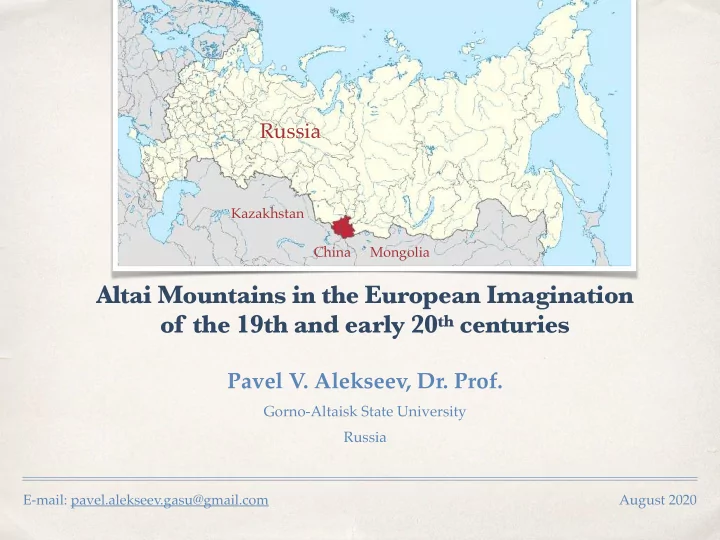
Altai Mountains in the European Imagination
- f the 19th and early 20th centuries
Pavel V. Alekseev, Dr. Prof.
Gorno-Altaisk State University Russia
Russia
Mongolia Kazakhstan China E-mail: pavel.alekseev.gasu@gmail.com August 2020
Altai Mountains in the European Imagination of the 19th and early 20 - - PowerPoint PPT Presentation
Russia Kazakhstan China Mongolia Altai Mountains in the European Imagination of the 19th and early 20 th centuries Pavel V. Alekseev, Dr. Prof. Gorno-Altaisk State University Russia E-mail: pavel.alekseev.gasu@gmail.com August 2020 Altai
Pavel V. Alekseev, Dr. Prof.
Gorno-Altaisk State University Russia
Russia
Mongolia Kazakhstan China E-mail: pavel.alekseev.gasu@gmail.com August 2020
Comparing old maps, starting with the collection of the Flemish cartographer Abraham Ortelius of the early 17th century, we can see how in the minds of Europeans gradually traced the idea of this place. The terrible inaccuracy of these maps was supplemented by the General mythological idea of limitless Tartary. The concept of "Tartary" was constructed in the middle of the 13th century in connection with the Mongol invasion of
was the inclusion of the Christian hell; as a result, there was "Tartary" as a specific designation that exists on the verge of real and imaginary geography
Altai – is a terra incognita located between the 48 and 52 degrees of North latitude and 99 and 107 degrees of East longitude - so stated in the first volume of "Geographical and statistical dictionary of the Russian Empire", published in 1863 by the famous traveler Pyotr Semyonov-Tyan-Shansky
1
2 3
✤ Peter Simon Pallas (1741-1811) ✤ Johann Gottlieb Georgi (1729-1802) ✤ Friedrich Wilhelm Heinrich Alexander von Humboldt
(1769-1859)
✤ Bernhard von Cotta (1808-1879) ✤ Hans Michael Renovanz (1744-1798) ✤ Alexander Georg von Bunge (1803-1890) ✤ Friedrich August von Gebler (1781-1850) ✤ Gregor von Helmersen (1803-1885) ✤ Gerhard Friedrich Müller (1705-1783) ✤ Johann Georg Gmelin (1709-1755) ✤ Friedrich Wilhelm Radloff (1837- 1917)
✤ von Humboldt
Russian naturalist and geologist who was admitted into the Russian Academy of Sciences in 1876 as an honorary member. He authored geographical and geological descriptions of the Altai, Xinjiang (1845), and Asia Minor (1853-1869). One of the Altai mountain ranges is named after him.
✤ The natives live in filth and
poverty
✤ These lands are very far from
civilization
✤ The natives have an Eastern
appearance
✤ The nature of Altai is exotic
✤ Kennan G. Siberia and the Exile System. 2 vols.
London, 1897.
✤ Krausse A. Russia in Asia. London, 1899. ✤ Stadling J. Through Siberia. London, 1901. ✤ Fraser J.F. The Real Siberia. London, 1902. ✤ Deutsch L. Sixteen years in Siberia. London, 1905. ✤ Price M.G. Siberia. London, 1912. ✤ Wright R.L., Digby B. Through Siberia. London,
1913.
✤ Nansen F. Through Siberia. The Land of the Future.
London, 1914.
✤ Czaplicka M.A. Aboriginal Siberia. London, 1915.
English architect, artist and traveller in Siberia and Central Asia. Between 1847 and 1853 he travelled over 40 000 miles through Central Asia and Siberia, much of the time together with his wife Lucy and son Alatau, who was born during their travels
In 1846 she met Thomas Witlam Atkinson, whom she married in February 1848 in
accompanied her husband on his travels through Siberia, south to the Kazakh steppes and eastwards as far as Irkutsk and the Chinese border, before they returned to Britain in 1858.
English soldier, naturalist and hunter, the older brother
Between 1884 and 1897 Swayne hunted whilst on active service in both Africa and India, shooting various animals including elephant, rhinoceros, lion, tiger, leopard and bear. Between 1898 and 1927 he made roughly 40 further privately funded trips throughout Africa and Asia to complete collections, see new countries and meet new tribes, including a trip to Siberia in 1902 with his friend Henry Seton-Karr.
A descendant of Akinfiy Demidoff, the founder
Councilor, poet. He graduated from the Imperial Alexander Lyceum. He served in the Russian embassies in London, Madrid, Copenhagen, Vienna. In 1912 he was an adviser to the Russian Embassy in Paris. Russian envoy to Greece (1912-1917). He visited Altai in 1897.
Ovis Ammon
Elim, his wife, and his friend Littledale
✤ All settlements and roads are
buried in mud
✤ The semantics of violence ✤ The local population is eking
✤ Kalmuks are difficult to
Christianize
✤ The natives adhere to the cruel
and disgusting rituals
The semantics of violence
«Here we made acquaintance with the Zaissan Semion, an energetic Kalmuk chief, who had been summoned by Mr. Meyer in order to superintend our expedition in procuring for us the best horses he could muster in the country, and the most reliable men. He was a christened native, and a great deal above the average of Kalmuk intelligence. As I have said before, the Zaissan, the elected chief of a tribe, is almost
arbitrary fashion, Government control amounting to very little, and the inhabitants being at the lowest possible degree of civilisation, if such it may be called. We were several times witnesses of punishments inflicted
and occasionally had to put a stop to them».
The natives adhere to the cruel and disgusting rituals
«Here we first came across Kalmuk offerings to their
the end of these poles hung skins of horses and goats; the wretched animals had been torn to pieces alive as a peace offering to the spirits. After two trees are hewn down the animal is tied, his fore feet to one and hind legs to the other, and the trees are
✤ The Russian government, despite almost a
century of possession of this territory, had no idea about its Mountainous South Siberian frontier;
✤ The process of inventing the Altai had a
foreign policy orientation;
✤ The strengthening of Russian expansion in
the Central Asian direction led to the anxiety of the British Empire;
✤ As a result of the influence of Russian and
European Imperial practices, the image of southern Siberia was strongly romanticized and saturated with contradictory meanings as a typically Eastern territory
Thanks for your attention!