PATTERN AND CLINICAL PRESENTATION OF ACUTE APPENDICITIS IN ADULTS IN - - PDF document

pattern and clinical presentation of acute appendicitis
SMART_READER_LITE
LIVE PREVIEW

PATTERN AND CLINICAL PRESENTATION OF ACUTE APPENDICITIS IN ADULTS IN - - PDF document

Pattern and Clinical Presentation of Acute Appendicitis Abraham D. et al 117 ORIGINAL ARTICLE PATTERN AND CLINICAL PRESENTATION OF ACUTE APPENDICITIS IN ADULTS IN ZEWDITU MEMORIAL HOSPITAL Abraham Deneke 1* , MD, Birhanu Tadesse 2 , MD


slide-1
SLIDE 1

Pattern and Clinical Presentation of Acute Appendicitis Abraham D. et al 117

ORIGINAL ARTICLE

PATTERN AND CLINICAL PRESENTATION OF ACUTE APPENDICITIS IN ADULTS IN ZEWDITU MEMORIAL HOSPITAL

Abraham Deneke1*, MD, Birhanu Tadesse2, MD

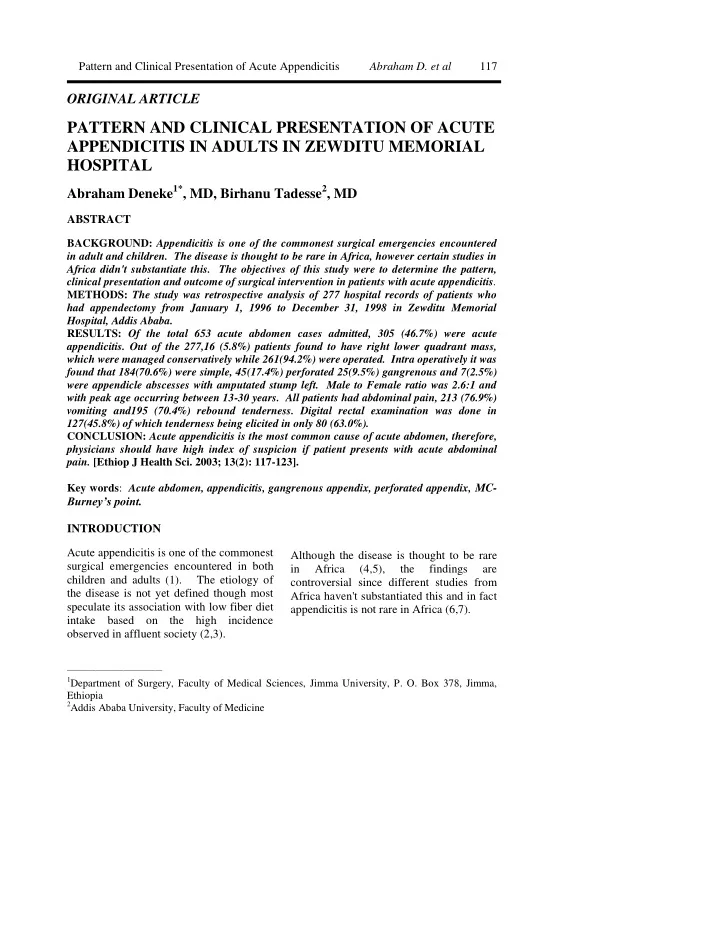
ABSTRACT BACKGROUND: Appendicitis is one of the commonest surgical emergencies encountered in adult and children. The disease is thought to be rare in Africa, however certain studies in Africa didn't substantiate this. The objectives of this study were to determine the pattern, clinical presentation and outcome of surgical intervention in patients with acute appendicitis. METHODS: The study was retrospective analysis of 277 hospital records of patients who had appendectomy from January 1, 1996 to December 31, 1998 in Zewditu Memorial Hospital, Addis Ababa. RESULTS: Of the total 653 acute abdomen cases admitted, 305 (46.7%) were acute

  • appendicitis. Out of the 277,16 (5.8%) patients found to have right lower quadrant mass,

which were managed conservatively while 261(94.2%) were operated. Intra operatively it was found that 184(70.6%) were simple, 45(17.4%) perforated 25(9.5%) gangrenous and 7(2.5%) were appendicle abscesses with amputated stump left. Male to Female ratio was 2.6:1 and with peak age occurring between 13-30 years. All patients had abdominal pain, 213 (76.9%) vomiting and195 (70.4%) rebound tenderness. Digital rectal examination was done in 127(45.8%) of which tenderness being elicited in only 80 (63.0%). CONCLUSION: Acute appendicitis is the most common cause of acute abdomen, therefore, physicians should have high index of suspicion if patient presents with acute abdominal

  • pain. [Ethiop J Health Sci. 2003; 13(2): 117-123].

Key words: Acute abdomen, appendicitis, gangrenous appendix, perforated appendix, MC- Burney’s point. INTRODUCTION Acute appendicitis is one of the commonest surgical emergencies encountered in both children and adults (1). The etiology of the disease is not yet defined though most speculate its association with low fiber diet intake based on the high incidence

  • bserved in affluent society (2,3).

Although the disease is thought to be rare in Africa (4,5), the findings are controversial since different studies from Africa haven't substantiated this and in fact appendicitis is not rare in Africa (6,7).

___________________________ 1Department of Surgery, Faculty of Medical Sciences, Jimma University, P. O. Box 378, Jimma,

Ethiopia

2Addis Ababa University, Faculty of Medicine

slide-2
SLIDE 2

Ethiop J Health Sci Vol. 13, No. 2 July 2003 118 For instance, studies carried out in some parts of Africa like Kenyata-National Hospital, Nairobi, in children and adults, in Khartoum as well as in Nigeria by different authors indicated that appendicitis is most common cause

  • f

acute abdominal emergency operations (1,9-11). However, few studies were done in

  • Ethiopia. To date, two studies were

conducted on children in Ethio-Sweddish Children Hospital (11, 13) and one on all age groups in North West of Ethiopia, Gondar Hospital (13), all of which confirm the reports, which have shown that appendicitis is a rare disease in Africa. The gold standard surgical approach for a patient suspected to have acute appendicitis is transverse or vertical incision at MC-Burney’s point i.e., two third from umbilicus on imaginary line drawn between the umbilicus and anterior superior iliac spine. Midline

  • r

paramedian, incision is utilized if presentation of patient is generalized peritonitis and diagnosis

  • ther

than appendicitis as a cause is suspected. The rate

  • f

normal appendectomy after presenting with clinical feature

  • f

appendicitis averages 16 percent (16). Mortality rate from appendicitis in USA has steadily decreased from 9.9 per 100,000 in 1939 to 0.2 per 100,000 patients in 1986 due to better diagnosis and treatment (16), but higher for developing countries. Thus, knowledge

  • n

prevalence, etiology and complications of this disease would enable better preparation for preventive work as well as for reduction of morbidity, mortality and cost of health

  • care. This study attempted to determine the

pattern, clinical presentation and out come

  • f surgical intervention in adult patients

presented with acute abdominal problem to Zewditu Memorial Hospital (ZMH), Addis Ababa. MATERIALS AND METHODS Zewditu Memorial Hospital is a teaching and referral hospital affiliated with Department

  • f

Surgery, Faculty

  • f

Medicine, Addis Ababa University. It is located in Addis Ababa, the capital city of

  • Ethiopia. It has 38 surgical beds for

elective surgery and additional 8 beds, which are reserved mostly for emergency surgical admissions. The hospital gives service for patients’ aged 13 and above. The source population was all cases of acute abdomen admitted to ZMH from January 1996 to December 31,1998. A total

  • f 653 patients with diagnosis of acute

abdomen were seen. Out of a total 653 patients with acute abdomen 305 patients were cases of appendicitis. Further more the discharge book showed that 277 patients had appendicitis, 16 patients were appendiceal mass and the cards of 28 patients were not available for analysis. Finally the 261 patients record were

  • rganized, analyzed and presented in this

study. Records of individual patients noted by the admitting residents, resident performed the surgery and the consultant on duty during postoperative follow up was included in the analysis. The data collected using pre-prepared data collecting format. The data were entered, edited and analyzed using EPI-Info statistical software and presented using frequency tables and figures. Definition of terms: Acute abdomen defined as acute abdominal pain of sudden

  • nset, is an emergency state which usually

requires surgical intervention. Permission from the department of surgery of ZMH was secured verbally to review patients card for this study.

slide-3
SLIDE 3

Pattern and Clinical Presentation of Acute Appendicitis Abraham D. et al 119 RESULTS During the three years a total of 653 patients were admitted with the diagnosis

  • f acute abdomen of which 305 (46.7%)

patients presented with a clinical diagnosis

  • f acute appendicitis. Out of the 305

patients’ records, 277 (90.8%) were retrieved for analysis and the remaining cards could not be traced. Out of the 277 patients, 201 (72.6%) were males and 76 (27.4%) were females, giving male to female ratio of 2.6:1. One hundred sixty four (59.5%) of cases came from Addis Ababa, 26 (9.4%) from outside Addis and the addresses of the remaining 87 (31.4%) patients was not recorded. The age at presentation ranged from 13-75 years with mean ages of 25.6 years. The majority of cases, 212 (76.5%) occurred between the ages of 13 and 30 years (Table 1). The time lapse between the onset of symptoms and patient presentation to the hospital is shown in Fig1. Majority, 164 (59.2%) presented within 1-3 days and 64 (23.1%) with 4 or more days after the onset

  • f symptoms while only 47 (17.7%)

presented in the first 24 hours of onset of symptoms. Table 1. Distribution

  • f

Cases

  • f

appendicitis by Age, Zewditu Memorial Hospital, Addis Ababa, January 1996- December 1998 Age in year Number

  • f cases

Percent <20 112 40.5 21-30 100 36.1 31-40 44 15.9 41-50 14 5.0 >50 7 2.5 Total 277 100 5 10 15 20 25 30 35

%

<12 12-23- 24-28 49-72 >72 Time in Hours Fig 1. Distribution of time lapse during presentation to Hospital, Zewdity Memorial Hospital, Addis Ababa, January 1996-Dec 1998

slide-4
SLIDE 4

Ethiop J Health Sci Vol. 13, No. 2 July 2003 120 The clinical presenting pattern is shown in Fig 2. Shifting abdominal pain and vomiting were the commonest symptoms while right lower quadrant tenderness and rebound tenderness were the commonest

  • signs. Digital rectal examination was

recorded only for 127 (45.8%) patients, out

  • f which 63.0%was found to have right

lower quadrant tenderness. Anorexia was not recorded in all patients. White blood cell (WBC) count was done for 217 (78.3%) patients. Out of which 49.4% had count between 4000- 1100 cells/mm3 and the rest had a count greater than 1100/mm3. Out of the 277 clinically diagnosed cases of acute appendicitis 261 were

  • perated and 16 were found to have mass at

right lower quadrant of the abdomen

  • examination. The later were managed

conservatively and discharged with improvement and advised to come back for interval appendectomy.

100 76.9 35.2 7.6 6.9 92.4 70.4 13.7 7.6 10 20 30 40 50 60 70 80 90 100

%

Pain Vomiting Nausea Diarrhea Constipation Localized Tenderness Rebound Tenderness Mass Generalized Tenderness

Fig 2. Distribution of Clinical Presentation of Patient with Acute Appendicitis, ZMH, AA, Jan 1996-December 1998

slide-5
SLIDE 5

Pattern and Clinical Presentation of Acute Appendicitis Abraham D. et al 121 Most patients, 206 (78.9%) were

  • perated through transverse abdominal

incision at Mc- Burney’s point while in the rest 55 (21.1%) mid-line or Para median abdominal incision was made. The latter incision was utilized mostly in female patients and in patients presented with generalized peritonitis. Intra-operative findings are shown on table 2. Accordingly perforation rates were 17.2%, 9.6% had gangrenous appendix and 2.5% found to have abscess intra

  • peratively. In the later the abscess was

drained and the appendix was removed

  • concomitantly. There was no report of

removal of normal appendix after operating for presumed appendicitis. Three patients (1.2%) died postoperatively after surgery. All of them presented in more than four days after the onset of illness and found to have features of generalized peritonitis. Appendicitis constituted most of the acute emergency abdominal operations for the years 1996, 1997 and 1998 in Zewditu Memorial Hospital with respective figures

  • f 86(39.1%), 82(42.5%) and 137(57.1%)

[Table 2]. Table 2. Distribution of Emergency Admission for acute abdomen by year, Zewditu Memorial Hospital, Addis Ababa, January1996-December 1998

Year All acute Abdomen per year Appendicitis No % 1996 220 86 39.1 1997 192 82 42.5 1998 241 137 57.1 Average 653 305 46.7

Table 3. Distribution of intra-operative gross findings of operated cases, January 1996 – December 1998, Zewditu Memorial Hospital Number

  • f cases

Percent Simple 184 70.6 Perforation 45 17.4 Gangrenous 25 9.5 Abscess 7 2.5 Total 261 100 DISCUSSION Appendicitis though thought as uncommon cause of acute abdomen in Africa, some study end up with contrary result (5, 9, 11). This study has shown that acute appendicitis is not a rare disease in Africa; this is in agreement with other studies (1,13,15). The male preponderance and the commonest age of presentation (13-40 years) are in agreement with other studies in Ethiopia and some African countries (5, 7, 13, 14). The clinical presentation of abdominal pain in all patients with a shifting pain in 223 (80.5%) of cases and associated vomiting in 213 (76.9%). In addition, localized tenderness in 256 (92.4%) with rebound tenderness in 195 (70.4%) in the right lower quadrant found on examination are similar to studies by other investigators (1,7). Bowel habit change i.e., diarrhea and constipation were found in 7.6% and 6.9%

  • respectively. This is also in agreement

with low incidence of constipation (13.0%) and diarrhea (10.0%), reported by Ahmed (14), and 10.0% of diarrhea and 15.0% of constipations found by Ochola - Abila (1). Rectal digital examination done in 127 (45.8%) of patient out of which 80 (63.0%)

  • f patient had tenderness

which is comparable to the finding by Bonnello (15) in which he found positive correlation in 3.0-72.0%. Based on the wide variation

slide-6
SLIDE 6

Ethiop J Health Sci Vol. 13, No. 2 July 2003 122 found on other studies we can say tenderness on rectal examination can be supportive but its absence shouldn’t lead to exclusion of the diagnosis of appendicitis. Besides it indicates that most physician might be reluctant to do digital rectal examination in patients with suspected acute appendicitis. Analysis of the WBC in relation to diagnosis of a cute appendicitis as in most studies end up with controversial results (14). It was found that 50.0% of patients had WBC count above 11,000/mm3, which is above normal. A high count is supportive to clinical diagnosis but a normal count (4000-1100/mm3) cannot rule

  • ut appendicitis since the rest 50.0% of

cases with proven appendicitis found to lie in the later group. Transverse or vertical incision at MC- Burney’s point was utilized in 206 (78.9%)

  • f the patients, which is in agreement with

78.0% found by Ahmed (14). A perforation rate of 45 (17.2%) in this study correlates well with other studies done in adult age groups reported by Ahmed (14). Three (1.2%) postoperative deaths are low when compared to other studies in this country (9,11,13). This could be as a result of better awareness and early treatment seeking behavior of the people as observed most are from Addis. In this study there was no report of normal appendix intra-operatively, which contradicts studies done somewhere else (14,16,17). This could be either too specific diagnostic and admission criteria

  • f appendicitis which result in false

negative diagnosis

  • r

too sensitive diagnostic criteria in other countries .The common trend observed among surgical residents in ZMH is a tendency to report as “minimally inflamed appendix” instead of a grossly normal looking appendix intra-

  • peratively. Another common limitation is

failure to send the removed specimen for pathological analysis. The above- mentioned reasons might contribute for the exaggerated result of the absence of normal appendix. In conclusion acute appendicitis is the most common cause among all emergency acute abdominal operations performed in ZMH and we believe that there are similar high incidences in other hospitals in Addis

  • Ababa. Therefore a high index of suspicion

should be born in mind by physician in patients presenting with acute abdominal pain in order to have early diagnosis, avoid complication and to reduce mortality and cost associated with complicated appendicitis. ACKNOWLEDGEMENTS We would like to pass our gratitude to Dr. Demeke Assefa for his invaluable comments without whom it would have been impossible to finish our work. We also thank W/ro Asiya Suleyman and Kokebe Wolde who wrote this paper. We would also like to thank the Department of Surgery, Zewditu Memorial Hospital, Addis Ababa for letting us review the patients records. REFERENCES

  • 1. Ochola - Abila P. Appendicitis in

children and adults in Kenyata National Hospital, Nairobi. 1979; 56: 368 - 74.

  • 2. Gerst PH, Mukherjec A, Kumar A,

Albu E. Acute appendicitis in minority communities: an epidemiological

  • study. J NaH Med Assoc. 1997, 89(3)

168-72.

  • 3. Walker ARP, Richardson BD, Walker

BF, Woolford A. Appendicitis, fiber intake and bowel behavior in ethnic groups in South Africa. Post Graduate

  • Med. J 1973; 49: 243-9.
slide-7
SLIDE 7

Pattern and Clinical Presentation of Acute Appendicitis Abraham D. et al 123

  • 4. Rode J, Dhillon AP, Hutt MS.

Appendicitis revisited: a comparative study

  • f

Malawian and English

  • appendices. J Pathol 1987; 153(4);

357-63.

  • 5. Zelalem A. Pattern of acute abdomen

in Yirgalem Hospital. Ethiop Med J 2000; 38: 227-33.

  • 6. Dutubo-Brown

BD, Adotey JM. Pattern of surgical acute abdomen in the university

  • f

Port Harcourt Teaching Hospital. West Afr J Med 1990; 9(1): 59-62.

  • 7. Ogbonna BC, Obekpa PO, Momoh JT,

Ige JT. Another look at acute appendicitis in tropical Africa and the value of laparascopy in diagnosis. Trop Doct 1993; 23: 82-4.

  • 8. Out AA. Tropical surgical abdominal

emergencies: acute appendicitis. Trop Geogr Med 1998; 41(2); 118-22.

  • 9. Orvar J, Mesfin A, Adem A, Demissie
  • H. Appendicitis in childhood. Ethiop

Med J 1981; 19; 1-7.

  • 10. Kakende I, Kuvuma J, Kayando J.

Appendicitis in Mulago Hospital. East Afr Med J 1978; 55; 1972-74.

  • 11. Ephrem D, Desalegn M. Childhood

appendicitis; Factors associated with its incidence and perforations in Ethiopian children. Ethiop Med J 1991; 29; 15-19.

  • 12. Umerah

B, Obadike G. Acute abdomen in the Zambian African. East Afr Med J 1987; 55(2): 77-80.

  • 13. Birhanu

K, Gashaw M. Acute appendicitis in Ethiopia. East Afr Med J 1996; 73; 251-252.

  • 14. Ahmed ME. Acute appendicitis in

Khartoum: pattern and clinical

  • presentation. East Afr Med J 1987; 64:

202-6.

  • 15. Muthuphei MN, Morwamoche P. The

surgical pathology of the appendix in South African blacks. Center Afr J

  • Med. 1988; 44(1): 9-11.
  • 16. Scwartz S, Shires GT, Spencer F.

Principles of Surgery. 7th edition, 1999.

  • 17. Madiba TE, Haffejee AA, Mbele DL,

Chaithrain H, John J. Appendicitis among African patient at King Edward VIII Hospital, Durban, South Africa: a

  • review. East Afr Med. J 1998; 75:81-

84.