---PAST--PRESENT--FUTURE--- IN DEVELOPMENTAL DISABILITIES IN OHIO - - PowerPoint PPT Presentation

past present future in developmental disabilities in ohio
SMART_READER_LITE
LIVE PREVIEW

---PAST--PRESENT--FUTURE--- IN DEVELOPMENTAL DISABILITIES IN OHIO - - PowerPoint PPT Presentation

---PAST--PRESENT--FUTURE--- IN DEVELOPMENTAL DISABILITIES IN OHIO AND THE UNITED STATES David Braddock, Ph.D. Associate Vice President, University of Colorado System & Executive Director, Coleman Institute for Cognitive Disabilities


slide-1
SLIDE 1

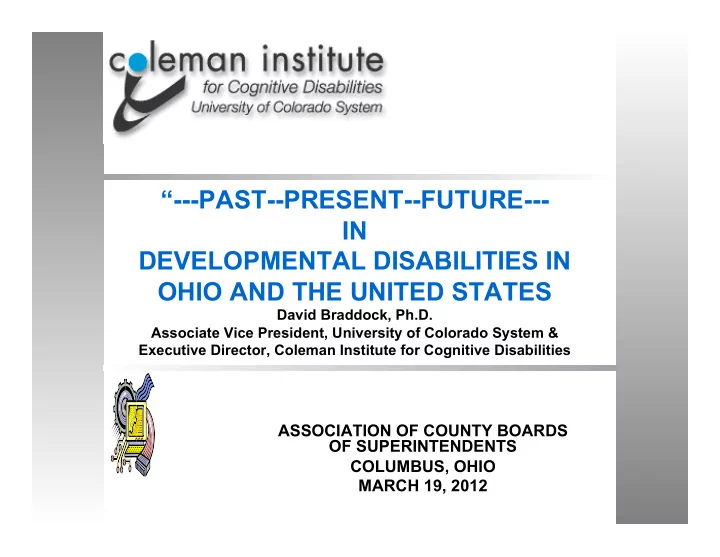
“---PAST--PRESENT--FUTURE--- IN DEVELOPMENTAL DISABILITIES IN OHIO AND THE UNITED STATES

David Braddock, Ph.D. Associate Vice President, University of Colorado System & Executive Director, Coleman Institute for Cognitive Disabilities

ASSOCIATION OF COUNTY BOARDS OF SUPERINTENDENTS COLUMBUS, OHIO MARCH 19, 2012

slide-2
SLIDE 2

2

PAST--PRESENT--FUTURE

  • I. THE PAST--

THE INSTITUTIONAL ERA, ITS DECLINE, AND THE RISE OF COMMUNITY, FAMILY AND INDIVIDUAL

  • II. THE PRESENT--

OVERVIEW OF I/DD SERVICES IN OHIO AND THE U.S.

  • III. ECONOMIC UNCERTAINTY IN THE STATES--

THE GREAT RECESSION

  • IV. THE FUTURE--
  • EMERGING TECHNOLOGIES
  • GROWING INEQUALITY &

THE AMERICAN PROMISE

slide-3
SLIDE 3

3

FIRST MENTAL DISABILITY INSTITUTIONS

BETHLEHEM, LONDON, ENGLAND (1403) VALENCIA, SPAIN (1409) ZARAGOZA, SPAIN (1425) SEVILLE, SPAIN (1436) VALLADOLID, SPAIN (1436) PALMA MAJORCA, SPAIN (1456) TOLEDO, SPAIN (1480) GRANADA, SPAIN (1527) SAN HIPOLITO, MEXICO CITY (1566)

  • I. THE PAST: INSTITUTIONAL ERA: 1403-1960
slide-4
SLIDE 4

4

ERA OF INSTITUTIONALIZATION - NEW BETHLEM HOSPITAL IN MORE FIELDS: 1725

slide-5
SLIDE 5

5

STATE INSTITUTION FOR FEEBLE MINDED-CHILDREN SYRACUSE, NEW YORK (1851)

  • D. Braddock, University of Colorado, 2005.
slide-6
SLIDE 6

6

PENNSYLVANIA INSTITUTION FOR FEEBLE-MINDED CHILDREN, (ELWYN) 1853

  • D. Braddock, University of Colorado, 2005.
slide-7
SLIDE 7

7

OHIO STATE ASYLUM FOR EDUCATION OF IDIOTIC AND IMBECILE YOUTH (COLUMBUS) 1857

slide-8
SLIDE 8

8

LINCOLN STATE SCHOOL AND COLONY LINCOLN, ILLINOIS (1865)

  • D. Braddock, University of Colorado, 2006.
slide-9
SLIDE 9

9

NEW YORK STATE CUSTODIAL ASYLUM FOR WOMEN, NEWARK (1885)

  • D. Braddock, University of Colorado, 2006.
slide-10
SLIDE 10

10

STATE EPILEPTIC HOSPITAL, GALLIPOLIS, OHIO (1890)

  • D. Braddock, University of Colorado, 2006.
slide-11
SLIDE 11

11

LACONIA STATE SCHOOL FOR FEEBLE MINDED CHILDREN, LACONIA, NEW HAMPSHIRE (1901)

  • D. Braddock, University of Colorado, 2006.
slide-12
SLIDE 12

12

PENNHURST INSTITUTION FOR FEEBLE MINDED AND EPILEPTICS, SPRING CITY, PENNSYLVANIA (1903)

  • D. Braddock, University of Colorado, 2006.
slide-13
SLIDE 13

13

ILLINOIS INDUSTRIAL COLONY FOR IMPROVABLE EPILEPTICS, DIXON, ILLINOIS (1918)

  • D. Braddock, University of Colorado, 2006; Abraham Lincoln Pres. Library.
slide-14
SLIDE 14

14

“THE SHAME OF THE STATES”

Source: D. Braddock, University of Colorado, 2012.

January 4, 1952

slide-15
SLIDE 15

15

WHILE WASHINGTON SLEPT KENNEDY FOUNDATION DID NOT

Source: D. Braddock, University of Colorado, 2012.

February 20, 1952

slide-16
SLIDE 16

16

FAST FORWARD TO NEW YORK STATE INSTITUTION, 1960s

  • D. Braddock, University of Colorado, 2012.
slide-17
SLIDE 17

17

PENNHURST STATE SCHOOL, 1960s

Source: D. Braddock, University of Colorado, 2012.

slide-18
SLIDE 18

18

PROGRESS STIMULATED BY THE PRESIDENT’S PANEL: 1961

Source: D. Braddock, University of Colorado, 2012.

slide-19
SLIDE 19

19

slide-20
SLIDE 20

20

PRESIDENT KENNEDY SIGNS STATE PLANNING ACT IN 1963 --”A BOLD NEW APPROACH”

Source: D. Braddock, University of Colorado, 2012.

slide-21
SLIDE 21

21

DAILY CENSUS OF STATE I/DD INSTITUTIONS, 1848-2009

Source: Braddock, D., State of the States in Developmental Disabilities, 2010.

slide-22
SLIDE 22

22

14 STATES WITHOUT STATE-OPERATED I/DD INSTITUTIONS: 2012

  • 1. DISTRICT OF COLUMBIA (1991)
  • 2. NEW HAMPSHIRE (1991)
  • 3. VERMONT (1993)
  • 4. RHODE ISLAND (1994)
  • 5. ALASKA (1997)
  • 6. NEW MEXICO (1997)
  • 7. WEST VIRGINIA (1998)
  • 8. HAWAII (1999)
  • 9. MAINE (1999)
  • 10. MICHIGAN (2009)
  • 11. OREGON (2009)
  • 12. ALABAMA (2012)
  • 13. MINNESOTA (2000)*
  • 14. INDIANA (2007)*
slide-23
SLIDE 23

23

156 STATE-OPERATED INSTITUTIONS CLOSED, PROJECTED TO CLOSE: 1969-2015*

Source: Braddock, D., State of the States in Developmental Disabilities, 2011.

*Data for 2015 projected based on 2000-2010 trend; 155 closures through 2011.

slide-24
SLIDE 24

24

UNITED STATES

Source: Braddock, D., State of the States in Developmental Disabilities, 2011.

WILL THERE ALWAYS BE STATE-OPERATED INSTITUTIONS?

slide-25
SLIDE 25

25

WHO’S NEXT?

Source: Braddock, D., State of the States in Developmental Disabilities, 2011.

slide-26
SLIDE 26

26

WHO’S NOT?

Source: Braddock, D., State of the States in Developmental Disabilities, 2011.

slide-27
SLIDE 27

27

II.1 STRUCTURE AND FINANCING OF INTELLECTUAL/DEVELOPMENTAL DISABILITY (I/DD) SERVICES II.2 MEASURING STATE COMMITMENT TO I/DD SERVICES: FISCAL EFFORT II.3 RECENT TRENDS IN FAMILY SUPPORT, SUPPORTED EMPLOYMENT AND AGING CAREGIVERS

  • II. THE PRESENT: OVERVIEW OF

SERVICES IN OHIO AND THE U.S.

slide-28
SLIDE 28

28

II.1 FINANCING I/DD SERVICES

  • DURING 2006, 2008 AND 2009, AGGREGATE

PUBLIC NATIONWIDE I/DD SPENDING GREW BY THE SMALLEST AMOUNTS WE HAVE OBSERVED IN 32 YEARS.

slide-29
SLIDE 29

29

ANNUAL % CHANGE IN TOTAL INFLATION- ADJUSTED I/DD SPENDING IN THE U.S.: 1978-09

3.8%

U.S. I/DD SPENDING

Source: Braddock, D., State of the States in Developmental Disabilities, 2012.

slide-30
SLIDE 30

30

NUMBER OF STATES WITH INFLATION-ADJUSTED CUTS IN I/DD SPENDING : 1978-2009

Source: Braddock, D., State of the States in Developmental Disabilities, 2012.

slide-31
SLIDE 31

31

23 STATES REDUCED INFLATION ADJUSTED I/DD SPENDING IN FY 2009

Source: Braddock, D., State of the States in Developmental Disabilities, 2012.

slide-32
SLIDE 32

32

Utilization Rate: 194 per 100,000

INDIVIDUALS WITH I/DD IN OUT-OF-HOME PLACEMENTS IN THE U.S., 2009

Source: Braddock, D., State of the States in Developmental Disabilities, 2011.

slide-33
SLIDE 33

33

INDIVIDUALS WITH I/DD IN OUT-OF-HOME PLACEMENTS IN 2009

SMALL NEW ENGLAND STATES

(MAINE, NEW HAMPSHIRE, RHODE ISLAND, VERMONT)

Source: Braddock, D., State of the States in Developmental Disabilities, 2011.

Total Consolidated General Population in 2009: 4.3 million.

slide-34
SLIDE 34

34

Source: Braddock, D., State of the States in Developmental Disabilities, 2012.

INDIVIDUALS WITH I/DD IN OUT-OF-HOME PLACEMENTS IN 2011

OHIO

slide-35
SLIDE 35

35

INDIVIDUALS WITH I/DD BY SIZE AND TYPE OF SETTING IN OHIO: 1977

Source: Braddock, D., State of the States in Developmental Disabilities, 2012.

slide-36
SLIDE 36

36

SETTINGS FOR 6 OR FEWER PERSONS ASCEND RAPIDLY 2001-2011; INSTITUTIONS DECLINE

OHIO

slide-37
SLIDE 37

37

Source: Braddock, D., State of the States in Developmental Disabilities, 2012.

STRONG GROWTH OF SETTINGS FOR 1-6 PERSONS DURING 2001-2011

OHIO

slide-38
SLIDE 38

38

OHIO

Source: Braddock, D., State of the States in Developmental Disabilities, 2012. *Ohio among last 9 states to initiate HCBS Waiver spending.

HCBS WAIVER PARTICIPANTS INCREASE 18% PER YEAR DURING 2001-2011*

slide-39
SLIDE 39

39

OHIO: I/DD REVENUE SOURCES IN 2011

Source: Braddock, D., State of the States in Developmental Disabilities, 2012.

slide-40
SLIDE 40

40

OHIO

OHIO’S WAIVER SPENDING 62% ABOVE ICF/ID SPENDING IN 2011--ICF/ID PLATEAUS 1995-2011

Source: Braddock, D., State of the States in Developmental Disabilities, 2012.

slide-41
SLIDE 41

41

COUNTY I/DD FUNDING IN OHIO SURPASSED NON-COUNTY FUNDING IN 2002

Source: Braddock, D., State of the States in Developmental Disabilities, 2012.

slide-42
SLIDE 42

42

OHIO’S COUNTY FUNDING FOR COMMUNITY I/ DD SERVICES EXCEEDS STATE FUNDING*

Source: Braddock, D., State of the States in Developmental Disabilities, 2012. *NOTE: Drop 2006-11 in County Funding due to termination of Medicaid Community Alternative Funding System (CAFS) funding in 2005, resulting in drop in County Medicaid match funding.

slide-43
SLIDE 43

43

UNITED STATES

U.S. FEDERAL HCBS WAIVER SPENDING IS DOUBLE ICF/ID SPENDING IN 2009

Intercept (2001)

Source: Braddock, D., State of the States in Developmental Disabilities, 2012.

slide-44
SLIDE 44

44

NEW YORK RECEIVES 20% OF NATION’S I/DD MEDICAID FUNDING

NY Times, August 2, 2011

slide-45
SLIDE 45

45

II.2 MEASURING STATE COMMITMENT TO I/DD SERVICES: FISCAL EFFORT

Fiscal effort is a ratio that can be

utilized to rank states according to the proportion of their total statewide personal income devoted to the financing

  • f I/DD services.

Fiscal effort is defined as a state’s spending for I/DD services per $1,000 of total statewide personal income.

slide-46
SLIDE 46

46

OHIO’S FISCAL EFFORT FOR I/DD SERVICES EXCEEDS U.S.1979-2011

Source: Braddock, D., State of the States in Developmental Disabilities, 2012.

(Ohio ranked 7TH in 2009 and 10th in Community Fiscal Effort)

slide-47
SLIDE 47

47

II.3 RECENT TRENDS: FAMILY SUPPORT, SUPPORTED EMPLOYMENT, AGING CAREGIVERS

  • A. FAMILY SUPPORT
  • B. SUPPORTED

EMPLOYMENT

  • C. IMPACT OF AGING

CAREGIVERS

slide-48
SLIDE 48

48

II.3A FAMILY SUPPORT DEFINED

FAMILY SUPPORT INCLUDES

  • Respite
  • Family counseling
  • Architectural adaptation of the home
  • In-home training, education, behavior management
  • Sibling support programs, and
  • Purchase of specialized equipment

“CASH SUBSIDY FAMILY SUPPORT” INCLUDES: Payments or vouchers directly to families;

families determine what is purchased

slide-49
SLIDE 49

49

FAMILIES SUPPORTED IN OHIO ARE 20% OF TOTAL ESTIMATED I/DD CAREGIVING FAMILIES

Source: Braddock, D., State of the States in Developmental Disabilities, 2012.

slide-50
SLIDE 50

50

METHOD OF ESTIMATING NUMBER OF I/DD CAREGIVING FAMILIES IN OHIO*

  • A. Ohio state population: 11,545,485
  • B. Estimated I/DD (@1.58%): 182,419
  • C. Less out-of-home placements (38,038): 147,381
  • D. Estimated individuals with I/DD living with

spouse, relative, in own home: 47,162

  • E. Estimated I/DD with caregiving families: 100,219

(C. minus D.)

*Sources: Braddock et al. (2012). Coleman Institute and Department of Psychiatry, University of Colorado, 2012; based on Fujiura (1998), Larson et al. (2001).

slide-51
SLIDE 51

51

FAMILIES SUPPORTED: OHIO SLIGHTLY ABOVE THE U.S. AVERAGE

Source: Braddock, D., State of the States in Developmental Disabilities, 2012.

slide-52
SLIDE 52

52

NUMBER OF U.S. FAMILIES SUPPORTED GROWS BUT ONLY 7% OF TOTAL I/DD SPENDING

Family support spending in 2009 constituted 7% of total I/DD long- term care spending ($53.2 billion).

Source: Braddock, D., State of the States in Developmental Disabilities, 2012.

UNITED STATES

slide-53
SLIDE 53

53

NUMBER OF OHIO FAMILIES SUPPORTED GROWS BUT ONLY 3% OF TOTAL I/DD SPENDING

Source: Braddock, D., State of the States in Developmental Disabilities, 2012; number of families reported to our study by personnel from the Ohio Department of Developmental Disabilities.

Family support spending in 2011 constituted 3% of total I/DD long- term care spending in Ohio ($3.15 billion).

OHIO

slide-54
SLIDE 54

54

22 STATES HAD CASH SUBSIDIES FOR FAMILIES IN 2009—OHIO DID NOT

Source: Braddock, D., State of the States in Developmental Disabilities, 2012.

slide-55
SLIDE 55

55

  • “While supported employment

has made significant gains since its formal introduction in 1984 (P.L. 98-527), segregated services continue to outpace the growth of supported employment nationally.”

  • True in 2004 and true today.

(Rusch & Braddock, Research and Practice for Persons with Severe Disabilities, 2004)

II.3B SUPPORTED EMPLOYMENT

slide-56
SLIDE 56

56

PER CAPITA* SUPPORTED EMPLOYMENT WORKERS IN OHIO RANKED IN TOP 3RD OF STATES IN 2009

*Per 100,000 of General Population

slide-57
SLIDE 57

57

I/DD SUPPORTED EMPLOYMENT WORKERS GROWS RAPIDLY THEN PLATEAUS

Source: Braddock, D., State of the States in Developmental Disabilities, 2012.

UNITED STATES

slide-58
SLIDE 58

58

I/DD SUPPORTED EMPLOYMENT WORKERS IN OHIO PEAKS IN 2003, THEN DECLINES

Source: Braddock, D., State of the States in Developmental Disabilities, 2012.

slide-59
SLIDE 59

59

LONGEVITY OF PERSONS WITH I/ DD, THE AGING OF AMERICA, AND AGING I/DD FAMILY CAREGIVERS

II.3C AGING CAREGIVERS

slide-60
SLIDE 60

60

  • 1970s: 59.1 years
  • 1993: 66.2 years
  • U.S. General Population: 70.4 years
  • In the future “…those without severe

impairment can be expected to have a life span equal to that of the general population.” LONGEVITY INCREASES FOR PERSONS WITH AN INTELLECTUAL DISABILITY

Source: M. Janicki. (1996). Rehabilitation Research and Training Center on Aging and Mental Retardation, University of Illinois at Chicago.

slide-61
SLIDE 61

61

AN ESTIMATED 27% OF PERSONS WITH I/DD LIVE AT HOME WITH CAREGIVERS AGED 60 YEARS OR MORE

OHIO

slide-62
SLIDE 62

62

OHIO RANKS 6TH IN U.S. IN POPULATION AGED 65+ YEARS, 2010

Source: U.S. Bureau of the Census, 2010

slide-63
SLIDE 63

63

AGED 65+ YEARS: 2010-2050

AGING POPULATION DOUBLES 2010-40, U.S.

Source: U.S. Bureau of the Census, 2009

slide-64
SLIDE 64

64

ECONOMIC UNCERTAINTY IN THE STATES AND THE GREAT RECESSION

  • III. ECONOMIC UNCERTAINTY
slide-65
SLIDE 65

65

WHICH STATES ARE CONFIDENT ABOUT THE U.S. ECONOMY? NONE ARE! DC IS!

slide-66
SLIDE 66

66

FOUR US RECESSIONS: AGGREGATE STATE GENERAL FUNDS DROP

slide-67
SLIDE 67

67

FACTORIES, UTILITIES, MINES

U.S. INDUSTRIAL CAPACITY UTILIZATION: JANUARY 2005-JANUARY 2012

slide-68
SLIDE 68

68

STATE BUDGETARY SHORTFALLS:2002-12

slide-69
SLIDE 69

69

STATE BUDGET SHORTFALLS FOR FY 2012

slide-70
SLIDE 70

70

STATE TAX REVENUE FELL FROM 2008 Q2 THROUGH 2009 Q2. REBOUNDED TO 2011 Q 2 – BUT DOWN Q3

Source: The Nelson A. Rockefeller Institute of Government, January 2012.

slide-71
SLIDE 71

71

STATES’ SALES TAX REVENUES INCREASE 6.1% IN 3rd QUARTER OF 2011

Source: The Nelson A. Rockefeller Institute of Government, January 2012.

slide-72
SLIDE 72

72

Source: Bureau of Economic Analysis, U.S. Department of Commerce (2012).

AGGREGATE PERSONAL INCOME GREW 3.4% 2010-12, BUT REMAINS BELOW 2005 LEVEL

slide-73
SLIDE 73

73

ECONOMIC MOMENTUM IN THE STATES: TOP FIVE AND BOTTOM FIVE

slide-74
SLIDE 74

74

slide-75
SLIDE 75

75

POPULATION MIGRATION IN THE STATES: 2006-09

Source: Federal Funds Information for States (2009). State Policy Reports, Vol. 27, No. 21.

slide-76
SLIDE 76

76

  • IV. THE FUTURE: EMERGING

TECHNOLOGIES

“I think we can do a ‘virtual nursing home’ with technology”…

Andy Grove Co-Founder, Intel Corp. In USA Today, 2006

slide-77
SLIDE 77

77

PROJECTED U.S.GROWTH IN RESIDENTIAL SERVICES IN THE NEXT DECADE: 165.6k

Projected from 2000-2009

Source: Braddock, D., State of the States in Developmental Disabilities, 2012.

slide-78
SLIDE 78

78

INTEGRATED WIRELESS SENSOR NETWORKS IN THE FUTURE:

  • A combination of wireless cell phone,

Internet, and sensor technology will connect people, objects, and events.

  • Smart homes/care will play key roles in

assisted living for persons with I/DD, allowing seamless connectivity between clients, caregivers/health care providers, and parents.

slide-79
SLIDE 79

79

MIT PLACELAB - BEHIND THE SCENES

Context-aware PDA with wireless sensors/motes

Source: MIT PlaceLab website at http://architecture.mit.edu/house_n/placelab.html

slide-80
SLIDE 80

80

Source: Braddock, D., Coleman Institute, University of Colorado, 2010.

U.S. SMART HOME SERVICE PROVIDERS FOR PERSONS WITH ID

  • IMAGINE!

BOULDER AND LONGMONT COLORADO

  • REST ASSURED, LLC.
  • SOUND RESPONSE,

MADISON, WISCONSIN

slide-81
SLIDE 81

81

IMAGINE! SMART HOME, BOULDER, COLORADO: COMPLETED 2009

Imagine! Smart Homes in Boulder and Longmont, Colorado http://www.imaginesmarthomes.org/

slide-82
SLIDE 82

82

IMAGINE! SMART HOME, BOULDER, COLORADO: GREEN TECHNOLOGIES

Geothermal systems heat and cool the home Photovoltaic cells generate electricity

slide-83
SLIDE 83

83

IMAGINE! SMART HOME, LONGMONT, CO, OPENED MAY 2010

Imagine! Smart Homes in Boulder and Longmont, Colorado http://www.imaginesmarthomes.org/

slide-84
SLIDE 84

84

  • Private donations
  • HUD
  • Cities of Boulder and

Longmont

  • State of Colorado/Medicaid

FUNDING FOR HOMES

slide-85
SLIDE 85

85

  • Employee/manager portal for centralized

information collection and reporting

  • Web-based medication prompt system
  • Location based activity prompting/logging
  • Web based training courses
  • Lifelogging of resident histories
  • Family portal for daily activities and health

status with text and picture-sharing STAFF SYSTEMS

IMAGINE! SMART HOMES, BOULDER/ LONGMONT

slide-86
SLIDE 86

86

  • Accessible control of environment and appliances
  • Accessible, safe kitchen and bathroom
  • Cameras monitor high-risk areas
  • Automated windows and doors
  • Task prompters and reminders
  • Specialized, accessible PC, Internet, journaling

and web conferencing

CONSUMER, ENVIRONMENTAL AND COMMUNICATIONS ADAPTATIONS

IMAGINE! SMART HOMES, BOULDER/ LONGMONT

slide-87
SLIDE 87

87

REST ASSURED PROGRAM

Staff person monitors several apartments simultaneously.

slide-88
SLIDE 88

88

  • Uses PTZ (Pan, Tilt, Zoom) cameras for monitoring

in high risk areas like the kitchen

  • Remote supervision via two-way audio/video

communication with caregiver

  • Motion, temperature, carbon monoxide, and door brake

sensors used in, in addition to a Personal Emergency Response System

  • Consumers report increased independence; caregiver

is not a constant physical presence in the house

  • Reduced overall cost of care
  • Currently used primarily for third-shift support

Source: Rest Assured, Wabash, Indiana.

REST ASSURED PROGRAM

slide-89
SLIDE 89

89

  • Developed in collaboration with EPICS

(Engineering Projects In Community Service) at Purdue University

  • Serves consumers with ID
  • Nearly 300 homes and apartments with
  • ver 400 consumers served in eight states:

FL, GA, IL, IN, KS, MD, OH, & WI

Source: Dustin Wright, General Manager, Rest Assured LLC, Wabash, Indiana.

REST ASSURED PROGRAM–ATTRIBUTES

slide-90
SLIDE 90

90

  • Professional Monitors
  • Communication between

Monitor and staff/ individuals served

  • Access to protocols and

personal intervention strategies

  • Provider agency back-up
  • Individualized alarm

readings

  • Generates reports

SOUND RESPONSE SYSTEMS: MADISON

slide-91
SLIDE 91

91

  • Completely Wireless in the Home
  • Cellular Transmission- No Phone or Internet

Connection is Required

  • 2-Way Communication
  • Event Sequencing
  • Data Tracking
  • Portable and Adaptable to People’s

Homes and Abilities

EQUIPMENT FEATURES

slide-92
SLIDE 92

92

INDIANA GOVERNOR MITCH DANIELS ENDORSES SMART HOME TECHNOLOGY

“We can alleviate some of the demand for Direct Support Professionals (DSPs) by identifying new service options for people who do not need intensive DSP support. The system is tailored to the needs of each person who uses it and has been shown to improve personal independence, as well as alleviating the needs for a direct support professional where one is not needed.”

Mitch Daniels, Governor, State of Indiana The Arc of Indiana, Meet the Candidates, Summer 2008

slide-93
SLIDE 93

93

MEDICAID WAIVER AMENDMENT APPROVED

  • INDIANA, KANSAS, LOUISIANA,

OHIO*, WEST VIRGINIA STATES EXPRESSING INTEREST

  • KENTUCKY, MASSACHUSETTS,

NEW JERSEY

STATES WITH MEDICAID SUPPORT FOR SMART HOME TECHNOLOGIES

* Ohio’s Individual Options Waiver includes payment for equipment used to operate systems such as live video feed, live audio feed, motion sensing system, radio frequency identification, web-based monitoring system…and equipment used to engage in live two-way communication with the individual being monitored…Ohio will collect data to determine if the proposed amount is reasonable.

slide-94
SLIDE 94

94

PDA TASK PROMPTING SOFTWARE

Visual Assistant (Prompting System)

Source: Ablelink Technologies, Colorado Springs (Terry & Jonathan).

slide-95
SLIDE 95

95

 A pocket personal computer with an integrated PC-slot digital camera;  Staff/caretakers take pictures of— and narrate--the steps in a task;

SOURCE: Ablelink Technologies, Colorado Springs.

 The verbal instructions and images guide users through the steps: – Grocery shopping – Medications – Personal hygiene – Using public transportation, etc.

VISUAL ASSISTANT

slide-96
SLIDE 96

96

Adapted Web Browser

The Web Trek adapted web browser improves access to the World Wide Web for people who have difficulty with reading and writing.

ADAPTED WEB BROWSER AND E-MAIL

SOURCE: Ablelink Technologies, Colorado Springs.

Adapted E-mail Program

slide-97
SLIDE 97

97

Source: Ablelink Technologies, Colorado Springs; www.ablelinktech.com

ROCKET READER AUDIO BOOKS

slide-98
SLIDE 98

98

LOCATION TRACKING

  • Nextel mobile locator:

http://www.nextel.com/en/services/gps/mobile_locator

  • Wherifone:

http://www.wherify.com/wherifone/

  • Accutracking:

http://www.accutracking.com/

  • 911 to go:

http://www.travelbygps.com/articles/tracking.php/ Contact your cell phone provider for phones/services

slide-99
SLIDE 99

99

TREKKER BREEZE GPS

Verbally announces the names of streets, intersections and landmarks as you walk.

Source: http:// www.visabilitystore.org/ browse.cfm/trekker-breeze- gps/

slide-100
SLIDE 100

100

INDOOR WAYFINDING SUPPORT

SOURCE: http://cognitivetech.washington.edu/assets2006_liu.pdf.

Participants preferred images with arrows, not audio alone

[In Development]

slide-101
SLIDE 101

101

  • V. INEQUALITY REIGNS SUPREME

CONCLUSION “… inequality is the ill that underlies all the others…”in the United states Between 1979 and 2006, middle-class incomes after taxes increased by 21% The poorest saw their incomes rise by

  • nly 11 percent.

The top one percent, by 256%.

George Packer The Broken Contract: Inequality and American Decline Foreign Affairs, November/December 2011.

slide-102
SLIDE 102

102

THE AMERICAN PROMISE IS BROKEN

“…Some argue that this inequality was an avoidable result of deeper shifts: global competition, cheap goods made in China, technological changes….Book after book by economists and other scholars over the past few years has presented an airtight case: over the past three decades, the government has consistently favored the

  • rich. This is the source of the problem: our

leaders, our institutions.

George Packer The Broken Contract: Inequality and American Decline Foreign Affairs, November/December 2011.

slide-103
SLIDE 103

103

AVERAGE TAX BREAK FOR THE WEALTHY IS 25 TIMES THE POOREST

AVERAGE/TAXPAYER SHARE OF TOTAL TOTAL ($ BILLIONS)

Source: Eduardo Porter, A nation of too many tax breaks, NY Times, 3/12/12, p. B1

slide-104
SLIDE 104

104

AMERICA’S TAX BURDEN IS AMONG THE SMALLEST IN THE DEVELOPED WORLD

Organisation for Economic Co-operation and Development (OECD). (2008). Tax burden: Personal income, employee and employer social security contributions, and payroll taxes as a % of GDP (households of married couples, two children).

slide-105
SLIDE 105

105

SOCIAL JUSTICE IN THE 31 OECD* COUNTRIES

*OECD: Organisation for Economic Co-operation and Development

slide-106
SLIDE 106

106

WHAT IS TO BE DONE? GALBRAITH’S GUIDANCE

“…we could begin to develop a society in which our work, our cultural accomplishments, social life, sense of fairness, the general standard for the whole population, your work with helping people who come into society with disabilities and impairments, these things become the true and dominant measure of how well we’re doing….”

James Galbraith University of Texas Economist and Professor of Government At the Coleman Conference, November 5, 2009.

slide-107
SLIDE 107

107

MEASURE OUR WELL-BEING: NOT JUST OUR GROSS NATIONAL PRODUCT

…the time is ripe for our measurement system to shift emphasis from measuring economic production [GDP] to measuring people’s well-being….

  • J. STIGLITZ, A. SEN, & FITTOUSI, Report by the Commission on the

Measurement of Economic Performance and Social Progress, 2010, p. 12. [www.stiglitz-sen-fitoussi.fr]

slide-108
SLIDE 108

108

EXERCISE WORKS > It promotes health AND WELL BEING LET’S TRY MORE PHYSICAL ACTIVITY, NUTRITION EDUCATION, AND HEALTH PROMOTION PROGRAMS EXERCISE: THE MOST COST-EFFECTIVE “MEDICINE” YET INVENTED SPEAKING OF “WELL-BEING…”

slide-109
SLIDE 109

109

PHYSICAL ACTIVITY BENEFITS EVERYBODY AND MIND

  • PHYSICAL ACTIVITY HAS SUBSTANTIAL BENEFITS IN

IMPROVING THE HEALTH OF PEOPLE WITH INTELLECTUAL AND OTHER DISABILITIES BY:

  • REDUCING THE INCIDENCE OF DISEASE (e.g., TYPE 2

DIABETES, HEART DISEASE, OBESITY)

  • IMPROVING SECONDARY CONDITONS ASSOCIATED

WITH DISABILITY; (e.g., WEAKNESS, FATIGUE, REDUCED MOBILITY, JOINT STIFFNESS, SOCIAL ISOLATION, DEPRESSION);

  • AND ALLOWING INDIVIDUALS TO MAINTAIN A HIGHER

LEVEL OF INDEPENDENCE IN PERFORMING ACTIVITIES OF DAILY LIVING. STAFF MUST BE ROLE MODELS.

Source: Rimmer (2007); Rimmer, Riley, Wang, Rauworth, & Jurkowski (2004).

slide-110
SLIDE 110

110

SELF-REPORTED HEALTH STATUS

slide-111
SLIDE 111

111

OBESITY,SMOKING & INACTIVITY RISKS: TWICE AS LIKELY FOR PERSONS WITH DIABILITIES

slide-112
SLIDE 112

112

WILLIAM POUND, Executive Director, National Conference of State Legislatures: The State of the States in the Great Recession and It’s Aftermath. DAVID BRADDOCK, PhD, Associate VP, University of Colorado: The State of the States in Developmental Disabilities: 2012. BILL COLEMAN, Silicon Valley Entrepreneur, Founding Donor of the Coleman Institute, Partner, Alsop-Louie Partners, San Francisco: Cloud Computing and its Implications for Disability PETER BLANCK, PhD, JD, Chairman, Burton Blatt Institute, Syracuse University: Is There a Right to Technology Access for People with I/DD? CATHY BODINE,PhD, DIRECTOR, COLORADO ENGINEERING RESEARCH CENTER ON COGNITIVE TECHNOLOGIES

COLEMAN INSTITUTE CONFERENCE, NOVEMBER 2012 IN WESTMINSTER, CO

THE STATE OF THE STATES IN COGNITIVE DISABILITY AND TECHNOLOGY: 2012 ANNUAL REVIEW AND FORECAST ColemanInstitute.org
slide-113
SLIDE 113

113

CONTACT INFORMATION

David Braddock, Ph.D. Associate Vice President, University of Colorado Coleman-Turner Chair/Professor in Psychiatry & Executive Director Coleman Institute for Cognitive Disabilities (SYS 586) 3825 Iris Avenue, Suite 200 Boulder, CO 80301 E-mail: braddock@cu.edu Phone: 303-492-0639

http://ColemanInstitute.org https://stateofthestates.org