
SLIDE 1
1
Reprinted from Passive Optical Network, by Ray Horak, CommWeb.com, 05/17/02
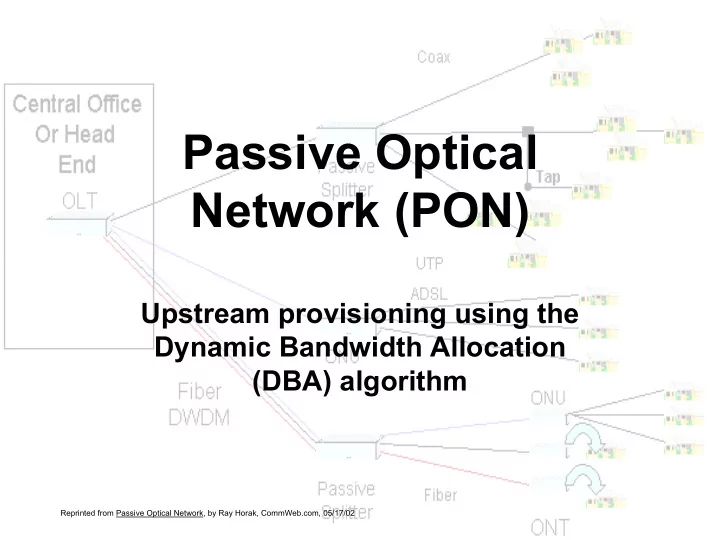
Passive Optical Network (PON)
Upstream provisioning using the Dynamic Bandwidth Allocation (DBA) algorithm
Passive Optical Network (PON) Upstream provisioning using the - - PowerPoint PPT Presentation
Passive Optical Network (PON) Upstream provisioning using the Dynamic Bandwidth Allocation (DBA) algorithm 1 Reprinted from Passive Optical Network, by Ray Horak, CommWeb.com, 05/17/02 In this student lecture we will cover: PON and need
1
Reprinted from Passive Optical Network, by Ray Horak, CommWeb.com, 05/17/02
Upstream provisioning using the Dynamic Bandwidth Allocation (DBA) algorithm
2
In this student lecture we will cover:
Control Bandwidth (OAM, MPCP) Highest Priority Fixed Bandwidth (time critical and fixed) High Priority Assured Bandwidth (data transfer, email) Highest Priority Best Effort Bandwidth (Unreliable, UDP) Low Priority
Btotal DBA Model Btarget
3
PONs are a point to multi-point architecture
4
PON Components: Optical Line Terminals (OLT), Optical Network Units (ONUs), passive splitters, and Optical Network Terminals (ONTs ). Time Division Multiplexed (TDM): PONs use optical power splitters. Wave Division Multiplexed (WDM): PONs use optical wavelength splitters.
5
PONs uses small (about the size of a pack of chewing gum), relatively inexpensive optical splitters, placed near the ONT. PON is usually refers to TDM technology, where BPON designates WDM technology.
6
CO ONT PON PON PON PON 8 λ 8 λ ONU 8 ONTs Single λ 32 λ 16 λ
7
Current TDM APON implementations generally are asymmetric, running at speeds
upstream. The upstream becomes a “bottle neck”. EPON is typically a symmetrical 1 Gbps
8
Issues in EPON systems using TDMA
ONU is inefficient
polling cycle time
using multi-point control protocol
9
Choi-Huh DBA algorithm model Control Bandwidth (OAM, MPCP) Highest Priority Fixed Bandwidth (time critical and fixed) High Priority Assured Bandwidth (data transfer, email) Highest Priority Best Effort Bandwidth (Unreliable, UDP) Low Priority
Btotal Btarget
10
Control Bandwidth Highest Priority
11
Control Bandwidth (OAM, Queue Length) Highest Priority Fixed Bandwidth (time critical and fixed) High Priority
Fixed Bandwidth High Priority
12
Control Bandwidth (OAM, Queue Length) Highest Priority Fixed Bandwidth (time critical and fixed) High Priority
Assured Bandwidth Medium Priority
13
Low Priority: Bbest = Btarget - Σ (GHi + GMi ) then GLi = (RLi/Σ RLi)*(Bbest) GLi = QLi /Tupdate Best Effort Bandwidth Low Priority
14
Control Bandwidth High Priority: GHi = BHi Med Priority: If ΣRMi ≤ Btarget - Σ GHi
then GMi = RMi (QMi /Tupdate) else if Σ RMi > Btarget - Σ GHi , then GMi = (RMi /Σ RMi)*(Btarget -Σ GHi )
Low Priority: Bbest effort = Btarget- Σ (GHi + GMi )
then GLi = (RLi /Σ RLi )*(Bbest effort) GLi = QLi /Tupdate
15
Multi-Point Control Protocol (MPCP)
Specifies point-to-multi-point communication between PON OLT and ONTs. MPCP is a MAC layer protocol. Supported by bridging elements. Functions:
16
Active message exchange: OLT Gate: DS S/D, Time stamps, ONT discovery, continuous
ranging, and dynamic time slot. Grant Levels: High, Med, and Low
ONU Report: US Queue level, length, and amount Auto-Discovery:
OLT Gate: Multi-cast, I am granting to ONU MAC address. ONU Register_Request: I want time slots and here is
who I am. Echo OLT.
OLT Register: New ONU MAC address, Echo ONU OLT Gate: New ONU MAC address, Grant ONU Register_ACK: I got the message, Channel
established
17
Gate Register_Req Register Grant Register_ACK Report ONT OLT
18
Downstream ONT ONT
Time M M M H H M
Upstream ONT
Time
ONT
M M M L M L C
19
Results of PONs using DBA with MCPL
20
Conclusions
PON ONTs are not used
statistical multiplexing with jitter.
grant transmission allocation to ONUs. MCPC is a standard MAC protocol.
21
Resources
Algorithm for Multimedia Services over Ethernet PON”, ETRI Journal, Volume 24, Number 6, December 2002, URL (http://etrij.etri.re.kr/etrij/pdfdata/24-06-08.pdf.)
EPONs”, 802.3ah EPON Security Track meeting, September 2002, URL (http://www.ieee802.org/linksec/meetings/ MeetingsMaterial/Sep02/Gaglianello_sec_1_0902.pdf.)
allocation over passive optical networks”, Terawave Communications, August 12, 2001 URL (http://www.terawave. com/news/dynamic_ bandwidth_allocation.htm.) 4. Liu, Zheng-Yang, “Guaranteeing QoS in PON Designs”, CommsDesign.com, CMP Media LLC, October 3, 2002, URL (http://www.commsdesign.com/design_corner/ OEG20021003S0012.)
22
Rundquist, R., “DBA (Dynamic Bandwidth Allocation) Overview”, EFM Interim meeting, 10/10/2001, URL (http://grouper.ieee.org/ groups/802/3/efm/public/sep01/wang_1_0901.pdf.)
802/3/efm/public/mar02/bemmel_1_0302.pdf.)
Growth Opportunity”, Reed Elsevier, Inc., May 20, 2002, URL (http://www.instat.com/newmk.asp?ID=217.)
CMP Media LLC, May 17, 2002, URL (www.commweb.com/ techcenters/main/experts/3783/COM20020219S0005.)
Piscataway, NJ, March 12,2003, URL (http://www.ileos.org/info/ passive_optical_network.asp.)
23
Questions
algorithm being proposed for TDM PON upstream, instead of the TDM PON downstream?
algorithm?
32 ONT APON upstream (155 Mbps) application? Each report = 64 bytes every 2ms plus 1 us guard band per report, High Priority/report for all PONs = 120 kb, Med Priority/report for all PONs = 100 kb.