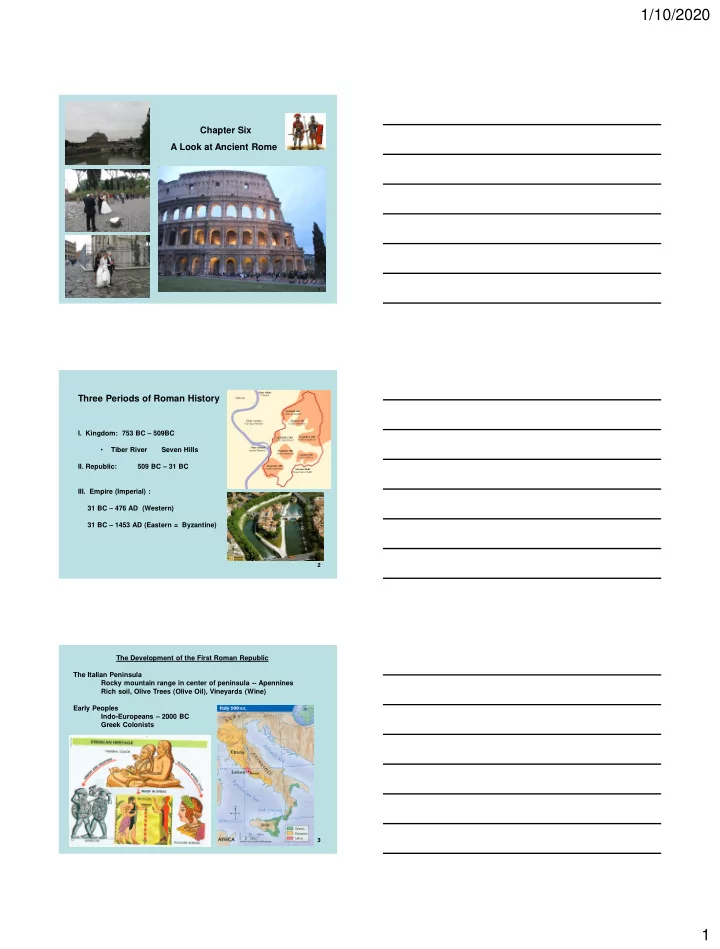
1/10/2020 Chapter Six A Look at Ancient Rome 1 Three Periods of - - PDF document

1 10 2020
SMART_READER_LITE
LIVE PREVIEW

1/10/2020 Chapter Six A Look at Ancient Rome 1 Three Periods of - - PDF document

1/10/2020 Chapter Six A Look at Ancient Rome 1 Three Periods of Roman History I. Kingdom: 753 BC 509BC Tiber River Seven Hills 509 BC 31 BC II. Republic: III. Empire (Imperial) : 31 BC 476 AD (Western) 31 BC 1453 AD


slide-1
SLIDE 1

1/10/2020 1

Chapter Six A Look at Ancient Rome

1 2

Three Periods of Roman History

  • I. Kingdom: 753 BC – 509BC
  • Tiber River

Seven Hills

  • II. Republic:

509 BC – 31 BC

  • III. Empire (Imperial) :

31 BC – 476 AD (Western) 31 BC – 1453 AD (Eastern = Byzantine)

2 3

The Development of the First Roman Republic The Italian Peninsula Rocky mountain range in center of peninsula -- Apennines Rich soil, Olive Trees (Olive Oil), Vineyards (Wine) Early Peoples Indo-Europeans – 2000 BC Greek Colonists

3

slide-2
SLIDE 2

1/10/2020 2

4

The Etruscans

  • Ruled Northern Italy: 900 – 500 B.C.
  • Little is known about them.
  • Language still is not deciphered;

alphabet from the Greeks.

  • Some Greek influence – Would

influence the Romans.

  • Wealthy society; social classes.
  • Legacy left in burial chambers and

artifacts.

5 6

Etruscan Funeral Rites

slide-3
SLIDE 3

1/10/2020 3

7 8 9

slide-4
SLIDE 4

1/10/2020 4

10 10 11 12 12

slide-5
SLIDE 5

1/10/2020 5

13 13 14

Latin's

Tiber River

  • Drains into the Mediterranean Sea
  • Marshy area – disease prone

Rome – 8th century B.C.

  • Legend
  • Fact – Farming people
  • Join into a single unit

Seven Hills of Rome City develops unique character between these hills Early 7th century B.C. falls under control of Etruscan’s Tarquin Family – Provides Etruscan kings over Rome and the Latin’s

  • Remain in power approximately 100 years.
  • Tarquin the Proud 534 – 509 B.C.

14 15

Latin’s Cont.’

Brought first city-state civilization to Italy Taught Greek Alphabet and Arches Group of Nobles -- named Senate -- Called Patricians Common people called Plebeians

slide-6
SLIDE 6

1/10/2020 6

16

Rome under the Tarquins

Roman Forum develops – market place –center of town Greek = Agora 509 B.C. – Roman populace rise up – overthrow the Tarquin monarchs Romans vow to never live under a king. Republic established 509 B.C.

16 17 17

The Roman Forum

The Center of the Life of Rome

18

Rome begins to grow as a Republic Conflict with Neighbors

18

slide-7
SLIDE 7

1/10/2020 7

19

Executive Branch Consuls – Two each– One Year terms Dictator – sole leader in time of emergency Legislative Branch Senate 300 Patricians – serve for life Plebeians Against Patricians Plebeians want equal rights Made up the bulk of the army Plebeian assembly -- Tribunes ”Veto = I Forbid” Writing down of laws for all to see Plebeian assembly becomes popular assembly The Twelve Tables 451 B.C. Placed in the Forum

19 20 20 21

Religion

  • Strong Greek influence
  • Deities names and functions

Family Family Values – Father absolute head of household

  • Live simply
  • Work hard
  • Sense of duty

21

Hi; I’m Travel Bear

slide-8
SLIDE 8

1/10/2020 8

22

Expansion and Crisis

Romans conquer the Southern Italian/Greeks

  • Pyrrhus - Greek
  • Beat Roman army twice
  • Third battle indecisive with Romans,
  • returned to Greece

”Pyrrhic Victory” --- Won at great cost!! (“Perhaps not worth the effort”) Romans exercise wise leadership after conquests Roman citizenship given to conquered peoples Romans controlled administration

  • f justice

22 23 23 24

Roman Legions

  • Originally -- Citizen soldiers
  • Roman Legion - 5/6,000 men
  • Only Romans at first
  • Used auxiliaries
  • Built military roads
  • Romans successful because
  • f geography
  • Central location of Rome
  • Established military coloniae

24

slide-9
SLIDE 9

1/10/2020 9

25 25

The largest element of the Roman Army was the Legion (“Muster”) Approximately 6,000 men; Height of the Empire, 30 legions (180,000) +Auxiliaries (300,000) from all over the Republic and Empire One legion (+ Staff) = 10 Cohorts (500 men) = 60 centuries (80 men) Symbol of the Legion

Eagle

26 26

Roman Army Develops Warfare Tactics and Strategies Move from use of the Phalanx to what becomes the Legion

27 27

The Roman Soldier Emerges as the Best Fighting Man

slide-10
SLIDE 10

1/10/2020 10

28 28

Reforms of Marius

1st Professional Standing Army in Rome .. Loyalty to the Commander

Start of Pax Romana Standard Image

  • f the Roman

Legionnaires

Equipment would remain the same for 200 years (31 / 27 B.C.) 29 29

By the time of Augustus the Roman century was down from 100 men to 80 men.

30 30

The Roman Army was masters at Siege Warfare … each soldier was also and engineer and builder

slide-11
SLIDE 11

1/10/2020 11

31

Rome’s First “Real Crisis” --- Rome Against Carthage

  • Roman rival in trade and control of the Mediterranean Sea
  • Phoenicians -- 814 B.C.
  • Punic = Latin for Phoenicians

Port of City of Carthage Rich Trade – Competition from Rome

31 32 32

Rome Builds a Navy

33

The First Punic War (264 BC – 241 BC) Fought over Sicily (Straits of Messina) Romans won Carthage – Indemnity Paid to Rome Rome Controls Sicily Establishes Presence

33

slide-12
SLIDE 12

1/10/2020 12

Roman Villa at Casale, Sicily 3rd Century A.D.

34

1,700 Year Old Mosaics! World Famous Mosaic The “Bikini Girls”

35

Curious Image

Why?

36

slide-13
SLIDE 13

1/10/2020 13

37 38

The Second Punic War (218 BC – 202 BC)

Rome vs. Hannibal

  • Sagunto, Spain
  • Alps - Elephants
  • Battle of Cannae (216 BC) - Defeated Rome

Roman Scipio invaded N. Africa

  • Hannibal returns to Carthage
  • Hannibal defeated at Zama

38 Hi! It’s me again, Travel Bear 39

Battle of Cannae 216 BC – Hannibal is victorious

39

slide-14
SLIDE 14

1/10/2020 14

40

Hannibal Never Attacked Rome Itself! Why?

The Walls of Rome Protected the City!

41 41

Archimedes

Dies 212/211 BC in Roman Siege

  • f Syracuse

Tomb ? 42 42

Scipio’s Triumph on his return to Rome after the Battle of Zama

slide-15
SLIDE 15

1/10/2020 15

43

The Third Punic War (149- 146 BC) Roman ultimatum – Cato – Roman Senate “Carthage Must Be Destroyed” Destruction of Carthage – Sowing of Salt in the Earth

  • Gen. George S. Patton 1943

Mare Nostrum “Our Sea” -- the Mediterranean

43 44

The Republic in Crisis

Political Changes -- Corruption in the Provinces *Power concentrated in Senate *Small land owners unhappy – lose farms *Slave labor (Latifundia) Crowding the Cities Reformers and Generals Tiberius Gracchus Gaius Gracchus Roman Civil War Marius vs. Sulla General Sulla brought temporary peace

44 45

Slave Revolt – Spartacus (73 BC – 71 BC)

Began at the Gladiator School at Capua (Southern Italy)

  • 2nd Largest Amphitheater in Roman Empire!
slide-16
SLIDE 16

1/10/2020 16

46

Julius Caesar

Popular military leader Had support of the army Became part of the 1st triumvirate Pompey -- military hero Crassus -- wealthy Roman

46 47

Caesar and the Pirates Caesar in Spain Caesar and Cleopatra

47 48

Julius Caesar

Popular military leader

  • Had support of the army

Became part of the 1st triumvirate

  • Pompey -- military hero
  • Crassus -- wealthy Roman

Caesar conquers Gaul and Northern tribes

slide-17
SLIDE 17

1/10/2020 17

49

Celtic Influence in Europe!

50

Celts and the Romans in Gaul (France)

50 51 51

slide-18
SLIDE 18

1/10/2020 18

52

Alesia 52 B.C.

Caesar’s Greatest Triumph

52 53 53 54

Siege of Alesia 52 BC Then Alesia, France Now

54

slide-19
SLIDE 19

1/10/2020 19

55

Alesia Today (August 2002)

55 56 56 57

Reconstructed Roman Fortifications of Alesia

57

slide-20
SLIDE 20

1/10/2020 20

58 58 59 59 60

Julius Caesar

Popular military leader Had support of the army Became part of the 1st triumvirate Pompey -- military hero Crassus -- wealthy Roman Caesar conquers Gaul and Northern tribes Roman Civil War – “Crossing the Rubicon” (Popular term!) Defeats Pompey in Greece Becomes a dictator for life Extends Roman citizenship to conquered peoples Begins public works projects Murdered by Brutus -- “Et Tu Brutae?”

slide-21
SLIDE 21

1/10/2020 21

61

Roman Civil War

“Crossing the Rubicon” (Popular term!)

62

Rome at the Death of Caesar in 44 B.C.

62 63

End of the Republic

Caesar Murdered 44 BC – Ides of March Civil War 44 – 31 BC (2nd Triumvirate)

  • Octavian
  • Marc Antony
  • Marcus Lepidus – (“goes away”)

Octavian grandnephew of Caesar

  • (Adopted Heir)

Marc Antony defeated by Octavian

  • Cleopatra
  • Battle of Actium 31 B.C.

Egypt becomes a Roman province Octavian called “Imperator” (Victorious General) = Emperor

Empire Begins under one ruler

  • Octavian is now called Augustus

“Majestic One”

63

slide-22
SLIDE 22

1/10/2020 22

64

Cleopatra’s Royal Barge

65 65 66

Augustus – the First Emperor of Rome (27 BC – 14 AD)

  • Significant Reforms – Life better/Less corruption/Stable society
  • Does not establish clear line of succession
  • Pax Romana Begins (31 BC – 180 AD)

66

slide-23
SLIDE 23

1/10/2020 23

67 67 68 68 68 69

slide-24
SLIDE 24

1/10/2020 24

70

Circus Maximus

  • In the center of Rome
  • 150,000 or more spectators!!
  • Chariot Races (“Ben Hur”)

70 70 71

Ostia / The Port of Rome

71

Four Story Apartment Buildings

  • f Ostia

(2009)

72

slide-25
SLIDE 25

1/10/2020 25

73 73

  • St. Peter &
  • St. Paul ?

74 75

All Roads Lead to Rome

Major Highway -- Appian Way

  • 50,000 miles paved roads

75

slide-26
SLIDE 26

1/10/2020 26

76

Eruption of Mount Vesuvius – 79 AD

  • Southern Italy – South of Naples
  • Buries Pompeii and Herculaneum

77 78

slide-27
SLIDE 27

1/10/2020 27

79 80 80

Herculaneum Today --- 2005

80 81

slide-28
SLIDE 28

1/10/2020 28

82

The “Good” Emperors

(96 – 180 AD)  Nerva  Trajan  Hadrian (Final Revolt in Judea)  Antoninous Pius  Marcus Aurelius *Strengthened Rome’s Frontiers *Continued economic prosperity *Greatest extent of the Roman Empire *Strong imperial Government

82 83

Building the Frontiers of Rome

The Limes in England (73 Miles) and Germany (Rhine and Danube Rivers)

83 84

July 2017 Dillingen, Saar, Germany

slide-29
SLIDE 29

1/10/2020 29

85 85 86

July 2019 - North of Frankfurt

Like my Selfie?

87

Roman London (Londinium)

 Established 43 AD (Claudius)  Walled City by 200 AD

87

slide-30
SLIDE 30

1/10/2020 30

88 88 89 89

The Pantheon – Best Preserved Ancient Structure in Rome! 126 A.D. Temple to all the gods of Rome

  • St. Mary & the Martyrs Basilica

90

slide-31
SLIDE 31

1/10/2020 31

91 91 92 92 92

Various modern legal concepts can trace their origins to Roman law codes

Lictors of Rome

  • Bodyguard to the magistrates
  • Power to arrest and punish

As a symbol of

  • ffice; carried the

“fasces” Axe and Rods Associated with Mussolini - Fascist Italy 1919 93 93

Science and Medicine:

  • Ptolemy -- Egyptian – Astronomy
  • Galen – Greek / Doctor / Medicine / Blood circulation
  • Romans built the first hospitals

Roman Education

  • Followed Greek models
  • Private – at Home – Slaves as tutors
  • Caesar’s Conquests -- Gallic wars
slide-32
SLIDE 32

1/10/2020 32

94

Language and Literature of Rome

  • Latin language preserved through the Catholic Church.
  • Remained in common use through 1500’s

Virgil -- Aeneid – Similar to Homer – Epic Poem – praise of Rome Livy – History of Rome (excellent source) Tacitus: The Annals (14 – 68 AD) Histories (68 – 96 A.D.)

95

Jewish Revolt in 66 A.D. – Sicarii – Extremist Branch of Zealots

  • Revolt Defeated by 70 AD
  • Vespasian / Titus
  • Jerusalem Sacked

One Roman Failure -- Judea

Jerusalem Destroyed a 2nd time 132 AD

96

Siege and conquest of Jerusalem would last four years (66-70 A.D.)

  • Documented in book called “The Jewish War”
  • written by a Jewish leader Josephus
  • captured by the Romans and became an

advisor to them in return for his freedom … became a controversial figure

  • Excellent source for early Christian history!
slide-33
SLIDE 33

1/10/2020 33

97

  • Zealots seized Herod’s fortress -- Palace in the Judean Desert
  • Held out against the Romans until 72/73 A.D.
  • Died by their own hand rather than surrender to the Romans
  • Symbolic Center of Israeli Defense Forces

97

MASADA

98 98 99

Flavius Silva’s Roman Legion Camp Roman Siege Ramp

99

Fortress of Masada

slide-34
SLIDE 34

1/10/2020 34

100

66 A.D. 1990

100 101 101 102

The Spread of Christianity

The Five Early Patriarchs

  • Rome
  • Antioch
  • Alexandria
  • Constantinople
  • Jerusalem

 Bishops become successors of Apostles  Chosen locally by followers  Bishop of Rome becomes head of the Christian (Catholic) Church

slide-35
SLIDE 35

1/10/2020 35

103 104

Symbolism = To recognize fellow believers Anchor = Strong Faith Fish = Jesus and followers – fishers of men Chi Rio = First two letters

  • f Christ’s name in Greek

105

To Improve Control Divide the Empire West Gaul Italy East Illyricum Byzantium

  • Temporary
  • Rivals fight it out!
  • Consolidation again

Key Cities  Trier  Milan  Ravenna  Byzantium Diocletian – 284 to 305 A.D. (Retires)

Tetrarchy

slide-36
SLIDE 36

1/10/2020 36

106

Battle of Milvian Bridge

28 October 312 A.D.

“In this sign you will conquer”

Chi Rho

107

Legalizes Christianity Edict of Milan 313 A.D.

  • Defender of Christianity
  • St. Augustine
  • St. Ambrose – Milan
  • Former Government buildings become

first churches!

108

In the East Theodosius makes Christianity the “Official” Religion of Rome in 392 A.D. 395 A.D. Rome in the West = Roman Empire Rome in the East = Byzantine Empire (Byzantium) Constantine’s Move to Byzantium – 330 A.D.

slide-37
SLIDE 37

1/10/2020 37

109

Decline and Fall of Rome – 476 A.D.

Do you see any modern parallels?? Critical “Hypothetical” Thinking Diocletian’s Reforms Failed – end of 3rd Century

110

Invasions Focus on West Collapse 476 A.D.