Partnerships: IOOS delivers on its promise, through unmanned - - PowerPoint PPT Presentation
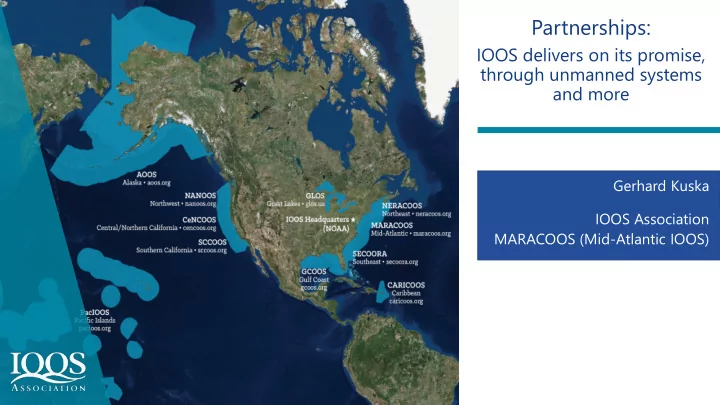
Partnerships: IOOS delivers on its promise, through unmanned systems and more Gerhard Kuska IOOS Association MARACOOS (Mid-Atlantic IOOS) Overview 1. Background 2. IOOS and unmanned systems 3. The right tool for the right job: Why is
Overview
- 1. Background
- 2. IOOS and unmanned systems
- 3. The right tool for the right job: Why is
IOOS a useful construct for partnering?
- 4. Opportunities
The promise of partnership
2004 Final Report of the US Commission on Ocean Policy
- Ch.26 – Achieving a
sustained Integrated Ocean Observing System (IOOs)
- Promote strong partnerships
through IOOS
IOOS Overview
Coastal Component
17 Federal agencies 11 regional associations Academia & Industry
Global Component
US contribution to GOOS 63% of the Global Climate Ocean Observing System completed
Mission Areas
Predicting Weather & Climate variability Support Safe & Efficient Transportation and Commerce Preparedness and Risk Reduction for Coastal Communities
Integrated Coastal Ocean Observing System (ICOOS) Act (P .L. No 111-11, March 2009)
IOOS Association
- Non-federal
umbrella
- rganization for
IOOS partners / regional associations
- Advocacy
- Coordination among
regions
- Common and
Emerging Issues
- Special Projects
- It is an important
partnership venue f IOOS
Observing our oceans, coasts and Great Lakes Providing information to those who need it, when they need it
U.S. IOOS Enacted and President’s Budgets FY04-20
Glider history and IOOS partners
- 2005-06: Navy funded Glider Technology Centers
- 200x: IOOS Regional Associations provide glider observations and
worked to advance the technology.
- 2009: RU27: MARACOOS/Rutgers - Crossing the Atlantic
- 2012: Held first national glider meeting
- 2013: Established a National Glider Data Assembly Center
(NGDAC)
- 2014: Released a Glider Network White Paper
- 2015: Established an IOOC Glider Task team
- 2017: Established Underwater Glider User Group (UG2)
- 2019: Hosted International Glider Workshop
Certified National Network
- National consistency while addressing
unique and diverse regional needs
- Ready access, and preserves data with
transparency and documentation
- Enhances efficient interagency
coordination at the regional and national level
All 11 regions have met the rigorous federal standards for governance and data management
Why does it matter?
IOOS Glider DAC
IOOS sponsors the glider Data Assembly Center for integrating and disseminating non-federal data Easy access to glider data for the entire nation All IOOS RAs are certified to the same data management standards as Federal Agencies
- National standard
data format
- NDBC GTS Access
- NCEI Archive
- QARTOD Manual
- QA/QC tool
- Delayed mode
data upload tool
https://gliders.ioos.us/
Glider Days by Year
https://gliders.ioos.us/
Many themes to address stakeholder needs
Climate/Ecosystem/Fisheries Management/Water Quality Hurricane Forecasting Response to Oil Spill
SoCal Niño Index
CalCOFI
Fish Tracking HABs
Deep Water Horizon Alaska Hypoxia Exercising the Network Offshore Wind
Examples of areas to fill gaps
- Alaska - Marine
mammals, fisheries
- Northeast – Right whale,
HABs
- Great Lakes - HAB and
hypoxia in Erie, SagBay and Green Bay
- California - Marine heat
waves and navigation, oil spill response, HABs and fisheries.
Glider partnerships through IOOS
Demonstrating the coordination / leveraging of glider operations of multiple
- rganizations with varying
funding sources and missions 18 partner institutions 36 Gliders Canada to the Gulf of Mexico Summer through Fall
Group Gliders 1 Memorial University 3 2 Dalhousie (OTN) 2 3
- Univ. of Maine
2 4 Woods Hole Inst. 5 5
- Univ. of Mass. Dartmouth
1 6 Teledyne Webb 3 7 NSF OOI 3 8 Rutgers Univ. 4 9
- Univ. of Delaware
1 10
- Univ. of Maryland
1 11 VIMS 1 12 BIOS 1 13 Skidiaway Inst 1 14 Mote Marine Lab 1 15 Univ of S. Florida 1 16
- US. Navy
2 17
- Univ. of Southern Miss.
1 18 Texas A&M 3 TOTAL: 36
Gliderpalooza 2014
Hurricane gliders
IOOS-NOAA-Navy partnership Needs dictated by oceanographic features 4 IOOS RAs- Gulf of Mexico, Caribbean, Southeast and MidAtlantic NOAA AOML Objective is to improve ocean models to contribute to improved hurricane intensity forecasting
Advancing science as a benefit of
- perations
- Essential ocean features
- Essential ocean processes
- Rapid intensification
- Rapid de-intensification
- And there are still many
unknowns to study, understand, and transition into operations
- Essential Ocean Features
- Known to cause rapid intensification and de-
intensification
- Occur close to populated and vulnerable coastlines
- Challenging for models to get right due to dynamic
nature and limited observations Examples
- Loop Current
- Atlantic Warm Pool
- Gulf Stream
- Mid-Atlantic Cold Pool
IOOS User Group
Purpose: to strengthen international collaboration through community dialogue, exchanges of information, sharing of experiences, and development of best practices to support the glider community.
Education and workforce development
- Undergraduate and
graduate courses
- Special summer courses
- Interns/ Staff
- Instilling in students/staff
a culture of collaboration and partnering across institutions, disciplines, and regions
Why is IOOS a useful construct for partnering?
- Partnership types and vehicles
- Providing UxS services and/or data
- R&D partnerships
- Geographic considerations
- Communication and transparency
- Agility, flexibility, and adaptability in
partnerships
- Entrepreneurial opportunities
- Workforce development
- CENOTE Act considerations
- Setting and managing expectations for both
partners
It is the right tool for the right job:
Opportunity: The right tool at the right time
- Turn on the engine that is this consortium of
groups that is:
- Managing at the regional scale
- Operating cost effectively
- Demonstrating reliability and flexibility
- Meeting federal standards
- Nurturing relationships with local
communities of stakeholders
- Drawing in and leveraging the best
experts across the country from academia, the private sector and government
- Under the stewardship and guidance of
NOAA
Opportunity areas for partnering
Develop and expansion is recommended in a number of areas:
- Operations - prepping, deploying,
recovering underwater gliders
- Working with the research community to
transition new technology and services
- Serving as a testbed for innovating new
unmanned systems (primarily underwater gliders, but possibly also small aerial systems)
- Testbed for new sensors
- Data management
- Operational support; for example, for
models
- Community of Practice
- Education and workforce development
- (And IOOS partners are strong research