PARTNERSHIP Guilt Gendered Construct of Creativity = Eminence - - PowerPoint PPT Presentation

partnership
SMART_READER_LITE
LIVE PREVIEW

PARTNERSHIP Guilt Gendered Construct of Creativity = Eminence - - PowerPoint PPT Presentation

SUPPORTING CREATIVE PRODUCTIVITY OF MOTHERS Individual Barriers Societal Barriers PARTNERSHIP Guilt Gendered Construct of Creativity = Eminence Perfectionism & Self-Criticism Rigid Gender Roles FAMILIES Lack of


slide-1
SLIDE 1

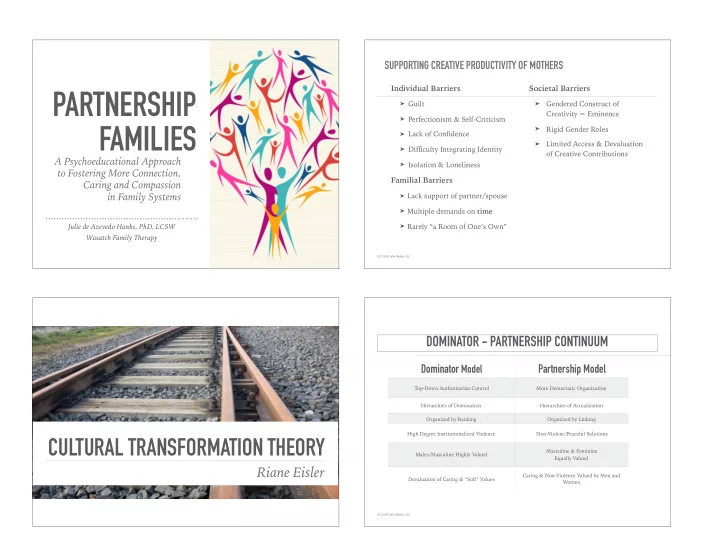
PARTNERSHIP FAMILIES

Julie de Azevedo Hanks, PhD, LCSW Wasatch Family Therapy

A Psychoeducational Approach to Fostering More Connection, Caring and Compassion in Family Systems

(C) 2016 Julie Hanks, LLC

SUPPORTING CREATIVE PRODUCTIVITY OF MOTHERS

Individual Barriers ➤ Guilt ➤ Perfectionism & Self-Criticism ➤ Lack of Confidence ➤ Difficulty Integrating Identity ➤ Isolation & Loneliness Familial Barriers ➤ Lack support of partner/spouse ➤ Multiple demands on time ➤ Rarely “a Room of One’s Own” Societal Barriers Gendered Construct of Creativity = Eminence Rigid Gender Roles Limited Access & Devaluation
  • f Creative Contributions

CULTURAL TRANSFORMATION THEORY

Riane Eisler

(C) 2016 Julie Hanks, LLC

DOMINATOR - PARTNERSHIP CONTINUUM

Dominator Model Partnership Model

Top-Down Authoritarian Control More Democratic Organization Hierarchies of Domination Hierarchies of Actualization Organized by Ranking Organized by Linking High Degree Institutionalized Violence Non-Violent/Peaceful Solutions Males/Masculine Highly Valued Masculine & Feminine Equally Valued Devaluation of Caring & “Soft” Values Caring & Non-Violence Valued by Men and Women
slide-2
SLIDE 2

DOMINATION IS “PRIDE” / RANKING

➤ 2 Nephi 28:24-26 ➤ lifted up in pride ➤ wearing of costly apparel ➤ they did have their goods and their substance no more common ➤ divided into classes, build up churches unto themselves to get gain ➤ Mormon 8:28 ➤ lifted up in the pride of their hearts ➤ leaders of churches and teachers shall rise in the pride of their hearts ➤ 3 Nephi 6:15 ➤ puffing them up with pride ➤ tempting them to seek for power, and authority, and riches

PARTNERSHIP IS “ZION”

➤ 4 Nephi 1:15 ➤ no contention in the land because of the love of God which did dwell in the hearts of the people.” ➤ 4 Nephi 1:16 ➤ no envyings, nor strifes, nor tumults, nor whoredoms, nor lyings, nor murders, nor any manner of lasciviousness ➤ there could not be a happier people ➤ Mosiah 27:4 ➤ every man should esteem his neighbor as himself ➤ Alma 1:30 ➤ they did not send away any who were naked, hungry, athirst, or sick ➤ did not set their hearts upon richest ➤ therefore they were liberal to all, old/young, bond/free, both male/female, whether out or in church or in the church ➤ no respect to persons as to those who stood in need. ➤ D&C 121:41 ➤ No power or influence can or ought to be maintained by virtue of the priesthood, only by persuasion, by long-suffering, by gentleness and meekness, and by love unfeigned.” 6

DEFINING “THE FAMILY”

➤ Family Proclamation - ideal, marriage between man & women,

multiply and replenish

➤ Reality ➤ Less than half of American children lived with a married

heterosexual couple (Livingston, 2014)

➤ Only 16% of households consist of a married male and

female raising their own biological children (Krogstad, 2014).

“Family” is broadly defined as a group of people living in the same household who self identify as a family.

THE LADDER

Dominator Families

➤ Hierarchies of domination with male “in charge” ➤ Authoritarian parenting style, high demand, low responsiveness, fear & force ➤ Members’ needs and value are ranked ➤ Emotional and physical violence used to resolve conflict ➤ Boys/masculine strength valued ➤ Nurturing others is devalued and is
  • nly “women’s work”
slide-3
SLIDE 3

THE FIELD

Partnership Families

➤ Led by hierarchies of actualization ➤ Democratic structures ➤ Organized by linking ➤ Needs of all family members equal ➤ Prioritize caring for others ➤ Non-violent solutions ➤ “Masculine” & “feminine”

contributions are valued

➤ Diversity is seen as a strength

MINOAN SNAKE GODESS

http://arthistoryresources.net/snakegoddess/minoanwomen.html

MINOAN CRETE 3650-1400 BCE

MINOAN MAIDEN WITH PRAYER BEADS

http://www.veniceclayartists.com/minoan-art-pottery/

TOREADOR FRESCO, KNOSSOS 1400 BCE

http://arthistoryresources.net/greek-art-archaeology-2016/minoan-bull-jumping.html
slide-4
SLIDE 4

MINOAN PRIEST-KING (RESTORED FRESCO)

https://www.britannica.com/media/full/171379/1105

ADDITIONAL THEORIES & CONCEPTS

➤ Systems Theory (Interdisciplinary study of Relationships,

interconnections, interdependence

➤ Family Systems Theory (Individuals cannot be understood in

isolation from one another, but rather relationships, family as it’s

  • wn unit)
➤ Cybernetics (study of pattern, science of organization,

communication, recursive feedback, circularity)

➤ Self-Reflexivity (Referring to or discussing itself or its own

creation; self-referential)

➤ Complexity (the state of having many parts and being difficult to

understand or find an answer to)

PARTNERSHIP MODEL OF FAMILY ORGANIZATION

8 C’s of Partnership Families(PMFO)TM

“ As a microcosm of society, the family can act as a crucible for the creation of partnership. It seems the most obvious place to start, with the people we love most and are closest to.” (Montouri & Conti, 1993, p. 126)

slide-5
SLIDE 5

1) COOPERATIVE ADULT LEADERSHIP

➤Actualization

hierarchy

➤Equal partnership

marriage

➤Authoritative

parenting style

ACTUALIZATION HIERARCHY - DEFINED

➤ The term “self-actualization,” people who are actively creating

meaning and are fully engaged in the use of talents, capacities, and the development of their potentialities (Maslow, 1973).

➤ Actualization is the realization of our highest human potential

to inspire, support, and empower others and ourselves (Eisler, 2008a)

➤ Family members’ values and needs do not need to be ranked in
  • rder of importance or power, but decisions are made with the

welfare of all in mind

➤ Moses 1:39 For behold, this is my work and my glory—to bring to pass the

immortality and eternal life of man.

EQUAL PARTNERSHIP MARRIAGE - RESEARCH

➤ Less negative interaction & more positive interaction (Gray-

Little, Baucom, & Hamby, 1996)

➤ More likely to work together in parenting (Hughes, Gordon

& Gaertner, 2004)

➤ Better physical intimacy (Brezsnyak, & Whisman, 2004)

EQUAL PARTNERSHIP MARRIAGE

➤ ”Marriage requires a full partnership where wives and

husbands work side by side to meet the needs of the family.”

➤ “

A marriage of equal partners is also one in which the partners help one another in their stewardships, indeed, are “obligated to help one another as equal partners.” This partnership extends to housework and childcare. President Packer has said, “There is no task, however menial, connected with the care of babies, the nurturing of children, or with the maintenance of the home that is not [the husband’s] equal obligation.”

(Husdon & Miller, 2013, April)
slide-6
SLIDE 6

EQUAL PARTNERSHIP MARRIAGE - CASE EXAMPLE

➤ Janice (33), singer, AS, & Shawn (33), entrepreneur, child-free ➤ Janice: Shawn’s emotional and mental health are more important than

the amount of a paycheck, so although the business start-up was a slight decrease in income, I fully supported his decision to undertake the

  • pportunity.
➤ Janice: Shawn has been very supportive of my endeavors to share my

singing talent through community choral opportunities, and I have recently decided to start a solo career. Shawn frequently inquires about the progress of my singing business, and is genuinely thrilled for me when I tell him about new opportunities.

AUTHORITATIVE PARENTING - RESEARCH

➤ Authoritative parenting balances clear, high parental

demands with emotional responsiveness and recognition

  • f child’s autonomy is a consistent predictors of competence

from childhood through adolescence. (Darling, N., and Steinberg, L., 1993)

➤ Between authoritative, authoritarian, indulgent, uninvolved

styles, authoritative parenting style had best behavioral

  • utcomes in children (Luyckx, K., Tildesley, E. A., Soenens,

B., Andrews, J. A., Hampson, S. E., Peterson, M., & Duriez, B., 2011)

2) CONNECTION ORIENTATION

➤ Building secure

attachments

➤ Relationship focus

(process)

➤ Recognize

interconnection with larger systems

SECURE ATTACHMENT - DEFINITION

➤ Behavioral motivation system seeks close emotional attachment with caregiver for survival. ➤ Components of secure attachment:
  • 1. Proximity maintenance: the desire to be near attachment figures, to
maintain physical closeness.
  • 3. Secure base: the role the caregiver or attachment figure plays, and
from which the child can explore the larger world
  • 4. Safe haven: the return to the caregiver for a kiss or hug (when that
same toddler feels scared or threatened, she will return to the caregiver for comfort).
  • 5. Separation distress: the emotional upset exhibited by young children
when they are separated from their parent or caregiver.\(Bowlby, 1988)
slide-7
SLIDE 7

SECURE ATTACHMENT - INFANT RESEARCH

➤ Attuned parents and affectionate touch buffers an infant’s stress

response

➤ Increased oxytocin levels have been reported in fathers after play

with their infants (Feldman, et al., 2010)

➤ During face-to-face interactions, mothers and infants coordinate

heart rhythms, the beginnings of regulation (Feldman, et al, 2011)

➤ Parents are neurologically wired to feel good when nurturing each
  • ther and their children (Holt-Lunstad, Birmingham, & Light, 2014).
➤ A caregiver’s healthy predictable, repetitive, nurturing responses

enable a young child’s neurophysiology to develop the capacity to regulate stress and to form healthy attachments (Ludy-Dobson & Perry, 2010).

RELATIONSHIP FOCUS (PROCESS)

➤ Differentiation of self - Process of navigating the tension of

becoming unique individual while being in relationship.

➤ Darwin’s theory of evolution -“love” and “moral sensitivity”

as the pinnacles and drivers of evolution (Loye, 2004)

➤ Attachment needs drive our intimate adult relationships.

(Hazan and Shaver 1987)

INTERCONNECTION WITH LARGER SYSTEMS - CASE EXAMPLE

➤ Shanna (30) & Doug (34), 4-year old twins ➤ Shanna: We work hard in our church community and try to show the boys that there is life beyond our nuclear family. We do family events with our extended family and aim to see one group that is farther away once a year. ➤ Fran (38) & Jeff ( 37), 2 children from Jeff’s previous relationships ➤ Fran: Son’s mother shows up every Wednesday and every other Saturday and Sunday to visit with him. As hard as it is (drug history), he needs to know that his mother loves him… Because he grew up with grandma, we have a Tuesday night grandma sleepover. She knows she can call whenever she likes and Daniel has that consistency as well. ➤ We make sure our other son (and his mother) has child support and monetary support to help him have the proper medication to get through school as a kid with autism. We try to be flexible with visitation because we know that sometimes he needs to be home. But we jump whenever she calls, even if we just get 3 hours notice before a visit because we want her to know and our son to know that he is our priority. We have become a very flexible family.

3) CARETAKING EMPHASIS

➤Caring for others is

highly valued

➤All family members

participate in caring for each other

➤Value caring for

community and the earth

slide-8
SLIDE 8

CARING FOR OTHERS IS HIGHLY VALUED

➤ Caring Economy (caringeconomy.org ) ➤ GDP doesn’t count caring as work. ➤ If included, care work at home would add another 30-50% to reported GDP ➤ Is the only developed nation with no national funding for paid parental leave and invests the least in early childhood care and education. ➤ The ROI for early childhood education is between $7 to $16 per dollar invested ➤ 1 in 3 U.S. women is living below or on the brink of poverty largely because they are the bulk of underpaid & unpaid caregivers

CARING FOR OTHERS IS HIGHLY VALUED

➤ Involved fathers improve child outcomes ➤ Fathers who increased their involvement with their

children experienced increase in self-confidence in their parenting abilities, in satisfaction with the fathering role, and in overall self-esteem.

➤ “Defining these characteristics as central to the new

masculinity requires that fathering be redefined to emphasize the intimacy, care, and connection that previously characterized what we have thought of as “mothering.” (Silverstein, L. B.,1996).

ALL FAMILY MEMBERS PARTICIPATE IN CARE: CASE EXAMPLE

➤ Shanna (30) & Doug (33), professional, parents of twin

toddlers

➤ Shanna: Any predetermined absences for doctors appointments, school

closings, etc., are alternated between me and my husband. We have also split days -- each taking a 1/2 day from home -- to coordinate around each other's meetings. I feel we are a good team in this regard. It takes a lot of communicating to get it right though! My husband stayed home with the boys for their first 7 months, only 9 weeks of which I was on maternity leave, as he was unemployed. During that time, he was able to bring the babies to me at work to swap out for his job interviews, or I could work from home etc.

ALL FAMILY MEMBERS PARTICIPATE IN CARING

Do we also teach our sons and daughters there is no greater honor, no more elevated title, and no more important role in this life than that of mother or father? All of us—women, men, youth, and children, single or married—can work at being homemakers. We should “make our homes” places of order, refuge, holiness, and safety.

  • President Bonnie Oscarson
(Oscarson, 2015)
slide-9
SLIDE 9

CARE FOR COMMUNITY AND THE EARTH

➤ Alma 6:6 Nevertheless the children of God were commanded that they

should gather themselves together oft, and join in fasting and mighty prayer in behalf of the welfare of the souls of those who knew not God.

➤ Psalm 155:16 The heaven, even the heavens, are the Lord’s: but the

earth hath he given to the children of men.

➤ Moses 2:28 And I, God, blessed them, and said unto them: Be fruitful,

and multiply, and replenish the earth, and subdue it, and have dominion over the fish of the sea, and over the fowl of the air, and over every living thing that moveth upon the earth.

4) COLLABORATIVE ROLES & RULES

➤ Fluidity in gender

expectations

➤ Moving from roles to

rules(process)

➤ Expansion of acceptable

behaviors for males and females

FLUIDITY IN GENDER EXPECTATIONS

slide-10
SLIDE 10

FLUIDITY IN GENDER EXPECTATION - EASE EXAMPLE

➤ Beth (34) & John (38), 4 children ages 4-13 ➤ Beth: When a toilet broke this week and we took a trip to

Home Depot, my husband said, “We have sons. They need to learn how to fix stuff.” When I raised my eyebrows he rephrased to say, “We have children. They need to learn how to fix stuff.”

MOVING FROM ROLES TO RULES (OR INTERACTIONS)

“When two people get together they immediately exchange clues as to how they are defining the nature of the relationship; this set of behavioral tactics is modified by the other person by the manner in which he responds…this definition of who each is in relation to the other can best be expressed as quid pro quo.”

(Jackson, 1965, p. 591)

EXPANSION OF ACCEPTABLE BEHAVIORS FOR MALES & FEMALES

  • CASE EXAMPLE
➤ Lana (54), Von (51), Midwest, both professors, 4 children, 2

children still living at home, 2 in college.

➤ Lana: We take turns cooking and the chores for cleaning are rotated

and for the most part it works. As we were in school my spouse and I worked our schedules so that our older children were never in daycare. We worked night jobs or whatever so one of us was always home. There are clipboards with daily jobs that we think should be accomplished and people just look at the list if they can't or don't know what needs to be done on a certain day.

5) CELEBRATION OF ALL CONTRIBUTIONS

➤ Value“masculine” and

“feminine” contributions

➤ De-emphasis on gender

differences and stereotypes

➤ Integration of "masculine"

and "feminine" in each individual

slide-11
SLIDE 11

VALUE “MASCULINE” AND “FEMININE” CONTRIBUTIONS

➤ Every person is seen as making a contributions ➤ How can you celebrate a child who is acting out? ➤ Acknowledge physical and emotional labor ➤ Acknowledge leadership and nurturing ➤ No rigid gender stereotypes ➤ Strength and vulnerability honored ➤ Leading and yielding

DE-EMPHASIS ON GENDER STEREOTYPES - CASE STUDY

➤ Couples Therapy Case Study ➤ Pat (44) mother/homemaker & Bob (45), 3 children ages 9-18 ➤ Seeking Couples therapy ➤ Bob’s complaint: “wife has low self-esteem and is overly

emotional, always stressed”

➤ Pat’s complaint: “husband emotionally disengaged, poor

communication”

➤ Rigid “traditional roles”/ oriented toward dominator model ➤ Bob reported being satisfied with current patterns, but Pat

DE-EMPHASIS ON GENDER STEREOTYPES - CASE STUDY

Bob wanted pat to start working outside the home to earn money, but still expected her to perform all of the responsibility at home. Bob would call her “entitled” to her life at home. In working through collaborative roles in therapy, Bob was able to voice his fear that he will not be able to work because of his chronic health problems. He expressed worry that because of the rigid roles and expectations that Pat would not work and their family would have no income. Pat was able to reassure her husband that they were a team, and it didn’t matter who made the money or who took care of the children they would work it out. In an effort to support her husband and have the “collaborative roles” Pat has found a job at the school district. It is “very part time” but allows her to build her resume so if she needs to start working she has started laying the groundwork.

INTEGRATION OF MASCULINE AND FEMININE

➤ Jung - Collective unconsious ➤ anima (unconscious feminine aspect in males) ➤ animus (unconscious masculine aspect in females) ➤ The anima/animus, or soul images, are archetypes of the collective unconscious and may serve as guides to the unconscious mind. ➤ They are the “inward personification of one’s psyche” and is the wellspring of relatedness and creative power; the soul as the source of identity and our fulfillment” (Hopcke & Maidenbaum, 1989, p. 93) ➤ Jesus Christ as example of integration ➤ 3 Nephi 27:27 …Therefore, what manner of men ought ye to be? Verily I say unto you, even as I am.
slide-12
SLIDE 12

6) COMPASSIONATE COMMUNICATION

➤ HOW you

communicate and resolve conflict and tension

➤ Non-violent

Communication

➤ Empathy ➤ Practice of self-

compassion

COMPASSION

➤ 3 Nephi 17:7 …I will heal them, for I have compassion upon you; my

bowels are filled with mercy.

➤ John 13:34 A new commandment I give unto you, That ye love one

another; as I have loved you, that ye also love one another.

➤ 1 John 4:7 Beloved, let us love one another: for love is of God; and

every one that loveth is born of God, and knoweth God.

➤ Moroni 7:46 Wherefore, my beloved brethren, if ye have not charity,

ye are nothing, for charity never faileth. Wherefore, cleave unto charity, which is the greatest of all, for all things must fail— But charity is the pure love of Christ, and it endureth forever; and whoso is found possessed of it at the last day, it shall be well with him.

NON-VIOLENT COMMUNICATION SKILLS

  • 1. Differentiating observation from evaluation, being able to carefully observe what is
happening free of evaluation, and to specify behaviors and conditions that are affecting us;
  • 2. Differentiating feeling from thinking, being able to identify and express internal
feeling states in a way that does not imply judgment, criticism, or blame/ punishment;
  • 3. Connecting with the universal human needs/values (e.g. sustenance, trust,
understanding) in us that are being met or not met in relation to what is happening and how we are feeling; and
  • 4. Requesting what we would like in a way that clearly and specifically states what we
do want (rather than what we don’t want), and that is truly a request and not a demand (i.e. attempting to motivate, however subtly, out of fear, guilt, shame,
  • bligation, etc. rather than out of willingness and compassionate giving).
(Rosenberg, 2003)

EMPATHY - RESEARCH

➤ Examined links between two distinct facets of empathy and relationship satisfaction: ➤ Empathic accuracy ➤ Eerceived empathic effort ➤ Findings ➤ Men’s relationship satisfaction was related to the ability to read their partners’ positive emotions accurately, ➤ Women’s relationship satisfaction was related to their partners’ ability to read women’s negative emotions accurately. ➤ Women’s ability to read their husbands’ negative emotions was positively linked to both men’s and women’s relationship satisfaction. ➤ “Findings suggest that the perception of a partner’s empathic effort—as distinct from empathic accuracy—is uniquely informative in understanding how partners may derive relationship satisfaction from empathic processes.” (Cohen, Schulz, Weiss, Waldinger, 2012)
slide-13
SLIDE 13

3 COMPONENTS OF SELF-COMPASSION

  • 1. Self-kindness - being warm and understanding toward
  • urselves when we suffer rather than ignoring our pain or
  • criticizing. how you treat yourself when you are suffering
  • 2. Common humanity - suffering and personal inadequacy is

part of the shared human experience

  • 3. Mindfulness - awareness of emotion, emotional balance,

negative emotions are neither suppressed nor exaggerated, non judgmentally observe our negative thoughts and emotions with openness and clarity without suppressing or denying (Neff, 2011)

7) CONSCIOUS LANGUAGE USE

➤WHAT you say ➤Words create ➤Words choices reflect

awareness of diversity

➤Language includes shared

responsibility for caring

➤Circularity and

complexity are acknowledged and embraced

Each word creates something else from which is it is being distinguished; language is our epistemological knife. It divides up our world into chunks for the purposes of knowing about them. Immersed in the flow of language we don’t realize that we create the similarities and differences, and we relate to those similarities and differences as if they were not made by us. Objects, events and issues appear as we name them.

  • Lloyd Fell
(Fell, 2011)

WORDS HAVE THE POWER TO CREATE

➤ Jacob 4:9 “For behold, by the power of his word

man came upon the face of the earth, which earth was created by the power of his word. Wherefore, if God being able to speak and the world was, and to speak and man was created, O then, why not able to command the earth, or the workmanship of his hands upon the face of it, according to his will and pleasure?”

➤ D&C 38:3 “I am the same which spake, and the

world was made, and all things came by me."

slide-14
SLIDE 14

WORDS SHOW AWARENESS OF DIVERSITY

➤ ‘Gay' —> silly ➤ 'Retard' —-> you didn’t think about that before you did it ➤ “The Priesthood” (referring to a group of men) —> men,

males, young men

➤ “Lamanites" —> Native Americans ➤ “Sister Missionary” —> Missionary ➤ “Female Leader” —> Leader

  • Eisler and Loye

The use of the words mankind, man, and he to include both sexes “unconsciously conditions both men and women to think in male-centered ways, effectively teaching that women are secondary.”

(Eisler &Loye,1990)

WORDS INDICATE SHARED FAMILY RESPONSIBILITY

➤ My —> Our ➤ My children —> Our children ➤ Thanks for loading the dishwasher for me—> Thanks for

loading the dishwasher for our family

➤ That’s not my job, it’s mom’s job —-> This is our job ➤ My house —> Our house ➤ Dad + Mom ➤ Thanks for taking us to dinner, Dad —-> Thanks Dad and

Mom

➤ Head of household—> heads of household

WORDS SHOW AWARENESS OF DIVERSITY - CASE EXAMPLE

Beth (34) & John (34), 4 children

➤ Husband is caretaking or parenting, not “babysitting” ➤ We avoid phrases like “man up”(although our daughter has

taken to using “woman up”)

➤ Let our boys cry and be sad ➤ Recently coached husband into using “woman” to refer to

adult women. Previously every female was a “girl” (i.e. “girl at work”) or occasionally “chick.”

➤ We avoid using phrases that demean others lifestyles,

religions, ethnicity

slide-15
SLIDE 15

CIRCULARITY AND COMPLEXITY ACKNOWLEDGED AND EMBRACED

➤ Reframe relationships as circular, co-created patterns, not

linear exchanges

➤ Eliminates shame and blame and promotes responsibility for

each persons contribution

➤ Avoid reductionism and oversimplifying situations or people ➤ Move from binary thinking to dialogic thinking

8) CREATION & COLLECTION OF PARTNERSHIP STORIES

➤Inclusion of

partnership themed in media

➤Inclusion of feminine

divine

➤Encouragement of

creativity as an approach to life

➤Supporting women’s

creativity and art

INCLUSION OF PARTNERSHIP THEMES BOOKS/MEDIA

➤ Reduce exposure to violence ➤ “The research demonstrates a consistent relation between

violent video game use and increases in aggressive behavior, aggressive cognitions and aggressive affect, and decreases in prosocial behavior, empathy and sensitivity to aggression.” (APA, 2015).

➤ Seek stories with diverse representations

Picture books are predominantly white male characters (Krogstad, (J. M., 2014)

➤ Seek media that highlights caring and connecting themes

INCLUSION OF FEMININE DIVINE - CASE EXAMPLE

➤ Shanna (30) & Doug (34) Shanna: We recently got the new book Our Heavenly Families, Our Earthly Families, and that has been a great resource for Heavenly Mother. We also bring Her up in prayers, in FHE discussions, and my son even asked for Her during night songs one night (I swapped out the words in A Child's Prayer). We talk about Heavenly Parents working together, and we try to show examples of different families in lots of things we do. My goal is to show it's good to have a partner, but not that it needs to be a heterosexual couple to be a valid one.
slide-16
SLIDE 16

ENCOURAGE CREATIVITY AS DAILY PRACTICE

➤ What do you want to be when you grow up? —> What

problem do you want to solve?

➤ Creativity as process and product ➤ Spontaneous emergence of activity, solutions ➤ Improvisation, play, absurdity, laughter ➤ Nurture a growth mindset, embracing ambiguity ➤ Perfectionism, fear of failure, and fear of criticism are

significant individual barriers to creativity (Hanks, 2015)

SUPPORT WOMEN’S CREATIVE WORK

CaitlynConnolly.com DeseretBook.com HighlyCreativeWomen.com

Unfortunately, many of the stories we inherited from earlier times teach that dominating or being dominated are the only
  • alternatives. That there are today stories offering a partnership
alternative of relations built on mutual benefit, mutual respect, and mutual accountability is a sign of a major revolution in consciousness… We need a concerted effort through the arts, music, and literature, as well as through science, to show that a partnership way of structuring human society is a viable
  • possibility. …we need the new language for describing
societies offered by the partnership system and domination system.

(Eisler, 2008b, p. 7)

PRESENTATION SLIDES

DRJULIEHANKS.COM/AMCAP

slide-17
SLIDE 17 (C) 2016 Julie Hanks, LLC

CONTACT / RESOURCES

➤ DrJulieHanks.com ➤ PartnershipFamilies.com ➤ HighlyCreativeWomen.com ➤ @DrJulieHanks.com on social media ➤ Email julie@drjuliehanks.com (C) 2016 Julie Hanks, LLC

REFERENCES & READINGS

American Psychological Association. (2015). Resolution on Violent Video Games. Retrieved from: http://www.apa.org/about/policy/violent-video-games.aspx Bateson, M. C. (2001). Composing a life. New York: Penguin Books. Bartley, S. J., Blanton, Priscilla W. & Gilliard, J. L. (2005) Husbands and Wives in Dual-Earner Marriages: Decision-Making, Gender Role Attitudes, Division of Household Labor, and Equity, Marriage & Family Review, 37:4, 69-94, DOI: 10.1300/1.J002v37n04_05 Bishop, R. S. (1990). Mirrors, windows, and sliding glass doors. Perspectives: Choosing and Using Books for the Classroom, 6(3). Retrieved from http://www.rif.org/us/ literacyresources/multicultural/mirrors-windows-and-sliding-glass-doors.htm Bowlby, J. (1988). A secure base: Clinical applications of attachment theory. New York, NY: Routledge. Brezsnyak, M. & M.A. Whisman, (2004).“Sexual Desire and Relationship Functioning: The Effects of Marital Satisfaction and Power,” Journal of Sex & Marital Therapy, vol. 30, 199–217. Coltrane, S. (1997). Family man: Fatherhood, housework, and gender equity. Oxford University Press. Cook, Q.L. (2011, May). LDS some are incredible. Ensign. Retrieved from https://www.lds.org/general-conference/2011/04/lds-women-are-incredible?lang=eng&_r=1 Cohen, S., Schulz, M. S., Weiss, E., & Waldinger, R. J. (2012). Eye of the beholder: The individual and dyadic contributions of empathic accuracy and perceived empathic effort to relationship satisfaction. Journal of Family Psychology, 26(2), 236-245. Darling, N., & Steinberg, L. (1993). Parenting style as context: An integrative model. Psychological bulletin, 113(3), 487. Eisler, R. (1987). The chalice and the blade: Our history, our future. San Francisco, CA: Harper & Row. Eisler, R. (2008a). The real wealth of nations: Creating a caring economics. San Francisco, CA: Berrett-Koehler. Eisler, R. (2008b). Building cultures of partnership and peace: Four cornerstones. Retrieved from http://www.partnershipway.org/learn-more/articles-by-riane- eisler/ partnership-culture/Building%20Cultures%20of%20Partnership%20 and%20Peace.pdf/view Eisler, R. (1996). Creating partnership futures. Futures, 28(6), 563-566. Eisler, R. T., & Loye, D. (1990). The partnership way: New tools for living & learning: A practical companion for the Chalice and the blade healing our families, our communities, and our world . San Francisco, CA: Harper. Feldman, R., Singer, M., & Zagoory, O. (2010). Touch attenuates infants’ physiological reactivity to stress. Developmental Science, 13 :2 271-278. Feldman, R., Magori, Cohen, R., Galili, G., Singer, M., & Louzoun, Y. (2011). Mother and infant coordinate heart rhythms through episodes of interaction synchrony. Infant Behavior and Development, 34, 569–577. (C) 2016 Julie Hanks, LLC

REFERENCES AND READINGS

Fell, L. (2011). MIND and LOVE: The Human Experience: The Human Experience. Lulu. com. Gray-Little, B., Baucom, D. H. and Hamby, S. L. (1996). Marital Power, Marital Adjustment, and Therapy Outcome. Journal of Family Psychology, 10:33, 292–303. Hanks, J. A. (2015). Bringing Partnership Home: A Model of Family Transformation. Interdisciplinary Journal of Partnership Studies: 1: Article 4. Retrieved from http:// pubs.lib.umn.edu/ijps/vol2/iss1/4 Hudson, V. M., & Miller, R.B. (2013, April). Equal Partnership in Marriage. The Ensign. Retrieved from https://www.lds.org/ensign/2013/04/equal-partnership-in-marriage? Hughes, F. M.,Gordon, K.C. & Gaertner, L.,(2004).“Predicting Spouses’ Perceptions of Their Parenting Alliance,” Journal of Marriage and Family, 66, 506–14. Holt-Lunstad, J., Birmingham, W., & Light, K. (2014). Relationship quality and oxytocin Influence of stable and modifiable aspects of relationships. Journal of Social and Personal Relationships, 32(4),472-490. doi: 10.1177/0265407514536294 Hopcke, R. H., & Maidenbaum, A. (1989). A guided tour of the collected works of C. G. Jung. Minneapolis, MN: Shambhala. Johnson, S. (2008). Hold me tight: Seven conversations for a lifetime of love. Little, Brown. Jackson, D. D. (1965). Family rules: Marital quid pro quo. Archives of General Psychiatry, 12, 589-594. Luyckx, K., Tildesley, E. A., Soenens, B., Andrews, J. A., Hampson, S. E., Peterson, M., & Duriez, B. (2011). Koss, M. D. (2015). Diversity in contemporary picture books: A content analysis. Journal of Children's Literature, 41(1), 32-42. Krogstad, J. M. (2014). 5 facts about the modern American family. Pew Research Center. Retrieved from http://www.pewresearch.org/facttank/2014/04/30/5-facts-about-the-modern- american-family/ Loye, D. (2004). "Darwin, Maslow, and the fully human theory of evolution." The great adventure: Toward a fully human theory of evolution: 20-38. Ludy-Dobson, C.,& Perry, B. (2010). The Role of healthy relational interactions in buffering the impact of childhood trauma. In Gil, E. (Ed.) Working with children to heal interpersonal trauma: The Power of play. The Guilford Press. (Chapter 3). Luyckx, K., Tildesley, E. A., Soenens, B., Andrews, J. A., Hampson, S. E., Peterson, M., & Duriez, B.(2011). Parenting and trajectories of children's maladaptive behaviors: A 12 year prospective community study. Journal of Clinical Child and Adolescent Psychology, 40 (3), 468-478. (C) 2016 Julie Hanks, LLC

REFERENCES AND READINGS

Maslow, A. H. (1973). On dominance, self-esteem, and self-actualization. Monterey, CA: Brooks/Cole. McCarthy, G., & Maughan, B. (2010). Negative childhood experiences and adult love relationships: The role of internal working models of attachment. Attachment & Human Development, 12 (5), 445-461. Miller, J. B. (1986). Toward a new psychology of women. Boston, MA: Beacon. Montouri, A., & Conti, I. (1993). From power to partnership. New York, NY: Harper Collins. Neff, K, (2011). Self-compassion, self-esteem, and well-being. Social and Personality Psychology Compass, 5(1), 1–12. doi:10.1111/j.1751-9004.2010.00330.x Oscarson, B. (2015). Defenders of the Family Proclamation https://www.lds.org/general-conference/2015/04/defenders-of-the-family-proclamation? Siegel, D. J. (2001). Toward an interpersonal neurobiology of the developing mind: Attachment relationships,“mindsight,” and neural integration. Infant Mental Health Journal, 22(1-2), 67-94. Silverstein, L. B. (1996). Fathering is a feminist issue. Psychology of Women Quarterly, 20, 3-37.