
SLIDE 1
Part B: Mullin type bijections B.I Mullin bijection and - - PowerPoint PPT Presentation
Bijections for maps: Beautiful and Powerful Part B: Mullin type bijections B.I Mullin bijection and Sheffieldburger paradigm Mullins bijection Def. A tree-decorated map is a map with a marked spanning tree. Mullins bijection Def. A
Mullin’s bijection
Mullin’s bijection
with n edges and pairs of trees with n, n + 1 edges. Hence, # tree-decorated maps with n edges = CatnCatn+1 =
(2n)!(2n+2)! n!(n+1)!2(n+2)!.
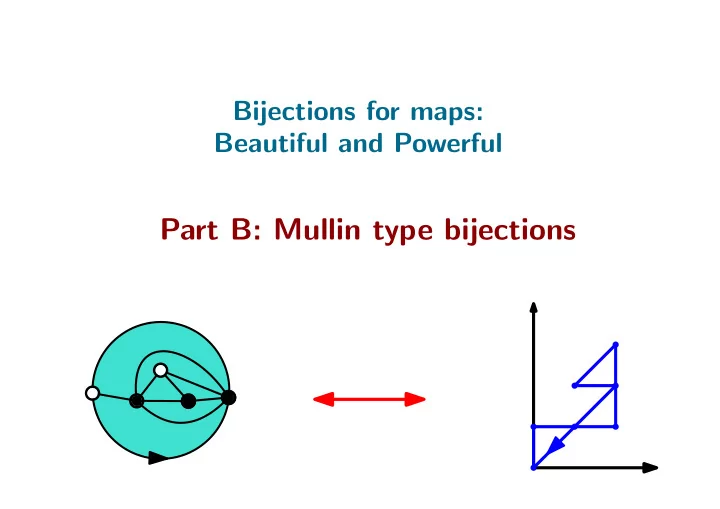
Mullin’s bijection Thm.[Mullin 67, Lehman & Walsh 72] Tree-decorated maps with n edges are in bijection with lattice paths in N2 made of 2n steps →, ←, ↓, ↑, starting and ending at (0, 0).
Mullin’s bijection Def of Mullin bijection. Turn around the tree and write: → when following an edge of the tree for first time ← when following edge of tree for second time ↑ when crossing edge not in tree for first time ↓ when crossing edge not in tree for second time
Mullin’s bijection Def of Mullin bijection. Turn around the tree and write: → when following an edge of the tree for first time ← when following edge of tree for second time ↑ when crossing edge not in tree for first time ↓ when crossing edge not in tree for second time
Mullin’s bijection Def of Mullin bijection. Turn around the tree and write: → when following an edge of the tree for first time ← when following edge of tree for second time ↑ when crossing edge not in tree for first time ↓ when crossing edge not in tree for second time Easy to see it is bijection (...)
Mullin’s bijection Remark:: ↔ gives the contour code of the tree. gives the contour code of the dual tree. Hence the Mullin code is the shuffle of the two contour codes.
Mullin’s bijection Remark:: ↔ gives the contour code of the tree. gives the contour code of the dual tree. Hence the Mullin code is the shuffle of the two contour codes.
Mullin’s bijection Remark:: ↔ gives the contour code of the tree. gives the contour code of the dual tree. Hence the Mullin code is the shuffle of the two contour codes.
# tree decorated maps with n edges = n
k=0
2n
2k
Other Mullin type bijections Percolation-decorated triangulations Schnyder-decorated triangulations
[Bernardi,Holden,Sun 19] [Bernardi 07] without [Bonichon 05] [Bernardi,Bonichon 09] [Li,Sun,Watson] [Kenyon, Miller, Sheffield, Wilson 15]
Bipolar-decorated triangulations
Other Mullin type bijections Question: Is there a master Mullin-type bijection for Gessel walks?
Other Mullin type bijections Question: Is there a master Mullin-type bijection for Gessel walks?
Question: Is there a master bijection for Mullin-type bijections?
Sheffield’s freshburgers Question: Mullin bijection is for tree-decorated maps. What about other subgraph-decorated maps?
Sheffield’s freshburgers Question: Mullin bijection is for tree-decorated maps. What about other subgraph-decorated maps? Idea: Associate every subgraph to a spanning tree (+ some marks), in order to obtain a bijection subgraph-decorated maps ← → marked tree-decorated maps.
Sheffield’s freshburgers
strictly above of the last step.
at the right of the last step.
Sheffield’s freshburgers
(via the Mullin encoding) to the last step of a cone excursion.
strictly above of the last step.
at the right of the last step. fresh
Sheffield’s freshburgers
(via the Mullin encoding) to the last step of a cone excursion.
strictly above of the last step.
at the right of the last step.
fresh fresh fresh fresh
Example.
Sheffield’s freshburgers
(via the Mullin encoding) to the last step of a cone excursion.
strictly above of the last step.
at the right of the last step.
Footnote 1: Why “fresh”? producing a cheeseburger eating a cheeseburger A step is fresh in the above sense if it corresponds to eating the freshest item currently available on the shelf. eating a hamburger producing a hamburger
Sheffield’s freshburgers
(via the Mullin encoding) to the last step of a cone excursion.
strictly above of the last step.
at the right of the last step.
Footnote 2: Given the spanning tree T, an edge e is “fresh” if it is the last edge to be visited within the cycle/cocycle it forms with T. This is similar to the notion of activity in the sense of the Tutte polynomial.
Sheffield’s freshburgers Lemma:[Bernardi 08/ Sheffield 12] 1. Every subgraph-decorated map is obtained in a unique way by adding/deleting some fresh edges to a tree-decorated map.
Sheffield’s freshburgers Lemma:[Bernardi 08/ Sheffield 12] 1. Every subgraph-decorated map is obtained in a unique way by adding/deleting some fresh edges to a tree-decorated map.
spanning trees and fresh edges (x) subgraphs obtained by adding/deleting edges
Example:
Sheffield’s freshburgers Lemma:[Bernardi 08/ Sheffield 12] 1. Every subgraph-decorated map is obtained in a unique way by adding/deleting some fresh edges to a tree-decorated map.
#connected components of subgraph = 1+ #fresh edges deleted. # cycles of subgraph (nullity) = # fresh edges added.
Sheffield’s freshburgers Lemma:[Bernardi 08/ Sheffield 12] 1. Every subgraph-decorated map is obtained in a unique way by adding/deleting some fresh edges to a tree-decorated map.
#connected components of subgraph = 1+ #fresh edges deleted. # cycles of subgraph (nullity) = # fresh edges added. Corollary:
subgraph-decorated map
xc(S)−1 yn(S) =
+ some marked fresh edges
xfresh← yfresh ↓.
Sheffield’s freshburgers Lemma:[Bernardi 08/ Sheffield 12] 1. Every subgraph-decorated map is obtained in a unique way by adding/deleting some fresh edges to a tree-decorated map.
#connected components of subgraph = 1+ #fresh edges deleted. # cycles of subgraph (nullity) = # fresh edges added.
Partition function of FK-cluster model on maps (⇐ ⇒ Potts model on maps) (⇐ ⇒ Tutte polynomial of maps)
Corollary:
Partition function of quarter-walks counted by size and #fresh steps
# connected components # fresh marked edges nullity
subgraph-decorated map
xc(S)−1 yn(S) =
+ some marked fresh edges
xfresh← yfresh ↓.
Sheffield’s freshburgers
subgraph-decotated map qc(S)−1+n(S) =
+ some marked fresh edges q#marked fresh. Critical FK-cluster model on maps (q determines the central charge)
Sheffield’s freshburgers
subgraph-decotated map qc(S)−1+n(S) =
+ some marked fresh edges q#marked fresh. Critical FK-cluster model on maps (q determines the central charge)
Rk: q ր ⇐ ⇒ fresh steps ր ⇐ ⇒ correlation of coordinates ր.
Sheffield’s freshburgers
subgraph-decotated map qc(S)−1+n(S) =
+ some marked fresh edges q#marked fresh. Critical FK-cluster model on maps (q determines the central charge)
Rk: q ր ⇐ ⇒ fresh steps ր ⇐ ⇒ correlation of coordinates ր.
α(q) Brownian excursion with correlated coordinates Brownian excursion in a cone
⇐ ⇒
Sheffield’s freshburgers
subgraph-decotated map qc(S)−1+n(S) =
+ some marked fresh edges q#marked fresh. Critical FK-cluster model on maps (q determines the central charge)
Theorem: [Sheffield 16] For q ∈ [0, 4] the scaling limit of fresh-weighted walks is a Brownian motion in a cone of angle α(q). Rk: q ր ⇐ ⇒ fresh steps ր ⇐ ⇒ correlation of coordinates ր.
α(q) Brownian excursion with correlated coordinates Brownian excursion in a cone
⇐ ⇒
Sheffield’s freshburgers
subgraph-decotated map qc(S)−1+n(S) =
+ some marked fresh edges q#marked fresh. Critical FK-cluster model on maps (q determines the central charge)
Theorem: [Sheffield 16] For q ∈ [0, 4] the scaling limit of fresh-weighted walks is a Brownian motion in a cone of angle α(q). Example: α(0) = π/2 for tree-decorated, α(1) = 2π/3 for percolation, α(2) = 3π/8 for Ising. Rk: q ր ⇐ ⇒ fresh steps ր ⇐ ⇒ correlation of coordinates ր.
α(q) Brownian excursion with correlated coordinates Brownian excursion in a cone
⇐ ⇒
Mating of trees [Duplantier, Miller, Sheffield] There is a parallel story in the context of Liouville quantum gravity:
Mating of trees [Duplantier, Miller, Sheffield] There is a parallel story in the context of Liouville quantum gravity: Theorem: [Duplantier, Miller, Sheffield 14] Grow a space-filling SLEκ(q) on LQGγ(q) and record length of sides. This process is equal to the “correlated” 2D-Brownian motion which is the limit of q-fresh-weighted walks. Moreover, the above is a σ-algebra preserving correspondence.
Mating of trees [Duplantier, Miller, Sheffield] There is a parallel story in the context of Liouville quantum gravity: Theorem: [Duplantier, Miller, Sheffield 14] Grow a space-filling SLEκ(q) on LQGγ(q) and record length of sides. This process is equal to the “correlated” 2D-Brownian motion which is the limit of q-fresh-weighted walks. Moreover, the above is a σ-algebra preserving correspondence. Gives hope of connecting (FK-weighted) maps to LQG and SLE via the walk encoding.
Percolation on triangulation CLE on Liouville Quantum Gravity
Percolation on triangulation CLE on Liouville Quantum Gravity “Random curves on a random surface”
Percolation on triangulation CLE on Liouville Quantum Gravity Kreweras excursion 2D Brownian excursion
Percolation on a regular lattice Triangular lattice
Percolation on a regular lattice Site percolation: Color vertices black or white with probability 1/2.
Percolation on a regular lattice Questions:
A n × B n box Site percolation: Color vertices black or white with probability 1/2.
Percolation on a regular lattice Questions:
Site percolation: Color vertices black or white with probability 1/2.
Percolation on a regular lattice Questions:
Site percolation: Color vertices black or white with probability 1/2.
Triangulations (of the disk)
Triangulations (of the disk) =
(considered up to deformation).
Triangulations (of the disk) (multiple edges allowed, loops forbidden)
(considered up to deformation).
Triangulations (of the disk)
(considered up to deformation).
Percolation on triangulations We can consider percolation on random triangulations of the disk. (k exterior vertices, n interior vertices; uniform probability)
Percolation on triangulations Same questions:
We can consider percolation on random triangulations of the disk. (k exterior vertices, n interior vertices; uniform probability)
Percolation on triangulations Same questions:
We can consider percolation on random triangulations of the disk. (k exterior vertices, n interior vertices; uniform probability) Goal 1: Answer these questions. (as n → ∞, k ∼ √n)
We can also consider infinite triangulations. Percolation on triangulations Same questions:
We can consider percolation on random triangulations of the disk. (k exterior vertices, n interior vertices; uniform probability) Uniform Infinite Planar Triangulation [Angel,Schramm 04] Goal 1: Answer these questions. (as n → ∞, k ∼ √n)
Regular lattices Vs random lattices Is it interesting to study statistical mechanics on random lattices? Vs regular lattice random lattice
Regular lattices Vs random lattices Is it interesting to study statistical mechanics on random lattices? Vs regular lattice random lattice Yes! New tools: random matrices, generating functions, bijections.
Regular lattices Vs random lattices Yes! The “critical exponents” on regular Vs random lattices are related by the KPZ formula [Knizhnik, Polyakov, Zamolodchikov]. Is it interesting to study statistical mechanics on random lattices? Vs regular lattice random lattice Yes! New tools: random matrices, generating functions, bijections.
Regular lattices Vs random lattices Yes! The “critical exponents” on regular Vs random lattices are related by the KPZ formula [Knizhnik, Polyakov, Zamolodchikov]. Yes! Critically weighted random lattices random surfaces. Is it interesting to study statistical mechanics on random lattices? Vs regular lattice random lattice Yes! New tools: random matrices, generating functions, bijections.
What is . . . Liouville Quantum Gravity?
What is . . . Liouville Quantum Gravity? LQG is a random area measure µ on a C-domain which is related to the Gaussian free field.
(image by J. Miller)
What is . . . Liouville Quantum Gravity? 1D LQG Brownian motion 1 1D LQG 1
h µ = eγhdx
What is . . . Liouville Quantum Gravity?
Random function chosen with probability proportional to e −
n
(h(i) − h(i − 1))2 2
Brownian motion 1D LQG 1D LQG
hn : [n] → R µ = eγhdx
1
h = lim hn
1 n
What is . . . Liouville Quantum Gravity?
hn : [n]2 → R µ = eγhdxdy h = lim hn Random function chosen with probability proportional to e −
(h(u) − h(v))2 2
Gaussian Free Field LQG
(a distribution) (area measure)
What is . . . Liouville Quantum Gravity?
hn : [n]2 → R µ = eγhdxdy h = lim hn γ ∈ [0, 2] controls how wild LQG measure is. Today: γ =
“pure gravity”
What is... a SLE (Schramm–Loewner evolution)?
What is... a SLE (Schramm–Loewner evolution)? SLEκ is a random (non-crossing, parametrized) curve in a C-domain.
What is... a SLE (Schramm–Loewner evolution)? SLEκ were introduced to describe the scaling limit of curves from statistical mechanics. SLEκ is a random (non-crossing, parametrized) curve in a C-domain. The parameter κ determines how much the curve “wiggles”.
What is... a SLE (Schramm–Loewner evolution)? SLE are characterized by:
1 γ
What is... a SLE (Schramm–Loewner evolution)? SLE are characterized by:
1 1 φ conformal
γ(t)
What is... a SLE (Schramm–Loewner evolution)? SLE are characterized by:
1 1 ei√κW (t)
γ(t) Brownian
˜ φ conformal
What is... a SLE (Schramm–Loewner evolution)? Today: κ = 6 (percolation)
What is... a SLE (Schramm–Loewner evolution)? Today: κ = 6 (percolation) Theorem [Smirnov 01]: Convergence. SLE6
What is... a SLE (Schramm–Loewner evolution)? Today: κ = 6 (percolation) Theorem [Smirnov 01]: Convergence.
What is... a SLE (Schramm–Loewner evolution)? CLE6
Conformal Loop Ensemble
Today: κ = 6 (percolation) Theorem [Smirnov 01]: Convergence. Theorem [Camia, Newman 09]: Convergence.
The big conjecture
Riemann mapping
Nice embedding
The big conjecture under nice embedding
LQG√
8/3
LQG√
8/3 + CLE6
The big conjecture under nice embedding
bijection
[Bernardi 2007] σ-algebra preserving coupling [Bernardi, Holden, Sun 2019] LQG√
8/3 + CLE6
[Duplantier, Miller, Sheffield 2014] “mating of trees”
under nice embedding Strategy of proof
Kreweras walks Def. A Kreweras walk is a lattice walk on Z2 using the steps a = (1, 0), b = (0, 1) and c = (−1, −1). b a c
Thm [Bernardi 07/ Bernardi, Holden, Sun 18]: There is a bijection between:
and staying in N2.
with 2 exterior vertices: one white and one black.
n interior vertices
3n steps
Example: w = baabbcacc
Example: w = baabbcacc a a b b c a c c b
Example: w = baabbcacc b a a b b b Definition:
Example: w = baabbcacc Definition:
c a c c
a b c Well defined? #a − #c #b − #c
a b c Well defined? #a − #c #b − #c Bijective? a a b b c a c c b
a b c Well defined? #a − #c #b − #c a a b b c a c c b Bijective? inverse bijection
Variants of the bijection Spherical case Disk case UIPT case
Dictionary percolated triangulation walk edges steps vertices c-steps black vertices c steps of type a left-boundary length x-coordinate of walk walk perco-interface toward t walk of excursions clusters envelope intervals cluster’s bubbles cone intervals
Basic observations
Dictionary: triangles ← → a, b steps inner vertices ← → c steps inner edges +root-edge ← → a, b, c steps c a b
Basic observations
Remark. Subwalk made of a, c steps form a parenthesis system. Subwalk made of b, c steps form a parenthesis system. Example: w = b a a b b c a c c. c a b
Basic observations
Remark. Subwalk made of a, c steps form a parenthesis system. Subwalk made of b, c steps form a parenthesis system. Example: w = b a a b b c a c c. Dictionary. triangles incident to left boundary ← → unmatched a-steps. triangles incident to right boundary ← → unmatched b-steps. c a b
Basic observations
Def: c-steps are of two types: xxxxx a xxxx b xxxx c xxxx xxxxx b xxxx a xxxx c xxxx c a b type a type b
Basic observations
Def: c-steps are of two types: xxxxx a xxxx b xxxx c xxxx xxxxx b xxxx a xxxx c xxxx c a b Dictionary. white inner vertex ← → c-step of type a black outer vertex ← → c-step of type b type a type b
Basic observations
Def: c-steps are of two types: xxxxx a xxxx b xxxx c xxxx xxxxx b xxxx a xxxx c xxxx c a b Dictionary. white inner vertex ← → c-step of type a black outer vertex ← → c-step of type b type a type b Math puzzle: Prove directly that the number of c-steps of type a follows a binomial B(n, 1/2) distribution.
Dictionary: percolation-interface to t ← → walk of excursions
Dictionary: percolation-interface to t ← → walk of excursions Flatten each cone-excursion into a single step empty the bubbles Shuffle of 2 looptrees Flattened walk
Dictionary: percolation-interface to t ← → walk of excursions
Exploration tree
edge joins comparable vertices (one ancestor of the other). YES NO
Exploration tree
edge joins comparable vertices (one ancestor of the other). YES NO
Defth-First Search of the graph.
Exploration tree Lemma [BHS]: Let M be a loopless triangulation of the disk with root-edge e0. There is a bijection between
0.
M M ∗ e0
Exploration tree From black/white coloring to DFS-tree: Make a depth-first search of the map, with the following rule when choosing between two unexplored directions: if the forward face is black, then turn left, else turn right. Lemma [BHS]: Let M be a loopless triangulation of the disk with root-edge e0. There is a bijection between
0.
Exploration tree From DFS-tree to percolation: Let T be a DFS tree of M ∗ Color white the faces of M ∗ “at the left” of T. Color black the faces of M ∗ “at the right” of T. Lemma [BHS]: Let M be a loopless triangulation of the disk with root-edge e0. There is a bijection between
0.
Dictionary: Let w ∈ K and (M, σ) = Φ(w). Call exploration tree τ ∗ the DFS-tree of M ∗ corresponding to σ. Then,
where hk is the number of steps in the path of excursion of the walk w truncated after the kth a, b step. Exploration tree in terms of the walk
Tree of clusters
Tree of clusters
A B D E A T B E C C D tree of clusters
Tree of clusters
Lemma [BHS]: Let τ be the spanning tree of M which is dual to the exploration tree τ ∗. The tree of clusters T is obtained from τ by contracting every monochromatic edge.
Tree of clusters
Lemma [BHS]: Let τ be the spanning tree of M which is dual to the exploration tree τ ∗. The tree of clusters T is obtained from τ by contracting every monochromatic edge. A T
B E
C D
Tree of clusters in terms of the walk Dictionary: The tree τ can be obtained from the walk w by . . .
discrete dictionary
continuum dictionary
[Duplantier, Miller, Sheffield] [Bernardi, Holden, Sun]
Perfect correspondence!
under nice embedding
Thm [Bernardi, Holden, Sun 19] Percolation on random triangulation CLE on Liouville Quantum Gravity under nice embedding some
Thm [Bernardi, Holden, Sun 19] Let (Mn, σn) uniformly random percolated triangulation of size n (n interior vertices, √n exterior vertices). There exist embeddings φn : Mn → D (and coupling) such that the following converge jointly in probability:
→
φn(Mn) LQG√
8/3
weak topology
Thm [Bernardi, Holden, Sun 19] Let (Mn, σn) uniformly random percolated triangulation of size n (n interior vertices, √n exterior vertices). There exist embeddings φn : Mn → D (and coupling) such that the following converge jointly in probability:
→
φn(Mn, σn) LQG√
8/3 +
independent CLE6
embedded percolation cycles γn
1 , γn 2 , . . .
− → CLE6 loops γ1, γ2, . . .
uniform topology
Thm [Bernardi, Holden, Sun 19] Let (Mn, σn) uniformly random percolated triangulation of size n (n interior vertices, √n exterior vertices). There exist embeddings φn : Mn → D (and coupling) such that the following converge jointly in probability:
→
embedded percolation cycles γn
1 , γn 2 , . . .
− → CLE6 loops γ1, γ2, . . .
uniform topology on subtrees
Thm [Bernardi, Holden, Sun 19] Let (Mn, σn) uniformly random percolated triangulation of size n (n interior vertices, √n exterior vertices). There exist embeddings φn : Mn → D (and coupling) such that the following converge jointly in probability:
→
embedded percolation cycles γn
1 , γn 2 , . . .
− → CLE6 loops γ1, γ2, . . .
weak topology
i,n −
→ νǫ
i , and , νǫ i,j,n−
→ νǫ
i,j.
Thm [Bernardi, Holden, Sun 19] Let (Mn, σn) uniformly random percolated triangulation of size n (n interior vertices, √n exterior vertices). There exist embeddings φn : Mn → D (and coupling) such that the following converge jointly in probability:
→
embedded percolation cycles γn
1 , γn 2 , . . .
− → CLE6 loops γ1, γ2, . . .
Eb(vn) − → Eb(v).
i,n −
→ νǫ
i , and , νǫ i,j,n−
→ νǫ
i,j.
Thm [Bernardi, Holden, Sun 19] Let (Mn, σn) uniformly random percolated triangulation of size n (n interior vertices, √n exterior vertices). There exist embeddings φn : Mn → D (and coupling) such that the following converge jointly in probability:
Overview of proof:
Convergence of walk ++++
bijection
[Bernardi 2007] σ-algebra preserving coupling [Bernardi, Holden, Sun 2018] (Mn, σn) LQG√
8/3 + CLE6
[Duplantier, Miller, Sheffield 2014] “mating of trees”
Overview of proof:
Convergence of walk ++++
bijection
Embedding φn defined using “space filling exploration” [Bernardi 2007] σ-algebra preserving coupling [Bernardi, Holden, Sun 2018] (Mn, σn) LQG√
8/3 + CLE6
[Duplantier, Miller, Sheffield 2014] “mating of trees”
Cardy embedding of triangulations Theorem:[Holden, Sun 2020+] under nice embedding + Miller, Sheffield Holden, Sun + Albenque, Garban, Gwynne, Lawler, Li, Sepulveda
Cardy embedding of triangulations Theorem:[Holden, Sun 2020+] Convergence holds for the Cardy embedding. (because φn ≈ Cardy embedding) Cardy embedding where p• = Pperco
Key ingredient used: “convergence componentwise” Same triangulation k independent percolations k Kreweras walks k Brownian motions Same LQG k independent CLE
To upgrade the “crossing event result” from an annealed result to a quenched result. This implies (...) that φn ≃ Cardy embedding. Why useful?
To upgrade the “crossing event result” from an annealed result to a quenched result. This implies (...) that φn ≃ Cardy embedding. Why useful? How is it proved?
with convergence in Gromov-Hausdorff-Prokhorov topology.
point result).
Main references (for the part B of this minicourse)
Miller, Sheffield 14]
a bijective path to Liouville Quantum Gravity [Bernardi,Holden,Sun 19]
ding [Holden, Sun ??]
Bonus: Another look at Mullin’s bijection
QM M
Bonus: Another look at Mullin’s bijection
QM M edges of M ← → blue-blue diagonals of QM. edges of M ∗ ← → green-green diagonals of QM.
Bonus: Another look at Mullin’s bijection
QM M edges of M ← → blue-blue diagonals of QM. edges of M ∗ ← → green-green diagonals of QM. subgraphs of M ← → triangulations QM.
Bonus: Another look at Mullin’s bijection