
SLIDE 1
Functions
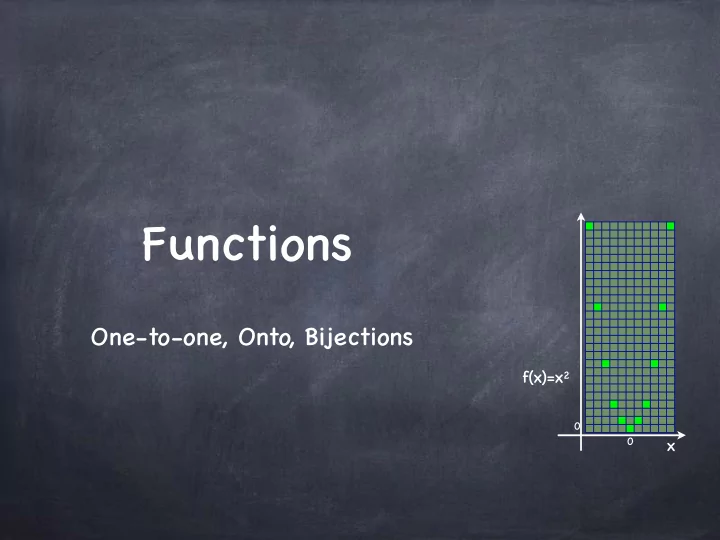
x f(x)=x2
Functions One-to-one, Onto, Bijections f(x)=x 2 0 0 x Types of - - PowerPoint PPT Presentation
Functions One-to-one, Onto, Bijections f(x)=x 2 0 0 x Types of Functions Function viewed as a matrix: every column has exactly one cell on Onto Function (surjection): Every row has at least one cell on One-to-One function
x f(x)=x2
Function viewed as a matrix: every column has exactly one cell “on” Onto Function (surjection): Every row has at least one cell “on” One-to-One function (injection): Every row has at most one cell “on” Bijection: Every row has exactly one cell “on”
x f(x)=x2 x f(x)=5x x f(x)=x x f(x)= ⌊x/5⌋
Onto Function (surjection): Every row has at least one cell “on” Given f:A→B, one can always define an “equivalent” onto function f’:A→Im(f) such that ∀x∈A f(x)=f’(x)
x f(x)=x2 x f(x)=5x x f(x)=x x f(x)= ⌊x/5⌋
∀y∈B ∃ x∈A f(x)=y
One-to-One function (injection): Every row has at most one cell “on” Domain matters : Z → Z defined as f(x)=x2 is not one-to-one, but f : Z+ → Z+ defined as f(x)=x2 is one-to-one E.g., strictly increasing or decreasing functions
x f(x)=x2 x f(x)=5x x f(x)=x x f(x)= ⌊x/5⌋
∀x,x’∈A f(x)=f(x’) → x=x’ ∀y∈Im(f) ∃! x∈A f(x)=y
x f(x)
∀y∈Im(f) ∃! x∈A f(x) = y
y g(y)
One-to-one functions are invertible Suppose f : A→B is one-to-one Let g : B→A be defined as follows: for y∈Im(f), g(y)=x s.t. f(x)=y (well-defined) for y∉ Im(f), g(y) = some arbitrary element in A Then g○f ≡ IdA, where IdA : A→A is the identity function over A g need not be invertible 1 2 3 01 11 00 10 1 2 3 f is said to be invertible if ∃g s.t. g○f ≡ Id
Can recover x from f(x): f doesn’ t lose information
One-to-one functions are invertible And invertible functions are one-to-one Suppose f : A→B is invertible Let g : B→A be s.t. g○f ≡ Id Now, for any x1,x2 ∈ A, if f(x1) = f(x2), then g(f(x1))=g(f(x2)) But g(f(x)) = Id(x) = x Hence, ∀x1,x2 ∈ A, if f(x1)=f(x2), then x1=x2 f is said to be invertible if ∃g s.t. g○f ≡ Id
Bijection: both onto and one-to-one Every row and every column has exactly one cell “on” Every element in the co-domain has exactly one pre-image If f : A→B, f-1 : B→A such that f-1○f : A→A and f○f-1 : B→B are both identity functions Both f and f-1 are invertible, and the inverses are unique (f-1) -1 = f 1 2 3 01 11 10 1 2 3 01 11 10
Suppose f : A→B where A, B are finite |Im(f)| ≤ |A|, with equality holding iff f is one-to-one |Im(f)| ≤ |B|, with equality holding iff f is onto If f is onto, then |A| ≥ |B| f onto ⇒ Im(f) = B ⇒ |B| ≤ |A| If f is one-to-one, then |A| ≤ |B| f one-to-one ⇔ |Im(f)| = |A|. But |Im(f)| ≤ |B| ⇒ |A| ≤ |B| Contrapositive: If |A| > |B|, then f not one-to-one Pigeonhole principle If f is a bijection, then |A| = |B| If |A| = |B|, then f is onto ≡ f in one-to-one ≡ f is a bijection
Defined only if Im(f) ⊆ Domain(g) Typically, Domain(g) = Co-domain(f) g○f : Domain(f) → Co-domain(g) Im(g○f) ⊆ Im(g)
5 4 3 2 1 High Medium Low
(Alice, Alice) (Alice, Jabberwock) (Alice, Flamingo) (Jabberwock, Alice) (Jabberwock, Jabberwock) (Jabberwock, Flamingo) (Flamingo, Alice) (Flamingo, Jabberwock) (Flamingo, Flamingo)
f g
High Medium Low
(Alice, Alice) (Alice, Jabberwock) (Alice, Flamingo) (Jabberwock, Alice) (Jabberwock, Jabberwock) (Jabberwock, Flamingo) (Flamingo, Alice) (Flamingo, Jabberwock) (Flamingo, Flamingo)
g○f
Composition of functions f and g: g○f : Domain(f) → Co-domain(g) g○f(x) ≜ g(f(x))
Suppose Domain(g) = Co-Domain(f) (then g○f well-defined). Composition “respects onto-ness” If f and g are onto, g○f is onto as well If g○f is onto, then g is onto
1 2 3 4 5
α β γ δ 1 2 3
g f
ε
Composition “respects one-to-one-ness” If f and g are one-to-one, g○f is one-to-one as well If g○f is one-to-one, then f is one-to-one
Suppose Domain(g) = Co-Domain(f) (then g○f well-defined). Composition “respects onto-ness” If f and g are onto, g○f is onto as well If g○f is onto, then g is onto
1 2 3 4 5
α β γ δ 1 4 2 5 3
g f
ζ ε
6
Composition “respects one-to-one-ness” If f and g are one-to-one, g○f is one-to-one as well If g○f is one-to-one, then f is one-to-one
Suppose Domain(g) = Co-Domain(f) (then g○f well-defined). Composition “respects onto-ness” If f and g are onto, g○f is onto as well If g○f is onto, then g is onto Hence, composition “respects bijections” If f and g are bijections then g○f is a bijection as well If g○f is a bijection, then f is one-to-one and g is onto
Exercise: What if Domain(g) ⊋ Co-Domain(f)? What if Domain(g) = Im(f) and/or Co-Domain(f) = Im(f) ?
To permute = to rearrange e.g., π53214(hello) = lleoh e.g., π35142(lleoh) = ehlol Permutations are essentially bijections from the set of positions (here {1,2,3,4,5}) to itself A bijection from any finite set to itself is called a permutation Permutations compose to yield permutations (since bijections do so) e.g., π35142 ○ π53214 = π21534
1 2 3 4 5 1 2 3 4 5 h e l l
l e
a b c d e 1 2 3 4 5 e h l
1 2 3 4 5 1 2 3 4 5
Bijection with additional “structure preserving properties” “Structure”: some relation(s) Consider sets S and S’ and relations R ⊆ S × S and R’⊆ S’ × S’ An isomorphism between R and R’ is a bijection from S to S’ such that ∀x,y ∈ S, R(x,y) ↔ R’(f(x),f(y))
S S’ d 1 a 2 b 3 c An isomorphism S S’ a 1 b 2 c 3 d Not an isomorphism 1 2 3 R a b c d R’