Part 1 of 4: Why Would I Have to Disclose? Disclosure Obligations for - - PDF document

part 1 of 4 why would i have to disclose disclosure
SMART_READER_LITE
LIVE PREVIEW

Part 1 of 4: Why Would I Have to Disclose? Disclosure Obligations for - - PDF document

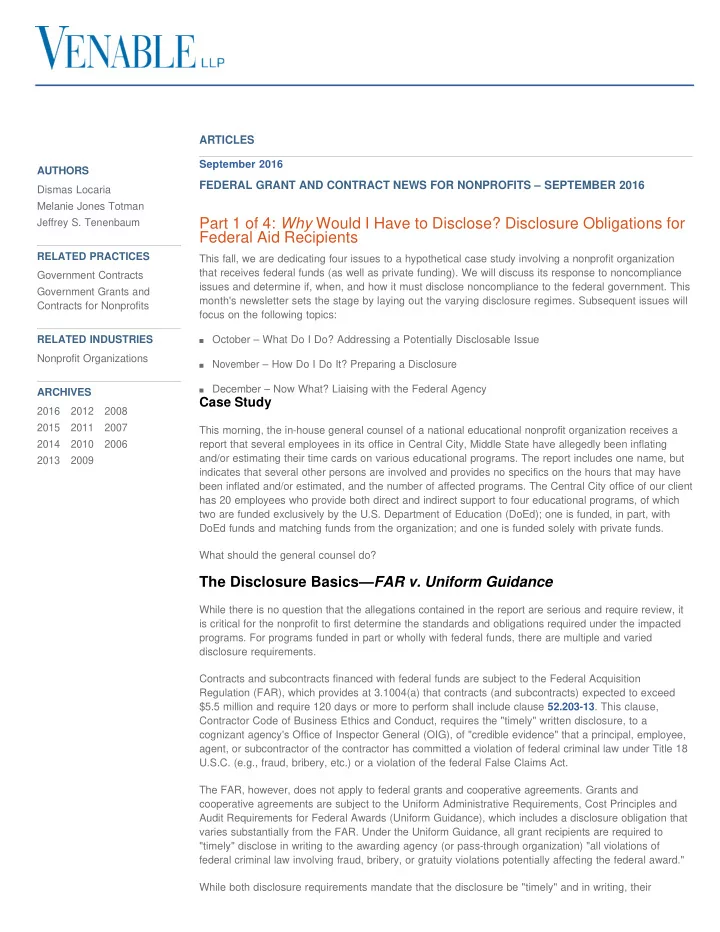
ARTICLES September 2016 AUTHORS FEDERAL GRANT AND CONTRACT NEWS FOR NONPROFITS SEPTEMBER 2016 Dismas Locaria Melanie Jones Totman Part 1 of 4: Why Would I Have to Disclose? Disclosure Obligations for Jeffrey S. Tenenbaum Federal Aid


slide-1
SLIDE 1

Dismas Locaria Melanie Jones Totman Jeffrey S. Tenenbaum Government Contracts Government Grants and Contracts for Nonprofits Nonprofit Organizations AUTHORS RELATED PRACTICES RELATED INDUSTRIES ARCHIVES 2016 2015 2014 2013 2012 2011 2010 2009 2008 2007 2006 September 2016

Part 1 of 4: Why Would I Have to Disclose? Disclosure Obligations for Federal Aid Recipients

This fall, we are dedicating four issues to a hypothetical case study involving a nonprofit organization that receives federal funds (as well as private funding). We will discuss its response to noncompliance issues and determine if, when, and how it must disclose noncompliance to the federal government. This month's newsletter sets the stage by laying out the varying disclosure regimes. Subsequent issues will focus on the following topics:

October – What Do I Do? Addressing a Potentially Disclosable Issue

November – How Do I Do It? Preparing a Disclosure

December – Now What? Liaising with the Federal Agency

Case Study

This morning, the in-house general counsel of a national educational nonprofit organization receives a report that several employees in its office in Central City, Middle State have allegedly been inflating and/or estimating their time cards on various educational programs. The report includes one name, but indicates that several other persons are involved and provides no specifics on the hours that may have been inflated and/or estimated, and the number of affected programs. The Central City office of our client has 20 employees who provide both direct and indirect support to four educational programs, of which two are funded exclusively by the U.S. Department of Education (DoEd); one is funded, in part, with DoEd funds and matching funds from the organization; and one is funded solely with private funds. What should the general counsel do? ARTICLES

FEDERAL GRANT AND CONTRACT NEWS FOR NONPROFITS – SEPTEMBER 2016

The Disclosure Basics—FAR v. Uniform Guidance

While there is no question that the allegations contained in the report are serious and require review, it is critical for the nonprofit to first determine the standards and obligations required under the impacted

  • programs. For programs funded in part or wholly with federal funds, there are multiple and varied

disclosure requirements. Contracts and subcontracts financed with federal funds are subject to the Federal Acquisition Regulation (FAR), which provides at 3.1004(a) that contracts (and subcontracts) expected to exceed $5.5 million and require 120 days or more to perform shall include clause 52.203-13. This clause, Contractor Code of Business Ethics and Conduct, requires the "timely" written disclosure, to a cognizant agency's Office of Inspector General (OIG), of "credible evidence" that a principal, employee, agent, or subcontractor of the contractor has committed a violation of federal criminal law under Title 18 U.S.C. (e.g., fraud, bribery, etc.) or a violation of the federal False Claims Act. The FAR, however, does not apply to federal grants and cooperative agreements. Grants and cooperative agreements are subject to the Uniform Administrative Requirements, Cost Principles and Audit Requirements for Federal Awards (Uniform Guidance), which includes a disclosure obligation that varies substantially from the FAR. Under the Uniform Guidance, all grant recipients are required to "timely" disclose in writing to the awarding agency (or pass-through organization) "all violations of federal criminal law involving fraud, bribery, or gratuity violations potentially affecting the federal award." While both disclosure requirements mandate that the disclosure be "timely" and in writing, their

slide-2
SLIDE 2

similarity ends there. The most notable distinctions between the two reporting regimes include the following:

The FAR disclosure requirement mandates disclosures based on "credible evidence," which, as the FAR Council explained in the guidance implementing 52.203-13, means that contractors had the

  • pportunity to conduct a preliminary examination to determine whether credible evidence in fact
  • existed. A FAR contractor needs to disclose prior to determining an actual violation has occurred.

Conversely, the Uniform Guidance requires disclosure of "violations" of certain laws. Violations are legal conclusions rendered by a judge or jury. Certainly this bar is high and would exclude mere whistleblower reports, such as that presented above, until after a judge or jury deemed (beyond a reasonable doubt) the allegation(s) true. Yet, from a practical standpoint, OIGs have made clear that they read and apply the Uniform Guidance's reporting obligation in a manner that is equal to the "credible evidence" standard under the FAR. Some agencies include this higher standard in the terms of the grant agreement. Until a nonprofit challenges an OIG and/or agency in a lawsuit, this broad interpretation is likely to persist.

The Uniform Guidance further limits its disclosure obligation to violations of "criminal" matters, leaving

  • ut civil violations of law, such as those claims and allegations that may be made under the federal

False Claims Act. Again, while this distinction is great, OIGs generally appear to be narrowing the gap between these two standards by stretching criminality to include conduct that would typically be reserved for civil actions under the FCA.

Finally, the Uniform Guidance requires disclosures to be submitted to the awarding agency or the pass-through organization. The FAR, on the other hand, requires submission to the cognizant OIG, with a copy to the contracting officer. Indeed, this distinction is great, as contracting and grant

  • fficers are far more likely to view matters in a contract administration context, whereas OIGs are

more inclined to allege fraud. It is also worth noting that a subrecipient is not even obligated, per the terms of the rule, to notify the federal government, but rather must notify the pass-through

  • rganization. In reality, however, OIGs again have been asserting authority beyond the plain text,

demanding that disclosures under the Uniform Guidance be submitted directly to them.

Why Would I Have to Disclose?

Given the foregoing, upon receiving the allegation, our hypothetical nonprofit should determine the funding streams at issue and the obligations thereunder. Here, the general counsel looks at the entire funding instrument for each of the four revenue sources, including provisions incorporated by reference and referenced regulatory requirements. Three of the four programs involve federal grant funds. They do not appear to include federal contract dollars and do not include 52.203-13. Thus, our nonprofit is subject to the less rigorous disclosure requirements of the Uniform Guidance. With respect to the privately funded program, the nonprofit should review the agreement itself to determine the obligations the agreement may include, and ensure (to the extent it can, based on the documents) that it does not include federal or state funds.1 While the disclosure obligations under the Uniform Guidance appear less rigorous than the FAR, as explained above, in practice, the nonprofit would likely be best served by treating the obligations in a manner similar to the disclosure requirements under the FAR. In our experience, OIGs are quick to assert fraud and question the present responsibility of an organization that strictly adheres to their minimum obligations under the regulatory requirements. Although an OIG's overreach would seem ripe for a successful federal lawsuit, most nonprofits prefer as smooth a relationship as possible with their federal funding partner, and treating potentially disclosable issues with the utmost attention, care, and cooperation will aid the nonprofit in avoiding and/or mitigating further disharmony with its federal partner.

To Be Continued…

Now that we have established the regulatory and practical backdrop of the obligations and expectations

  • f potential misconduct, next month we will delve into the steps for reviewing these timekeeping

allegations to determine whether there is in fact a disclosable issue (i.e., credible evidence of misconduct).

slide-3
SLIDE 3

Webinar Recording Available

September 20, 2016: How to Protect Nonprofits’ Federally Funded Programs with Global Anti- Corruption Controls This program takes you beyond the four corners of the federal False Claims Act and Foreign Corrupt Practices Act to provide you with legal and practical solutions to protect your nonprofit's program integrity and revenue.

Upcoming Nonprofit Luncheons/Programs and Webinars

October 13, 2016: How Your Nonprofit Can Operate a Legally Sound Certification or Accreditation Program November 10, 2016: Federal and State Regulators and Watchdog Groups Are Bearing Down on Charities and Their Professional Fundraisers: How to Prepare for the Regulatory Storm December 12, 2016: Top Ten Risks Facing Nonprofits Operating Internationally, co-sponsored by Venable LLP and BDO

To view our prior publications on nonprofit government grant and contract issues, please click here.

[1] Few states have mandatory reporting obligations, but nonprofits should be careful with state funds, because sometimes they are commingled with federal funds and carry with them federal obligations, and in many instances states have enforcement statutes such as state-based false claims act statutes that include unique provisions that could trigger liability if not properly addressed. For example, some states have state-based false claims act statutes with omission liability, meaning that should a nonprofit omit certain information from a discussion, it could be exposing itself to a state false claims act allegation.

slide-4
SLIDE 4

Dismas Locaria Melanie Jones Totman Jeffrey S. Tenenbaum Government Contracts Government Grants and Contracts for Nonprofits Nonprofit Organizations AUTHORS RELATED PRACTICES RELATED INDUSTRIES ARCHIVES 2016 2015 2014 2013 2012 2011 2010 2009 2008 2007 2006 October 2016

Part 2 of 4: What Do I Do? Addressing a Potentially Disclosable Issue

This month’s newsletter resumes our four-part discussion on responsiveness to noncompliance issues as exemplified by specific case studies. The following case is the basis for our continuing analysis, which outlines basic steps for reviewing and investigating a report of noncompliance. In the end, investigators generally are seeking to determine 1) what truly happened, 2) whether what happened is compliant with the law or the terms of the grant agreement, and 3) what measures have been instituted to help ensure that the noncompliance does not recur in the future. Case Study Reminder This morning, the in-house general counsel of a national educational nonprofit organization received a report that several employees in its office in Central City, Middle State have allegedly been inflating and/or estimating their time cards on various educational programs. The report includes one name, but indicates that several other persons are involved and provides no specifics on the hours that may have been inflated and/or estimated, or on the number of affected programs. The Central City office of our client has 20 employees who provide both direct and indirect support to four educational programs, two

  • f which are funded exclusively by the U.S. Department of Education (DoEd); one is funded, in part, with

DoEd funds and matching funds from the organization; and one is funded solely with private funds. What should the general counsel do? What Do I Do? Addressing a Potentially Disclosable Issue It is important to understand that every organization—no matter how small or sophisticated—will face compliance issues at some point. The mere fact that alleged noncompliance may have occurred is not unusual or worthy of embarrassment. Rather, it is the response of the organization in the face of such allegations that will set the tone regarding the organization’s ethics and integrity. Knowing that some sort of noncompliance is a near certainty, the first step in resolving a report of noncompliance should happen well before the matter arises, by establishing a procedure for reviewing such allegations. To be clear, this is not merely a whistleblower policy that explains how to report an issue; rather, it is a procedure that clearly explains how the organization will respond. This type of procedure demonstrates the organization’s commitment to effectively examining, correcting, and resolving a problem. Moreover, it will help to lay the groundwork for defending an organization against claims made by the U.S. Department of Justice (DOJ) and its Office of Inspectors General (OIG) that the organization is not a responsible steward of federal funds. ARTICLES

FEDERAL GRANT AND CONTRACT NEWS FOR NONPROFITS - OCTOBER 2016

Prepare an Investigation Procedure So what does an investigation procedure look like? As with almost all internal controls, it should be tailored to the needs and specific characteristics of the organization. However, there are hallmark traits that every responsible grantee should consider. The first is determining the right investigative team – deciding who will be the investigator of the issue, and who or what body of the organization will be responsible for particular decisions. Setting out these responsibilities promotes fairness over time and a consistent body of actions and decisions across the organization. Assembling the Investigation Team The lead investigator and any other investigator (if there are more than one) should have management’s attention and respect, and be familiar with the day-to-day program operations of the organization. It is critical to choose a person of integrity and good judgment who is free from actual or even apparent bias. Investigators also should have autonomy from the program or business personnel, and have structural (either direct or dotted-line) reporting obligations to the board of directors, audit committee, and/or

slide-5
SLIDE 5

highest level of management (depending on the circumstances). Making sure that the board of directors is aware of high-risk compliance issues is important, not just in resolving the issue at hand, but in ensuring that the appropriate resources are devoted to reviewing and correcting the problem. When deciding whether the federal government or outside legal counsel should be part of your team, you need to make an initial assessment of the allegations. Depending on the allegations, for example, you should consider when and how to reach out to the federal government and when to reach out to

  • utside legal counsel. Although some federal government officials prefer to be notified immediately of

any noncompliance, you are not legally obligated to do so until you are sure there is a reportable

  • ccurrence. However, there are times when the matter is sensitive enough in nature, such as if an

employee has violated the Human Trafficking regulations or is discovered committing criminal fraud, to warrant involving the federal government earlier in the investigative process. In the event you contact the federal government, we recommend also contacting outside legal counsel. Establishing and maintaining attorney-client privilege is also a major consideration in assembling an investigative team. Nonprofits with in-house counsel may be able to do this internally. However, outside counsel often is retained, and in many cases, it is advisable to solidify this protection. Outside counsel can have the advantage of acting as an impartial reviewer, and can provide important industry best practices in developing corrective action plans. Regardless, it will be critical for any outside counsel that you do hire or use to have the support of the

  • rganization and easy, ready access to facts and information within the organization. Thus, if outside

counsel is retained to investigate, the organization should assign an internal team leader who can help coordinate the effort and educate counsel on the ins and outs of the organization and its operations. Depending on the type of issue being reviewed, certain specialist team members (e.g., accountants) may be needed and considered. Setting out the Scope of Review Next, the lead investigator should define the scope of the review. Nonprofits do not have unlimited resources to spend on compliance issues; therefore, they should seek to develop an appropriate scope

  • f review. Scattered and ill-defined investigations can cost organizations dearly, while failing to

determine the real problem. Defining scope typically contributes to effective marshaling of resources, financial and otherwise. Another aspect of defining scope is determining who within the organization is involved. Before running to ask the individuals involved about the allegations, it may be worth taking a moment to sketch out the individuals one anticipates as being involved. Nonprofit grantees should think more broadly than the specific individuals who are part of the allegation. For example, in our current case study, who is the potential timekeeper’s supervisor—was the supervisor on notice about the inflated time? Did he/she sign

  • ff? In other cases, you may consider, who certified to compliance? Who in finance draws down on the

funds? Who reviews performance, financial, or audit reports? Was there a basis for believing the certification or reports that formed the basis of the investigation were inaccurate? If no one was on notice, is there an error in the infrastructure that kept critical information from flowing across departments to the appropriate personnel? Again, as stated above, the objective is to determine what happened in the allegation. “What happened” may be broader than something a specific individual did

  • incorrectly. Rather, it could be that an organizational gap or barrier prevented compliance.

Once individuals are identified as potential witnesses, it also is critical that the investigator give some thought to relationships between all of the witnesses and what conflicts of interest and/or perspectives might arise from such. A third aspect of defining scope is understanding the color of the money involved. Federal funds versus private funds, and federal contract funds versus federal grant funds, as well as a myriad of other combinations, can all have an impact on how one might approach a review. For example, in this case study, two are funded exclusively by DoEd; one is funded, in part, with DoEd funds and matching funds from the organization; and one is funded solely with private funds. In these instances, it will be critical to review the funding agreements before moving on with your review. Are there statutory, regulatory, and agency rules that apply because of the nature of the funds? From where do the matching funds and private funds derive? Do they have additional requirements? In a situation of mixed funding, when you compare the applicable requirements, do any contradict? If so, determine which requirements take precedence. Preparing for the Investigation Having set out the scope of the review, the investigator should develop a preliminary outline that sets out

slide-6
SLIDE 6

his or her initial thoughts on documents that should be collected for review and analysis. At a minimum, this will likely include most, if not all, of the funding agreement documents, including critical modifications and amendments. In this case the DoEd grant documents and the privately funded agreement should be collected for review. Furthermore, relevant policies and procedures and other documents should be considered and

  • examined. Again, in this particular case, the investigator should record timekeeping policies and

procedures, the organization’s code of conduct and employee handbook, as well as the time cards for all work under the four agreements. At times the amount of documents may be voluminous and cause

  • rganizations to shy away from the collection effort; however, in our experience, it is certainly preferred

to collect and review all such documents internally in advance of the federal government seeking and reviewing such documents, so that the organization can proactively consider what corrective and prophylactic measures it should take immediately. Typically, after reviewing the documents, the investigator may begin in-person interviews of personnel. Before getting started, a number of considerations should be taken into account, including, but not limited to:

Who should be interviewed?

What areas of inquiry should you have for this individual?

Are there any interview constraints that should be factored into the order or timing? For example, are any witnesses leaving for an extended period of time or permanently? Can you follow up with an interviewee with a second or third interview if needed?

Among all of the currently known interviewees and any scheduling realities, in what order should you interview them (i.e., are there some witnesses that will provide information to build toward other interviews)?

Are there any other sensitivities with any of the interviewees or issues that need to be planned around? While a good deal of planning should go into any investigation before conducting interviews, it is critical that the investigators remain open-minded and flexible as they prepare their outline, review documents, and certainly as they interview witnesses. Indeed, the investigation outline should be viewed as a living document that evolves with the investigation, and the inquiry itself should not be predisposed toward an

  • utcome, but rather should follow the facts to the supported conclusion.

Interviewing Witnesses Once meeting with individuals, ideally in person, the investigator (if an attorney) should begin with Upjohn warnings. If performed by an attorney, these warnings put the witness on notice that 1) they are being interviewed by an attorney; 2) the attorney represents the organization’s interests and not that of the individual personally; 3) because an attorney is speaking with them, attorney-client privilege attaches to the conversation and that privilege is held by the organization; 4) since the organization holds the privilege, to ensure the preservation of attorney-client privilege and the integrity of the investigation, it is critical that the interviewee keep the conversation confidential; 5) the organization may choose to disclose the findings of the interview and/or the investigation to outside parties, including federal government officials; and 6) it is important that they understand these concepts, and, if they wish to speak to an attorney for themselves at any time, they must inform the interviewer. After having delivered Upjohn warnings, investigators should select an interview style most comfortable for them, keeping in mind any sensitivies or characteristics of the interviewee. Typically, it may be most comfortable for the interviewee that the inquiry begin with simple factual items relating to the interviewee’s background and experience. As the interviewee becomes more comfortable, the investigator can begin to build the foundation to the heart of the inquiry. Sometimes having copies of documents may be useful; at other times, you may want the interviewee to draw upon their memory. There are a host of tactics and styles one may employ, but at bottom, the investigator should not be untruthful or deceitful or cause the interviewee to feel as though they have been detained against their will. Making Judgments

slide-7
SLIDE 7

Following the investigation (and often as the investigation unfolds), it is crucial for the investigator to assemble all of the information learned and attempt to put together the most logical and credible story. Often certain pieces or recounts may not fit together. It will be the job of the investigator to determine whether this is happening because someone misremembered, forgot, or lied about key facts or information, or there is a loose end that needs to be examined further. Ultimately, every fact of the story may be difficult to surmise with certainty, but at the conclusion of an investigation, a good sense of what actually happened should arise. In addition to developing the story of what occurred, the investigator must keep in mind steps that can be taken to ensure that noncompliance is not repeated (or at least is mitigated) and that the

  • rganization is able to learn and grow from the experience. In other words, what actions or procedures

would have prevented the discovered misconduct from occurring again? Are the individuals involved deserving of discipline? Should policies and procedures be revised or new ones developed altogether? Would additional training for staff and others help? Notwithstanding these considerations, the organization must be mindful that anything it does in advance

  • f informing federal government officials, if warranted, should be done extremely carefully, to ensure that

federal government officials do not view any action as destroying information, tainting witnesses, or

  • therwise interfering with what may ultimately become a federal government investigation.

Case Study: What Was Learned Having applied the above principles and guidance, in our case study, it was determined that while timekeeping noncompliance occurred, it was limited to three individuals, but applied to all four funding

  • instruments. Perhaps most fortunate, it appears that these individuals were not purposefully inflating

their time, but rather were rounding it up and sometimes estimating their time because they did not understand the importance of accurate timekeeping. Furthermore, because all three of the individuals at issue were relatively new to the organization, the noncompliance dated back only eight months. In response, the organization has taken immediate steps to train these individuals on the importance of timekeeping policies and has reviewed and updated its new hiring training program to better emphasize accurate timekeeping. The organization has maintained all of the documents it collected in the course

  • f the investigation.

To Be Continued… Notwithstanding the fact that these timekeeping infractions were not intentional, they did result in an

  • vercharge to the federal government on three grants. Next month, given this information, we will

discuss next steps.

To view our prior publications on nonprofit government grant and contract issues, please click here.

slide-8
SLIDE 8

Dismas Locaria Melanie Jones Totman Jeffrey S. Tenenbaum Government Contracts Government Grants and Contracts for Nonprofits Nonprofit Organizations AUTHORS RELATED PRACTICES RELATED INDUSTRIES ARCHIVES 2016 2015 2014 2013 2012 2011 2010 2009 2008 2007 2006 November 2016

Part 3 of 4: How Do I Do It? Preparing a Disclosure

This month's newsletter continues our four-part discussion of how a nonprofit organization might respond to an instance of potential noncompliance. The following case study is the basis of our continued analysis, which outlines basic steps for reviewing and investigating a reported

  • noncompliance. Last month, we discussed steps one should consider taking when addressing a

reported noncompliance. After having performed an inquiry or investigation and determining that a reportable incident occurred, we now focus our attention on the disclosure an organization might make. Case Study Reminder The in-house general counsel of a national educational nonprofit organization receives a report that several employees in its office in Central City, Middle State have allegedly been inflating and/or estimating their time cards on various educational programs. The report includes one name and indicates that several other persons were involved, but provides no specifics on the hours that may have been inflated and/or estimated, or on the number of affected programs. The Central City office has 20 employees who provide both direct and indirect support to four educational programs, of which two are funded exclusively by the U.S. Department of Education (DoEd); one is funded, in part, with DoEd funds and matching funds from the organization; and one is funded solely with private funds. In last month's newsletter, we walked through the investigation, whereby we also learned that while timekeeping noncompliance occurred, it was limited to three individuals, but applied to all four

  • programs. Perhaps most fortunate, it appears that these individuals were not purposefully inflating their

time, but rather were routinely rounding up their time (against company policy) and sometimes estimating their time because they did not understand the importance of accurate timekeeping. Furthermore, because all three of the individuals at issue were relatively new to the organization, the noncompliance dated back only eight months. In response, the organization took immediate steps to train these individuals on the importance of timekeeping policies and reviewed and updated its new hiring training program to better emphasize accurate timekeeping. The organization has maintained all

  • f the documents it collected in the course of the investigation.

With this information in hand, what should the general counsel do? Assessing the Need to Disclose When preparing to make a disclosure to a funding partner, it is critical to understand the requirements

  • f any such disclosure, including whether there is an affirmative requirement to disclose a
  • noncompliance. As discussed in the first newsletter of this series, federal awards (i.e., grants,

cooperative agreements and/or contracts) have certain disclosure requirements and varying disclosure

  • thresholds. This, however, may not be the case for state or privately funded arrangements.

Nevertheless, even if an affirmative disclosure obligation does not exist, the noncompliance, if discovered, may result in a breach of contract claim or undermine the grantee's relationship with its

  • agency. Therefore, as a general rule, it is typically a good idea to consider disclosing noncompliances

to your funding partners, regardless of whether there is a specific, affirmative obligation. In our hypothetical situation, the noncompliance implicates federal grant funds in three of the funding instruments, and a fourth does not include an affirmative disclosure obligation, but does include language that requires accurate timekeeping and billing. Accordingly, given that the investigation suggests that timekeeping and the corresponding invoices were not accurate, raising this issue with the private funding partner is advisable. Before disclosing, the organization, with the guidance of legal counsel, should fully understand the issues and the potential consequences of a disclosure. Depending on the type of noncompliance and ARTICLES

FEDERAL GRANT AND CONTRACT NEWS FOR NONPROFITS - NOVEMBER 2016

slide-9
SLIDE 9

the harm to the funding entity, a disclosure can set off a chain reaction of events that may result in substantial exposure to the organization, as well as individuals. This can include both civil and criminal penalties, as well as potential administrative action (i.e., suspension or debarment). Part of the conversation, however, must acknowledge that, should the organization fail to disclose a known noncompliance, if it is later discovered, the decision not to disclose will significantly increase the likelihood of civil, criminal and/or administrative action, or, at the very least, decrease the federal government's confidence in the organization. The Anatomy of a Disclosure With the above considerations in mind, it is generally advisable to include the entire context that led to a noncompliance. This allows the disclosing party the ability to explain itself and demonstrate to the funding partner that the disclosing party 1) has truly diagnosed the problem; 2) has taken the appropriate steps to mitigate the problem; and 3) can still be trusted as a responsible steward of the funding partner's funds. While some federal agencies provide disclosure forms, these are typically the "check-the-box" type, which leads little room for detailed narratives, and we generally counsel against using them. For example, organizations should consider including background on the disclosing

  • rganization's business generally and its history with the funding partner (including their joint

successes) and, of course, background on the specific project at issue, including any related challenges or difficulties experienced along the way (with reminders of those instances where the disclosing party previously apprised the funding partner of such challenges or difficulties). Similarly, it is critical that the disclosing party fully explain the particular facts and circumstances that led to the

  • noncompliance. In this way, the organization is able to fully contextualize any noncompliance, placing it

within the appropriate context of its relationship with the organization and its overall internal control structure. Of equal importance to the explanation regarding the disclosure are the actions an organization takes after learning of the issue. The federal government is inevitably looking to determine how the

  • rganization responded to the noncompliance and whether those steps will be effective in minimizing or

eliminating similar issues in the future. Key to this portion of the explanation is tying in the corrective actions to the actual noncompliance. If an agency feels the corrective actions are cosmetic or fail to address the root cause of an issue, the agency may not be satisfied with the response and may have continuing concerns. Furthermore, because not all actions can be or should be implemented immediately, taking a measured and methodical approach is usually acceptable, as long as the disclosure explains why a program or practice may take time to implement. Additional Considerations As explained in our first newsletter in this series, the requirement to disclose under a federal grant is very different form that under a federal contract (criminal violations versus credible evidence of a civil federal False Claims Act violation). Nevertheless, in our hypothetical scenario, it is clear that our

  • rganization has overcharged the federal government, and that it may be subject to civil False Claims

Act scrutiny. Thus, while it may not be specifically required by the Uniform Guidance (because the

  • vercharging alone may not be tantamount to a criminal violation), it is advisable that the matter be

raised with the granting agency. Here, DoEd is the federal funding entity under three affected programs. Although the funding agency is the same, it is not uncommon for each funding agreement to be administered by a different grants

  • fficer. Thus, the organization should ensure that it submits the disclosure to the correct individuals.

When multiple disclosures are necessary, the disclosing party should consider whether to make a single disclosure to all officials (i.e., putting all officials on notice of the issues the organization has under other funding arrangements) or an agreement-specific disclosure to each cognizant official. In presenting its disclosure, the organization also may consider providing back-up calculations so the federal government officials can review the calculation. Often, by being upfront about difficult issues, an

  • rganization can provide a sense of confidence that it has handled the matter appropriately and short-

circuit greater inquiry and scrutiny from the agency, potentially avoiding a federal inspector general or U.S. Department of Justice investigation. To Be Continued… Having made the disclosure to DoEd , as explained above, next month we will discuss some of the follow-up questions and/or actions that may ensue and thoughts and strategies for addressing them. * * * * * * * * * *

slide-10
SLIDE 10

DoD First to Bar Contracts from Contractors that Prohibit Employees from Reporting Waste, Fraud, and Abuse On November 14, 2016, the U.S. Department of Defense (DoD) issued a class deviation to the Federal Acquisition Regulation (FAR) that prohibits contracting officers from awarding contracts to contractors that prohibit their employees from reporting waste, fraud, and abuse to federal officials. This class deviation seeks to implement section 743 of Division E, Title VII of the Consolidated and Further Continuing Appropriations Act, 2015 (Pub. L. 113-235) and successor provisions in subsequent appropriations acts (and as extended in continuing resolutions). Section 743 prohibits the use of funds appropriated under or otherwise made available by Division E or any other Act for a contract, grant, or cooperative agreement with an entity that requires employees or subcontractors of such entity seeking to report waste, fraud, or abuse to sign internal confidentiality agreements or statements prohibiting or

  • therwise restricting such employees or subcontractors from lawfully reporting such waste, fraud, or

abuse to a designated investigative or law enforcement representative of a federal department or agency authorized to receive such information. To date, the Uniform Guidance has yet to be amended to implement Section 743, but prohibitions of this sort appear to be forthcoming. For more information on the DoD class deviation, please click here.

slide-11
SLIDE 11

Dismas Locaria Melanie Jones Totman Jeffrey S. Tenenbaum Government Contracts Government Grants and Contracts for Nonprofits Nonprofit Organizations AUTHORS RELATED PRACTICES RELATED INDUSTRIES ARCHIVES 2016 2015 2014 2013 2012 2011 2010 2009 2008 2007 2006 December 15, 2016

Part 4 of 4: Now What? Liaising with the Federal Agency

This month's newsletter is the fourth of a four-part discussion regarding an organization's response to a potential noncompliance. The following case study is the basis of our continued analysis, which outlines basic steps for reviewing and investigating a reported noncompliance. Last month, we discussed the anatomy of a written disclosure and the various considerations that go into it. Once the disclosure is submitted, the effort turns to discussions with government officials in an attempt to resolve the matter. Case Study Reminder The in-house general counsel of a national educational nonprofit organization receives a report that several employees in its office in Central City, Middle State allegedly inflated and/or estimated their time cards on various educational programs. In previous newsletters, we walked through the investigation, in which we confirmed that the timekeeping noncompliance occurred and that it was limited to three individuals across four programs. The investigation also revealed that these individuals were not purposely inflating their time, but rather were routinely rounding it up (against organization policy) and sometimes estimating their time because they did not understand the importance of accurate

  • timekeeping. Because all three of the individuals at issue were relatively new to the organization, the

noncompliance dated back only eight months. In response, the organization took immediate steps to train these individuals on the importance of timekeeping policies and reviewed and updated its new hiring training program to better emphasize accurate timekeeping. The organization has maintained all

  • f the documents it collected in the course of the investigation.

Last month, we discussed the written disclosure, and now we will walk our readers through some of the steps and issues an organization is confronted with after it has submitted its disclosure and works toward resolution. Set Your Goals As in any negotiation, it is critical for an organization to consider its goals before initiating the

  • conversation. In our experience, there are typically two main objectives once a disclosure has been

submitted: 1) expediency and 2) a favorable resolution. Unfortunately, these are not always compatible and are often at odds. For example, in order to work through all of the details that would lead to the most favorable resolution for the organization, time is required on both sides. Conversely, if the government has a settlement number early on, it might be far more expedient to agree to the number to resolve the matter, even though it is not likely the most favorable or lowest number that the agency would settle for. As a consequence, before starting a dialog with the government, it is critical to discuss and consider which of these goals, or others, are most important to the organization and why. The answer to these questions will likely shape how you approach discussions and negotiations. Strategy One can take any number of approaches when liaising with the government following a disclosure. When the government responds with questions or further inquiry, one's initial inclination may be to be defensive; however, if you put yourself in the government's shoes, you may see that their follow-up inquiry may be nothing more than an attempt to better understand the matter. As a result, we commonly have to combat an instinct to be defensive. Rather, in our experience we strive to adhere to three key concepts: 1. Be proactive; 2. Be cooperative and transparent; and ARTICLES

FEDERAL GRANT AND CONTRACT NEWS FOR NONPROFITS—DECEMBER 2016

slide-12
SLIDE 12

3. Be creative. After all, while you are working toward resolution of the instant matter, you must also keep in mind that, regardless of the severity of the noncompliance, should your government counterpart find your conduct to be unhelpful or even misleading, they could recommend the organization for far more disastrous action, such as a review by a suspension and debarment official. Be Proactive There is sometimes a natural reaction after a disclosure is submitted to let it lie until the government reaches out to the organization. This makes sense for a time, but it may not always be the best

  • approach. Reaching out to the agency to introduce oneself and orally introduce the issues at play can
  • ften shape how the government views the disclosure. This is also often an opportunity for the
  • rganization to make a first impression, expressing how the organization understands the severity of the

issue, its desire to be cooperative, and its commitment to compliance going forward. Moreover, it establishes a connection between the individuals speaking, which helps to facilitate communication from the government. After all, the worst-case scenario is one in which the government has questions but does not feel that the organization is interested, available, or open to their feedback. In these situations, we often see far more onerous outcomes, including referrals to suspension and debarment

  • fficials.

Be Cooperative and Transparent Although it may seem simple, cooperation can be harder than one imagines. Often the response from the government can be critical or skeptical. This response may then beget an equally uncooperative and defensive response from the organization. These cascading reactions do not lend themselves to quick

  • r favorable resolutions. In fact, the consequence is usually the opposite, and may ultimately be far

greater action by the government, such as the issuance of a subpoena for records or the involvement of an Assistant United States Attorney to examine the matter under the federal False Claims Act. Alternatively, even though the government's assessment may be critical or its allegations ill founded, cooperation will usually help to assuage government skepticism. Cooperation, however, is more than just a friendly or helpful demeanor; it also means being transparent to the greatest extent possible. This means being prepared to allow the government to examine all relevant records, documents, emails, and personnel, as needed. As explained before, there are necessary limitations to cooperation and transparency, but having the matter well understood before the disclosure may allow the organization to recognize where it can be transparent and where it must be more protective. This then gives the organization the ability to showcase its transparency while working toward a resolution. How it arrives at what is best to showcase for the government often relies upon the third key concept—being creative. Be Creative Your ability to think outside the box can help you to be proactive and cooperative. Indeed, the concept

  • f cooperation often runs counter to other important considerations, such as attorney-client privilege or

self-incrimination. Certainly we do not advocate that an organization waive any of these rights. Rather, the organization should come up with creative options or solutions to inquiries that ask for a waiver of these rights. For example, rather than argue over the absurdity of a government request or simply acquiesce by producing a privileged report, proactively offer to provide the documents (that are not privileged) that the report is based upon. After all, the government would typically have a right to these documents anyway; therefore, you are just refocusing their interest on materials that are not as controversial, in order to avoid a dispute with them while also not waiving a Constitutional right. Another approach, especially when it is clear that the government will want documents or data, is to proactively present to them various options for targeted and manageable document or data production, rather than having them issue a document request or a subpoena that essentially asks for every piece

  • f information created under the grant or contract. The offer is typically well received, furthering their

comfort with the organization, and will save the organization time and expense otherwise spent on collecting and preparing what would have undoubtedly been a larger document or data request.

slide-13
SLIDE 13

Creativity also can assist in resolving a matter. While the government may be justified in seeking repayment of certain amounts, organizations do not always have those amounts at their fingertips; yet you also do not want to let the settlement offer slip away. In this vein, consider alternative means of resolution—a payment plan, offsetting, increasing one's cost share, adding no-cost work or program activities to a contract or program, etc. The Case Study Given the foregoing and applying it to our case study, where noncompliant overcharges were due to inexperience and insufficient training, we were able to discuss the matter freely and openly with the

  • government. More importantly, however, we would have spent a good deal of time discussing how the

insufficient training was not indicative of the organization as a whole and that this particular deficiency has been rectified. Furthermore, as noted in our prior newsletters, because we were proactive in our disclosure, we provided the government with the overcharge calculations and the back-up calculations, we answered a few follow-up questions posed by the government auditor to clarify the calculations, the numbers we presented were accepted, and the organization repaid each of the four grants directly. Year-End Thoughts It has been a great exercise for us to present this series over the last four months of the year. We hope you found it useful. We also hope you will consult our new Government Grants Resource Library, which will include each of the articles from this series, as well as a host of other articles and materials for receipts of government grants and cooperative agreements. We wish you the very best in your endeavors and a happy and safe holiday season. Venable's New Government Grants Resource Library We would like to introduce our readers to a resource that your newsletter editors have created for the grant and cooperative agreement community—Venable's Government Grants Resource Library. This site includes articles and presentations grouped by categories relevant to government grants or cooperative agreements. The site is also a library of notable regulations, guidance, and information released by various government agencies and actors, past and present. It is Venable's investment in the grant community, and our hope is that this site will serve as a one-stop shop for your needs. Finally, because our aim is to make the site your go-to resource, if you have any thoughts on or recommendations for content you would like written about or included in the library, please contact one

  • f the primary authors. We look forward to hearing from you. To view Venable's Government Grants

Resource Library, visit www.GrantsLibrary.com.