Part 1: Intro Charting some developments in feature theory - - PowerPoint PPT Presentation

part 1 intro
SMART_READER_LITE
LIVE PREVIEW

Part 1: Intro Charting some developments in feature theory - - PowerPoint PPT Presentation

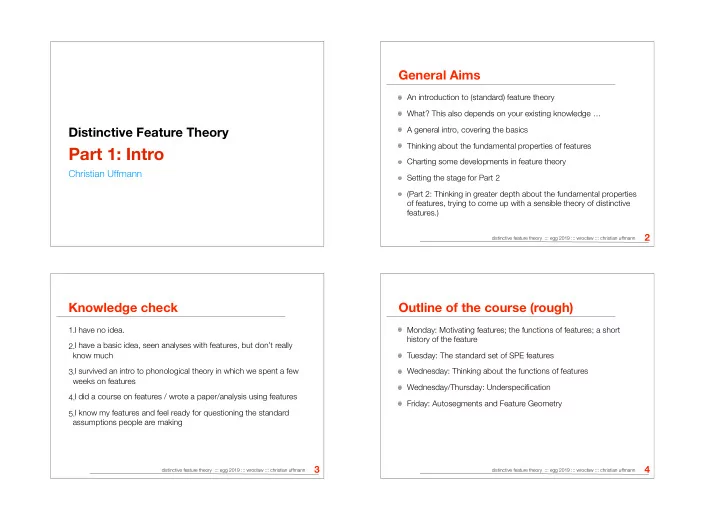
General Aims An introduction to (standard) feature theory What? This also depends on your existing knowledge Distinctive Feature Theory A general intro, covering the basics Thinking about the fundamental properties of features Part 1:


slide-1
SLIDE 1

Distinctive Feature Theory

Part 1: Intro

Christian Uffmann

distinctive feature theory ::: egg 2019 ::: wrocław ::: christian uffmann

General Aims

An introduction to (standard) feature theory What? This also depends on your existing knowledge … A general intro, covering the basics Thinking about the fundamental properties of features Charting some developments in feature theory Setting the stage for Part 2 (Part 2: Thinking in greater depth about the fundamental properties

  • f features, trying to come up with a sensible theory of distinctive

features.)

2

distinctive feature theory ::: egg 2019 ::: wrocław ::: christian uffmann

Knowledge check

1.I have no idea. 2.I have a basic idea, seen analyses with features, but don’t really know much 3.I survived an intro to phonological theory in which we spent a few weeks on features 4.I did a course on features / wrote a paper/analysis using features 5.I know my features and feel ready for questioning the standard assumptions people are making

3

distinctive feature theory ::: egg 2019 ::: wrocław ::: christian uffmann

Outline of the course (rough)

Monday: Motivating features; the functions of features; a short history of the feature Tuesday: The standard set of SPE features Wednesday: Thinking about the functions of features Wednesday/Thursday: Underspecification Friday: Autosegments and Feature Geometry

4

slide-2
SLIDE 2

distinctive feature theory ::: egg 2019 ::: wrocław ::: christian uffmann

Why features?

Structuralism: phoneme as smallest unit in phonology. Why not? Why assume smaller units? Two papers by Roman Jakobson in 1939 to motivate binary features. First paper: discussion of Turkish vowel harmony. Let’s recap main arguments and develop fundamental properties

  • f features from this point.

5

distinctive feature theory ::: egg 2019 ::: wrocław ::: christian uffmann

Turkish vowel harmony

Standard Turkish: 8 vowels
 /i, e, y, ø, ɨ, α, u, o/ And for now forget everything you ever knew about phonetics but let us look at the phonological behaviour of these vowels. Do vowels group into classes, defined by phonological activity? Handout!

6

distinctive feature theory ::: egg 2019 ::: wrocław ::: christian uffmann

Turkish vowel harmony

7

distinctive feature theory ::: egg 2019 ::: wrocław ::: christian uffmann

Turkish vowel harmony

8

slide-3
SLIDE 3

distinctive feature theory ::: egg 2019 ::: wrocław ::: christian uffmann

Turkish vowel harmony: summary

Phonological behaviour provides evidence for 3 features. Each of these features also has a phonetic ‘signature’. Each vowel is contrastively specified by these 3 features — every vowel is a unique combination of feature values. In order to specify 8 vowels contrastively, 3 features are sufficient — and only these features seem to be phonologically active.

9

distinctive feature theory ::: egg 2019 ::: wrocław ::: christian uffmann

Three functions of the feature

Classificatory: grouping segments into classes, characterised by the same phonological behaviour Descriptive: features are grounded in phonetics, they describe the segment in articulatory terms: We can think of a speech sound as a combination of feature specifications as phonetic instructions. Contrastive: features describe possible phoneme contrasts between sounds; phonetically, there is much more variation than can be described by features. Claim: this is irrelevant for phonological systems, which can be described as a finite (actually rather small) set of binary distinctions.

10

distinctive feature theory ::: egg 2019 ::: wrocław ::: christian uffmann

Phonetics and Phonology

The classificatory and descriptive functions of the feature provide a link between phonetics and phonology. Phonological classes are phonetically natural classes (really?).

(Not predicted: /p, l, g, i/ -> [s] / ___ /e, u, n/)

Offers a solution to the problem of how abstract symbolic representations are ‘translated’ into phonetics. (In structuralism, list of allophones associated with phonemes.)

11

distinctive feature theory ::: egg 2019 ::: wrocław ::: christian uffmann

A brief history

Next: a very brief history of the feature from Jakobson (1939) to the standard set of features in the Sound Pattern of English (SPE; Chomsky & Halle 1968). Different ideas and formalisations that were subsequently abandoned but still hang around, some making an occasional comeback. Useful to think about some of these alternatives.

12

slide-4
SLIDE 4

distinctive feature theory ::: egg 2019 ::: wrocław ::: christian uffmann

Trubetzkoy (1939)

Trubetzkoy provides a taxonomy of oppositions in his Grundzüge: privative: presence/absence of a property or feature, e.g. voicing. Also introduces idea of markedness — one member is unmarked. gradual: oppositions on a gradient phonetic scale, e.g. vowel height equipollent: opposition of two or more members that are logically equivalent, e.g. places or manners of articulation. Idea of Jakobson (1939ff): translate all these oppositions into binary

  • ppositions.

Zur Struktur des Phonems: binary features for vowels (Turkish) Classement phonologique des consonnes: French consonants

13

distinctive feature theory ::: egg 2019 ::: wrocław ::: christian uffmann

Towards Jakobson, Fant & Halle

Jakobson & Lotz (1949): first full analysis of a phoneme system in terms of distinctive features (French).

Uses 6 features in total, differently defined for vowels and consonants Assumes mix of articulatory and acoustic based features

Jakobson, Fant & Halle (1952) — Preliminaries: features are defined acoustically, by spectral properties

(e.g. oppositions acute-grave, compact-diffuse, strident-mellow …) Only phonemic oppositions are expressed by feature values — underspecification (wait …) Features are universal.

14

distinctive feature theory ::: egg 2019 ::: wrocław ::: christian uffmann

SPE

In the Sound Pattern of English, Chomsly & Halle propose a list of articulation-based features that is still used today (with minor adjustments). Motivation for shift to articulatory features: Lieberman’s (1967) Motor Theory of speech perception. Now: a quick overvierw of standard set of features, also highlighting areas of disagreement. (Sorry if a lot of this is familiar to you.)

15

distinctive feature theory ::: egg 2019 ::: wrocław ::: christian uffmann

Major Class Features

[±consonantal] Are you a consonant or a vowel/glide?

Note: Glottals count as [–cons] in SPE; are they?

[±sonorant] Sonorant or obstruent? [±approximant] Vowels and liquids vs nasals and obstruents

Do we need this feature?

[±syllabic] Designates syllable nuclei; made obsolescent
 by developments in suprasegmental phonology

16

slide-5
SLIDE 5

distinctive feature theory ::: egg 2019 ::: wrocław ::: christian uffmann

Major Class Features

17 [+consonantal] [–consonantal] [+sonorant] liquids, nasals vowels, glides [–sonorant]

  • bstruents

distinctive feature theory ::: egg 2019 ::: wrocław ::: christian uffmann

Major Class Features

18

distinctive feature theory ::: egg 2019 ::: wrocław ::: christian uffmann

Continuancy

One more manner feature to distinguish between major classes of sounds: [±continuant] Is the oral airstream continuous or blocked? Nasals thus count as [–cont]: oral airstream is blocked. For laterals the situation isn’t quite clear. Does phonology help? Mixed evidence for both classes, as argued by Mielke (2008): may be language-specific what counts as [+continuant]

19

distinctive feature theory ::: egg 2019 ::: wrocław ::: christian uffmann

Main classes of sounds

20 [+continuant] [–continuant] [+sonorant] liquids nasals [–sonorant] fricatives plosives

slide-6
SLIDE 6

distinctive feature theory ::: egg 2019 ::: wrocław ::: christian uffmann

More manner features

[±nasal] nasal vs. oral sounds [±lateral] [±strident] Strident sounds are characterised by 
 additional turbulence, noisiness [strident] distinguishes fricatives. Sibilants that often act as a natural class = [+strident] coronal sounds. Also distinguishes [f] from [ф], [χ] from [x] Proposal that affricates are [+strident] stops. Alternatively, feature [delayed release] specifically for affricates

21

distinctive feature theory ::: egg 2019 ::: wrocław ::: christian uffmann

Sonorant manners

22

distinctive feature theory ::: egg 2019 ::: wrocław ::: christian uffmann

Laryngeal features

[± voice]: voiced sounds are [+voice], voiceless sounds are [–voice] [± spread glottis]: aspirated sounds are [+spread glottis] [± constricted glottis]: glottal stops, ejectives, implosives are [+constricted glottis] Technically impossible: [+spread, +constricted] Rather short-lived: [±stiff vocal folds, ±slack vocal folds], replacing [±voice].

23

distinctive feature theory ::: egg 2019 ::: wrocław ::: christian uffmann

Laryngeal features

24

[p] [b] [ph] [bh] [p’] [ɓ] [voice] – + – + – + [spread g.] – – + + – – [constricted g.] – – – – + +

slide-7
SLIDE 7

distinctive feature theory ::: egg 2019 ::: wrocław ::: christian uffmann

Vowel features

[±round] Rounded vowels are [+round] [±back] Back vowels are [+back] [±high] and [±low] High vowels are [+high, –low]
 Mid vowels are [–high, –low]
 Low vowels are [–high, +low] [±ATR] = advanced tongue root:
 ‘tense’ vowels are [+ATR], ‘lax’ vowels are [–ATR]


25

distinctive feature theory ::: egg 2019 ::: wrocław ::: christian uffmann

Vowel features

26

distinctive feature theory ::: egg 2019 ::: wrocław ::: christian uffmann

Place features

Different developments make it harder to present a unified view. Start off with SPE type features Brief intro to present-day privative (unary) place features, possibly with discussion

27

distinctive feature theory ::: egg 2019 ::: wrocław ::: christian uffmann

Place features (SPE)

[±anterior] Sounds produced in the anterior part of the oral tract (labial to alveolar) are [+anterior], further back (postalveolar to pharyngeal) are [–anterior] [±labial] Labial sounds are [+labial] [±coronal] Sounds produced with the tongue blade (dental, alveolar, postalveolar, retroflex) are [+coronal].

28

slide-8
SLIDE 8

distinctive feature theory ::: egg 2019 ::: wrocław ::: christian uffmann

Place features

29 [+anterior] [–anterior] [+coronal] dental, alveolar postalveolar, retroflex [–coronal] labial palatal, velar, uvular

distinctive feature theory ::: egg 2019 ::: wrocław ::: christian uffmann

Further divisions

[±distributed] [+distributed] sounds are made with the tongue flat in the mouth, with broad contact; apical sounds are [–dist] Captures dental/alveolar and postalveolar/retroflex distinctions For consonants produced in the back of the mouth, vowel features are recycled. Palatals are [–back], velars/uvulars are [+back] Palatals/velars are [+high], uvulars are [–high] Pharyngeals are [+low]

30

distinctive feature theory ::: egg 2019 ::: wrocław ::: christian uffmann

Place features: matrix

31

[f] [θ] [s] [ʃ] [ç] [x] [χ] [labial] + – – – – – – [coronal] – + + + – – – [anterior] + + + – – – – [high] – – – + + + – [back] – – – – – + +

distinctive feature theory ::: egg 2019 ::: wrocław ::: christian uffmann

Privative place features

An alternative model assumes that each major articulator has one feature: [labial], [coronal], [dorsal] In addition, these features are privative (unary), rather than binary, that is, present or absent Evidence from phonology: labials behave as a natural class, non- labials never do [coronal] sounds can then be further subdivided by the features [±anterior] and [±distributed]. Wait until Relation between [dorsal] and [high, back, low]? Wait until Friday …


32

slide-9
SLIDE 9

distinctive feature theory ::: egg 2019 ::: wrocław ::: christian uffmann

Summary

SPE provides a list of features grounded in articulation that still form the basis of mainstream phonology. Features correspond to distinct articulatory gestures, and features are universal; idea of “universal phonetics”. One prediction: Same feature specifications across languages should result in similar (identical?) phonetic surface segments. Another prediction: the feature make-up of a segment can be read

  • ff the phonetic surface.

And another one: Phonological classes are phonetically natural

  • classes. Phonological alternations should be phonetically uniform.

33

distinctive feature theory ::: egg 2019 ::: wrocław ::: christian uffmann

Title

34