Parasismic verification of a building according to Eurocode 8 Make - - PowerPoint PPT Presentation

parasismic verification of a building according to
SMART_READER_LITE
LIVE PREVIEW

Parasismic verification of a building according to Eurocode 8 Make - - PowerPoint PPT Presentation

Parasismic verification of a building according to Eurocode 8 Make the seismic verification of the new building of the sport center located in Liege according to the Eurocode EN 1998-1 The building characteristics are: Rectangular building


slide-1
SLIDE 1

Parasismic verification of a building according to Eurocode 8

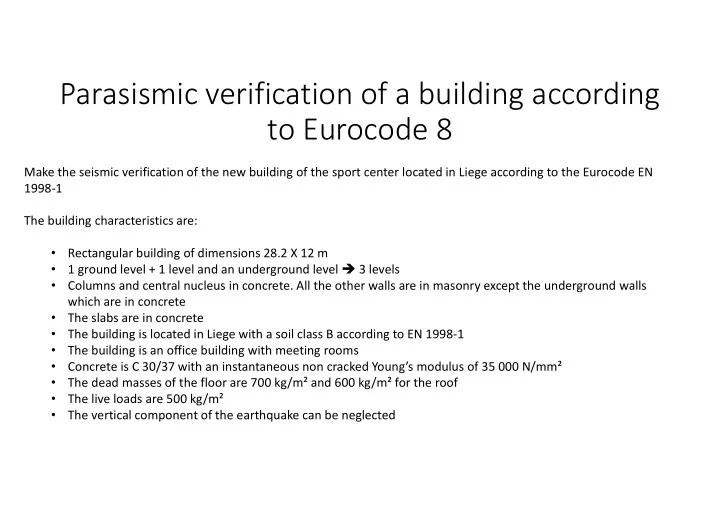
Make the seismic verification of the new building of the sport center located in Liege according to the Eurocode EN 1998-1 The building characteristics are:

  • Rectangular building of dimensions 28.2 X 12 m
  • 1 ground level + 1 level and an underground level  3 levels
  • Columns and central nucleus in concrete. All the other walls are in masonry except the underground walls

which are in concrete

  • The slabs are in concrete
  • The building is located in Liege with a soil class B according to EN 1998-1
  • The building is an office building with meeting rooms
  • Concrete is C 30/37 with an instantaneous non cracked Young’s modulus of 35 000 N/mm²
  • The dead masses of the floor are 700 kg/m² and 600 kg/m² for the roof
  • The live loads are 500 kg/m²
  • The vertical component of the earthquake can be neglected
slide-2
SLIDE 2

Plane view - underground

slide-3
SLIDE 3

Plane view – level 0

slide-4
SLIDE 4

Plane view – level 1

slide-5
SLIDE 5

Plane view – roof

slide-6
SLIDE 6

Elevation

slide-7
SLIDE 7

Elevation

slide-8
SLIDE 8

Facades

slide-9
SLIDE 9

Facades

slide-10
SLIDE 10
  • 1. Simplify the static scheme

Ask yourself the following questions:

  • In which direction do the earthquake loads act?
  • What are the resisting elements under earthquake ?
  • Do the columns sustain earthquakes loads ?
  • What are the flexible parts of the building ?
  • Which elements must be modelled ?
  • The masonry has a very small resistance to horizontal loads  no resistance
  • Make the simplest model to represent the structure behaviour under earthquake, minimise the dofs

Model the building with beam elements with only a few nodes, minimise the number of nodes

slide-11
SLIDE 11

Static scheme – which element sustains the horizontal loads ?

Only the concrete central core !

slide-12
SLIDE 12

Static scheme – improve the behaviour under horizontal loads

Big torsion in the central core. What can be done to reduce the torsion ?

slide-13
SLIDE 13

Static scheme – improve the behaviour under horizontal loads

To add a concrete wall at the opposite side to increase the lever arm

slide-14
SLIDE 14

Static scheme – underground level not taken into account

masonry concrte Very stiff In the soil  not taken into account

slide-15
SLIDE 15

Static scheme – plane view

510 x 200 Th = 20 510 x 20 25 m 3.3 m 12 m

Econcrete,cracked = Econcrete/2

slide-16
SLIDE 16

Static scheme – elevation view

1200 x 40 25 m 3.3 m 4 m 1200 x 40 5 m

Econcrete,cracked = Econcrete/2

slide-17
SLIDE 17

Static scheme – elevation view

1200 x 40 25 m 3.3 m 4 m 1200 x 40 5 m No effect on the horizontal stiffness  not modelled But masses to take into account  Mnode = m.l

slide-18
SLIDE 18

Static scheme – Masses

25 m 3.3 m 4 m 5 m

Masses = dead loads + 0.24 live loads 2 = 0.3 offices  = 0.8 Storeys with correlated occupancies

M = 600 kg/m² + 0.24 * 500 kg/m² = 720 kg/m² M = 700 kg/m² + 0.24 * 500 kg/m² = 820 kg/m²

slide-19
SLIDE 19
  • 2. Frequencies and eigen modes
  • Establish and Compute the stiffness matrix of the system
  • Establish and Compute the mass matrix of the system
  • Compute the eigen modes and the frequencies
  • Draw the deformed shape of the first 2 modes (by hand)
  • How many modes do you have ?
slide-20
SLIDE 20

Beam Stiffness Matrix

Matrix in the local axe of the element L : length A : section Iz : in-plane inertia Iy : out-of-plane inertia Ct: torsional stiffness

slide-21
SLIDE 21

Beam Static Characteristics

b h A = b.h I = b.h³ /12 J = h.b³ /3 b h A = b.h – (b-2.t).(h-2.t) I = b.h³ /12-(b-2.t).(h-2.t)³ /12 J =

. ∫

  • 𝑒𝑡 =

( .()) .

.

  • S = surface inside the red line

  • = length of the red line divided by the thickness

t

slide-22
SLIDE 22

Local axes  Global axes

Apply a rotation matrix

1 2 3 4 5 6 1 C S 2

  • S

C 3 1 4 C S 5

  • S

C 6 1

r = R = r r

Kglo = RT * Kloc * R

slide-23
SLIDE 23

6x6 6x6 6x6 6x6 6x6 6x6 6x6 6x6 6x6 6x6 6x6 6x6

Matrix assembly

1 1 3 2 2 4 3 K1= K2= K3=

1 2 3 4 1 6x6 6x6 2 6x6 6x6 6x6 3 6x6 6x6 4 6x6 6x6 6x6

NODES NODES

slide-24
SLIDE 24

Supports

1 2 4 3 NODES NODES

1 2 3 4 1 6x6 6x6 2 6x6 6x6 6x6 3 6x6 6x6 4 6x6 6x6 6x6

Suppress the dofs related to supported nodes

slide-25
SLIDE 25

Mass Matrix

1 2 3 4 5 6 7 8 9 10 11 12 1 m.L/2 2 m.L/2 3 m.L/2 4 5 6 7 m.L/2 8 m.L/2 9 m.L/2 10 11 12

m = mass by unit length L = length m,L x y Mloc  Mglo ; the same as the stiffness matrix Assembly of matrices; the same as the stiffness matrix

slide-26
SLIDE 26
  • 3. Modal properties
  • Compute the modal stiffness and mass of each mode
  • Compute the effective modal mass in both horizontal direction
  • Compute the modal share ratio for both horizontal direction
slide-27
SLIDE 27
  • 4. Parasismic calculation
  • Establish the design acceleration spectrum according to EN 1998-1

The building is located in Liege with a soil class B according EN 1998-1 The building is an office building with meeting rooms The q factor is taken equal to 1.5

  • Compute the response (displacements) of each mode in each direction
  • Compute the maximum response in each direction (SSRS) of the building top
  • Which modes govern the total seismic response for each direction ?
  • Compute the support forces
  • Combine the support forces in the X and Y direction
  • Find a linear combination of the modes to obtain concomitant value of support forces at the foot of the

central core 𝛽 =

  • 𝑥𝑗𝑢ℎ 𝑁 =

∑ 𝑁

  • 𝑁= ∑ 𝛽 . 𝑁
slide-28
SLIDE 28

Design Spectrum definition

According to EN 1998-1: chapter 3.2.2.5

slide-29
SLIDE 29

Design Spectrum definition

slide-30
SLIDE 30

Design Spectrum definition

ag = i*agr agr=0.1.g

slide-31
SLIDE 31

Design Spectrum definition

0,000 0,500 1,000 1,500 2,000 2,500 3,000 0,000 0,200 0,400 0,600 0,800 1,000 1,200 1,400 1,600 1,800 2,000

Sd (m/s²) T (s)

design Spectrum Response

Behaviour factor : q = 1.5