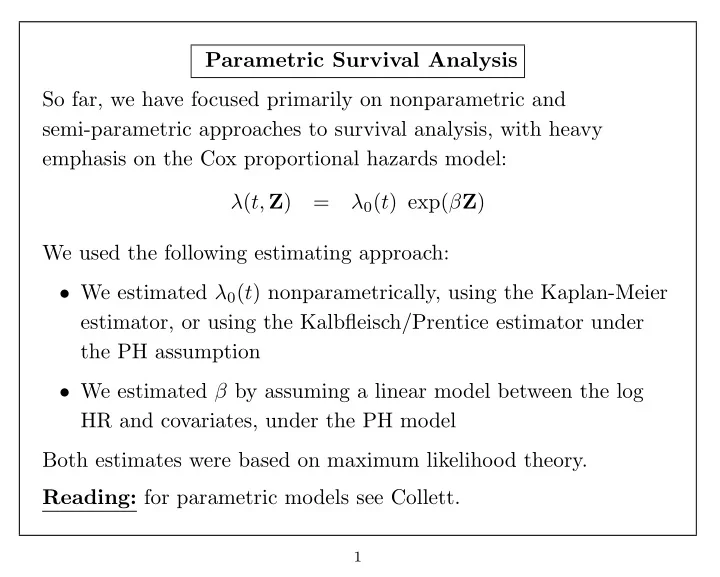
SLIDE 1 Parametric Survival Analysis So far, we have focused primarily on nonparametric and semi-parametric approaches to survival analysis, with heavy emphasis on the Cox proportional hazards model: λ(t, Z) = λ0(t) exp(βZ) We used the following estimating approach:
- We estimated λ0(t) nonparametrically, using the Kaplan-Meier
estimator, or using the Kalbfleisch/Prentice estimator under the PH assumption
- We estimated β by assuming a linear model between the log
HR and covariates, under the PH model Both estimates were based on maximum likelihood theory. Reading: for parametric models see Collett.
1
SLIDE 2 There are several reasons why we should consider some alternative approaches based on parametric models:
- The assumption of proportional hazards might not be
appropriate (based on major departures)
- If a parametric model actually holds, then we would probably
gain efficiency
- We may want to handle non-standard situations like
– interval censoring – incorporating population mortality
- We may want to make some connections with other familiar
approaches (e.g. use of the Poisson likelihood)
- We may want to obtain some estimates for use in designing a
future survival study.
2
SLIDE 3 A simple start: Exponential Regression
(Xi, δi, Zi) for individual i, Zi = (Zi1, Zi2, ..., Zip) represents a set of p covariates.
- Right censoring: Assume that Xi = min(Ti, Ui)
- Survival distribution: Assume Ti follows an exponential
distribution with a parameter λ that depends on Zi, say λi = Ψ(Zi). Then we can write: Ti ∼ exponential(Ψ(Zi))
3
SLIDE 4
First, let’s review some facts about the exponential distribution (from our first survival lecture): f(t) = λe−λt for t ≥ 0 S(t) = P(T ≥ t) = ∫ ∞
t
f(u)du = e−λt F(t) = P(T < t) = 1 − e−λt λ(t) = f(t) S(t) = λ constant hazard! Λ(t) = ∫ t λ(u) du = ∫ t λ du = λt
4
SLIDE 5 Now, we say that λ is a constant over time t, but we want to let it depend on the covariate values, so we are setting λi = Ψ(Zi) The hazard rate would therefore be the same for any two individuals with the same covariate values. Although there are many possible choices for Ψ, one simple and natural choice is: Ψ(Zi) = exp[β0 + Zi1β1 + Zi2β2 + ... + Zipβp] WHY?
- ensures a positive hazard
- for an individual with Z = 0, the hazard is eβ0.
The model is called exponential regression because of the natural generalization from regular linear regression
5
SLIDE 6 Exponential regression for the 2-sample case:
- Assume we have only a single covariate Z = Z,
i.e., (p = 1). Hazard Rate: Ψ(Zi) = exp(β0 + Ziβ1)
Zi = 0 if individual i is in group 0 Zi = 1 if individual i is in group 1
- What is the hazard for group 0?
- What is the hazard for group 1?
- What is the hazard ratio of group 1 to group 0?
- What is the interpretation of β1?
6
SLIDE 7 Likelihood for Exponential Model Under the assumption of right censored data, each person has one
- f two possible contributions to the likelihood:
(a) they have an event at Xi (δi = 1) ⇒ contribution is Li = S(Xi)
λ(Xi)
survive to Xi fail at Xi (b) they are censored at Xi (δi = 0) ⇒ contribution is Li = S(Xi)
survive to Xi
7
SLIDE 8 The likelihood is the product over all of the individuals: L = ∏
i
Li = ∏
i
( λe−λXi)δi
e−λXi)(1−δi)
censorings = ∏
i
λδi ( e−λXi)
8
SLIDE 9 Maximum Likelihood for Exponential How do we use the likelihood?
- first take the log
- then take the partial derivative with respect to β
- then set to zero and solve for
β
- this gives us the maximum likelihood estimators
9
SLIDE 10
The log-likelihood is: log L = log [∏
i
λδi ( e−λXi) ] = ∑
i
[δi log(λ) − λXi] = ∑
i
[δi log(λ)] − ∑
i
λXi For the case of exponential regression, we now substitute the hazard λ = Ψ(Zi) in the above log-likelihood: log L = ∑
i
[δi log(Ψ(Zi))] − ∑
i
Ψ(Zi)Xi (1)
10
SLIDE 11 General Form of Log-likelihood for Right Censored Data In general, whenever we have right censored data, the likelihood and corresponding log likelihood will have the following forms: L = ∏
i
[λi(Xi)]δi Si(Xi) log L = ∑
i
[δi log (λi(Xi))] − ∑
i
Λi(Xi) where
- λi(Xi) is the hazard for the individual i who fails at Xi
- Λi(Xi) is the cumulative hazard for an individual at their
failure or censoring time For example, see the derivation of the likelihood for a Cox model
- n p.11-18 of Lecture 4 notes. We started with the likelihood
above, then substituted the specific forms for λ(Xi) under the PH assumption.
11
SLIDE 12
Consider our model for the hazard rate: λ = Ψ(Zi) = exp[β0 + Zi1β1 + Zi2β2 + ... + Zipβp] We can write this using vector notation, as follows: Let Zi = (1, Zi1, ...Zip)T and β = (β0, β1, ...βp) (Since β0 is the intercept (i.e., the log hazard rate for the baseline group), we put a “1” as the first term in the vector Zi.) Then, we can write the hazard as: Ψ(Zi) = exp[βZi] Now we can substitute Ψ(Zi) = exp[βZi] in the log-likelihood shown in (1): log L =
n
∑
i=1
δi(βZi) −
n
∑
i=1
Xi exp(βZi)
12
SLIDE 13 Score Equations Taking the derivative with respect to β0, the score equation is: ∂ log L ∂β0 =
n
∑
i=1
[δi − Xi exp(βZi)] For βk, k = 1, ...p, the equations are: ∂ log L ∂βk =
n
∑
i=1
[δiZik − XiZik exp(βZi)] =
n
∑
i=1
Zik[δi − Xi exp(βZi)] To find the MLE’s, we set the above equations to 0 and solve (simultaneously). The equations above imply that the MLE’s are
- btained by setting the weighted number of failures (∑
i Zikδi)
equal to the weighted cumulative hazard (∑
i ZikΛ(Xi)). 13
SLIDE 14 To find the variance of the MLE’s, we need to take the second derivatives: − ∂2 log L ∂βk∂βj =
n
∑
i=1
ZikZijXi exp(βZi) Some algebra (see Cox and Oakes section 6.2) reveals that V ar( β) = I(β)−1 = [ Z(I − Π)ZT ]−1 where
- Z = (Z1, . . . , Zn) is a (p + 1) × n matrix
(p covariates plus the “1” for the intercept β0)
- Π = diag(π1, . . . , πn) (this means that Π is a diagonal matrix,
with the terms π1, . . . , πn on the diagonal)
14
SLIDE 15
- πi is the probability that the i-th person is censored, so
(1 − πi) is the probability that they failed.
- Note: The information I(β) (inverse of the variance) is
proportional to the number of failures, not the sample size. This will be important when we talk about study design.
15
SLIDE 16
The Single Sample Problem (Zi = 1 for everyone): First, what is the MLE of β0? We set ∂ log L
∂β0
= ∑n
i=1[δi − Xi exp(β0Zi)] equal to 0 and solve:
⇒
n
∑
i=1
δi =
n
∑
i=1
[Xi exp(β0)] d = exp(β0)
n
∑
i=1
Xi exp( β0) = d ∑n
i=1 Xi
ˆ λ = d t where d is the total number of deaths (or events), and t = ∑ Xi is the total person-time contributed by all individuals.
16
SLIDE 17
If d/t is the MLE for λ, what does this imply about the MLE of β0? Using the previous formula V ar(ˆ β) = [ Z(I − Π)ZT ]−1, what is the variance of β0?: With some matrix algebra, you can show that it is: V ar( β0) = 1 ∑n
i=1(1 − πi) = 1
d
17
SLIDE 18
What about ˆ λ = e ˆ
β0?
By the delta method, V ar(ˆ λ) = ˆ λ2 V ar( β0) = ?
18
SLIDE 19
The Two-Sample Problem: Zi Subjects Events Follow-up Group 0: Zi = 0 n0 d0 t0 = ∑n0
i=1 Xi
Group 1: Zi = 1 n1 d1 t1 = ∑n1
i=1 Xi 19
SLIDE 20
The log-likelihood: log L =
n
∑
i=1
δi(β0 + β1Zi) −
n
∑
i=1
Xi exp(β0 + β1Zi) so ∂ log L ∂β0 =
n
∑
i=1
[δi − Xi exp(β0 + β1Zi)] = (d0 + d1) − (t0eβ0 + t1eβ0+β1) ∂ log L ∂β1 =
n
∑
i=1
Zi[δi − Xi exp(β0 + β1Zi)] = d1 − t1eβ0+β1
20
SLIDE 21
This implies: ˆ λ1 = e
ˆ β0+ ˆ β1 =?
ˆ λ0 = e
ˆ β0 =?
ˆ β0 = ? ˆ β1 = ?
21
SLIDE 22
Important Result: The maximum likelihood estimates (MLE’s) of the hazard rates under the exponential model are the number of events divided by the person-years of follow-up! (this result will be relied on heavily when we discuss study design)
22
SLIDE 23 Exponential Regression: Means and Medians Mean Survival Time For the exponential distribution, E(T) = 1/λ.
T 0 = 1/ˆ λ0 = 1/ exp(ˆ β0)
T 1 = 1/ˆ λ1 = 1/ exp(ˆ β0 + ˆ β1)
23
SLIDE 24 Median Survival Time This is the value M at which S(t) = e−λt = 0.5, so M = median = − log(0.5)
λ
ˆ M0 = − log(0.5) ˆ λ0 = − log(0.5) exp(ˆ β0)
ˆ M1 = − log(0.5) ˆ λ1 = − log(0.5) exp(ˆ β0 + ˆ β1)
24
SLIDE 25
Exponential Regression: Variance Estimates and Test Statistics We can also calculate the variances of the MLE’s as simple functions of the number of failures: var(ˆ β0) = 1 d0 var(ˆ β1) = 1 d0 + 1 d1
25
SLIDE 26
So our test statistics are formed as: For testing Ho : β0 = 0: χ2
w
= ( ˆ β0 )2 var(ˆ β0) = [log(d0/t0)]2 1/d0 For testing Ho : β1 = 0: χ2
w
= ( ˆ β1 )2 var(ˆ β1) = [ log( d1/t1
d0/t0 )
]2
1 d0 + 1 d1
How would we form confidence intervals for the hazard ratio?
26
SLIDE 27
The Likelihood Ratio Test Statistic: (An alternative to the Wald test) A likelihood ratio test is based on 2 times the log of the ratio of the likelihoods under the null and alternative. We reject H0 if 2 log(LR) > χ2
1,0.05, where
LR = L(H1) L(H0) = L( λ0, λ1) L( λ)
27
SLIDE 28 For a sample of n independent exponential random variables with parameter λ, the Likelihood is: L =
n
∏
i=1
[λδi exp(−λxi)] = λd exp(−λ ∑ xi) = λd exp(−λn¯ x) where d is the number of deaths or failures. The log-likelihood is ℓ = d log(λ) − λn¯ x and the MLE is
x)
28
SLIDE 29
2-Sample Case: LR test calculations Data: Group 0: d0 failures among the n0 females mean failure time is ¯ x0 = (∑n0
i
Xi)/n0 Group 1: d1 failures among the n1 males mean failure time is ¯ x1 = (∑n1
i
Xi)/n1 Under the alternative hypothesis: L = λd1
1 exp(−λ1n1¯
x1) × λd0
0 exp(−λ0n0¯
x0) log(L) = d1 log(λ1) − λ1n1¯ x1 + d0 log(λ0) − λ0n0¯ x0
29
SLIDE 30 The MLE’s are:
= d1/(n1¯ x1) for males
= d0/(n0¯ x0) for females Under the null hypothesis: L = λd1+d0 exp[−λ(n1¯ x1 + n0¯ x0)] log(L) = (d1 + d0) log(λ) − λ[n1¯ x1 + n0¯ x0] The corresponding MLE is
x1 + n0¯ x0]
30
SLIDE 31
A likelihood ratio test can be constructed by taking twice the difference of the log-likelihoods under the alternative and the null hypotheses: −2 [ (d0 + d1) log (d0 + d1 t0 + t1 ) − d1 log[d1/t1] − d0 log[d0/t0] ]
31
SLIDE 32 Nursing home example: For the females:
- n0 = 1173
- d0 = 902
- t0 = 310754
- ¯
x0 = 265 For the males:
- n1 = 418
- d1 = 367
- t1 = 75457
- ¯
x1 = 181 Plugging these values in, we get a LR test statistic of 64.20.
32
SLIDE 33 Hand Calculations using events and follow-up: By adding up “los” for males to get t1 and for females to get t0, I
- btained:
- d0 = 902 (females)
d1 = 367 (males)
- t0 = 310754 (female follow-up)
t1 = 75457 (male follow-up)
- This yields an estimated log HR:
ˆ β1 = log [d1/t1 d0/t0 ] = log [ 367/75457 902/310754 ] = log(1.6756) = 0.5162
33
SLIDE 34
- The estimated standard error is:
√ var( ˆ β1) = √ 1 d1 + 1 d0 = √ 1 902 + 1 367 = 0.06192
- So the Wald test becomes:
χ2
W
= ˆ β2
1
var( ˆ β1) = (0.51619)2 0.061915 = 69.51
β0 = log(d0/t0) = −5.842, along with its standard error se(ˆ β0) = √ (1/d0) = 0.0333
34
SLIDE 35 Exponential Regression in STATA
. use nurshome . stset los fail . streg gender, dist(exp) nohr failure _d: fail analysis time _t: los Iteration 0: log likelihood = -3352.5765 Iteration 1: log likelihood =
Iteration 2: log likelihood = -3320.4792 Iteration 3: log likelihood = -3320.4766 Iteration 4: log likelihood = -3320.4766 Exponential regression -- log relative-hazard form
1591 Number of obs = 1591
1269 Time at risk = 386211 LR chi2(1) = 64.20 Log likelihood =
Prob > chi2 = 0.0000
Coef.
z P>|z| [95% Conf. Interval]
- --------|--------------------------------------------------------------
gender | .516186 .0619148 8.337 0.000 .3948352 .6375368 _cons |-5.842142 .0332964
0.000
- 5.907402
- 5.776883
- Since Z = 8.337, the chi-square test is Z2 = 69.51.
35
SLIDE 36
The Weibull Regression Model At the beginning of the course, we saw that the survivorship function for a Weibull random variable is: S(t) = exp[−λ(tκ)] and the hazard function is: λ(t) = κ λ t(κ−1) The Weibull regression model assumes that for someone with covariates Zi, the survivorship function is S(t; Zi) = exp[−Ψ(Zi)(tκ)] where Ψ(Zi) is defined as in exponential regression to be: Ψ(Zi) = exp[β0 + Zi1β1 + Zi2β2 + ...Zipβp] For the 2-sample problem, we have: Ψ(Zi) = exp[β0 + Zi1β1]
36
SLIDE 37 Weibull MLEs for the 2-sample problem: Log-likelihood: log L =
n
∑
i=1
δi log [ κ exp(β0 + β1Zi)Xκ−1
i
] −
n
∑
i=1
Xκ
i exp(β0 + β1Zi)
⇒ exp(ˆ β0) = d0/t0κ exp(ˆ β0 + ˆ β1) = d1/t1κ where tjκ =
nj
∑
i=1
X ˆ
κ i
among nj subjects ˆ λ0(t) = ˆ κ exp(ˆ β0) tˆ
κ−1 ˆ
λ1(t) = ˆ κ exp(ˆ β0 + ˆ β1) tˆ
κ−1
= ˆ λ1(t)/ˆ λ0(t) = exp(ˆ β1) = exp (d1/t1κ d0/t0κ )
37
SLIDE 38 Weibull Regression: Means and Medians Mean Survival Time For the Weibull distribution, E(T) = λ(−1/κ)Γ[(1/κ) + 1].
T 0 = ˆ λ(−1/ˆ
κ)
Γ[(1/ˆ κ) + 1]
T 1 = ˆ λ(−1/ˆ
κ) 1
Γ[(1/ˆ κ) + 1]
38
SLIDE 39 Median Survival Time For the Weibull distribution, M = median = [
− log(0.5) λ
]1/κ
ˆ M0 = [− log(0.5) ˆ λ0 ]1/ˆ
κ
ˆ M1 = [− log(0.5) ˆ λ1 ]1/ˆ
κ
where ˆ λ0 = exp(ˆ β0) and ˆ λ1 = exp(ˆ β0 + ˆ β1).
39
SLIDE 40 Note: the symbol Γ is the “gamma” function. If x is an integer, then Γ(x) = (x − 1)! In cases where x is not an integer, this function has to be evaluated
- numerically. In homework and labs, I will supply this value to you.
The Weibull regression model is very easy to fit:
- In stata: Just specify dist(weibull) instead
- f dist(exp) within the streg command
- In sas: use model option dist=weibull within the proc lifereg
procedure Note: to get more information on these modeling procedures, use the
- nline help facilities. For example, in Stata, you can type:
.help streg
40
SLIDE 41 Weibull in Stata:
. streg gender, dist(weibull) nohr failure _d: fail analysis time _t: los Fitting constant-only model: Iteration 0: log likelihood = -3352.5765 Iteration 1: log likelihood =
Iteration 2: log likelihood = -3066.1526 Iteration 3: log likelihood =
Iteration 4: log likelihood =
Fitting full model: Iteration 0: log likelihood =
Iteration 1: log likelihood = -3045.8152 Iteration 2: log likelihood = -3045.2772 Iteration 3: log likelihood = -3045.2768 Iteration 4: log likelihood = -3045.2768 41
SLIDE 42 Weibull regression -- log relative-hazard form
1591 Number of obs = 1591
1269 Time at risk = 386211 LR chi2(1) = 41.73 Log likelihood =
Prob > chi2 = 0.0000
Coef.
z P>|z| [95% Conf. Interval]
- --------+--------------------------------------------------------------
gender | .4138082 .0621021 6.663 0.000 .2920903 .5355261 _cons |
.0891809
0.000 -3.711773
- 3.362191
- --------+--------------------------------------------------------------
/ln_p |
.0232089
0.00
.614439 .0142605 .5871152 .6430345 1/p | 1.627501 .0377726 1.555127 1.703243
SLIDE 43 Comparison of Exponential with Kaplan-Meier We can see how well the Exponential model fits by comparing the survival estimates for males and females under the exponential model, i.e., P(T ≥ t) = e(−ˆ
λzt), to the Kaplan-Meier survival
estimates:
S u r v i v a l 0.0 0.1 0.2 0.3 0.4 0.5 0.6 0.7 0.8 0.9 1.0 Length of Stay (days) 100 200 300 400 500 600 700 800 900 1000 1100
43
SLIDE 44 Comparison of Weibull with Kaplan-Meier We can see how well the Weibull model fits by comparing the survival estimates, P(T ≥ t) = e(−ˆ
λztˆ
κ), to the Kaplan-Meier
survival estimates.
S u r v i v a l 0.0 0.1 0.2 0.3 0.4 0.5 0.6 0.7 0.8 0.9 1.0 Length of Stay (days) 100 200 300 400 500 600 700 800 900 1000 1100
Which do you think fits best?
44
SLIDE 45 Other useful plots for evaluating fit to exponential and Weibull models
S(t)) vs t
S(t))] vs log(t) Why are these useful? If T is exponential, then S(t) = exp(−λt)) so log(S(t)) = −λt and Λ(t) = λ t a straight line in t with slope λ and intercept=0
45
SLIDE 46
If T is Weibull, then S(t) = exp(−(λt)κ) so log(S(t)) = −λtκ then Λ(t) = λtκ and log(− log(S(t))) = log(λ) + κ ∗ log(t) a straight line in log(t) with slope κ and intercept log(λ).
46
SLIDE 47 So we can calculate our estimated Λ(t) and plot it versus t, and if it seems to form a straight line, then the exponential distribution is probably appropriate for our dataset. Plots for nursing home data: ˆ Λ(t) vs t
Negative Log SDF 0.0 0.2 0.4 0.6 0.8 1.0 1.2 1.4 1.6 1.8 2.0 LOS 100 200 300 400 500 600 700 800 900 1000 1100 1200
47
SLIDE 48 Or we can plot log ˆ Λ(t) versus log(t), and if it seems to form a straight line, then the Weibull distribution is probably appropriate for our dataset. Plots for nursing home data: log[−log( ˆ S(t))] vs log(t)
Log Negative Log SDF
0.0 0.1 0.2 0.3 0.4 0.5 0.6 0.7 Log of LOS 4.50 4.75 5.00 5.25 5.50 5.75 6.00 6.25 6.50 6.75 7.00 7.25
48
SLIDE 49
Comparison of Methods for the Two-sample problem: Data: Zi Subjects Events Follow-up Group 0: Zi = 0 n0 d0 t0 = ∑n0
i=1 Xi
Group 1: Zi = 1 n1 d1 t1 = ∑n1
i=1 Xi
In General: λz(t) = λ(t, Z = z) for z = 0 or 1. The hazard rate depends on the value of the covariate Z. In this case, we are assuming that we only have a single covariate, and it is binary (Z = 1 or Z = 0)
49
SLIDE 50
Reading from Collett: Section(s) Description 4.1.1, 4.1.2 Exponential properties 4.1.3 Weibull properties 4.3.1, 4.4.2 Exponential ML estimation 4.3.2 Weibull ML estimation 4.5 General Weibull regression 4.6 Model selection - Weibull regression 4.7 Weibull/AFT model connection Ch.6 AFT - Other parametric models
50
SLIDE 51
MODELS Exponential Regression: λz(t) = exp(β0 + β1Z) ⇒ λ0 = exp(β0) λ1 = exp(β0 + β1) HR = exp(β1)
51
SLIDE 52
Weibull Regression: λz(t) = κ exp(β0 + β1Z) tκ−1 ⇒ λ0 = κ exp(β0) tκ−1 λ1 = κ exp(β0 + β1) tκ−1 HR = exp(β1) Proportional Hazards Model: λz(t) = λ0(t) exp(β1) ⇒ λ0 = λ0(t) KM? λ1 = λ0(t) exp(β1) HR = exp(β1)
52
SLIDE 53 Remarks
- Exponential model is a special case of the Weibull model with
κ = 1 (note: Collett uses γ instead of κ)
- Exponential and Weibull models are both special cases of the
Cox PH model. How can you show this?
- If either the exponential model or the Weibull model is valid,
then these models will tend to be more efficient than PH (smaller s.e.’s of estimates). This is because they assume a particular form for λ0(t), rather than estimating it at every death time.
53
SLIDE 54 For the Exponential model, the hazards are constant over time, given the value of the covariate Zi: Zi = 0 ⇒ ˆ λ0 = exp(ˆ β0) Zi = 1 ⇒ ˆ λ0 = exp(ˆ β0 + ˆ β1) For the Weibull model, we have to estimate the hazard as a function of time, given the estimates of β0, β1 and κ: Zi = 0 ⇒ ˆ λ0(t) = ˆ κ exp(ˆ β0) tˆ
κ−1
Zi = 1 ⇒ ˆ λ1(t) = ˆ κ exp(ˆ β0 + ˆ β1) tˆ
κ−1
However, the ratio of the hazards is still just exp(ˆ β1), since the
54
SLIDE 55
Here’s what the estimated hazards look like for the nursing home data:
Exponential Hazard: Female Exponential Hazard: Male Weibull Hazard: Female Weibull Hazard: Male H a z a r d R a t e 0.000 0.005 0.010 0.015 0.020 0.025 0.030 Length of stay (days) 100 200 300 400 500 600 700 800 900 1000
55
SLIDE 56
Proportional Hazards Model: To get the MLE’s for this model, we have to maximize the Cox partial likelihood iteratively. There are not closed form expressions like above. L(β) =
n
∏
i=1
[ eβZi ∑
ℓ∈R(Xi) eβZℓ
]δi =
n
∏
i=1
[ eβ0+β1Zi ∑
ℓ∈R(Xi) eβ0+β1Zℓ
]δi
56
SLIDE 57 Comparison with Proportional Hazards Model
. stcox gender, nohr failure _d: fail analysis time _t: los Iteration 0: log likelihood = -8556.5713 Iteration 1: log likelihood = -8537.8013 Iteration 2: log likelihood = -8537.5605 Iteration 3: log likelihood = -8537.5604 Refining estimates: Iteration 0: log likelihood = -8537.5604 Cox regression -- Breslow method for ties
1591 Number of obs = 1591
1269 Time at risk = 386211 LR chi2(1) = 38.02 Log likelihood =
Prob > chi2 = 0.0000
_d | Coef.
z P>|z| [95% Conf. Interval]
- --------+-------------------------------------------------------------
gender | .3943588 .0621004 6.350 0.000 .2726441 .5160734
β1 = 0.394 and HR = e0.394 = 1.483.
57
SLIDE 58 Comparison with the Logrank and Wilcoxon Tests
. sts test gender failure _d: fail analysis time _t: los Log-rank test for equality of survivor functions
Events gender |
expected
- ------+-------------------------
| 902 995.40 1 | 367 273.60
- ------+-------------------------
Total | 1269 1269.00 chi2(1) = 41.08 Pr>chi2 = 0.0000 58
SLIDE 59 . sts test gender, wilcoxon failure _d: fail analysis time _t: los Wilcoxon (Breslow) test for equality of survivor functions
Events Sum of gender |
expected ranks
- ------+--------------------------------------
| 902 995.40
1 | 367 273.60 99257
- ------+--------------------------------------
Total | 1269 1269.00 chi2(1) = 41.47 Pr>chi2 = 0.0000 59
SLIDE 60
Comparison of Hazard Ratios and Test Statistics for effect of Gender
Wald Model/Method λ0 λ1 HR log(HR) se(log HR) Statistic Exponential 0.0029 0.0049 1.676 0.5162 0.0619 69.507 Weibull t = 50 0.0040 0.0060 1.513 0.4138 0.0636 42.381 t = 100 0.0030 0.0046 1.513 t = 500 0.0016 0.0025 1.513 Logrank 41.085 Wilcoxon 41.468 Cox PH Ties=Breslow 1.483 0.3944 0.0621 40.327 Ties=Discrete 1.487 0.3969 0.0623 40.565 Ties=Efron 1.486 0.3958 0.0621 40.616 Ties=Exact 1.486 0.3958 0.0621 40.617 Score (Discrete) 41.085 60
SLIDE 61
Comparison of Mean and Median Survival Times by Gender
Mean Survival Median Survival Model/Method Female Male Female Male Exponential 344.5 205.6 238.8 142.5 Weibull 461.6 235.4 174.2 88.8 Kaplan-Meier 318.6 200.7 144 70 Cox PH 131 72 (Kalbfleisch/Prentice)
61
SLIDE 62 The Accelerated Failure Time Model The general form of an accelerated failure time (AFT) model is: log(Ti) = βAF T Zi + σϵ where
- log(Ti) is the log of a survival time
- βAF T is the vector of AFT model parameters corresponding to
the covariate vector Zi
- ϵ is a random “error” term
- σ is a scale factor
In other words, we can model the log-survival times as a linear function of the covariates! The streg command in stata (without the exponential or weibull
- ption) uses this “log-linear” model for fitting parametric models.
62
SLIDE 63 By choosing different distributions for ϵ, we can obtain different parametric distributions:
- Exponential
- Weibull
- Gamma
- Log-logistic
- Normal
- Lognormal
We can compare the predicted survival under any of these parametric distributions to the KM estimated survival to see which
Once we decide on a certain class of model (say, Gamma), we can evaluate the contributions of covariates by finding the MLE’s, and constructing Wald, Score, or LR tests of the covariate effects.
63
SLIDE 64 We can motivate the AFT model by first demonstrating the following two relationships:
- 1. For the Exponential Model:
If the failure times Ti = T(Zi) follow an exponential distribution, i.e., Si(t) = e−λit with λi = exp(βZi), then log(Ti) = −βZi + ϵ where ϵ follows an extreme value distribution (which just means that eϵ follows a unit exponential distribution).
64
SLIDE 65
- 2. For the Weibull Model:
If the failure times Ti = T(Zi) follow a Weibull distribution, i.e., Si(t) = eλitκ with λi = exp(βZi), then log(Ti) = −σβZi + σϵ where ϵ again follows an extreme value distribution, and σ = 1/κ. In other words, both the Exponential and Weibull model can be written in the form of a log-linear model for the survival times, if we choose the right distribution for ϵ.
65
SLIDE 66
The log-linear form for the exponential can be derived by: (1) Creating a new variable T0 = TZ × exp(βZi) (2) Taking the log of TZ, yielding log(TZ) = log (
T0 exp(βZi)
) Step (1): For an exponential model, recall that: Si(t) = Pr(TZ ≥ t) = e−λt, with λ = exp(βZi) It follows that T0 ∼ exp(1): S0(t) = Pr(T0 ≥ t) = Pr(TZ · exp(βZ) ≥ t) = Pr(TZ ≥ t exp(−βZ)) = exp [−λ t exp(−βZ)] = exp [− exp(βZ) t exp(−βZ)] = exp(−t)
66
SLIDE 67
Step (2): Now take the log of the survival time: log(TZ) = log ( T0 exp(βZi) ) = log(T0) − log (exp(βZi)) = −βZi + log(T0) = −βZi + ϵ where ϵ = log(T0) follows the extreme value distribution.
67
SLIDE 68
Relationship between Exponential and Weibull If TZ has a Weibull distribution, i.e., S(t) = e−λtκ with λ = exp(βZi), then you can show that the new variable T ∗
Z = T κ Z
follows an exponential distribution with parameter exp(βZi). Based on the previous page, we can therefore write: log(T ∗) = −βZ + ϵ (where ϵ has an extreme value distribution.)
68
SLIDE 69
But since log(T ∗) = log(T κ) = κ × log(T), we can write: log(T) = log(T ∗)/κ = (1/κ) (−βZi + ϵ) = −σβZi + σϵ where σ = 1/κ.
69
SLIDE 70
This motivates the following general definition of the Accelerated Failure Time Model by: log(Ti) = βAF T Zi + σϵ where ϵ is a random “error” term, σ is a scale factor, Y is the log of a survival random variable, and βAF T = −σβe where βe came from the hazard λ = exp(βZ).
70
SLIDE 71
The defining feature of an AFT model is: S(t; Z) = Si(t) = S0(ϕ t) That is, the effect of covariates is to accelerate (stretch) or decelerate (shrink) the time-scale. Effect of AFT on hazard: λi(t) = ϕ λ0(ϕt)
71
SLIDE 72 One way to interpret the AFT model is via its effect on median survival times. If Si(t) = 0.5, then S0(ϕt) = 0.5. This means: Mi = ϕM0 Interpretation:
- For ϕ < 1, there is an acceleration of the endpoint
(if M0 = 2yrs in control and ϕ = 0.5, then Mi = 1yr.
- For ϕ > 1, there is a stretching or delay in endpoint
- In general, the lifetime of individual i is ϕ times what they
would have experienced in the reference group Since ϕ must be positive and a function of the covariates, we model ϕ = exp(βZi).
72
SLIDE 73
When does Proportional hazards = AFT? According to the proportional hazards model: S(t) = S0(t)exp(βZi) and according to the accelerated failure time model: S(t) = S0(t exp(βZi)) Say Ti ∼ Weibull(λ, κ). Then λ(t) = λκt(κ−1)
73
SLIDE 74
Under the AFT model: λi(t) = ϕ λ0(ϕt) = eβZi λ0(eβZit) = eβZi λ0κ ( eβZit )(κ−1) = ( eβZi)κ λ0κt(κ−1) = ( eβZi)κ λ0(t) But this looks just like the PH model: λi(t) = exp(β∗Zi) λ0(t) It turns out that the Weibull distribution (and exponential, since this is just a special case of a Weibull with κ = 1) is the only one for which the accelerated failure time and proportional hazards models coincide.
74
SLIDE 75 Special cases of AFT models
- Exponential regression: σ = 1, ϵ following the extreme value
distribution.
- Weibull regression: σ arbitrary, ϵ following the extreme value
distribution.
- Lognormal regression: σ arbitrary, ϵ following the normal
distribution.
75
SLIDE 76 Examples in stata: Using the streg command, one has the following options of distributions for the log-survival times: . streg trt, dist(lognormal)
- exponential
- weibull
- gompertz
- lognormal
- loglogistic
- gamma
76
SLIDE 77 . streg gender, dist(exponential) nohr
Coef.
z P>|z| [95% Conf. Interval]
- --------+--------------------------------------------------------------------
gender | .516186 .0619148 8.337 0.000 .3948352 .6375368
- . streg gender, dist(weibull) nohr
- _t |
Coef.
z P>|z| [95% Conf. Interval]
- --------+--------------------------------------------------------------------
gender | .4138082 .0621021 6.663 0.000 .2920903 .5355261 1/p | 1.627501 .0377726 1.555127 1.703243
- . streg gender, dist(lognormal)
- _t |
Coef.
z P>|z| [95% Conf. Interval]
- --------+--------------------------------------------------------------------
gender |
.1127352
0.000
_cons | 4.957636 .0588939 84.179 0.000 4.842206 5.073066 sigma | 1.94718 .040584 1.86924 2.028371
SLIDE 78 . streg gender, dist(gamma)
Coef.
z P>|z| [95% Conf. Interval]
- --------+--------------------------------------------------------------------
gender |
.1147116
0.000
_cons | 4.788114 .1020906 46.901 0.000 4.58802 4.988208 sigma | 1.97998 .0429379 1.897586 2.065951
- This gives a good idea of the sensitivity of the test of gender to the
choice of model. It is also easy to get predicted survival curves under any of the parametric models using the following: . streg gender, dist(gamma) . stcurv, survival The options hazard and cumhaz can also be substituted for survival above to obtain plots.
78