
SLIDE 1
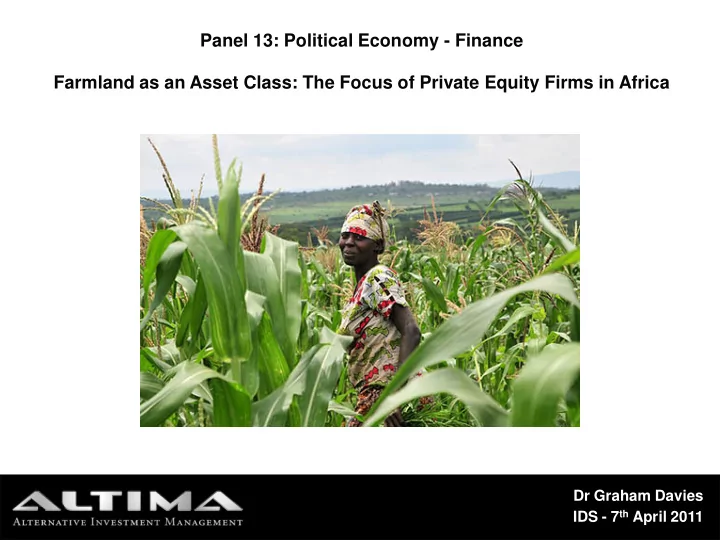
Panel 13: Political Economy - Finance Farmland as an Asset Class: - - PowerPoint PPT Presentation
Panel 13: Political Economy - Finance Farmland as an Asset Class: The Focus of Private Equity Firms in Africa Dr Graham Davies IDS - 7 th April 2011 Disclaimer THIS DOCUMENT IS NOT AN OFFER FOR SECURITIES OR INTERESTS IN ANY PROPOSED INVESTMENT
2 THIS DOCUMENT IS NOT AN OFFER FOR SECURITIES OR INTERESTS IN ANY PROPOSED INVESTMENT SCHEME DISCUSSED HEREIN. ANY INVESTMENT IN SUCH A SCHEME WILL BE SOLELY ON THE TERMS OF FINAL DOCUMENTATION MADE AVAILABLE IN DUE COURSE AND NOT ON THE TERMS HEREOF.
The information contained in this document is being communicated by Altima Partners LLP and Altima Securities L.P. (the “Manager” or “Altima”). The draft indicative terms and other information included in this document are provided for discussion purposes only, for the purpose of undertaking market research to establish potential interest in the concepts described herein, and are subject to updating, completion, further verification and/or amendment. No representation is being made that any potential investment opportunity will arise or that it will be profitable. No reliance may be placed for any purpose on the information and opinions contained in this document or their accuracy or completeness. This document refers to proposed future events or circumstances which have not at the date of this document occurred and which may not occur. The underlying information contained herein has not been verified by the Manager, which undertakes no obligation to update or amend or correct any inaccuracies herein. The Manager shall not owe any duties or responsibilities in connection with this document to any person. No representation, warranty, or other assurance, expressed or implied, is or will be made in relation to information provided and no responsibility or liability is or will be accepted for the accuracy or sufficiency of any of the information or opinions, or for any errors, omissions or misstatements in or supplied with this document or subsequently in connection with this document. No responsibility or liability is or will be accepted by the Manager, any fund entity or any of their respective directors, partners, employees or advisers, for any loss or damage directly or indirectly sustained from any action undertaken as a result of any person relying on the information provided herein. Any reproduction or distribution of this document in whole or in part, or the divulgence of any of its contents without the prior written consent of the Manager is prohibited. By receiving this document, the recipient agrees and acknowledges that this document and its contents are confidential and it must not be distributed, published, or reproduced in whole or in part or disclosed by recipients to any other person. It is the responsibility of every person reading this document to satisfy himself as to the full observance of the laws of any relevant country, including obtaining any government or other consent which may be required or observing any other formality which needs to be observed in that country. This document does not constitute (and may not be used for the purpose of) an offer or solicitation in any state of the United States of America or in any other jurisdiction in which such an offer or solicitation is not authorised or in which the person making such offer or solicitation is not qualified to do so or to any person to whom it is unlawful to make such an offer or solicitation. An offer to sell interests in the Fund can only be made in an offering memorandum or private placement memorandum for such entity. Potential investors must review the final offering memorandum or private placement memorandum for the terms and conditions of the offering, which may differ from the information contained in this document. The Interests have not been recommended by any US Federal or State Securities Commission or Regulatory Authority. Furthermore, the foregoing authorities have not confirmed the accuracy or determined the adequacy of these materials. Any representation to the contrary is unlawful. The interests described in these materials have not been, and will not be, registered under the U.S. Securities Act of 1933, as amended, (the “Securities Act”) or any state or other securities laws, and will be
securities laws. The Partnership will not be registered as an investment company under the U.S. Investment Company Act of 1940, as amended, (the “Investment Company Act”) and interests will only be offered and sold to certain “qualified purchasers” (as defined in the Investment Company Act). Accordingly, investors will not have the protections of the Investment Company Act. This document includes forward-looking statements, which involve risks and uncertainties. These forward-looking statements include all matters that are not historical facts, including, without limitation, those regarding the Fund’s financial position, business strategy, plans and objectives of management for future operations or statements relating to expectations in relation to investor returns, or distributions. These statements can be identified by the use of forward-looking terminology, including the terms “estimates”, “targets”, “believes”, “expects”, “aims”, “intends”, “plans”, “will”, “may”, “anticipates”, “would”, “could”, “should”, or similar expressions or the negative thereof. These forward looking statements are based on numerous assumptions regarding the Fund’s future business strategies and the environment in which the Fund will operate in the future. While the Manager believes that these assumptions are reasonable, it is difficult to predict the impact of known factors, and impossible to anticipate all factors that could affect the Fund’s actual results. All forward-looking statements speak only as of the date of this document. The Manager expressly disclaims any obligation or undertaking to disseminate any updates or revisions to any forward-looking statements contained herein to reflect any change in the Fund’s expectations with regard thereto, any new information or any change in events, conditions or circumstances on which any such statements are based, unless required to do so by law or any appropriate regulatory authority. References herein to $ or dollars are to United States dollars.
March, 2011.
3
Strictly Private & Confidential
4 Strictly Private & Confidential
Source: WSJ (2010)
5 Strictly Private & Confidential
6 Strictly Private & Confidential
Note: Increasing pressure on these figures from investors has seen moves down towards 1.5 & 15
7
8
* Agribusiness investments can, and do, involve the acquisition of land resources.
+ Based on NCEIF data of US Farmland appreciation over the long-term.
9
10
IFAD - Nwanze 2010).
11 Strictly Private & Confidential
Land PRODUCTION FACTORS Water Infrastructure & Equip Labour Inputs MANAGEMENT Production and Management SUPPORT & EXTENSION
STORAGE PROCESSING AND LOGISTICS
LOGISTICS MARKET MARKET MARKETING FINANCE FINANCE
COMMON AREAS OF BLOCKAGE OR FAILURE
1
Land rights are often ill- defined and insecure.
1
Equipment is often unavailable or expensive.
2
2 3
3
Inputs are often late and expensive.
4
4
Farmer support is often unreliable and misleading.
5
5
Production techniques are
inefficient.
7
7
Markets are often distant and unpredictable.
8
8
Pre-season finance is often unavailable to smallholders,
6
Storage often lacking. Processing opportunities
expensive.
6
Common areas of blockage
Common areas of blockage
AGRI- ENABLE capital AGRI- ENABLE capital Lead Farmer focus Lead Farmer focus Guaranteed local offtake at viable prices Guaranteed local offtake at viable prices Mills & Storage Mills and storage in proximity CFU & MACO CFU & MACO Formal recognition
Formal recognition
Tillage services Tillage services Provision of seed, fert, spray Provision of seed, fert, spray on time
AGRI-ENABLE supporting activities.
12 Strictly Private & Confidential
13 Strictly Private & Confidential