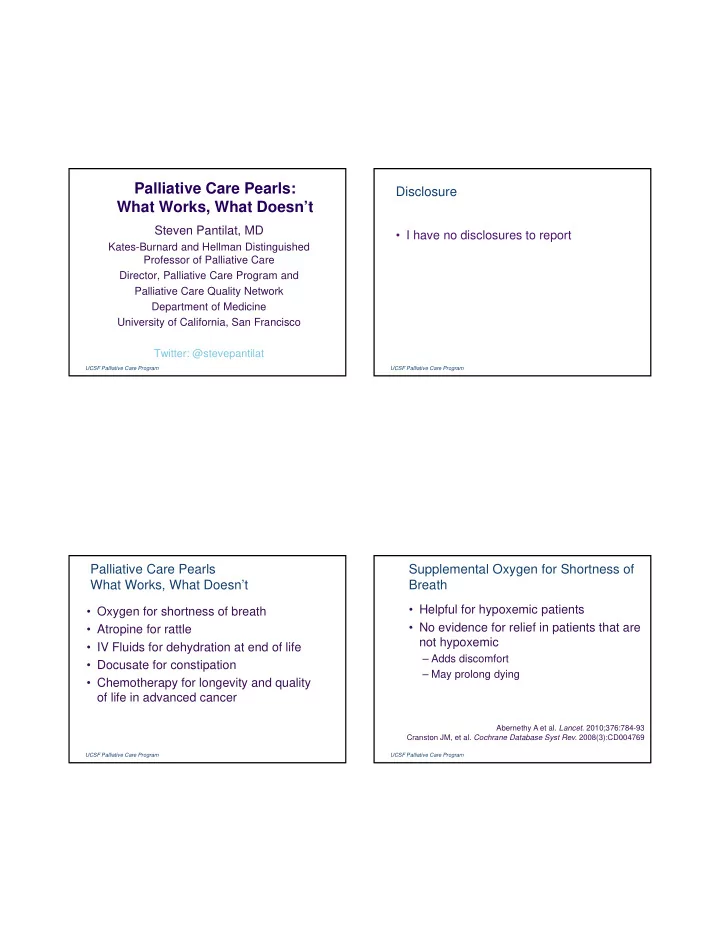
Palliative Care Pearls: Disclosure What Works, What Doesnt Steven - - PDF document

palliative care pearls
SMART_READER_LITE
LIVE PREVIEW

Palliative Care Pearls: Disclosure What Works, What Doesnt Steven - - PDF document

Palliative Care Pearls: Disclosure What Works, What Doesnt Steven Pantilat, MD I have no disclosures to report Kates-Burnard and Hellman Distinguished Professor of Palliative Care Director, Palliative Care Program and Palliative Care


slide-1
SLIDE 1

UCSF Palliative Care Program

Palliative Care Pearls: What Works, What Doesn’t

Steven Pantilat, MD

Kates-Burnard and Hellman Distinguished Professor of Palliative Care Director, Palliative Care Program and Palliative Care Quality Network Department of Medicine University of California, San Francisco Twitter: @stevepantilat

UCSF Palliative Care Program

Disclosure

  • I have no disclosures to report

UCSF Palliative Care Program

Palliative Care Pearls What Works, What Doesn’t

  • Oxygen for shortness of breath
  • Atropine for rattle
  • IV Fluids for dehydration at end of life
  • Docusate for constipation
  • Chemotherapy for longevity and quality
  • f life in advanced cancer

UCSF Palliative Care Program

Supplemental Oxygen for Shortness of Breath

  • Helpful for hypoxemic patients
  • No evidence for relief in patients that are

not hypoxemic

– Adds discomfort – May prolong dying

Abernethy A et al. Lancet. 2010;376:784-93 Cranston JM, et al. Cochrane Database Syst Rev. 2008(3):CD004769

slide-2
SLIDE 2

UCSF Palliative Care Program

Treatment of Shortness of Breath

  • Treat the underlying cause

– Pleural effusion, PE, pna, ascites

  • Opioids work in all cases

– Low dose: morphine 2mg po q3hrs prn – Safe even in COPD

  • Sitting upright
  • Fan and/or fresh air
  • Cold cloth to face

Ekstrom M et al. Ann Am Thoracic Soc. 2015; Bausewein C, et al. Cochrane Database Syst Rev. 2008(2):CD005623

UCSF Palliative Care Program

Palliative Care Pearls What Works, What Doesn’t

  • Oxygen for shortness of breath: only if

hypoxemic

  • Atropine for rattle
  • IV Fluids for dehydration at end of life
  • Docusate for constipation
  • Chemotherapy for longevity and quality
  • f life in advanced cancer

UCSF Palliative Care Program

Treatment of (Death) Rattle

  • Distressing sound in people near end of life

– Likely not distressing to patient

  • Poor prognostic sign

– 57 ± 82 hrs (23 hrs median survival)

  • Atropine sublingual does not reduce rattle

– Neither do any other meds

  • Turn patient
  • Limit IVF

Heisler et al. JPSM. 2013;45(1):14-22 Lokker et al. JPSM. 2014;47(1):105-122

UCSF Palliative Care Program

Palliative Care Pearls What Works, What Doesn’t

  • Oxygen for shortness of breath: only if

hypoxemic

  • Atropine for rattle: no
  • IV Fluids for dehydration at end of life
  • Docusate for constipation
  • Chemotherapy for longevity and quality
  • f life in advanced cancer
slide-3
SLIDE 3

UCSF Palliative Care Program

IV Fluids at End of Life

  • Significant controversy
  • Stopping to eat and drink is normal at end of

life

  • Associated with edema, effusions and

ascites

  • Does not reduce thirst
  • Management challenge at discharge

– Requires IV access

Bruera et al. J Clin Oncol. 2013;31:111-118.

UCSF Palliative Care Program

IV Fluids at End of Life

  • Trial of 1000ml/day vs 100ml/day IV

fluids in hospice patients with advanced cancer unable to take po fluids

  • No difference in symptoms, quality of life,
  • r survival

– Median survival 17 days

  • Minimize IV fluids at end of life

Bruera et al. J Clin Oncol. 2013;31:111-118

UCSF Palliative Care Program

Palliative Care Pearls What Works, What Doesn’t

  • Oxygen for shortness of breath: only if

hypoxemic

  • Atropine for rattle: no
  • IV Fluids for dehydration at end of life: no
  • Docusate for constipation
  • Chemotherapy for longevity and quality
  • f life in advanced cancer

UCSF Palliative Care Program

Treatment of Constipation

  • Very important to patients
  • Bowel regimen for patients on opioids is

a quality measure

– Bowel stimulants are essential

  • Senna and docusate are commonly used

Dy SM et al. JPSM. 2015;49:773-781

slide-4
SLIDE 4

UCSF Palliative Care Program

Treatment of Constipation

  • Evidence that docusate not helpful

– RCT of senna vs senna and docusate – Senna alone superior

  • Docusate tastes horrible

– Ruins applesauce

  • Start with senna

– Add polyethylene glycol, lactulose, or sorbitol

Hawley and Byeon. J Palliat Med. 2008;11:575-581 https://www.youtube.com/watch?v=9_4MzPv3NJE

UCSF Palliative Care Program

Treatment of Constipation

  • Methylnaltrexone

– For stimulant resistant, opioid induced constipation – Weight-based dosing, subcutaneous – Once daily, every other day

  • Works quickly when it works
  • Works half the time

Thomas J et al. NEJM 2008;358(22):2332-2343

UCSF Palliative Care Program

Palliative Care Pearls What Works, What Doesn’t

  • Oxygen for shortness of breath: only if

hypoxemic

  • Atropine for rattle: no
  • IV Fluids for dehydration at end of life: no
  • Docusate for constipation: no
  • Chemotherapy for longevity and quality
  • f life in advanced cancer

UCSF Palliative Care Program

Chemotherapy at End of Life

  • Goal is to improve quality of life and

extend survival

  • Considered more helpful in patients with

better functional status

  • Chemo in last weeks of life marker of poor

quality

  • Study: association of chemotherapy in last

6 months of life with QoL and survival

Prigerson HG et al. Jama Oncol 2015; doi:10.1001/jamaoncol.2015.2378

slide-5
SLIDE 5

UCSF Palliative Care Program

Chemotherapy at End of Life

  • Half of patients received chemo in last six

months of life

  • Patients with good functional status more

likely to receive chemo

  • No difference in survival chemo vs none
  • Chemo associated with worse QoL for

patients with better functional status at baseline

  • Question chemo in very sick patients

Prigerson HG et al. Jama Oncol 2015; doi:10.1001/jamaoncol.2015.2378

UCSF Palliative Care Program

Palliative Care Pearls What Works, What Doesn’t

  • Oxygen for shortness of breath: only if

hypoxemic

  • Atropine for rattle: no
  • IV Fluids for dehydration at end of life: no
  • Docusate for constipation: no
  • Chemotherapy for longevity and quality
  • f life in advanced cancer: no

UCSF Palliative Care Program

Communication about Palliative Care Issues

  • Patients want to talk
  • Discussions increase patient satisfaction
  • Absent explicit conversations, patients infer

and misunderstand

Lo et al. Arch Int Med 1986;146:1613-15 Tierney et al. JGIM 2001;16:32-40

UCSF Palliative Care Program

Increased Family Satisfaction

% time family talks Satisfaction

McDonagh et al. Crit Care Med 2004;32:1484-88

slide-6
SLIDE 6

UCSF Palliative Care Program

The Golden Questions

  • “When you think about the future, what do

you hope for?”

  • “When you think about what lies ahead,

what worries you the most?”

UCSF Palliative Care Program

Palliative Care Pearls

  • Oxygen for SOB only if patient is hypoxemic

– Opioids work

  • No pharmacologic treatments for rattle are

effective- turn the patient

  • Little benefit to IVF at end of life
  • Stop using colace for constipation
  • Chemotherapy in last months of life provides

little benefit

  • Communicate with patients about palliative

care issues

UCSF Palliative Care Program

life aft er t h e diagn osis

St even Pan t ilat , M D

E xper t Advice on L iving W ell w it h Ser ious I lln ess for Pat ient s an d C ar egivers

Publication date: Valentine’s Day 2017

Pre-order at amazon.com

www.lifeafterthediagnosis.com