
SLIDE 1
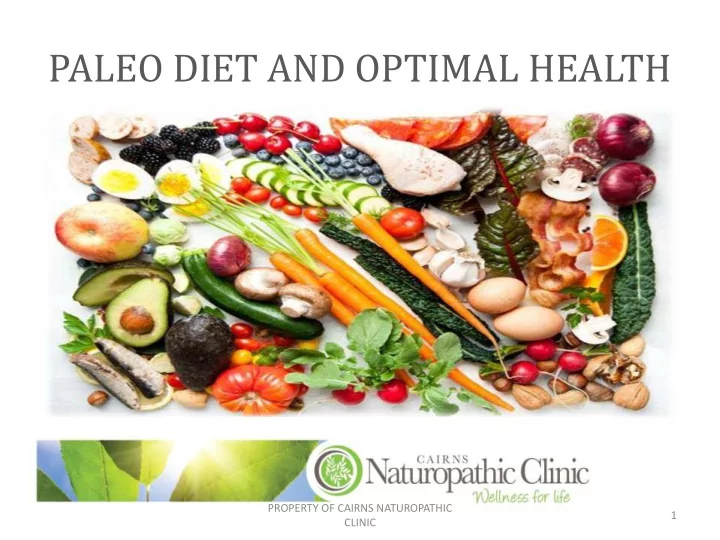
PALEO DIET AND OPTIMAL HEALTH
1 PROPERTY OF CAIRNS NATUROPATHIC CLINIC
PALEO DIET AND OPTIMAL HEALTH PROPERTY OF CAIRNS NATUROPATHIC 1 - - PowerPoint PPT Presentation
PALEO DIET AND OPTIMAL HEALTH PROPERTY OF CAIRNS NATUROPATHIC 1 CLINIC Who am I? Director Cairns Naturopathic Clinic Health Scientist with a focus on biochemical individuality and functional medicine. Our Services Optimising physical,
1 PROPERTY OF CAIRNS NATUROPATHIC CLINIC
Director Cairns Naturopathic Clinic Health Scientist with a focus on biochemical individuality and functional medicine. Our Services Optimising physical, emotional and spiritual health Disease Prevention Disease Management Our Practitioners Kylie Cloney Health Scientist, Naturopathic Medicine. Helen Watson Y Yoga Instructor, Remedial Massage Therapist Erin Reece Lomi Lomi Massage Therapist Susan Breeze Cranio Sacral Therapist Werner Rinseler Registered Psychologist Jillian Zamora Henna Tattooist – adorning and honouring the body I believe life is precious, often people do not appreciate the physical body until its already in a disease state. The majority of the western world invest more time and money into physical possessions than they do their own body. I believe in establishing Wellness for Life, Because life should be lived! 2 PROPERTY OF CAIRNS NATUROPATHIC CLINIC
LETS THINK ABOUT WHAT WE EAT… The Modern Western Diet
in the western world.
3 PROPERTY OF CAIRNS NATUROPATHIC CLINIC
4 PROPERTY OF CAIRNS NATUROPATHIC CLINIC
** Our next Seminar will discuss disease states and management in relation to Paleo diet.
5 PROPERTY OF CAIRNS NATUROPATHIC CLINIC
6 PROPERTY OF CAIRNS NATUROPATHIC CLINIC
7 PROPERTY OF CAIRNS NATUROPATHIC CLINIC
8
How many westerners actually eat like this though?
PROPERTY OF CAIRNS NATUROPATHIC CLINIC
9
Many Westerners are eating like this… Note – Alcohol should be included in this pyramid for many Australians
PROPERTY OF CAIRNS NATUROPATHIC CLINIC
10 PROPERTY OF CAIRNS NATUROPATHIC CLINIC
11 PROPERTY OF CAIRNS NATUROPATHIC CLINIC
12 PROPERTY OF CAIRNS NATUROPATHIC CLINIC
13 PROPERTY OF CAIRNS NATUROPATHIC CLINIC
14 PROPERTY OF CAIRNS NATUROPATHIC CLINIC
15 PROPERTY OF CAIRNS NATUROPATHIC CLINIC
16 PROPERTY OF CAIRNS NATUROPATHIC CLINIC
17
American Journal Clinical Nutrition – Statistics National sugar consumption and Obesity scale.
PROPERTY OF CAIRNS NATUROPATHIC CLINIC
18 PROPERTY OF CAIRNS NATUROPATHIC CLINIC
19 PROPERTY OF CAIRNS NATUROPATHIC CLINIC
20 PROPERTY OF CAIRNS NATUROPATHIC CLINIC
21 PROPERTY OF CAIRNS NATUROPATHIC CLINIC
22 PROPERTY OF CAIRNS NATUROPATHIC CLINIC
PROPERTY OF CAIRNS NATUROPATHIC CLINIC
Zonulin Opens up the spaces between the cells of the intestinal lining. That normally occurs, in order for nutrient and other molecules to get in and out of the
bloodstream where an immunologic reaction can take place. Once that happens, the body is primed to react to those proteins each and every time they
to filter out this garbage. Triggers that open the Zonulin doorway Based on Dr. Fasano’s research, we know that the two most powerful triggers to open the zonulin door are gluten and gut bacteria in the small
seal between the intestinal cells diminishes, opening up spaces between cells that allow all sorts of things to pass right through. This is called “leaky gut”. Its as if the security guard that keeps the bad guys out is taking a nap! Sometimes large food molecules will pass through to the immune
immune activation leads to more damage to the intestinal cells (called enterocytes) and the gut becomes more inflamed and more permeable or “leaky”. As the damage continues, the microvilli that line the intestines and absorb nutrients become damaged, leading to other nutrient deficiencies. Top causes of increased zonulin and development of leaky gut SIBO = small intestinal bacterial overgrowth Fungal dysbiosis or Candida overgrowth Parasite infections Overgrowth of harmful organisms, like bacteria or yeast in the intestine Gliadin in the diet (gluten containing foods) Gliadin a protein in wheat, that like gluten, is a trigger for people with celiac disease. However, a study published in the Scandinavian Journal of Gastroenterology in 2006 clearly showed that gliadin can affect zonulin even in people without the gene for celiac. The researchers concluded that Based on our results, we concluded that gliadin activates zonulin signaling irrespective of the genetic expression of autoimmunity, leading to increased intestinal permeability to macromolecules. The significance of this is that gluten affects intestinal permeability in all persons to different extents. It also means that 100% of patients with autoimmune disease or leaky gut could potentially benefit from a gluten-free diet.
24
Gliadin can affect zonulin even in people without the gene for celiac disease….. The significance of this is that gluten affects intestinal permeability in all persons…
PROPERTY OF CAIRNS NATUROPATHIC CLINIC
25 PROPERTY OF CAIRNS NATUROPATHIC CLINIC
Comparison with ancestral diets suggests dense a-cellular carbohydrates promote an inflammatory microbiota, and may be the primary dietary cause of leptin resistance and obesity.
26 Journal of Diabetes Metabolic Syndromes 2012;5:175-89. doi: 10.2147/DMSO.S33473. Epub 2012 Jul 6. Abstract A novel hypothesis of obesity is suggested by consideration of diet-related inflammation and evolutionary medicine. The
seen initially at vagal afferents, blunting the actions of satiety mediators, then centrally, with gastrointestinal bacterial- triggered SOCS3 signaling implicated. In humans, dietary fat and fructose elevate systemic lipopolysaccharide, while dietary glucose also strongly activates SOCS3 signalling. Crucially however, in humans, low-carbohydrate diets spontaneously decrease weight in a way that low-fat diets do not. Furthermore, nutrition transition patterns and the health of those still eating diverse ancestral diets with abundant food suggest that neither glycemic index, altered fat, nor carbohydrate intake can be intrinsic causes of obesity, and that human energy homeostasis functions well without Westernized foods containing flours, sugar, and refined fats. Due to being made up of cells, virtually all "ancestral foods" have markedly lower carbohydrate densities than flour- and sugar-containing foods, a property quite independent of glycemic index. Thus the "forgotten organ" of the gastrointestinal microbiota is a prime candidate to be influenced by evolutionarily unprecedented postprandial luminal carbohydrate concentrations. The present hypothesis suggests that in parallel with the bacterial effects
microbiota via the upper gastrointestinal tract, with fat able to effect a "double hit" by increasing systemic absorption of
whole foods with carbohydrate from cellular tubers, leaves, and fruits may produce a gastrointestinal microbiota consistent with our evolutionary condition, potentially explaining the exceptional macronutrient-independent metabolic health of non- Westernized populations, and the apparent efficacy of the modern "Paleolithic" diet on satiety and metabolism.
A diet of grain-free whole foods with carbohydrate from cellular tubers, leaves and fruits may produce a gastrointestinal microbiota consistent with our evolutionary condition…Potentially explaining the exceptional macronutrient metabolic health of NON Westernized populations… A-Cellular flours, sugars and processed foods produce inflammatory microbiota via the upper gastrointestinal
PROPERTY OF CAIRNS NATUROPATHIC CLINIC
27 PROPERTY OF CAIRNS NATUROPATHIC CLINIC
Phytin / Phytate
This stuff binds itself to minerals and keep them from being absorbed by those who eat it. As Mark Sisson puts it, “rats can break through the phytate and get at the minerals fairly well, but they evolved that ability – we did not. Heat does little to phytate, but since it’s located in the bran, physically removing the bran removes the phytate. That’s why brown rice eaters tend to have poorer mineral balances than white rice eaters.”
Trypsin Inhibitor
Trypsin is an enzyme produced in the pancreas, and its job is to cleave protein peptide chains into amino acids for easy absorption in the digestive
But again, trypsin inhibitor is “located primarily in the outer embryo of the rice seed, with a bit in the bran, and none in the polished, milled seed. Bran-free white rice has no trypsin inhibitor. Steaming rice bran deactivates it, too.”
Haemaglutinin-lectin
Haemagglutinin-lectin is a lectin that binds to certain carbohydrate receptor sites in the cells of the gut lining and thus blocks the absorption of
Oryzacystatin
Like trypsin, cysteine proteases are enzymes that degrade polypeptides, and in humans, they’re responsible for a host of biological processes, from apoptosis (necessary programmed cell death) to certain immune responses. Oryzacystatin, a cysteine protease inhibitor, messes with these
at least 30 minutes of boiling.”
Allergens
Wheat-sensitive individuals and others with food-related autoimmune disorders seem more susceptible to rice allergy, too (big surprise there), and allergic reactions generally manifest as atopic dermatitis, eczema, gastrointestinal distress, or asthma. If you’re sensitive to food in general and grains in particular, rice could pose a problem. And even if it doesn’t cause an immediate reaction, there remains the question of latent, hidden damage. if you stick with white rice (which doesn’t contain the phytate and trypsin inhibitor content of the less-milled brown rice) and you cook it properly (which neutralizes the haemagglutinin-lectin), you don’t have much to worry about from an anti-nutrient perspective. Yes, that’s right: Brown rice is worse for you than white rice. But just because white rice won’t destroy you doesn’t mean that it’s some kind of super-food. “White, milled, polished rice is basically pure starch… It is essentially a blank slate, nothing all that bad about it, but nothing all that great, either.” Rice can be tasty, but it’s really nothing more than empty, starchy calories.
28
Phytate in hull of brown rice binds to minerals and keeps them from being absorbed –( poor mineral balance) Trypsin inhibitor found in rice – means we can’t effectively digest the protein we eat with it. Cysteine proteases …. Responsible for host of biological processes… including immune responses…..inhibitors in rice mess with these processes… unable to be milled away or neutralised in cooking. Cooked white rice..doesn't contain anti- nutrients… Brown rice is worse for you… White, Milled polished rice is basically pure starch… it is essentially a blank slate, nothing all that bad about it but nothing all that great either… nothing more than empty calories…
PROPERTY OF CAIRNS NATUROPATHIC CLINIC
depends on whether the hull of the rice has been removed (white rice)
in the rice but also contains phytates and other anti-nutrients.
carbohydrate - glucose with neither nutrients nor toxins.
nutrient-dense foods – filling you up with empty calories.
29 PROPERTY OF CAIRNS NATUROPATHIC CLINIC
30 PROPERTY OF CAIRNS NATUROPATHIC CLINIC
The traditional diets of Pacific islanders free of heart disease, for example, vary widely in their proportions of fat and carbohydrate, but as can be seen in Figure 1, they are all rich in saturated fat and low in PUFA when compared to the standard American diet.
Each of these traditional diets is based primarily on starches, fruits, coconut and fish,
so the PUFA comes mostly from fish rather than from vegetable oils. 31 PROPERTY OF CAIRNS NATUROPATHIC CLINIC
32 PROPERTY OF CAIRNS NATUROPATHIC CLINIC
Almonds have a neutral effect on serum lipid profiles: a meta-analysis of randomized trials
J Am Diet Assoc. 2009 May;109(5):865-73. doi: 10.1016/j.jada.2009.02.014. Phung OJ1, Makanji SS, White CM, Coleman CI.
1University of Connecticut, Hartford Hospital Evidence-Based Practice Centre, Hartford, CT 06102-5037, USA.
Almond consumption may be associated with improvements in serum lipid profiles. The aim was to evaluate the influence of almonds on lipid parameters to help define the role of almonds as a lipid modulator. MEDLINE, EMBASE, Cochrane CENTRAL, and the Natural Medicines Comprehensive Database were searched through July 2008, with no language restrictions, for randomized controlled trials of almonds in human patients that reported efficacy data on at least one of the following endpoints: total, low-density lipoprotein (LDL), or high-density lipoprotein (HDL) cholesterol, triglycerides, or the LDL:HDL
randomized, controlled trials (totalling 142 participants) met all inclusion criteria. Upon meta-analysis, almond consumption ranging from 25 to 168 g/day significantly lowered total cholesterol [weighted mean difference -6.95 mg/dL (95% confidence interval [CI] -13.12 to -0.772) (-0.18 mmol/L [95% CI -0.34 to -0.02])] and showed a strong trend toward reducing LDL cholesterol [weighted mean difference -5.79 mg/dL (95% CI -11.2 to 0.00) (-0.15 mmol/L [95% CI -0.29 to 0.00])]. No significant effect on HDL cholesterol, triglycerides, or LDL:HDL ratio was found. No statistical heterogeneity was observed for any analysis (I2=0% for all). Review of funnel plots and the Egger's weighted regression statistic P values suggested a low likelihood of publication bias in all analyses (P>0.25 for all). Almond consumption may decrease total cholesterol and does not significantly affect LDL or HDL cholesterol, triglycerides, or the LDL:HDL ratio. The current body of randomized trials does not support the ingestion of almonds solely for their lipid modifying effects. Both the lipid modulating effects and the safety/tolerability of almonds should be further investigated through the conduction of larger randomized, double-blinded trials of longer duration. Such studies might focus specifically on whether the efficacy of almonds as a lipid modulator varies by dose or co-morbidity. 33
Almond consumption may decrease total cholesterol and does not significantly affect LDL or HDL cholesterol, triglycerides, or the LDL:HDL ratio. The aim was to evaluate the influence
Five randomized, controlled trials (totalling 142 participants) met all inclusion criteria
PROPERTY OF CAIRNS NATUROPATHIC CLINIC
Paleolithic diets as a model for prevention and treatment of Western disease.
Lindeberg S. Am J Hum Biol. 2012 Mar-Apr;24(2):110-5. doi: 10.1002/ajhb.22218. Epub 2012 Jan 19. Department of Primary Health Care Research, Lund University, Sweden. staffan.lindeberg@med.lu.se
Abstract OBJECTIVES: To explore the possibility that a paleolithic-like diet can be used in the prevention of age-related degenerative Western disease. METHODS: Literature review of African Paleolithic foods in relation to recent evidence of healthy nutrition. RESULTS AND DISCUSSION: Available evidence lends weak support in favour and little against the notion that lean meat, fish, vegetables, tubers, and fruit can be effective in the prevention and treatment of common Western diseases. There are no obvious risks with avoiding dairy products, margarine, oils, refined sugar, and cereal grains, which provide 70% or more of the dietary intake in northern European populations. If stroke, coronary heart disease, type 2 diabetes, and cancer are preventable by dietary changes, an ancestral-like diet may provide an appropriate template. 34
There are no obvious risks with avoiding dairy products, margarine, oils, refined sugar, and cereal grains, which provide 70% or more of the dietary intake in northern European populations
PROPERTY OF CAIRNS NATUROPATHIC CLINIC
35 PROPERTY OF CAIRNS NATUROPATHIC CLINIC
levels – Kidneys excrete more calcium in an acidic body.
36 PROPERTY OF CAIRNS NATUROPATHIC CLINIC
Whole milk intake is associated with prostate cancer-specific mortality among U.S. male physicians.
J Nutr. 2013 Feb;143(2):189-96. doi: 10.3945/jn.112.168484. Epub 2012 Dec 19. Song Y1, Chavarro JE, Cao Y, Qiu W, Mucci L, Sesso HD, Stampfer MJ, Giovannucci E, Pollak M, Liu S, Ma J. Department of Epidemiology and Program on Genomics and Nutrition, Fielding School of Public Health ,University of California-Los Angeles, Los Angeles, USA.
Abstract Previous studies have associated higher milk intake with greater prostate cancer (PCa) incidence, but little data are available concerning milk types and the relation between milk intake and risk of fatal PCa. We investigated the association between intake of dairy products and the incidence and survival of PCa during a 28-y follow-up. We conducted a cohort study in the Physicians' Health Study (n = 21,660) and a survival analysis among the incident PCa cases (n = 2806). Information on dairy product consumption was collected at baseline. PCa cases and deaths (n = 305) were confirmed during follow-up. The intake of total dairy products was associated with increased PCa incidence [HR = 1.12 (95% CI: 0.93, 1.35); >2.5 servings/d vs. ≤0.5 servings/d]. Skim/low-fat milk intake was positively associated with risk of low-grade, early stage, and screen-detected cancers, whereas whole milk intake was associated only with fatal PCa [HR = 1.49 (95% CI: 0.97, 2.28); ≥237 mL/d (1 serving/d) vs. rarely consumed]. In the survival analysis, whole milk intake remained associated with risk of progression to fatal disease after diagnosis [HR = 2.17 (95% CI: 1.34, 3.51)]. In this prospective cohort, higher intake of skim/low-fat milk was associated with a greater risk of nonaggressive PCa. Most importantly,
among cases. These findings add further evidence to suggest the potential role of dairy products in the development and prognosis of PCa.
37
The intake of total dairy products was associated with increased PCa incidence….
Whole milk intake remained associated with risk of progression to fatal disease after diagnosis…
PROPERTY OF CAIRNS NATUROPATHIC CLINIC
Green vegetables, sesame seeds, and even oranges contain lots of usable calcium, without problems associated with diary. Keep in mind that you retain the calcium better and just do not need as much when you don't consume a diet heavy in animal products and sodium, sugar, and caffeine. Many green vegetables have calcium-absorption rates of over 50 percent, compared with about 32 percent for milk. Additionally since animal protein induces calcium excretion in the urine, the calcium retention from vegetables is higher. All green vegetables are high in calcium.
Weaver, C.M., and K.L. Plawecki. 1994. Dietary calcium: adequacy of a vegetarian diet. Am. J. Nutr. 59 (supp.): 1238-41S.
The American "chicken and pasta" diet style is significantly low in calcium, so adding dairy as a calcium source to this mineral-poor diet makes superficial sense it is certainly better than no calcium in the diet. However, much more than just calcium is missing. The only reasons cow's milk is considered such an important source of calcium, is that the American diet is centred on animal foods, refined grains, and sugar, all of which are devoid of calcium. Any healthy diet containing a reasonable amount of unrefined plant foods will have sufficient calcium without milk. Fruits and vegetables strengthen
concluded that not only are fruits and vegetables rich in potassium, magnesium, calcium, and other nutrients essential for bone health, but, because they are alkaline, not acid-producing, they don induce urinary calcium loss. Green vegetables in particular have a powerful effect on reducing hip fractures, for they are rich not only in calcium but in other nutrients, such as vitamin K, which is crucial for bone health.
Tucker, K.L., M. T. Hannan, H. Chen, et al. 1999. Potassium, magnesium, and fruit and vegetable intakes are associated with greater mineral density in elderly men and women. Am. J.
and vegetable consumption and bone health? Am. J. Clin. Nutr. 71 (1): 142-51.
38 PROPERTY OF CAIRNS NATUROPATHIC CLINIC
39
Milk 32.1% Chinese Cabbage 53.8% Cauliflower 68.6% Sesame Seeds 20.8%
PROPERTY OF CAIRNS NATUROPATHIC CLINIC
40 PROPERTY OF CAIRNS NATUROPATHIC CLINIC
41 PROPERTY OF CAIRNS NATUROPATHIC CLINIC
42 PROPERTY OF CAIRNS NATUROPATHIC CLINIC
you cant have. Tell them how amazing you feel.
43 PROPERTY OF CAIRNS NATUROPATHIC CLINIC
and development
44 PROPERTY OF CAIRNS NATUROPATHIC CLINIC
45 PROPERTY OF CAIRNS NATUROPATHIC CLINIC