Page 3 of 73 services and protection for all members of [our] - - PDF document

page 3 of 73
SMART_READER_LITE
LIVE PREVIEW

Page 3 of 73 services and protection for all members of [our] - - PDF document

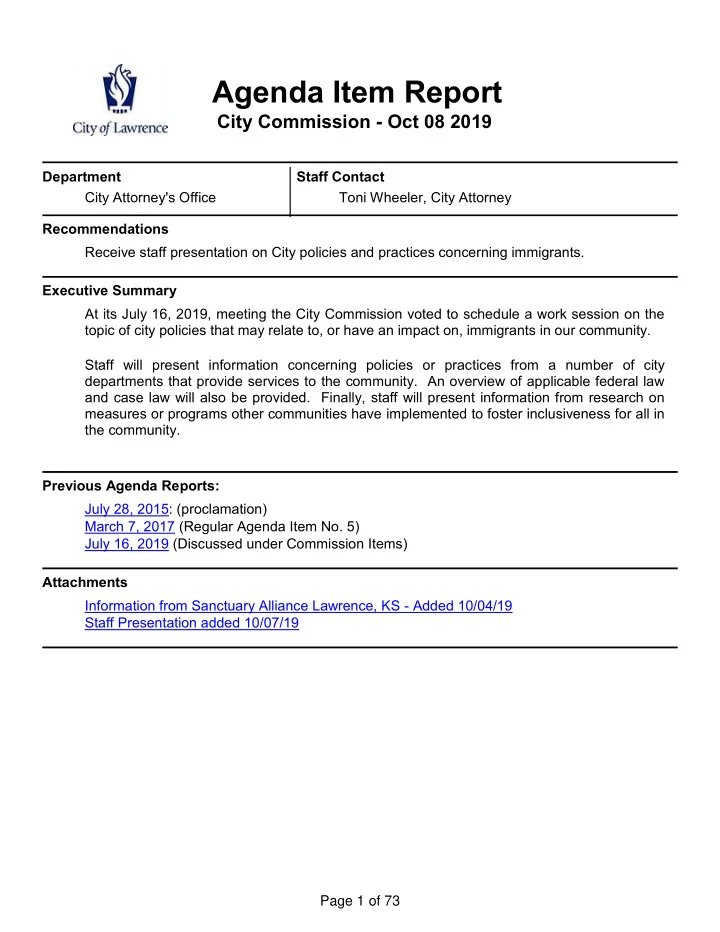
Agenda Item Report City Commission - Oct 08 2019 Department Staff Contact City Attorney's Office Toni Wheeler, City Attorney Recommendations Receive staff presentation on City policies and practices concerning immigrants. Executive Summary At


slide-1
SLIDE 1

Agenda Item Report

City Commission - Oct 08 2019

Department City Attorney's Office Staff Contact Toni Wheeler, City Attorney Recommendations Receive staff presentation on City policies and practices concerning immigrants. Executive Summary At its July 16, 2019, meeting the City Commission voted to schedule a work session on the topic of city policies that may relate to, or have an impact on, immigrants in our community. prac

  • r

policies concerning information present will Staff city

  • f

number a from tices departments that provide services to the community. An overview of applicable federal law and case law will also be provided. Finally, staff will present information from research on measures or programs other communities have implemented to foster inclusiveness for all in the community. Previous Agenda Reports: July 28, 2015: (proclamation) March 7, 2017 (Regular Agenda Item No. 5) July 16, 2019 (Discussed under Commission Items) Attachments Information from Sanctuary Alliance Lawrence, KS - Added 10/04/19 Staff Presentation added 10/07/19 Page 1 of 73

slide-2
SLIDE 2

Sanctuary Alliance Lawrence, KS

Sanctuary Now!

Contents: 1. Introduction: Who We Are 2. What Sanctuary Means to Us and Our City 3. Policy Proposals 4. Conclusion

  • 1. Introduction: Who We Are

We are a diverse group with experienced and qualified membership comprised of Lawrence residents, including attorneys, university professors, local activists and more. We are fundamentally committed to improving the quality of life for members of our community. Approximately 8% of all Lawrence residents were born outside of the United States. According to the most recent data from the

1

US Census Bureau, 5.3% of Lawrence residents were non-citizens . Our commitment to our community

2

translates to new and continued advocacy work in our local immigration system—and designing our policies so they can ultimately catalyze a shift in the rest of Kansas and beyond. We hope the City of Lawrence can continue to be a positive, innovative and equitable role model in our state, as we maintain transparent and responsible civic processes and local government. The following document represents months of hard work and research done to develop a specifically tailored approach for Lawrence to become a Sanctuary City. In addition to our core group which includes legal professionals, we’ve created several opportunities for the Lawrence community to provide input. We believe the following policy requests are the best fit for Lawrence.

  • 2. What sanctuary means to us and our city

How would we define sanctuary city? To us, a sanctuary city is a city that enacts immigrant-protective policies, a city that does more than claim to be welcoming by actively putting its community first—by not just saying, but showing that it values everyone who makes up the social fabric of our community regardless of their immigration

1 ​http://www.city-data.com/housing/houses-Lawrence-Kansas.html 2 American Community Survey Data, US Census Bureau: ​https://datausa.io/profile/geo/lawrence-ks/

1

Page 2 of 73

slide-3
SLIDE 3
  • status. While we recognize there is no exact definition for a sanctuary city, numerous cities still classify

themselves as sanctuary cities today. Why are sanctuary cities important?

3

There are several legal and practical rationales for implementing sanctuary policies. 1. To Maintain Local Control Over Criminal Justice The federal government’s attempts to press local law enforcement agencies into federal service conflict with our desire to preserve scarce resources for local priorities. Since immigration is a federal responsibility, cities and counties are not required to enforce federal immigration law in any way, and the Tenth Amendment guarantees freedom from federal commandeering of local

  • resources. As a result, the federal government's attempts to defund sanctuary cities and counties

4

have repeatedly failed. As recently as August 23, 2019, a federal court granted Santa Clara County and San Francisco permanent protections against the threat to withhold federal funding from the sanctuary jurisdiction.

5

2. To Prevent Unlawful Arrests Because "state and local police have no authority to arrest and detain a person for a civil violation," we don't want our police to get mixed up with immigration enforcement. Legally

6

speaking, detention on an immigration detainer constitutes a warrantless arrest and can be a potential violation of the Fourth Amendment.

78

3. To Ensure Equal Protection of the Law The Fourteenth Amendment declares that “[n]o State shall . . . deny to any person within its jurisdiction the equal protection of the laws.” Our goal is to "ensure 'fair and equal access' to

3 Lasch, Christopher N., R. Linus Chan, Ingrid V. Eagly, Dina Francesca Haynes, Annie Lai, Elizabeth M. McCormick, and Juliet P.

  • Stumpf. "Understanding Sanctuary Cities." BCL Rev.59 (2018): 1703.

(​https://lawdigitalcommons.bc.edu/cgi/viewcontent.cgi?article=3686&context=bclr​).

4 See Robert A. Mikos, Can the States Keep Secrets from the Federal Government?, 161 U. PA. L. REV. 103, 159–64 (2012)

(arguing that § 1373 imposes information-sharing requirements that violate Tenth Amendment’s anti-commandeering principle); see also Ilya Somin, Why Trump’s Executive Order on Sanctuary Cities Is Unconstitutional, WASH. POST (Jan. 26, 2017), https://www. washingtonpost.com/news/volokh-conspiracy/wp/2017/01/26/constitutional-problems-with-trumpsexecutive-order-on-sanctu ary-cities/?utm_term=.3db1ce3a9223 [https://perma.cc/65MX-UXB8] (arguing that § 1373 violates the Tenth Amendment because it is an attempt by the federal government “to prevent states from controlling their employees’ use of information that ‘is available to them only in their official capacity’”). The City and County of San Francisco, in its lawsuit challenging President Trump’s executive order threatening to defund sanctuary jurisdiction, has argued that § 1373 is facially unconstitutional. S.F. Complaint, supra note 57, at 20 (arguing § 1373 cannot be constitutionally applied to prohibit confidentiality requirements in San Francisco’s Sanctuary City law “enacted to further legitimate local interests grounded in the basic police powers of local government and related to public health and safety”).

5

https://www.paloaltoonline.com/news/2019/08/23/santa-clara-county-san-francisco-win-final-ruling-over-trumps-threat-again st-sanctuary-counties

6 Lasch, Christopher N., R. Linus Chan, Ingrid V. Eagly, Dina Francesca Haynes, Annie Lai, Elizabeth M. McCormick, and Juliet P.

  • Stumpf. "Understanding Sanctuary Cities." BCL Rev.59 (2018): 1703.

7

https://www.americanimmigrationcouncil.org/advocacy/assumption-risk-legal-liabilities-local-governments-choose-enforce-fe deral-immigration-laws

8 See ​Lunn​, 477 Mass. at 531 n.21 (“These are civil administrative warrants approved by, and directed to, Federal immigration

  • fficials. Neither form requires the authorization of a judge. Neither form is a criminal arrest warrant or a criminal detainer.”).

The Fourth Amendment requires that a probable cause determination be made by a “neutral magistrate,” an officer who must be “neutral and detached” from the activities of law enforcement. ​Shadwick v. City of Tampa​, 407 U.S. 345, 350 (1972).

2

Page 3 of 73

slide-4
SLIDE 4

services and protection for all members of [our] community, including immigrants and U.S. citizens in mixed-status families who may be concerned that a call to the police could lead to deportation

  • f a parent or spouse."

9

4. To Strengthen Community Trust

10

Research consistently shows that if residents associate their police with immigration enforcement, then the fear of getting deported or losing a loved one can prevent immigrants and people in mixed status families from reporting crimes or coming forward as witnesses —and this

11

not only inhibits the ability of our police to investigate the crimes that fall under their jurisdiction, but it also diminishes public safety.

12

5. To Promote Diversity and Inclusivity Choosing to classify ourselves as a sanctuary city sends a message that we respect and appreciate our diverse communities , and that we understand how deportation negatively

13

impacts our entire community—citizens and noncitizens alike. As a college town, this is an especially important message to send to all of our guests from abroad. 6. To Distance Ourselves from Unethical Federal Immigration Policy To distance our city from the harmful federal immigration agenda that is increasingly making headlines for its disruption of families ; its disregard for the legal right to seek asylum ;

14 15

its punishment of documented immigrants who aren't wealthy ; its hasty arrest of US citizens

16

based on their perceived ethnicity ; its prolonged abuse of those held in detention —especially

17 18

children ; and its irresponsible damage to local communities.

19 20 21 22

What are the costs of failing to become a sanctuary city?

9 Lasch, Christopher N., R. Linus Chan, Ingrid V. Eagly, Dina Francesca Haynes, Annie Lai, Elizabeth M. McCormick, and Juliet P.

  • Stumpf. "Understanding Sanctuary Cities." BCL Rev.59 (2018): 1703.

10 Lasch, Christopher N., R. Linus Chan, Ingrid V. Eagly, Dina Francesca Haynes, Annie Lai, Elizabeth M. McCormick, and Juliet P.

  • Stumpf. "Understanding Sanctuary Cities." BCL Rev.59 (2018): 1703.

11 See NIK THEODORE, INSECURE COMMUNITIES: LATINO PERCEPTIONS OF POLICE INVOLVEMENT IN IMMIGRATION

ENFORCEMENT 5–17 (May 2013), https://greatcities.uic.edu/wp-content/up loads/2014/05/Insecure_Communities_Report_FINAL.pdf [https://perma.cc/ARA5-A5C2] (reporting on the impact of police involvement in immigration enforcement on Latinos’ perceptions of public safety and their willingness to contact the police).

12 Marjorie S. Zatz & Hilary Smith, Immigration, Crime, and Victimization: Rhetoric and Reality, 8 ANN. REV. L. & SOC. SCI. 141,

150 (2012) (concluding that “laws and policies involving local police in immigration enforcement have thwarted community policing and other efforts to cultivate improved relations with communities that include significant numbers of immigrants”).

13 Lasch, Christopher N., R. Linus Chan, Ingrid V. Eagly, Dina Francesca Haynes, Annie Lai, Elizabeth M. McCormick, and Juliet P.

  • Stumpf. "Understanding Sanctuary Cities." BCL Rev.59 (2018): 1703.

14 ​https://www.cnn.com/2019/09/04/politics/family-separation-inspector-general-report/index.html 15 ​https://foreignpolicy.com/2019/08/07/trumps-asylum-policies-and-the-troops-who-enforce-them-are-breaking-the-law/ 16 ​https://www.nbcnews.com/think/opinion/trump-s-public-charge-plan-punishes-legal-immigrants-america-s-ncna1041941 17 ​https://www.foxnews.com/us/texas-u-s-citizen-released-ice-detention-center-three-weeks-francisco-erwin-galicia 18 ​https://www.nytimes.com/2019/02/27/us/immigrant-children-sexual-abuse.html 19

https://www.npr.org/sections/health-shots/2019/08/23/753757475/lengthy-detention-of-migrant-children-may-create-lasting

  • trauma-say-researchers

20 ​https://www.politico.com/agenda/story/2019/08/09/immigration-customs-enforcement-raids-000941 21 ​https://www.americanimmigrationcouncil.org/research/us-citizen-children-impacted-immigration-enforcement 22

https://www.washingtonpost.com/outlook/2019/08/09/poultry-industry-recruited-them-now-ice-raids-are-devastating-their-c

  • mmunities/

3

Page 4 of 73

slide-5
SLIDE 5

The costs and the risks are substantial and undeniable. These costs are borne economically, politically, psychologically, and emotionally by our community—by taxpayers, workers, families, colleagues, classmates, teachers, police officers, service providers, and more. Refusal to take action on

23

this issue diminishes public trust and public safety. In 2017, the White House issued two executive orders which effectively eliminated the use of discretion or prioritization in immigration enforcement and expanded the category of deportable

24

  • immigrants. In that same year, the acting director of Immigration and Customs Enforcement (ICE)

25

stated publicly that he would “never back down” from telling undocumented immigrants to be afraid.

26

Earlier this year, the Department of Homeland Security (DHS) announced an alarming expansion of the expedited removal process now targeting people throughout the country rather than just near the

  • border. This policy raises the chance of individuals "being erroneously deported from the United States,

potentially to imminent harm or death," and unjustly deprives individuals of the opportunity to defend themselves in immigration court even if they may qualify for deportation relief. The use of expedited

27

removal by ICE agents has accelerated in recent years. Prior to this expansion, 35 percent of all removals from the U.S. were conducted through expedited removal in Fiscal Year (FY) 2017, (the most recent government data available). Since 2017, the average daily population in U.S. detention centers has also

28

increased by more than 40 percent, with federal spending on detention now topping $3 billion.

29

Furthermore, since 2012, ICE has mistakenly arrested and detained more than 1,480 U.S. citizens. In

30

some cases, such as that of Davino Watson who spent more than three years in immigrant detention, these baseless arrests have resulted in lengthy detentions or deportations.

​ 31

ICE deploys a variety of strategies to convince local law enforcement agencies that detainer compliance will no longer expose them to liability; however, a joint report from the National Immigration Law Center states that “each of ICE’s detainer compliance options is illegal.” More

32

concerning still is that in recent years, ICE has intensified its use of tactics designed to create confusion and fear in communities. This includes impersonating police officers, potential employers, and normal

23 Duarte Geraldino, “What we’re missing in the debate about immigration,” filmed June 2017, TED video, 7:55.

https://www.ted.com/talks/duarte_geraldino_what_we_re_missing_in_the_debate_about_immigration

24 Executive Order No. 13768. 2017b. “Executive Order: Enhancing Public Safety in the Interior of the United States.” January 25.

The White House. (https://www. whitehouse.gov/the-press-office/2017/01/25/ presidential-executive-order-enhancing-publicsafety-interior-united).

25 Executive Order No. 13767. 2017a. “Executive Order: Border Security and Immigration Enforcement Improvements.” January

  • 25. The White House. (https://www. whitehouse.gov/the-press-office/2017/01/25/

executive-order-border-security-and-immigration-enforcement-improvements).

26 Roque Planas, Huffington Post, “ICE Chief Will ‘Never Back Down’ From Telling Undocumented Immigrants To Be Afraid,” Jan.

31, 2018), https://www.huffingtonpost.com/entry/ice-thomas-homan-immigrants-afraid_us_5a723134e4b09a544b562913.

27 American Immigration Council. "A Primer on Expedited Removal." (2017).

https://www.americanimmigrationcouncil.org/research/primer-expedited-removal

28 American Immigration Council. "A Primer on Expedited Removal." (2017).

https://www.americanimmigrationcouncil.org/research/primer-expedited-removal

29 ​https://www.theguardian.com/us-news/2019/sep/24/detained-us-largest-immigrant-detention-trump

30 ​https://www.latimes.com/local/lanow/la-me-citizens-ice-20180427-htmlstory.html 31

https://www.npr.org/sections/thetwo-way/2017/08/01/540903038/u-s-citizen-held-by-immigration-for-3-years-denied-compe nsation-by-appeals-court

32

https://www.americanimmigrationcouncil.org/advocacy/assumption-risk-legal-liabilities-local-governments-choose-enforce-fe deral-immigration-laws

4

Page 5 of 73
slide-6
SLIDE 6
  • citizens. They are also increasingly using surveillance tactics, following immigrants and detaining them

33

  • n their way to work, in traffic stops, on the street, or at courthouses.

34

Efforts to brand Lawrence a “welcoming city” stand to be diminished by voluntary and legally unnecessary cooperation with ICE. This would make Lawrence indistinguishable from cities that have passed explicit ordinances legalizing such hostility to immigrants. Without clear policy and accountability, our city jeopardizes public trust. Without apparent protections for our community, not everyone can truly feel welcome in Lawrence. According to a national map of local law enforcement involvement with ICE, as of 2015, Douglas County accepts ICE detainer requests and requests for Voluntary Notification; and on Sept 7, 2017, a local enforcement agency notified ICE they would hold people for up to 48 hours. While the City of Lawrence may not have formal contracts with ICE, the

35

Legal Immigration Resource Center notes that the lack of clear policy limiting cooperation with federal immigration enforcement indicates that we are at least potentially willing to hold immigrants on detainers, provide compromising information about individuals in local custody, and may voluntarily grant ICE requests to enforce federal immigration policy.

36

A study conducted by KU professors further illustrates the impact of these policies on Kansas

  • immigrants. The intensification of immigration enforcement, combined with extensive media coverage,

37

has amplified fear and anxiety among immigrant communities regardless of state residence or rural or urban location—including Kansas, which was the focus of their field study. The authors refer to such enforcement practices as legal violence, which operates by “harming the livelihood and constraining paths to incorporation of immigrants.” The consequences go beyond targeted immigrants, affecting

38

family members (including U.S. citizens) and entire communities. What can we do? As of 2018, over 400 counties had stronger limitations on engaging in immigration enforcement than they did a year prior. Twenty-four percent of jurisdictions nationally have adopted policies

39

limiting compliance with ICE detainers. At the local level in cities like Lawrence, we can most directly

40

counter harmful enforcement trends and their corrosive impact on the economic stability and social cohesion of our communities and the nation. Our school board has already taken important steps to protect our children from ICE in order to affirm their commitment to student safety and supportive

33 Nausicaa Renner, 2019. “As immigrants become more aware of their rights, ice steps up ruses and surveillance.”

(https://theintercept.com/2019/07/25/ice-surveillance-ruse-arrests-raids/).

34 Nausicaa Renner, 2019. “As immigrants become more aware of their rights, ice steps up ruses and surveillance.”

(https://theintercept.com/2019/07/25/ice-surveillance-ruse-arrests-raids/).

35 Immigrant Legal Resource Center, 2019. “National Map of Local Entanglement with ICE.”

(​https://www.ilrc.org/local-enforcement-map​) (Click on the interactive map to find Douglas County)

36 Immigrant Legal Resource Center, 2019. “National Map of Local Entanglement with ICE.”

(​https://www.ilrc.org/local-enforcement-map​) (See “More Explanation” for jurisdictions color-coded orange)

37 Alvord, Daniel R., Cecilia Menjívar, and Andrea Gómez Cervantes. "The Legal Violence in the 2017 Executive Orders: The

Expansion of Immigrant Criminalization in Kansas." Social Currents 5, no. 5 (2018): 411-420.

38 Alvord, Daniel R., Cecilia Menjívar, and Andrea Gómez Cervantes. "The Legal Violence in the 2017 Executive Orders: The

Expansion of Immigrant Criminalization in Kansas." Social Currents 5, no. 5 (2018): 411-420.

39 See Immigrant Legal Resource Center, The Rise of Sanctuary (2018). (https://www.ilrc.org/sites/default/fi

les/resources/rise_of_sanctuary-lg-20180201.pdf)

40

https://www.americanimmigrationcouncil.org/advocacy/assumption-risk-legal-liabilities-local-governments-choose-enforce-fe deral-immigration-laws

5

Page 6 of 73

slide-7
SLIDE 7
  • learning. The city commission can further strengthen this local effort by enacting new laws and policies

41

to protect our community.

  • 3. Policy Proposals

Our policy requests are listed below, based on policy options implemented by other municipalities:

42

1. Non-discrimination

A.

Not collecting immigration related information in the provision of city services, including policing , unless otherwise required by state or federal law ;

43 44

B.

Not discriminating on the basis of alienage or immigration status. City employees will serve all residents and city services will be accessible to all residents regardless of alienage or immigration status. City agencies, including law enforcement, that require individuals to provide identification shall accept any valid photo ID that provides the person’s name and photo, including Consular IDs, student IDs, foreign drivers’ licenses, etc. City agencies will work to develop a comprehensive list of acceptable documentation for identification. 2. Use of Local Resources

A.

Not allowing local funds, personnel, or facilities to be used for immigration enforcement, specifically prohibiting local law enforcement from complying with federal agency requests to support civil immigration enforcement operations ;

45

B.

Not complying with detainer requests unless they come with a judicial warrant

46

C.

Not allowing local law-enforcement officers to make arrests or detain individuals based on administrative warrants for removal entered by ICE into the National Crime Information Center (NCIC) database

47

D.

Clarifying interaction between local law enforcement and NCIC database, seek to limit provision of immigration status information from local law enforcement or courts to the database where permissible by law

E.

Prohibiting city prosecutors from transferring immigration information to ICE and requiring public defenders to affirmatively and competently advise defendants of the immigration

41

https://www2.ljworld.com/news/schools/2019/jul/22/school-board-expresses-opposition-to-authorities-using-schools-for-imm igration-enforcement-gives-initial-approval-to-2020-budget/

42 Immigrant Legal Resource Center, 2017. “Local Options for Protecting Immigrants: A Collection of City & County Policies to

Protect Immigrants from Discrimination and Deportation.” (​https://www.ilrc.org/local-options​.) (This resource identifies and explains some key provisions that cities and counties can enact to protect immigrants, including several examples of existing local laws.)

43 ​https://www.ilrc.org/sites/default/files/resources/hartford_ct.pdf​ ;

http://www.nola.gov/getattachment/NOPD/NOPD-Consent-Decree/Chapter-41-6-1-Immigration-Status-approval. pdf/

44 ​https://www.ilrc.org/sites/default/files/resources/vt_state_policy.pdf​ See Section VIII(B)(b) 45 Oregon Enforcement of federal immigration laws ​https://www.oregonlaws.org/ors/181A.820 46 Hennepin County Sheriff Statement June 11, 2014 ​https://www.ilrc.org/sites/default/files/resources/hennepin_county_0.pdf 47 ​https://www.ilrc.org/sites/default/files/resources/vt_state_policy.pdf​ See Section VIII( D)(a)

6

Page 7 of 73

slide-8
SLIDE 8

consequences of criminal offenses. Immigration consequences should be considered in plea negotiations and lack of status should never be a bar to diversion programs. 3. Notice and Identification

A.

Requiring local law enforcement to issue immediate public notice of any contact by state or federal agencies requesting assistance with federal immigration enforcement

B.

Requiring notice to people in custody if ICE or DHS requests to talk to them for any reason

C.

Requiring ICE and DHS to notify any individual in custody’s attorney prior to talking to them for any reason and to certify having done so

D.

Requiring ICE and DHS officers to identify themselves and wear duty jackets if allowed into any local facilities 4. Safe Spaces and Support Services

A.

Not allowing ICE or other DHS agents into local facilities, including but not limited to, municipal courts, City Hall, the Community Building and recreational facilities, for the purpose of federal immigration enforcement activities and declaring such facilities to be safe places where people can go without fearing immigration enforcement activities or raids.

B.

Providing funding for legal representation for local residents in immigration proceedings

C.

Providing language services so that foreign language speakers are able to access services

48

  • 4. Conclusion

Our community expressed overwhelming support for Lawrence to become a sanctuary city, as demonstrated by the large rally in Watson Park on July 12th that generated statewide media attention and more than 300 petition signatures in a matter of days. Sanctuary policies offer many benefits

49

which are rooted in a strong legal foundation. The absence of these protections carries immeasurable costs and risks. We have the ability to reinforce our city’s welcoming stance, our schools’ protective stance of their students, and our law enforcement’s commitment to public safety with clear, strong city policies that foster community trust. As we saw with the 2018 detention and threatened deportation of a then-55-year-old Lawrence resident to Bangladesh, where he would have faced persecution and possible death, the federal government's changes in immigration policies are unnecessarily hasty and cruel. The resident's 30

50

years in the U.S., career as an adjunct professor in chemistry, lack of criminal history, U.S.-born wife and dependent children, and a long history of community involvement did not protect him from ICE arrest

  • n his front lawn, in front of his children, when the new federal policies regarding supervised stays were

implemented.

48 ​https://www.ilrc.org/sites/default/files/resources/vt_state_policy.pdf 49

https://www2.ljworld.com/news/general-news/2019/jul/12/at-rally-hundreds-call-on-local-leaders-to-make-lawrence-a-sanctu ary-city/

50 Rick Montgomery, 2018. “Kansas chemistry instructor arrested by ICE while taking his daughter to school.”

(​https://www.kansascity.com/news/politics-government/article198215114.html​).

7

Page 8 of 73

slide-9
SLIDE 9

Detention and deportation carry heavy social and financial burdens felt not only by families, but by the broader community. There is a moral imperative to support all Lawrence residents, regardless of documentation status. Any entanglement with ICE jeopardizes the trust needed for immigrants to attend school, access health services, and be safe from violent crimes. Lawrence stands to make a new mark in history by rejecting the cruel targeting of immigrants and instead joining other municipalities in enacting the kind of ordinances that strengthen our resilience as a community. By becoming a sanctuary city, we solidify these efforts and affirm the value of all Lawrencians—and we say no one's existence is illegal. 8

Page 9 of 73

slide-10
SLIDE 10

October 8, 2019 City Commission Work Session

“Welcoming City” Policies

Page 10 of 73

slide-11
SLIDE 11

Agenda

  • 1. Review previous agenda items, City

Commission’s most recent direction, and the legal background on this topic

  • 2. Current City policies/practices
  • 3. Approaches taken by other jurisdictions
  • 4. Decision points
  • 5. Next steps

Page 11 of 73

slide-12
SLIDE 12

Previous Agenda Items

  • July

28, 2015: Proclamation declaring Lawrence a “Welcoming City.”

  • March 7, 2017: Proclamation reiterating the

City’s intent to be an inclusive community that values immigrants and fosters a safe and welcoming environment for all.

Page 12 of 73

slide-13
SLIDE 13

Most Recent City Commission Direction

July 16, 2019 City Commission direction:

  • A study session on City policies on

undocumented immigrants as a whole to include cooperation with ICE and sanctuary status .

  • City Manager also recommended a review of

best practices.

Page 13 of 73

slide-14
SLIDE 14

Legal Background

Page 14 of 73

slide-15
SLIDE 15

Legal Background

Federal Law

  • Statutes (8 U.S.C. 1373)
  • Executive order
  • “Sanctuary City” defined
  • Case Law

Page 15 of 73

slide-16
SLIDE 16

Legal Background

Case Caption Location City and County of San Francisco

  • v. Trump

California County of Santa Clara v. Trump California Cities of Chelsea and Lawrence v. Trump Massachusetts City of Richmond v. Trump California City of Seattle v. Trump Washington City of Chicago v. Sessions Illinois City and County of San Francisco

  • v. Sessions

California State of California v. Sessions California City of Philadelphia v. Sessions Pennsylvania City of Los Angeles v. Sessions California USA v. California California

Page 16 of 73

slide-17
SLIDE 17

Legal Background

FY 2018: City received $4.8 million in federal grant awards. Total expenditures: $157,933,574

  • $3.7 million from USDOT for transportation

projects

  • $1.033 million from HUD
  • $40,000 from DOJ for bullet proof vests
  • $6,808 from HHS for parks
  • $722 from DOI for parks

Page 17 of 73

slide-18
SLIDE 18

Legal Background

FY 2017: City received 5.3 million in federal funding

  • including a DOJ grant for $34,000

Page 18 of 73

slide-19
SLIDE 19

Legal Background

State Law

  • Several

attempts to prohibit sanctuary jurisdictions in 2017 but none passed. Currently no law against failure to cooperate in Kansas.

Page 19 of 73

slide-20
SLIDE 20

Legal Background

Local Law

  • Chapter 10 prohibits discrimination on the

basis of race, sex, religion, color, national

  • rigin,

age, ancestry, sexual

  • rientation,

disability or gender identity in employment and public accommodations.

  • Any person may file a complaint regardless
  • f immigration status.

Page 20 of 73

slide-21
SLIDE 21

City Policies/Procedures

Lawrence Police Department

Page 21 of 73

slide-22
SLIDE 22

Lawrence Police Department Gregory Burns, Chief of Police

  • Immigration enforcement is not a local law

enforcement matter. It falls under the jurisdiction of the United States Immigration and Customs Enforcement (ICE).

  • Lawrence Police Officers lack the jurisdiction

to enforce federal immigration law.

Page 22 of 73

slide-23
SLIDE 23

Lawrence Police Department Gregory Burns, Chief of Police

  • Section 2879(g) of the Immigration and

Nationality Act authorizes the Director of ICE to enter into requesting state and local law enforcement agencies, permitting designated

  • fficers

to perform immigration law enforcement functions.

Page 23 of 73

slide-24
SLIDE 24

Lawrence Police Department Gregory Burns, Chief of Police

  • There are currently 79 law enforcement

agencies that have 287(g) agreements. Lawrence has no such agreement.

  • As
  • f

May 2019, there are ten law enforcement agencies in Florida that have a “warrant service

  • fficer”

agreement with ICE, which provides limited duties of an immigration officer within a jail.

Page 24 of 73

slide-25
SLIDE 25

Lawrence Police Department Gregory Burns, Chief of Police

  • However, there are situations where ICE may

request assistance.

  • Current

administrative policies are under development for Immigration and Outside Agency Assist.

  • Policies will be grounded in current law, best

practices, and experience.

Page 25 of 73

slide-26
SLIDE 26

Lawrence Police Department Gregory Burns, Chief of Police

  • Arrest laws apply to everyone. All persons

shall be treated equally without regard to race, color, or national origin in any way that would violate the United States or Kansas Constitution legal or illegal.

Page 26 of 73

slide-27
SLIDE 27

Lawrence Police Department Gregory Burns, Chief of Police

  • Current practice is that the Lawrence Police

Department does not check

  • r

report people’s immigration status to federal immigration agencies, with exceptions made for some felony investigations.

Page 27 of 73

slide-28
SLIDE 28

Lawrence Police Department Gregory Burns, Chief of Police

  • All law enforcement officers shall attend and

successfully complete annual racial or other biased‐based policing training.

  • The Lawrence Police Department has had a

policy in place since 2014 that prohibits racial or biased-based policing.

Page 28 of 73

slide-29
SLIDE 29

Lawrence Police Department Gregory Burns, Chief of Police

  • “Racial
  • r
  • ther

biased-based policing” means the unreasonable use

  • f

race, ethnicity, national origin, gender or religion by a law enforcement officer in deciding to initiate an enforcement action. K.S.A. 22- 4606(d).

Page 29 of 73

slide-30
SLIDE 30

Lawrence Police Department Gregory Burns, Chief of Police

  • Any person who believes they have been

subjected to racial or other biased‐based policing by a law enforcement officer may file a complaint with KSCPOST and/or the attorney general’s office.

Page 30 of 73

slide-31
SLIDE 31

Lawrence Police Department Gregory Burns, Chief of Police

  • KSA 22-4610(d) requires all law enforcement

agencies to file an annual report

  • f

complaints alleging racial

  • r
  • ther

bias- based policing with the Office

  • f

the Attorney General at the end of each state fiscal year, due by July 31.

  • LKPD’s

report is

  • n

the department’s website.

Page 31 of 73

slide-32
SLIDE 32

Lawrence Police Department Gregory Burns, Chief of Police

  • Federal law allows local agencies to help

facilitate the issuance of temporary visas to benefit victims of certain crimes:

  • U visa (for victims and witnesses of certain

qualifying crimes (8 USC § 1101(a)(15)(U)).

  • T visa, is available for certain qualifying

victims

  • f

human trafficking (8 USC § 1101(a)(15)(T).

Page 32 of 73

slide-33
SLIDE 33

Lawrence Police Department Gregory Burns, Chief of Police

  • Propio

Language Service for telephone language translation is utilized when immediate translation is required. Propio provides translation for approximately 200 languages.

  • Additionally, LKPD has several bilingual
  • fficer.

Page 33 of 73

slide-34
SLIDE 34

Lawrence Police Department Gregory Burns, Chief of Police

  • The Douglas County Jail does not fall under

the authority

  • f

the Lawrence Police

  • Department. K.S.A.19-1903.
  • Detainer matters are generally handled

through the jail.

Page 34 of 73

slide-35
SLIDE 35

City Policies/Procedures

Lawrence Municipal Court

Page 35 of 73

slide-36
SLIDE 36

Municipal Court Vicki Stanwix, Municipal Court Manager

  • ICE

agents appearing in the Lawrence Municipal Court (Court) is rare (twice in 20 years).

  • The

Court does not inquire about immigration status and does not report status even if it becomes known.

Page 36 of 73

slide-37
SLIDE 37

Municipal Court Vicki Stanwix, Municipal Court Manager

  • One exception: A fingerprint card is required

for Class A & B misdemeanors (K.S.A. 21- 2501) and it asks about citizenship. The Court does not verify answers.

  • The

Lawrence Municipal Court does not initiate contact with ICE.

Page 37 of 73

slide-38
SLIDE 38

Municipal Court Vicki Stanwix, Municipal Court Manager

  • Court dockets and most case files are public

record under the Kansas Open Records Act.

  • Charges and court dates will be provided

to anyone in person or over the phone.

  • Copies of citations, charges, and case

disposition are provided upon written request.

  • Immigration status is not collected and

would not be contained in our records.

Page 38 of 73

slide-39
SLIDE 39

Municipal Court Vicki Stanwix, Municipal Court Manager

  • Constitutional
  • bligation

to provide interpretation for defendants who do not speak English.

  • Provides

services for 8-10 languages, including sign language.

  • When interpretation services are requested,

no inquiry is made regarding immigration status.

Page 39 of 73

slide-40
SLIDE 40

City Policies/Procedures

Finance

Page 40 of 73

slide-41
SLIDE 41

Finance Kristen Webb, Utility Billing Manager

  • To set up a utilities account, a person must

provide his or her:

  • Name
  • SSN or Federal Tax ID (if N/A a passport is requested)
  • If none available, an additional deposit is requested.
  • Second form of ID
  • Date of Birth
  • Phone number
  • Email address (optional)
  • Service is never denied; additional deposit to

prevent loss to the City may be required to keep rates reasonable for everyone.

Page 41 of 73

slide-42
SLIDE 42

City Policies/Procedures

Parks and Recreation

Page 42 of 73

slide-43
SLIDE 43

Parks & Recreation Mark Hecker, Assistant Director

  • All facilities and services are available to

residents, regardless of immigration status.

  • Exercise track and the workout area at SPL

requires proof of Douglas County residency to receive a key card for free.

  • Facility rentals and class registrations only

require payment, which can be made through cash, a check, or credit card.

Page 43 of 73

slide-44
SLIDE 44

Parks & Recreation Mark Hecker, Assistant Director

  • Proof of residency can be provided by:
  • Driver’s License
  • State Issued ID
  • Current Home Owners Insurance Policy
  • Property Tax Statement
  • Vehicle Registration
  • Mortgage or lease document

Page 44 of 73

slide-45
SLIDE 45

City Policies/Procedures

Fire/Medical

Page 45 of 73

slide-46
SLIDE 46

Fire/Medical Tom Fagan, Division Chief of Administration

  • Core

mission is to provide emergency services to individuals needing help.

  • Immigrant status is not a factor when

providing services.

Page 46 of 73

slide-47
SLIDE 47

City Policies/Procedures

City Clerk’s Office

Page 47 of 73

slide-48
SLIDE 48

City Clerk’s Office Sherri Riedemann, City Clerk

  • 31 licenses, permits, registration available
  • Generally, citizenship is not a requirement

for business licensure.

  • Exceptions:
  • Pawnbrokers (K.S.A. 16-708(a))
  • Cereal Malt Beverage License (K.S.A.

41-2702 (c)(5))

  • Liquor License (K.S.A. 41-311 (a)(1))

Page 48 of 73

slide-49
SLIDE 49

City Clerk’s Office Sherri Riedemann, City Clerk

  • Translation services are available
  • Provided by Propio

Page 49 of 73

slide-50
SLIDE 50

Lawrence Public Library

Page 50 of 73

slide-51
SLIDE 51

Lawrence Public Library

  • An ID and proof of residency are required to

get a library card (allows rental of 50 books)

  • A passport from any country is acceptable

to show ID.

  • If the passport does not show an address,

the applicant can show mail to prove he

  • r she resides in Lawrence.
  • Purpose is to follow up if the person is not

returning books.

Page 51 of 73

slide-52
SLIDE 52

Lawrence Public Library

  • Limited access library cards for those who do

not live here.

  • Allows a person to check out 3 books at a

time.

  • Auditorium can be rented by anyone who

can make payment for the rental.

  • Computer access is available to everyone.

Page 52 of 73

slide-53
SLIDE 53

Human Resources

Page 53 of 73

slide-54
SLIDE 54

Human Resources Jeremy Denham, H.R. Advisor

Recruitment:

  • Recruitment activities use diversity-focused

job boards and minority associations.

  • Website

statement

  • n

City’s non- discriminatory employment practices.

  • Application questions are job-related.

Page 54 of 73

slide-55
SLIDE 55

Human Resources Jeremy Denham, H.R. Advisor

Onboarding:

  • I-9 Verification and third party background

verifications.

  • Mismatch/Falsified Docs = No Hire.
  • There

is a process for clarifying

  • r

rectifying a situation in which a person feels the result is incorrect.

Page 55 of 73

slide-56
SLIDE 56

Human Resources Jeremy Denham, H.R. Advisor

Onboarding (continued)

  • Internal processes designed around USCIS

and DOL regulations.

  • Internal

policies/training

  • n

diversity, statement of individual respect.

Page 56 of 73

slide-57
SLIDE 57

Communications & Creative Resources

Page 57 of 73

slide-58
SLIDE 58

Communications & Creative Resources Porter Arneill, Director

  • Communications strives to be accessible to

the widest possible audience through its website and social media.

  • Established an accessibility page on the web

site which provides information and an

  • nline

request form for improvements. (https://lawrenceks.org/access/)

Page 58 of 73

slide-59
SLIDE 59

Communications & Creative Resources Porter Arneill, Director

  • The

City subscribes to a translation subscription service that allows staff to speak with non English-speaking customers

  • n the phone or in person and translate

documents.

Page 59 of 73

slide-60
SLIDE 60

Communications & Creative Resources Porter Arneill, Director

  • Google

currently provides an

  • ption

to translate web pages and there's a plug-in on the web site that allows people to translate the site into any one of some 30 languages.

  • When

appropriate, Communications produces information and materials in other languages.

Page 60 of 73

slide-61
SLIDE 61

Other Departments

Page 61 of 73

slide-62
SLIDE 62

Transit

Makes transit available to everyone regardless of immigration status.

Planning

Has language assistance and a number of limited English proficiency plans that comply with federal civil rights laws as well as HUD guidance on improving access to people with limited English proficiency.

Other Departments

Page 62 of 73

slide-63
SLIDE 63

Other Departments

Information Technology (IT)

Limited interaction with the public.

MSO

Provides services (like trash collection) regardless

  • f immigration status. Setup for this goes through

utility billing.

Page 63 of 73

slide-64
SLIDE 64

Other Departments

Advisory Boards

  • Resolution 7224
  • Resident or own a business here
  • Members should be diverse including diversity

among race, religion, national origin, ethnicity, ancestry, etc.

  • The City does collect data to be diverse in its

board member selection, but it is voluntarily given.

Page 64 of 73

slide-65
SLIDE 65

Other Jurisdictions

Page 65 of 73

slide-66
SLIDE 66
  • Nationally, many local governments have

created designated offices and staff to help new residents integrate into the communities and make local government more accessible and equitable to everyone.

Other Jurisdictions

Page 66 of 73

slide-67
SLIDE 67
  • "Welcoming City” Ordinance

Evanston, IL

  • Liaison Offices

Fort Wayne, Indiana Austin, Texas Skokie, Illinois (immigrant services)

Other Jurisdictions

Page 67 of 73

slide-68
SLIDE 68

Other Jurisdictions

  • Advisory Councils
  • Seattle, Washington
  • Boulder, Colorado
  • Nashville, Tennessee
  • Durham, North Carolina
  • Other

Los Angeles (Immigrant Integration Partnership)

Page 68 of 73

slide-69
SLIDE 69

Decision Points

Page 69 of 73

slide-70
SLIDE 70

Decision Points/Discussion

  • Are existing City practices acceptable?
  • Should the City’s practices be codified in an
  • verarching City policy?
  • Should the City utilize its existing Human

Relations Commission

  • r

the Community Police Review Board to model after the examples of other jurisdictions?

Page 70 of 73

slide-71
SLIDE 71

Decision Points/Discussion

  • Should the City evaluate creating a webpage

that lists all City services provided and requirements for participation, in multiple languages?

  • Should

the City amend Chapter 10 to prohibit discrimination

  • n

the basis

  • f

immigration status in housing and public accommodations?

Page 71 of 73

slide-72
SLIDE 72

Next Steps

Page 72 of 73

slide-73
SLIDE 73

Next Steps

  • Receive community input.
  • Schedule a future agenda item, if appropriate,

to:

  • Determine wants of the City within legal

parameters.

  • Develop priority initiatives related to this

topic.

  • Direct staff on priority initiatives and

desired timeframes.

Page 73 of 73