Page 1 1 Review: Coloring Categorical Data Review: Rainbow - - PDF document

page 1
SMART_READER_LITE
LIVE PREVIEW

Page 1 1 Review: Coloring Categorical Data Review: Rainbow - - PDF document

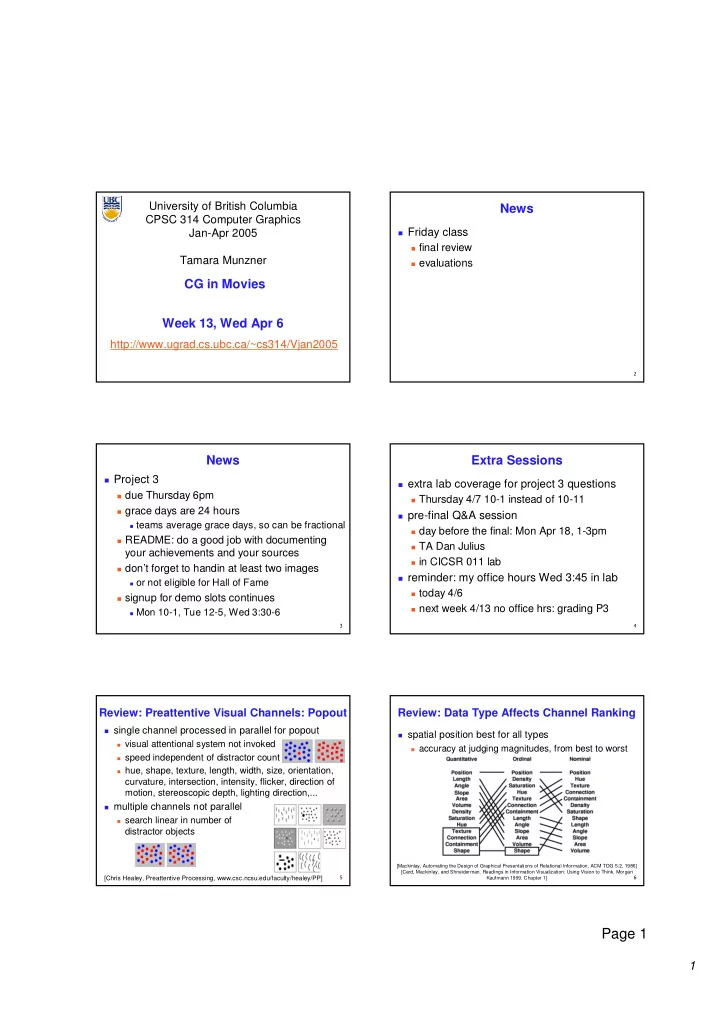
University of British Columbia News CPSC 314 Computer Graphics Friday class Jan-Apr 2005 final review Tamara Munzner evaluations CG in Movies Week 13, Wed Apr 6 http://www.ugrad.cs.ubc.ca/~cs314/Vjan2005 News Extra Sessions


slide-1
SLIDE 1

1

Page 1

University of British Columbia CPSC 314 Computer Graphics Jan-Apr 2005 Tamara Munzner http://www.ugrad.cs.ubc.ca/~cs314/Vjan2005

CG in Movies Week 13, Wed Apr 6

  • News

Friday class final review evaluations

  • News

Project 3 due Thursday 6pm grace days are 24 hours

teams average grace days, so can be fractional

README: do a good job with documenting

your achievements and your sources

don’t forget to handin at least two images

  • r not eligible for Hall of Fame

signup for demo slots continues

Mon 10-1, Tue 12-5, Wed 3:30-6

  • Extra Sessions

extra lab coverage for project 3 questions Thursday 4/7 10-1 instead of 10-11 pre-final Q&A session day before the final: Mon Apr 18, 1-3pm TA Dan Julius in CICSR 011 lab reminder: my office hours Wed 3:45 in lab today 4/6 next week 4/13 no office hrs: grading P3

  • Review: Preattentive Visual Channels: Popout

single channel processed in parallel for popout

visual attentional system not invoked speed independent of distractor count hue, shape, texture, length, width, size, orientation,

curvature, intersection, intensity, flicker, direction of motion, stereoscopic depth, lighting direction,...

multiple channels not parallel

search linear in number of

distractor objects

[Chris Healey, Preattentive Processing, www.csc.ncsu.edu/faculty/healey/PP]

  • Review: Data Type Affects Channel Ranking

spatial position best for all types

accuracy at judging magnitudes, from best to worst [Mackinlay, Automating the Design of Graphical Presentations of Relational Information, ACM TOG 5:2, 1986] [Card, Mackinlay, and Shneiderman. Readings in Information Visualization: Using Vision to Think. Morgan Kaufmann 1999. Chapter 1]

slide-2
SLIDE 2

2

Page 2

  • Review: Coloring Categorical Data

discrete small patches separated in space limited distinguishability: around 8-14 channel dynamic range: low choose bins explicitly for maximum mileage maximally discriminable colors from Ware maximal saturation for small areas

  • vs. minimal saturation for large areas

[Colin Ware, Information Visualization: Perception for Design. Morgan Kaufmann 1999. Figure 4.21]

  • Review: Rainbow Colormap Disadvantages

perceptually nonlinear segmentation, hue unordered (partial) solution perceptually isolinear map [Kindlmann, Reinhard, and Creem. Face-based Luminance Matching for Perceptual Colormap Generation.

  • Proc. Vis 02 www.cs.utah.edu/~gk/lumFace]

[Rogowitz and Treinish, How NOT to Lie with Visualization,www.research.ibm.com/dx/proceedings/pravda/truevis.htm

  • Review: Color Deficiency – vischeck.com

10% of males have red/green deficit

  • Review: Space vs. Time: Showing Change
  • Review: Space vs. Time: Showing Change
  • Making Movies
slide-3
SLIDE 3

3

Page 3

  • Stuart Little

500 shots with digital character 6 main challenges lip sync matchmove (CG to live-action) fur clothes animation tools rendering, lighting, compositing

  • Stuart Little

100+ people worked on CG 32 color/lighting/composite artists 12 technical assistants 30 animators 40 artists 12 R&D

  • Concept

adapt book/comic/game/etc

Stuart Little: adopt-a-mouse

  • riginal script

Toy Story: buddy movie

  • Storyboarding

explicitly define scenes camera shots special effects lighting scale used as guide by

animators

  • Sound

voice recording of talent completed before

animation begins

animations must match the voiceover quote from a puppeteer voice makes or breaks a character

  • Character Development

300 drawings

slide-4
SLIDE 4

4

Page 4

  • Character Development

40 sculptures

  • Character Development

computer

models

  • Layout and Look

build scenery match colors

  • Matchmoving

CG camera must exactly match the real camera

position, rotation, focal length, aperature

easy when camera is instrumented

film scanned camera tracking data retrieved

  • nce shot is prepared, 2D images rendered and

composited with live action

still hard to place CG on moving objects on film

  • Matchmoving
  • Merging CG and Live Action
slide-5
SLIDE 5

5

Page 5

  • Shooting Film For CG

square patterns in live action allow

easier matchmove tracking

furniture, wall paper actors practice with maquettes maquettes replaced with laser dots lasers on when camera shutter is closed after each take, three extra shots chrome ball for environment map for

Stuart’s eyes

white and gray balls for lighting info

  • Water
  • Particle Sim and Indentation
  • Tools
  • Compositing
  • Compositing

lighting

slide-6
SLIDE 6

6

Page 6

  • Facial Animation
  • Facial Animation
  • Fur
  • Cloth
  • Texture
  • Companies

Pixar Disney Sony Imageworks Industrial Light and

Magic (ILM)

Rhythm and Hues Pacific Data Images

(PDI)

Meteor Dreamworks

SKG

Tippett Studios Angel Studios Blue Sky Robert Abel and

Associates

Giant Studios BUF

slide-7
SLIDE 7

7

Page 7

  • Toy Story (1995)

77 minutes long, 110,064 frames frame render times: 45 min – 20 hours 800,000 machine hours of rendering renderfarm 110 Suns operating 24-7 300 CPUs 1 terabyte of disk space 3.5 minutes of animation produced each

week (maximum)

  • Toy Story

texture maps

Buzz: 189 scuffs and dirt: 450

number of animation ‘knobs’

Buzz: 700 Woody: 712 face: 212, mouth: 58 Sid’s backpack: 128

number of

leaves on trees: 1.2 million shaders: 1300 storyboards: 25,000

  • Toy Story 2

80 minutes long, 122,699 frames 1400 processor renderfarm frame render time of 10 min to 3 days software tools Alias|Wavefront Amazon Paint RenderMan lots of custom in-house tools

  • Newman!

subdivision surfaces polygonal hair (head) texture mapped on arms sculpted clothes complex shaders

  • Toy Store 2 Images
  • Toy Story 2 Images
slide-8
SLIDE 8

8

Page 8

  • Toy Story 2 Images
  • Final Fantasy

http://www.arstechnica.com/wankerdesk/01q3/ff-interview/ff-interview-2.html

  • Final Fantasy

main characters > 300,000 polys 1336 shots, 149,246 frames frame render time avg: 90 min 24,606 layers avg 18 per shot, max 500 934,162 days of render time if one CPU they used 1200 CPUs: 778 days of rendering and that’s just final rendering! lots of tests and tweaks before that

  • Final Fantasy

Renderman (Pixar) used for rendering direct illumination many hacks to fake global illumination Maya used for modeling hair modeled as splines lighting and rendering complicated as well

  • Production Team

director modeler lighting character animator technical director render wrangler tools developer shader writer effects animator looks team

  • Acknowledgements

David Brogan, University of Virginia CS 445/645, Fall 2002 http://www.cs.virginia.edu/~gfx/Courses/2002/Intro.fall.02/Lectures/lecture24.ppt