Page 1 ARM=RISC, ColdFire=CISC ARM Family Members ARM7 (1995) - - PDF document

page 1
SMART_READER_LITE
LIVE PREVIEW

Page 1 ARM=RISC, ColdFire=CISC ARM Family Members ARM7 (1995) - - PDF document

Reminders Last Time Get on the mailing list if youre not already Course perspective Looks like about 6 people need to do this Embedded systems introduction Definition of embedded system Lab after class today


slide-1
SLIDE 1

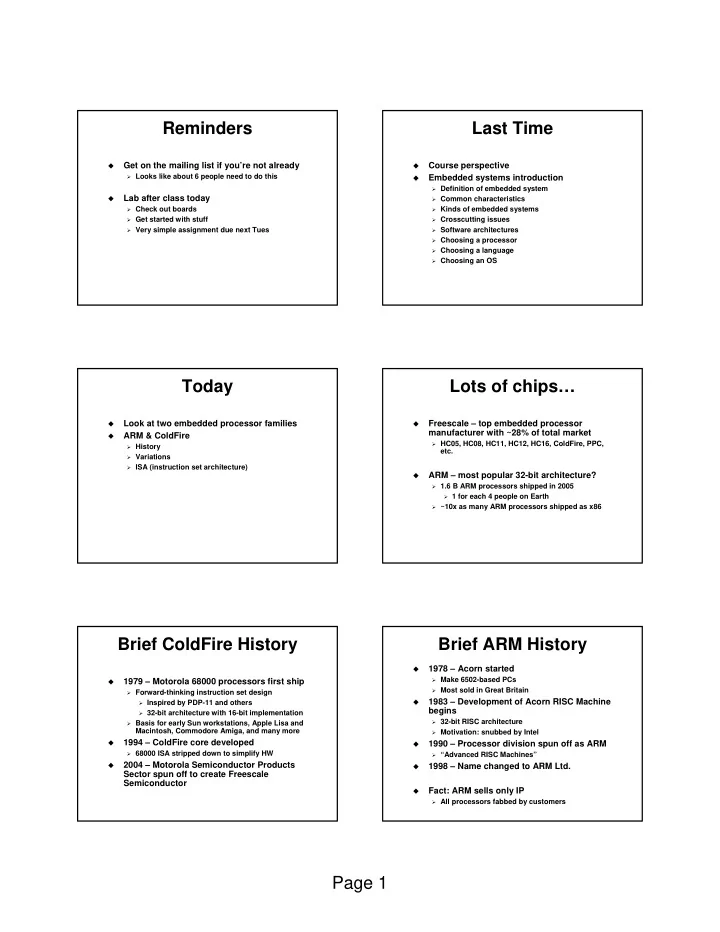
Page 1 Reminders

  • Get on the mailing list if you’re not already

Looks like about 6 people need to do this

  • Lab after class today

Check out boards Get started with stuff Very simple assignment due next Tues

Last Time

  • Course perspective
  • Embedded systems introduction

Definition of embedded system Common characteristics Kinds of embedded systems Crosscutting issues Software architectures Choosing a processor Choosing a language Choosing an OS

Today

  • Look at two embedded processor families
  • ARM & ColdFire

History Variations ISA (instruction set architecture)

Lots of chips…

  • Freescale – top embedded processor

manufacturer with ~28% of total market

HC05, HC08, HC11, HC12, HC16, ColdFire, PPC,

etc.

  • ARM – most popular 32-bit architecture?

1.6 B ARM processors shipped in 2005 1 for each 4 people on Earth ~10x as many ARM processors shipped as x86

Brief ColdFire History

  • 1979 – Motorola 68000 processors first ship

Forward-thinking instruction set design Inspired by PDP-11 and others 32-bit architecture with 16-bit implementation Basis for early Sun workstations, Apple Lisa and

Macintosh, Commodore Amiga, and many more

  • 1994 – ColdFire core developed

68000 ISA stripped down to simplify HW

  • 2004 – Motorola Semiconductor Products

Sector spun off to create Freescale Semiconductor

Brief ARM History

  • 1978 – Acorn started

Make 6502-based PCs Most sold in Great Britain

  • 1983 – Development of Acorn RISC Machine

begins

32-bit RISC architecture Motivation: snubbed by Intel

  • 1990 – Processor division spun off as ARM

“Advanced RISC Machines”

  • 1998 – Name changed to ARM Ltd.
  • Fact: ARM sells only IP

All processors fabbed by customers

slide-2
SLIDE 2

Page 2 ARM=RISC, ColdFire=CISC

  • However ARM is not all that RISC and

ColdFire is not all that CISC

  • Instruction length

ARM – fixed at 32 bits Simpler decoder ColdFire – variable at 16, 32, 48 bits Higher code density

  • Memory access

ARM – load-store architecture ColdFire – some ALU ops can use memory But less than on 68000

  • Both have plenty of registers

ARM Family Members

  • ARM7 (1995)

Three stage pipeline ~80 MHz 0.06 mW / MHz 0.97 MIPS / MHz Usually no cache, no MMU, no MPU

  • ARM9 (1997)

Five stage pipeline ~150 MHz 0.19 mW / MHz + cache 1.1 MIPS / MHz 4-16 KB caches, MMU or MPU

More ARM Family

  • ARM10 (1999)

Six-stage pipeline ~260 MHz 0.5 mW / MHz + cache 1.3 MIPS / MHz 16-32 KB caches, MMU or MPU

  • ARM11 (2003)

Eight-stage pipeline ~335 MHz 0.4 mW / MHz + cache 1.2 MIPS / MHz configurable caches, MMU

Extended ARM Family

  • Digital StrongARM
  • Intel XScale
  • Atmel SC100
  • New: Cortex series –

Cortex-A8 – large systems 1 GHz at < 0.4 W Cortex-R4 – real-time systems Cortex-M3 – small systems Intended to replace ARM7TDMI Intended to replace 8-bit and 16-bit CPUs in

new designs

Executes only Thumb-2 code $1 per chip

Register Files

  • Both ColdFire and ARM

16 registers available in user mode Each register is 32 bits

  • ColdFire

A7 – always the stack pointer Separate program counter

  • ARM

r13 – stack pointer by convention r14 – link register by convention: stores return

address of a called function

r15 – always the program counter

ColdFire Registers

slide-3
SLIDE 3

Page 3 ARM Banked Registers

  • 37 total registers

Only 18 available at any given time 16 + cpsr + spsr

  • Some register names refer to different

physical registers in different modes

  • Other registers shared across all modes

E.g. r0-r6, cpsr

  • Why is banking supported?
  • Note: Banking may go away

Thumb-2 doesn’t have it

ColdFire Instructions

  • Classic two address code

int sum (int a, int b) { return a + b; } link a6,#0 add.l d1,d0 unlk a6

dest src1 src2

ARM Instructions

  • Classic three address code

int sum (int a, int b) { return a + b; } 00000008 <sum>: 8: e0800001 add r0, r0, r1 c: e12fff1e bx lr

dest src1 src2

ARM Integrated Shifting

  • Most instructions can use a barrel

shift unit “for free”

Improves code density?

int foo (int a, int b) { return a + (b << 5); } 00000000 <foo>: 0:e0800281 add r0, r0, r1, lsl #5 4:e12fff1e bx lr

What are the costs of this design

decision?

ARM Conditional Execution

  • When condition is false, squash the

executing instruction

  • Supports implementing (simple)

conditional constructs without branches

Helps avoid pipeline stalls Compensates for lack of branch prediction

in low-end processors

  • Unique ARM feature: Almost all

instructions can be conditional

  • Suffixes in instruction mnemonics

indicate conditional execution

add – executes unconditionally addeq – executes when the Z flag is set

slide-4
SLIDE 4

Page 4 Conditional Example

int max (int a, int b) { if (a>b) return a; return b; } 000000bc <max>: bc:e1500001 cmp r0, r1 c0:b1a00001 movlt r0, r1 c4:e12fff1e bx lr

Another example: GCD

int gcd (int i, int j) { while (i != j) { if (i>j) { i -= j; } else { j -= i; } } return i; }

GCD assembly

000000d4 <gcd>: d4: e1510000 cmp r1, r0 d8: 012fff1e bxeq lr dc: e1510000 cmp r1, r0 e0: b0610000 rsblt r0, r1, r0 e4: a0601001 rsbge r1, r0, r1 e8: e1510000 cmp r1, r0 ec: 1afffffa bne dc <gcd+0x8> f0: e12fff1e bx lr

GCD on ColdFire

gcd: link a6,#0 cmp.l d1,d0 beq.s *+16 cmp.l d1,d0 ble.s *+6 sub.l d1,d0 bra.s *+4 sub.l d0,d1 cmp.l d1,d0 bne.s *-12 unlk a6 rts

Multiply and Accumulate

  • DSP codes such as FIR and IIR typically boil

down to repeated multiply and add int inner (int k, int j) { int i; int result = 0; for (i=0; i < 10; i++) { result += data[k][j] * coeff[k][i]; } return result; }

Multiply and Accumulate

00000000 <inner>: 0: e0800100 add r0, r0, r0, lsl #2 4: e59f3034 ldr r3, [pc, #52] ; 40 <.text+0x40> 8: e0811200 add r1, r1, r0, lsl #4 c: e52de004 str lr, [sp, #-4]! 10: e793e101 ldr lr, [r3, r1, lsl #2] 14: e59f3028 ldr r3, [pc, #40] ; 44 <.text+0x44> 18: e3a0c000 mov ip, #0 ; 0x0 1c: e0831180 add r1, r3, r0, lsl #3 20: e1a0200c mov r2, ip 24: e2822001 add r2, r2, #1 ; 0x1 28: e4913004 ldr r3, [r1], #4 2c: e352000a cmp r2, #10 ; 0xa 30: e02cce93 mla ip, r3, lr, ip 34: 1a000007 bne 24 <inner+0x24> 38: e1a0000c mov r0, ip 3c: e49df004 ldr pc, [sp], #4 40: 00000140 andeq r0, r0, r0, asr #2 44: 00000000 andeq r0, r0, r0

slide-5
SLIDE 5

Page 5 Multiple-Register Transfer

  • ColdFire:

movem.l d0-d7/a0-a6,(a7)

  • ARM:

stmdb sp!, {r4, r5, r6, r7, r8, r9, sl, fp, lr}

  • Improves code density
  • More efficient – why?
  • Main disadvantages?

Solutions?

ARM: Thumb

  • Alternate instruction set supported by many

ARM processors

  • 16-bit fixed size instructions

Only 8 registers easily available Saves 2 bits Registers are still 32 bits Drops 3rd operand from data operations Saves 5 bits Only branches are conditional Saves 4 bits Drops barrel shifter Saves 7 bits

ARM: Thumb

  • Natural evolution of RISC ideas for

embedded processors

Low gate count in decode logic no longer as

important

Still, decode shouldn’t be too hard Want compact instructions to keep I-fetch costs

low

  • Why use Thumb?

30% higher code density Potentially higher performance on systems with

16-bit memory bus

  • Why not use Thumb?

Performance may suffer on systems with 32-bit

memory bus

Thumb Continued

  • Thumb implementation

Thumb bit in the cpsr tells the CPU which mode

to execute in

In Thumb mode, each instruction is decoded to

an ARM instruction and then executed

  • ARM-Thumb “Interworking”:

Calling between ARM and thumb code Compiler will do the dirty work if you pass it the

right flags

  • How to decide which routines to compile as

ARM vs. Thumb?

  • Thumb2: Supposed to give code density

benefit w/o performance loss

So theoretically Thumb and ARM support can be

dropped from future chips

MCF52233

  • This is the chip on our demo boards
  • ColdFire v2 – low-end embedded

No MMU or FPU Single issue

  • 256 Kbyte Flash
  • 32 Kbyte RAM
  • 8ch x 12-Bit ADC
  • QSPI, IIC, and CAN Serial ports
  • Fast Ethernet Controller (FEC) and Ethernet

Phy (ePHY)

  • ~$9.00 in quantities of 1000 or more

M52233DEMO Board

  • CPU
  • Ethernet port
  • USB port
  • Serial port
  • 3-axis accelerometer
  • 4 user-controlled LEDs
  • 2 user-controlled push switches
  • 5k ohm pot
  • Costs $99
slide-6
SLIDE 6

Page 6 Summary

  • ARM and ColdFire are important embedded

architectures

Both are “modern” Worth looking at in detail