Page 1 Builder Pattern Builder Director Construct() BuildPart() - - PDF document

page 1
SMART_READER_LITE
LIVE PREVIEW

Page 1 Builder Pattern Builder Director Construct() BuildPart() - - PDF document

Podcast Ch08-19 Title : Builder Design Pattern Description : Motivation; generic class diagram; examples Participants : Barry Kurtz (instructor); Brandon Winters, Sara Hyde, Cheng Vue, Dan Baehr (students) Textbook :


slide-1
SLIDE 1

Page 1

Bernd Bruegge & Allen H. Dutoit Object-Oriented Software Engineering: Using UML, Patterns, and Java 1

Podcast Ch08-19

♦Title: Builder Design Pattern ♦Description: Motivation; generic class

diagram; examples

♦Participants: Barry Kurtz (instructor);

Brandon Winters, Sara Hyde, Cheng Vue, Dan Baehr (students)

♦Textbook: Object-Oriented Software

Engineering: Using UML, Patterns and Java by Bernd Bruegge and Allen H. Dutoit

Bernd Bruegge & Allen H. Dutoit Object-Oriented Software Engineering: Using UML, Patterns, and Java 2

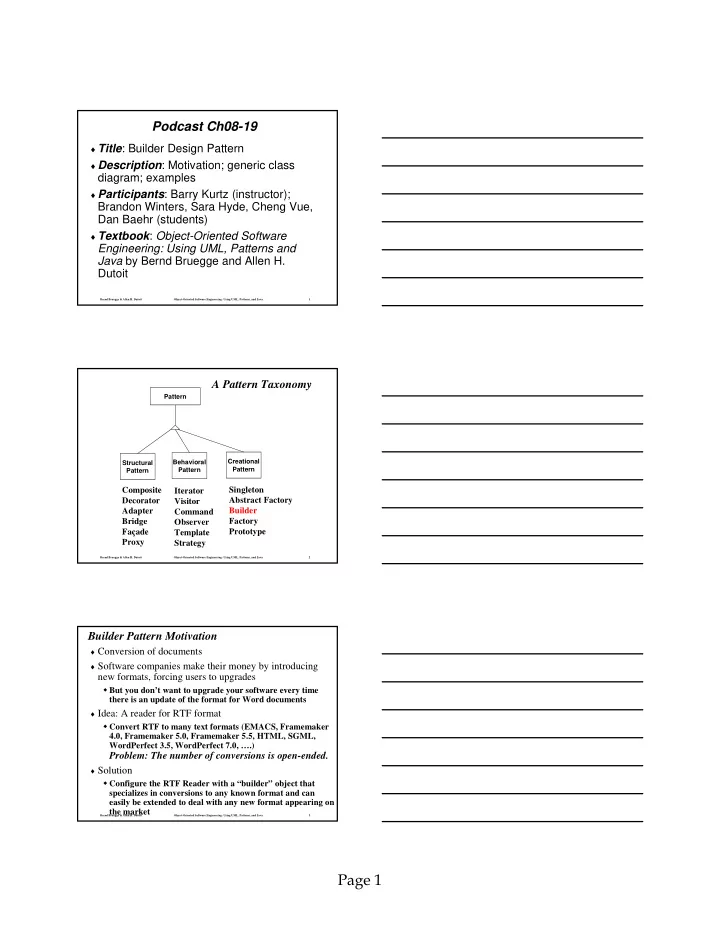
A Pattern Taxonomy

Pattern Structural Pattern Behavioral Pattern Creational Pattern

Composite Decorator Adapter Bridge Façade Proxy Iterator Visitor Command Observer Template Strategy Singleton Abstract Factory Builder Factory Prototype

Bernd Bruegge & Allen H. Dutoit Object-Oriented Software Engineering: Using UML, Patterns, and Java 3

Builder Pattern Motivation

♦ Conversion of documents ♦ Software companies make their money by introducing

new formats, forcing users to upgrades

But you don’t want to upgrade your software every time there is an update of the format for Word documents

♦ Idea: A reader for RTF format

Convert RTF to many text formats (EMACS, Framemaker 4.0, Framemaker 5.0, Framemaker 5.5, HTML, SGML, WordPerfect 3.5, WordPerfect 7.0, ….)

Problem: The number of conversions is open-ended.

♦ Solution

Configure the RTF Reader with a “builder” object that specializes in conversions to any known format and can easily be extended to deal with any new format appearing on the market

slide-2
SLIDE 2

Page 2

Bernd Bruegge & Allen H. Dutoit Object-Oriented Software Engineering: Using UML, Patterns, and Java 4

Builder Pattern

Construct()

Director

For all objects in Structure { Builder->BuildPart() } BuildPart()

Builder

BuildPart() GetResult()

ConcreteBuilderB Represen- tation B

BuildPart() GetResult()

ConcreteBuilderA Represen- tation A

Bernd Bruegge & Allen H. Dutoit Object-Oriented Software Engineering: Using UML, Patterns, and Java 5

Example

Parse()

RTFReader

While (t = GetNextToken()) { Switch t.Type { CHAR: builder->ConvertCharacter(t.Char) FONT: bulder->ConvertFont(t.Font) PARA: builder->ConvertParagraph } }

ConvertCharacter() ConvertFontChange ConvertParagraph()

TextConverter

ConvertCharacter() ConvertFontChange ConvertParagraph() GetASCIIText()

AsciiConverter AsciiText

ConvertCharacter() ConvertFontChange ConvertParagraph() GetASCIIText()

TexConverter TeXText

ConvertCharacter() ConvertFontChange ConvertParagraph() GetASCIIText()

HTMLConverter HTMLText

Bernd Bruegge & Allen H. Dutoit Object-Oriented Software Engineering: Using UML, Patterns, and Java 6

Builder - 1

slide-3
SLIDE 3

Page 3

Bernd Bruegge & Allen H. Dutoit Object-Oriented Software Engineering: Using UML, Patterns, and Java 7

Builder- 2

Bernd Bruegge & Allen H. Dutoit Object-Oriented Software Engineering: Using UML, Patterns, and Java 8

When do you use the Builder Pattern?

♦ The creation of a complex product must be

independent of the particular parts that make up the product

In particular, the creation process should not know about the assembly process (how the parts are put together to make up the product)

♦ The creation process must allow different

representations for the object that is constructed. Examples:

A house with one floor, 3 rooms, 2 hallways, 1 garage and three doors. A skyscraper with 50 floors, 15 offices and 5 hallways on each floor. The office layout varies for each floor.

Bernd Bruegge & Allen H. Dutoit Object-Oriented Software Engineering: Using UML, Patterns, and Java 9

Comparison: Abstract Factory vs Builder

♦ Abstract Factory

Focuses on product family: The products can be simple (“light bulb”) or complex (“engine”) Does not hide the creation process: The product is immediately returned

♦ Builder

The underlying product needs to be constructed as part of the system, but the creation is very complex The construction of the complex product changes from time to time The builder patterns hides the creation process from the user: The product is returned after creation as a final step

♦ Abstract Factory and Builder work well together for a

family of multiple complex products