
Page 1 Writing Cache Friendly Code Writing Cache Friendly Code
Repeated references to variables are good (temporal Repeated references to variables are good (temporal locality) locality) Stride Stride-
- 1 reference patterns are good (spatial locality)
1 reference patterns are good (spatial locality) Examples: Examples:
cold cache, 4-byte words, 4-word cache blocks – 1 – int sumarrayrows(int a[M][N]) { int i, j, sum = 0; for (i = 0; i < M; i++) for (j = 0; j < N; j++) sum += a[i][j]; return sum; } int sumarraycols(int a[M][N]) { int i, j, sum = 0; for (j = 0; j < N; j++) for (i = 0; i < M; i++) sum += a[i][j]; return sum; }
Miss rate = Miss rate = 1/4 = 25% 100%
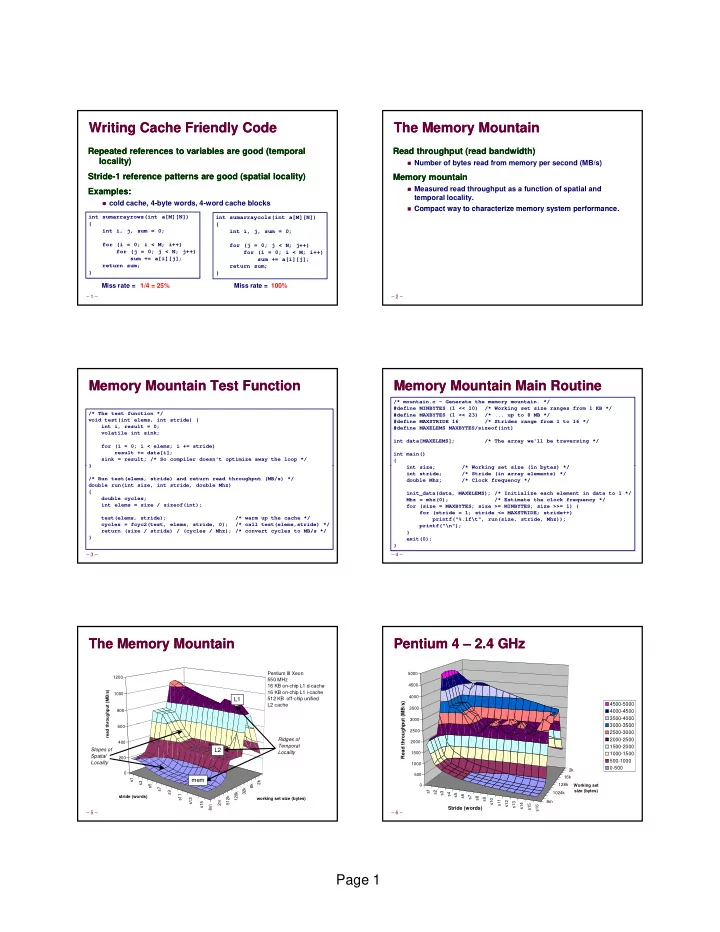
The Memory Mountain The Memory Mountain
Read throughput (read bandwidth) Read throughput (read bandwidth)
Number of bytes read from memory per second (MB/s)
Memory mountain Memory mountain
Measured read throughput as a function of spatial and
temporal locality.
Compact way to characterize memory system performance – 2 – Compact way to characterize memory system performance.
Memory Mountain Test Function Memory Mountain Test Function
/* The test function */ void test(int elems, int stride) { int i, result = 0; volatile int sink; for (i = 0; i < elems; i += stride) result += data[i]; sink = result; /* So compiler doesn't optimize away the loop */ } – 3 – } /* Run test(elems, stride) and return read throughput (MB/s) */ double run(int size, int stride, double Mhz) { double cycles; int elems = size / sizeof(int); test(elems, stride); /* warm up the cache */ cycles = fcyc2(test, elems, stride, 0); /* call test(elems,stride) */ return (size / stride) / (cycles / Mhz); /* convert cycles to MB/s */ }
Memory Mountain Main Routine Memory Mountain Main Routine
/* mountain.c - Generate the memory mountain. */ #define MINBYTES (1 << 10) /* Working set size ranges from 1 KB */ #define MAXBYTES (1 << 23) /* ... up to 8 MB */ #define MAXSTRIDE 16 /* Strides range from 1 to 16 */ #define MAXELEMS MAXBYTES/sizeof(int) int data[MAXELEMS]; /* The array we'll be traversing */ int main() { i t i /* W ki t i (i b t ) */ – 4 – int size; /* Working set size (in bytes) */ int stride; /* Stride (in array elements) */ double Mhz; /* Clock frequency */ init_data(data, MAXELEMS); /* Initialize each element in data to 1 */ Mhz = mhz(0); /* Estimate the clock frequency */ for (size = MAXBYTES; size >= MINBYTES; size >>= 1) { for (stride = 1; stride <= MAXSTRIDE; stride++) printf("%.1f\t", run(size, stride, Mhz)); printf("\n"); } exit(0); }
The Memory Mountain The Memory Mountain
800 1000 1200 hroughput (MB/s)
Pentium III Xeon 550 MHz 16 KB on-chip L1 d-cache 16 KB on-chip L1 i-cache 512 KB off-chip unified L2 cache
L1
– 5 –
s1 s3 s5 s7 s9 s11 s13 s15 8m 2m 512k 128k 32k 8k 2k 200 400 600 read th stride (words) working set size (bytes)
Ridges of Temporal Locality
L2 mem
Slopes of Spatial Locality
xe
Pentium 4 – 2.4 GHz Pentium 4 – 2.4 GHz
3000 3500 4000 4500 5000
put (MB/s) 4500-5000 4000-4500 3500-4000 3000 3500 – 6 –
s1 s2 s3 s4 s5 s6 s7 s8 s9 s10 s11 s12 s13 s14 s15 s16 8m 1024k 128k 16k 2k 500 1000 1500 2000 2500
Read throughp Stride (words)
Working set size (bytes)
3000-3500 2500-3000 2000-2500 1500-2000 1000-1500 500-1000 0-500