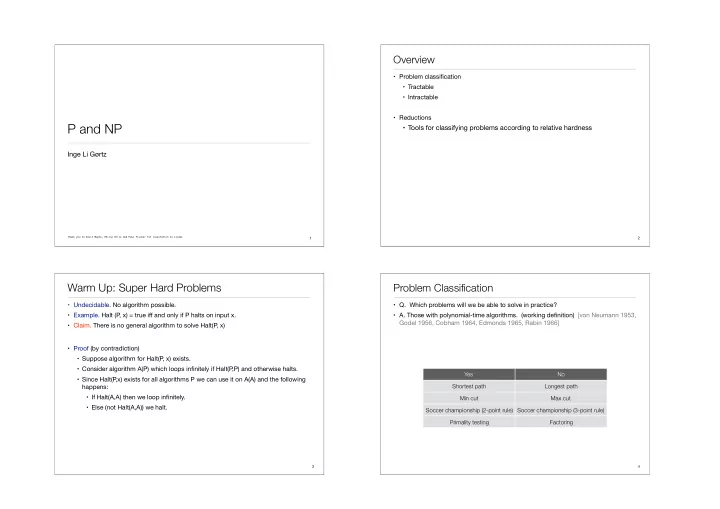
P and NP Tools for classifying problems according to relative - - PowerPoint PPT Presentation

p and np
SMART_READER_LITE
LIVE PREVIEW

P and NP Tools for classifying problems according to relative - - PowerPoint PPT Presentation

Overview Problem classification Tractable Intractable Reductions P and NP Tools for classifying problems according to relative hardness Inge Li Grtz Thank you to Kevin Wayne, Philip Bille and Paul Fischer for inspiration to


slide-1
SLIDE 1

P and NP

Inge Li Gørtz

Thank you to Kevin Wayne, Philip Bille and Paul Fischer for inspiration to slides

1

  • Problem classification
  • Tractable
  • Intractable
  • Reductions
  • Tools for classifying problems according to relative hardness

Overview

2

  • Undecidable. No algorithm possible.
  • Example. Halt (P

, x) = true iff and only if P halts on input x.

  • Claim. There is no general algorithm to solve Halt(P

, x)

  • Proof (by contradiction)
  • Suppose algorithm for Halt(P

, x) exists.

  • Consider algorithm A(P) which loops infinitely if Halt(P

,P) and otherwise halts.

  • Since Halt(P

,x) exists for all algorithms P we can use it on A(A) and the following happens:

  • If Halt(A,A) then we loop infinitely.
  • Else (not Halt(A,A)) we halt.

Warm Up: Super Hard Problems

3

  • Q. Which problems will we be able to solve in practice?
  • A. Those with polynomial-time algorithms. (working definition) [von Neumann 1953,

Godel 1956, Cobham 1964, Edmonds 1965, Rabin 1966] 


Problem Classification

Yes No Shortest path Longest path Min cut Max cut Soccer championship (2-point rule) Soccer championship (3-point rule) Primality testing Factoring

4

slide-2
SLIDE 2
  • Ideally, classify problems according to those that can be solved in polynomial-time

and those that cannot.

  • Provably requires exponential-time.
  • Given a board position in an n-by-n generalization of chess,


can black guarantee a win?

  • Provably undecidable.
  • Given a program and input there is no algorithm to decide if program halts.
  • Frustrating news. Huge number of fundamental problems have defied classification

for decades.

Problem Classification

5

Polynomial-time Reductions

6

  • A problem (problem type) is the general, abstract term:
  • Examples: Shortest Path, Maximum Flow, Closest Pair, Sequence Alignment,

String Matching.

  • A problem instance is the concrete realization of a problem.
  • Maximum flow. The instance consists of a flow network.
  • Closest Pair. The instance is a set of points
  • String Matching. The instance consists of two strings.

Instances

7

  • Reduction. Problem X polynomial reduces to problem Y if arbitrary instances of

problem X can be solved using:

  • Polynomial number of standard computational steps, plus
  • Polynomial number of calls to oracle that solves problem Y.
  • Notation. X ≤P Y.
  • We pay for time to write down instances sent to black box ⇒ instances of Y must

be of polynomial size.

Polynomial-time reduction

8

slide-3
SLIDE 3
  • Bipartite matching ≤P Maximum flow

Maximum flow and bipartite matching

9

1 1 1 1 1 1 1

s t

1

Maximum flow and maximum bipartite matching

10

1 1 1 1 1 1 1

s t

1

  • Bipartite matching ≤P Maximum flow
  • Matching M => flow of value |M|
  • Flow of value v(f) => matching of size v(f)
  • Purpose. Classify problems according to relative difficulty.
  • Design algorithms. If X ≤P Y and Y can be solved in polynomial-time, then

X can also be solved in polynomial time.

  • Establish intractability. If X ≤P Y and X cannot be solved in polynomial-time,

then Y cannot be solved in polynomial time.

  • Establish equivalence. If X ≤P Y and Y ≤P X, we use notation X =P Y.

Polynomial-time reductions

up to a polynomial factor

11

  • Independent set: A set S of vertices where no two vertices of S are neighbors (joined

by an edge).

  • Independent set problem: Given graph G and an integer k, is there an independent

set of size ≥ k?

  • Example:
  • Is there an independent set of size ≥ 6?

Independent set and vertex cover

12

slide-4
SLIDE 4
  • Independent set: A set S of vertices where no two vertices of S are neighbors (joined

by an edge).

  • Independent set problem: Given graph G and an integer k, is there an independent

set of size ≥ k?

  • Example:
  • Is there an independent set of size ≥ 6? Yes

Independent set and vertex cover

13

  • Independent set: A set S of vertices where no two vertices of S are neighbors (joined

by an edge).

  • Independent set problem: Given graph G and an integer k, is there an independent

set of size ≥ k?

  • Example:
  • Is there an independent set of size ≥ 6? Yes
  • Is there an independent set of size ≥ 7?

Independent set and vertex cover

14

  • Independent set: A set S of vertices where no two vertices of S are neighbors (joined

by an edge).

  • Independent set problem: Given graph G and an integer k, is there an independent

set of size ≥ k?

  • Example:
  • Is there an independent set of size ≥ 6? Yes
  • Is there an independent set of size ≥ 7? No

Independent set and vertex cover

15

  • Vertex cover: A set S of vertices such that all edges have at least one endpoint in S.
  • Independent set problem: Given graph G and an integer k, is there a vertex cover of

size ≤ k?

  • Example:
  • Is there a vertex cover of size ≤ 4?

Independent set and vertex cover

16

slide-5
SLIDE 5
  • Vertex cover: A set S of vertices such that all edges have at least one endpoint in S.
  • Independent set problem: Given graph G and an integer k, is there a vertex cover of

size ≤ k?

  • Example:
  • Is there a vertex cover of size ≤ 4? Yes

Independent set and vertex cover

17

  • Vertex cover: A set S of vertices such that all edges have at least one endpoint in S.
  • Independent set problem: Given graph G and an integer k, is there a vertex cover of

size ≤ k?

  • Example:
  • Is there a vertex cover of size ≤ 4? Yes
  • Is there a vertex cover of size ≤ 3?

Independent set and vertex cover

18

  • Vertex cover: A set S of vertices such that all edges have at least one endpoint in S.
  • Independent set problem: Given graph G and an integer k, is there a vertex cover of

size ≤ k?

  • Example:
  • Is there a vertex cover of size ≤ 4? Yes
  • Is there a vertex cover of size ≤ 3? No

Independent set and vertex cover

19

  • Claim. Let G=(V,E) be a graph. Then S is an independent set if and only if its

complement V-S is a vertex cover.

  • Proof.
  • =>: S is an independent set.

Independent set and vertex cover

vertex cover independent set

20

slide-6
SLIDE 6
  • Claim. Let G=(V,E) be a graph. Then S is an independent set if and only if its

complement V-S is a vertex cover.

  • Proof.
  • =>: S is an independent set.
  • e cannot have both endpoints in S => e have an endpoint in V-S.
  • V-S is a vertex cover.

Independent set and vertex cover

e

vertex cover independent set

21

  • Claim. Let G=(V,E) be a graph. Then S is an independent set if and only if its

complement V-S is a vertex cover.

  • Proof.
  • =>: S is an independent set.
  • e cannot have both endpoints in S => e have an endpoint in V-S.
  • V-S is a vertex cover
  • <=: V-S is a vertex cover.

Independent set and vertex cover

vertex cover independent set

22

  • Claim. Let G=(V,E) be a graph. Then S is an independent set if and only if its

complement V-S is a vertex cover.

  • Proof.
  • =>: S is an independent set.
  • e cannot have both endpoints in S => e have an endpoint in V-S.
  • V-S is a vertex cover
  • <=: V-S is a vertex cover.
  • u and v not part of the vertex cover = > no edge between u and v
  • S is an independent set.

Independent set and vertex cover

u v

vertex cover independent set

23

  • Claim. Let G=(V,E) be a graph. Then S is an independent set if and only if its

complement V-S is a vertex cover.

  • Independent set ≤P vertex cover
  • Use one call to the black box vertex cover algorithm with k = n-k.
  • There is an independent set of size ≥ k if and only if the vertex cover algorithm

returns yes.

  • vertex cover ≤P independent set
  • Use one call to the black box independent set algorithm with k = n-k.

Independent set and vertex cover

24

slide-7
SLIDE 7
  • Set cover. Given a set U of elements, a collection of sets S1,…Sm of subsets of U,

and an integer k. Does there exist a collection of at most k sets whose union is equal to all of U?

Set cover

25

S1 S3 S5 S4 S6 S2 S7 S8

U S

e1 e2 e3 e4 e5 e6 e7 e8 e9 e10 e11 e12 e13 e14

  • Set cover. Given a set U of elements, a collection of sets S1,…Sm of subsets of U,

and an integer k. Does there exist a collection of at most k sets whose union is equal to all of U?

  • Example:
  • Does there exist a set cover of size at most 6?

Set cover

26

S1 S3 S5 S4 S6 S2 S7 S8

U S

e1 e2 e3 e4 e5 e6 e7 e8 e9 e10 e11 e12 e13 e14

  • Set cover. Given a set U of elements, a collection of sets S1,…Sm of subsets of U,

and an integer k. Does there exist a collection of at most k sets whose union is equal to all of U?

  • Example:
  • Does there exist a set cover of size at most 6? Yes

Set cover

27

S1 S3 S5 S4 S6 S2 S7 S8

U S

e1 e2 e3 e4 e5 e6 e7 e8 e9 e10 e11 e12 e13 e14

  • Set cover. Given a set U of elements, a collection of sets S1,…Sm of subsets of U,

and an integer k. Does there exist a collection of at most k sets whose union is equal to all of U?

  • Example:
  • Does there exist a set cover of size at most 6? Yes

Set cover

28

slide-8
SLIDE 8

S1 S3 S5 S4 S6 S2 S7 S8

U S

e1 e2 e3 e4 e5 e6 e7 e8 e9 e10 e11 e12 e13 e14

  • Set cover. Given a set U of elements, a collection of sets S1,…Sm of subsets of U,

and an integer k. Does there exist a collection of at most k sets whose union is equal to all of U?

  • Example:
  • Does there exist a set cover of size at most 6? Yes
  • Does there exist a set cover of size at most 4?

Set cover

29

S1 S3 S5 S4 S6 S2 S7 S8

U S

e1 e2 e3 e4 e5 e6 e7 e8 e9 e10 e11 e12 e13 e14

  • Set cover. Given a set U of elements, a collection of sets S1,…Sm of subsets of U,

and an integer k. Does there exist a collection of at most k sets whose union is equal to all of U?

  • Example:
  • Does there exist a set cover of size at most 6? Yes
  • Does there exist a set cover of size at most 4? Yes

Set cover

30

S1 S3 S5 S4 S6 S2 S7 S8

U S

e1 e2 e3 e4 e5 e6 e7 e8 e9 e10 e11 e12 e13 e14

  • Set cover. Given a set U of elements, a collection of sets S1,…Sm of subsets of U,

and an integer k. Does there exist a collection of at most k sets whose union is equal to all of U?

  • Example:
  • Does there exist a set cover of size at most 6? Yes
  • Does there exist a set cover of size at most 4? Yes
  • Does there exist a set cover of size at most 3? No

Set cover

31

  • vertex cover ≤P set cover

Reduction from vertex cover to set cover

1 2 3 4 5 6 7 8 9 10

e5 e4 e3 e7 e13 e14 e12 e10 e11 e6 e9 e8 e1 e2

32

slide-9
SLIDE 9
  • vertex cover ≤P set cover
  • U = {e1, e2, e3, e4, e5, e6, e7, e8, e9, e10, e11, e12, e13, e14,}
  • S1 = {e1, e2, e3, e4}
  • S2 = {e1, e11, e10}
  • S3 = {e2, e8}
  • S4 = {e3, e9}
  • S5 = {e4, e5}
  • S6 = {e5, e6, e7}
  • S7 = {e7, e13}
  • S8 = {e8, e9, e10, e12, e13, e14}
  • S9 = {e11, e12}
  • S10 = {e6, e14}

Reduction from vertex cover to set cover

1 2 3 4 5 6 7 8 9 10

e5 e4 e3 e7 e13 e14 e12 e10 e11 e6 e9 e8 e1 e2

33

  • Reduction. X ≤P Y if arbitrary instances of problem X can be solved using:
  • Polynomial number of standard computational steps, plus
  • Polynomial number of calls to oracle that solves problem Y.
  • Strategy to make a reduction if we only need one call to the oracle/black box to

solve X:

  • 1. Show how to turn (any) instance Sx of X into an instance of Sy of Y in

polynomial time.

  • 2. Show that: Sx a yes instance of X => Sy a yes instance of Y.
  • 3. Show that: Sy a yes instance to Y => Sx a yes instance of X.
  • Reductions that needs more than one call to black box:
  • 1. Show how to turn (any) instance Sx of X into a polynomial number instance of

Sy,i of Y in polynomial time.

  • 2. Show: Sx a yes instance of X => one of the instances Sy,i is a yes instance of Y.
  • 3. Show: one of the instances Sy,i is a yes instance of Y => Sx a yes instance of

X.

Polynomial-time reductions

P and NP

35

  • P ~ problems solvable in deterministic polynomial time.
  • Given a problem type X, there is a deterministic algorithm A which for every

problem instance I ∈ X solves I in a time that is polynomial in |I|, the size of I.

  • I.e., the running time of A is O(|I|k) for all I ∈ X, where k is constant independent of

the instance I.

  • Examples.
  • Closest pair: There is an algorithm A such that for every set S of points, A finds a

closest pair in time O(|S|2).

  • Maximum flow: There is an algorithm A such that for any network, A finds a

maximum flow in time O(|V|3), where V is the set of vertices.

The class P

36

slide-10
SLIDE 10
  • Problem [POTATO SOUP]. A recipe calls for B grams of potatoes. You have a K kilo

bag with n potatoes. Can one select some of them such that their weight is exactly B grams?

  • Best known solution: create all 2n subsets and check each one.

Hard problems: Example

37

  • Many problems share the above features
  • Can be solved in time 2|T| (by trying all possibilities.)
  • Given a potential solution, it can be checked in time O(|I|k), whether it is a

solution or not. 


  • These problems are called polynomially checkable.
  • A solution can be guessed, and then verified in polynomial time.

Hard problems

38

  • Certifier. Algorithm B(s,t) is an efficient certifier for problem X if:
  • 1. B(s,t) runs in polynomial time.
  • 2. For every instance s:
  • Example. Independent set.
  • s: a graph G and an integer k.
  • t: a set of vertices from G.
  • B(s,t) returns yes if and only if t is an independent set of G and |S| ≥ k.
  • This can be checked in polynomial time by checking that no two vertices in t are

neighbors and that the size is at least k.

  • A problem X is in the class NP (Non-deterministic Polynomial time) if X has an

efficient certifier.

The class NP

s is a yes instance of X

there exists a certificate t of length polynomial in s and B(s,t) returns yes.

39

  • Consider decision problems (yes-no-problems).
  • Example.
  • [POTATO SOUP]. A recipe calls for B grams of potatoes. You have a K kilo bag

with n potatoes. Can one select some of them such that their weight is exactly B grams?

  • Optimization vs decision problem
  • [OPTIMIZATION LONGEST PATH] Given a graph G. What is the length of the

longest simple path?

  • [DECISION LONGEST PATH] Given a graph G and integer k. Is a there a simple

path of length ≥ k?

  • Exercise. Show that OPTIMIZATION LONGEST PATH can be solved in polynomial

time if and only if DECISION LONGEST PATH can be solved in polynomial time.

Optimization vs decision problems

40

slide-11
SLIDE 11
  • P solvable in deterministic polynomial time.
  • NP solvable in non-deterministic polynomial time/ has an efficient (polynomial time)

certifier.

  • P⊆NP (every problem T which is in P is also in NP).
  • It is not known (but strongly believed) whether the inclusion is proper, that is whether

there is a problem in NP which is not in P .

  • There is subclass of NP which contains the hardest problems, NP-complete

problems:

  • X is NP-Complete if
  • X ∈ NP
  • Y ≤P X for all Y ∈ NP

P vs NP

41

  • Preparing potato soup
  • Packing your suitcase
  • Satisfiability of clauses
  • Partition
  • Subset-sum
  • Hamilton Cycle
  • Travelling Salesman
  • Bin Packing
  • Knapsack
  • Clique
  • Independent Set
  • Vertex Cover
  • Set Cover

Examples of NP-complete problems

42

  • [SOCCER CHAMPIONSHIP 3-POINT RULE] In a football league n teams compete

for the championship. The leagues uses the 3-point rule, i.e., the points of match are distributed as 3:0, 1:1, or 0:3.

  • Input. The table with the points of every team at some point in the season, a list
  • f the matches to be played in that season and the name of some team.
  • Output.
  • YES if the named team still can become champion
  • NO otherwise.

NP-complete problems

43

  • [SATISFIABILITY]
  • Input: A set of clauses C = {c1, . . . , ck} over n boolean variables x1,…,xn.
  • Output:
  • YES if there is a satisfying assignment, i.e., if there is an assignment

a: {x1,...,xn} ︎→ {0,1} such that every clause is satisfied,

  • NO otherwise.

NP-complete problems

x1 ∨ x2 ∨ x3

( ) ∧

x1 ∨ x2 ∨ x3

( ) ∧

x1 ∨ x2 ∨ x4

( ) ∧

x1 ∨ x3 ∨ x4

( )

x1 =1, x2 =1, x3 = 0, x4 =1

instance s proposed solution/certificate t

44

slide-12
SLIDE 12
  • [HAMILTONIAN CYCLE].
  • Input: Undirected graph G
  • Output:
  • YES if there exists a simple cycle that visits every node
  • NO otherwise

NP-complete problems

instance s certificate t

45

  • Traveling Salesperson Problem TSP: Given a set of n cities and a pairwise

distance function d(u, v), is there a tour of length ≤ D?

All 13,509 cities in US with a population of at least 500
 Reference: http://www.tsp.gatech.edu 46

  • Traveling Salesperson Problem TSP: Given a set of n cities and a pairwise

distance function d(u, v), is there a tour of length ≤ D?

Optimal TSP tour Reference: http://www.tsp.gatech.edu 47

  • 1. Prove Y ∈ NP (that it can be verified in polynomial time).
  • 2. Select a known NP-complete problem X.
  • 3. Give a polynomial time reduction from X to Y (prove X ≤P Y):
  • Explain how to turn an instance of X into one or more instances of Y
  • Explain how to use a polynomial number of calls to the black box algorithm/
  • racle for Y to solve X.
  • Prove/argue that the reduction is correct.

How to prove a problem is NP-complete

48

slide-13
SLIDE 13
  • [HAMILTONIAN CYCLE]. Given a undirected graph G=(V,E), does there exists a

simple cycle that visits every node?

  • [TRAVELLING SALESMAN (TSP)] Given a set of n cities and a pairwise distance

function d(u, v), is there a tour of length ≤ D?

  • Show Hamiltonian Cycle ≤P TSP:
  • Idea: For every instance of Hamiltonian Cycle create an instance of TSP such

that the TSP instance has tour of length ≤ n if and only if G has a Hamiltonian cycle.

  • Reduction.
  • Given instance G=(V,E) of Hamiltonian Cycle, create n cities with distance

function

  • TSP instance has tour of length ≤ n if and only if G has a Hamiltonian cycle.

Reduction example

d(u, v) = 1 if (u, v) ∈ E 2 if (u, v) ∉ E $ % &

49

  • [GLASSES IN A CUPBOARD]. You have n glasses of equal height. If glass gj is put

into glass gi let dij be the amount of gj above the rim of gi. You want to stack them into a single stack, so they fit into a cupboard of height h; is that possible?

  • Glasses in a Cupboard in NP: Proposed solution can be verified in polynomial time.
  • NP-completeness:
  • Reduction from Directed Hamiltonian Path (DHP).
  • Directed Hamiltonian Path: Given a directed graph G, is there a directed simple

path visiting all vertices.

  • DHP is NP-complete
  • Reduction: For every instance (graph) of DHP make a set of glasses and a

cupboard, such that the glasses can be stacked into the cupboard if and only if the graph has a Hamiltonian path.

Reduction example

50

  • Let G = (E, V) a directed graph.
  • Make one glass for every node i ∈ V.
  • ︎ If (i, j) ∈ E ensure:
  • If (i, j) ∉ E ensure:
  • Glass i is red, glass j is yellow.
  • Height of the cupboard is |V| − 1 + height of glass

Reduction example

51

Reduction Example

52

slide-14
SLIDE 14

Reduction Example

53

The Main Question: P Versus NP

  • Does P = NP? [Cook 1971, Edmonds, Levin, Yablonski, Gödel]
  • Is the decision problem as easy as the certification problem?
  • Clay $1 million prize.
  • Consensus opinion on P = NP? Probably no.

EXP NP P If P ≠ NP If P = NP EXP P = NP 54